JF Ptak Science Books LLC Post 715
My apologies for the formatting problem below–Typepad again has struck with its incongruities. Again. Did I mention “again”?)
(and whose portrait appears, weirdly, disjointed and floating and entirely out
of place in the frontispiece to his famous book, completely separated from the
connectedness of his work) was also the designer of this gorgeous star “fort”
at Palmanova, in northeastern Italy—mainly
the Turks—but nothing ever threatened the place. Until Napoleon, that is,
who took the town without a flight in 1793.
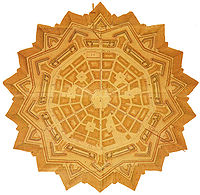
This is actually a plan for an entire town, the brainchild of its Venetian benefactors,
the very essence of which was fortification, repulse, security and defence. An
18th century
system for a fortified town for the time in which it was designed (1593).
It was supposed to stand to face the enemies of Venice
wonder if anyone derived inspiration in fort design from snowflakes? It
seems a little doubtful, perhaps, since snow wasn’t dealt with in scientific
detail until the every busy Johannes Kepler wrote his treatise on the six-cornered snowflake; and it also wasn’t seen under a microscope in its fabulous detail until 1665 by Robert Hooke. This was also about the time that modern canon tech was about to
make these sorts of designs not terribly practical. [Just last week I mentioned
that a fort on the island next to the island that my family vacations on,
Tybee, just south of Savannah , is home to the first rifled canon attack on a stone fort—the result was brutal and definitive,
the day of the fort was done. Until of course the tinny home fort was invented
by the American federal government to protect hundreds of millions of people
form devastating nuclear attacks by building steel and stone bunkers under a
bit of earth in the backyard, making every person their own bit of royalty, reigning
over one’s grave.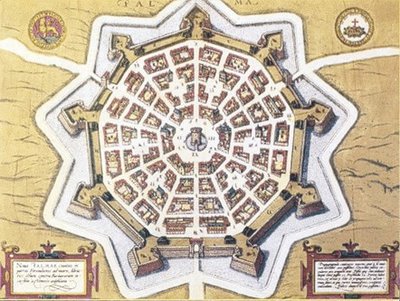
But that’s another story. Kepler thought very
deeply about snowflakes as a result of a serendipitous encounter with one—his
sympathico correspondence with a snowflake on his coat led to him publishing
(in 1611) a short treatise called A New Year’s Gift, or On the Six-Cornered
Snowflake, thinking that perhaps the snowflake’s six-cornered symmetry
revealed something much deeper about the basis of nature and the universe. He
was racing himself towards a significance of the facultas formatrix, or
morphogenetic field, and its relationship to everything else, as Kepler was
looking for a great pattern, his own 17th century Grand Unified Theory. The
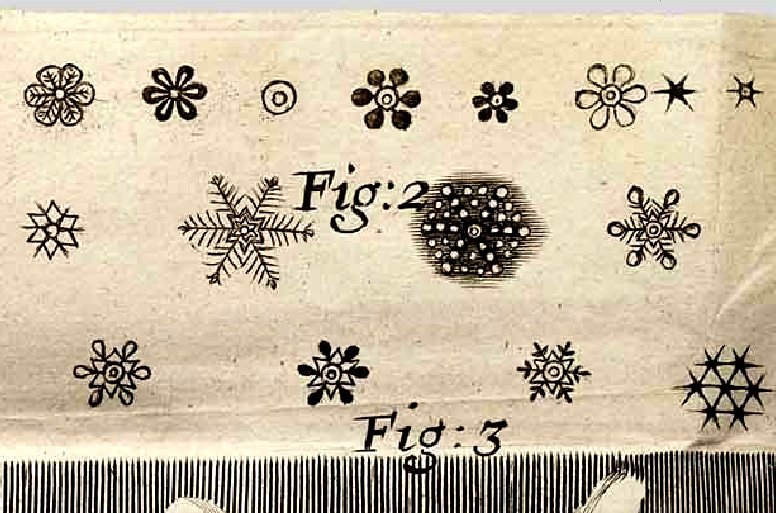
26-year-old Robert Hooke seems to be recognized as the first to throw the
snowflake under a microscope, publishing drawings of them and just about
everything else that he saw in his monumental (and tall, being 13-inches high)
Micrographia (1665)–the first truly scientific book of modern times.
 The largest of the large images was saved for the flea, showing the
unsuspecting public the great and beautiful nature of what seemed like a
fantastical beast (under magnification). Snowflakes appeared in the book,
revealed in their intricate and seemingly-symmetrical nature. They were
fantastic, not-yet imagined images. In between these two giants was
another–Rene Descartes–who was actually the first to render a relatively
accurate pre-microscope image of a snowflake and did some very good thinking
about their structure.]
Perhaps though it is the opposite, perhaps most of these pre-Renaissance Western European forts do bear resemblances to snowflakes, though without attribution. (I just did a quick google search on some of the major writers on the construction of forts, and “snowflake” makes not one appearance.) Of course there is no mention of any biological acuity in ancient and near-ancient city plans that bear striking resemblences to human biological units. I guess you really don’t need to have any idea about on the subject of crystal growth or know what super-cooled cloud droplets look like in order to design something that looks like one…