JF Ptak Science Books LLC Post 604 Blog Bookstore
Much of human intellectual history has been dedicated to looking inside, seeing
the unseen, the stuff underneath, the invisible, the clouded, the inscrutable, the
things-behind-something-else. If you could somehow weigh all of the stuff that
we know that is “visible” versus all of the other stuff that is not, I think that
the scales would fly over instantly into the world of the unseen. Some of this
material though does not have a measure: for
example, numbers are part of the unseen world, ideas made of nothing, points
and lines in an imaginary series of planes and dimensions, and so have no mass
themselves. Everything that is alive on and in our bodies, on our skin,
in our
water and food, and which were all basically unknown until the invention if the
microscope, have little weight in and of themselves, but when you add the whole biota together…well, then
you’ve got a whole weighty lot of nothing Then there’s the stars unseen beyond the six
or eight thousand that we can see without a telescope, the rest of the universe
waiting, discovered only 400-odd years ago, a very weight affair (and that’s not counting the dark matter).
I know that this is sort of a horrible argument, a beery and inelegant way
to describe the path of human knowledge, but it strikes a (dis)chord with me.
One part of this invisible empire is within us—the elements of our bodies. The Egyptians knew enough to do very simple
surgery and to perform a more-complicated mummification ritual, but in general
the body remained fairly well undiscovered until relatively recent times. Publishing findings on those dark
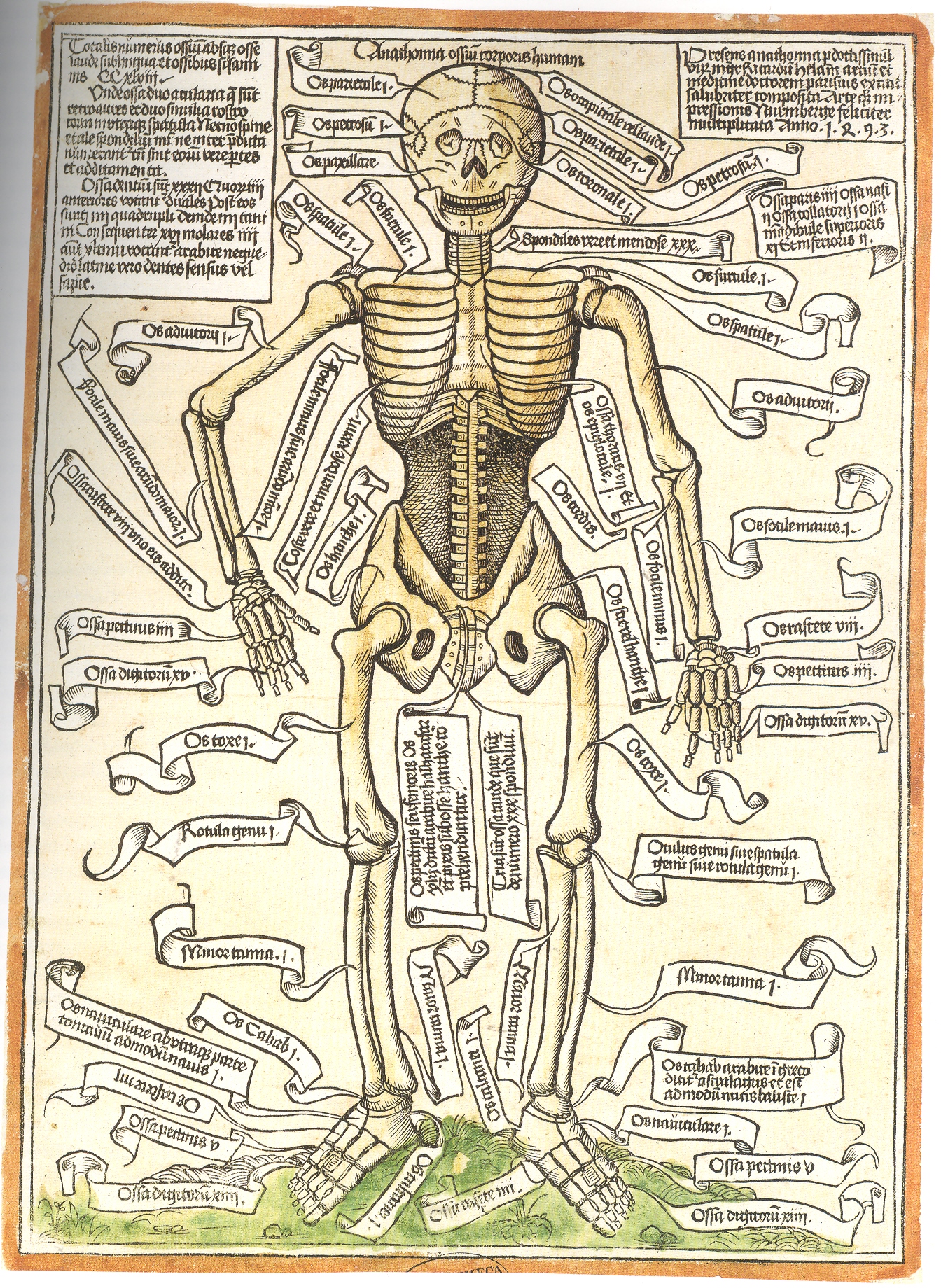
explorations was another matter, the first image of a human skeleton not
published until 1493 (shown here, the Anathomia ossium corporis humani)–this was the first revelation to the real world of science following a sleepytime of about 8oo years under the very heavy gaze of institutional religions.
work as a template for the display and presentation of anatomical practices and
medical rigour for many years to come, solidifying the pursuit of the knowledge
of the human body into a discipline.
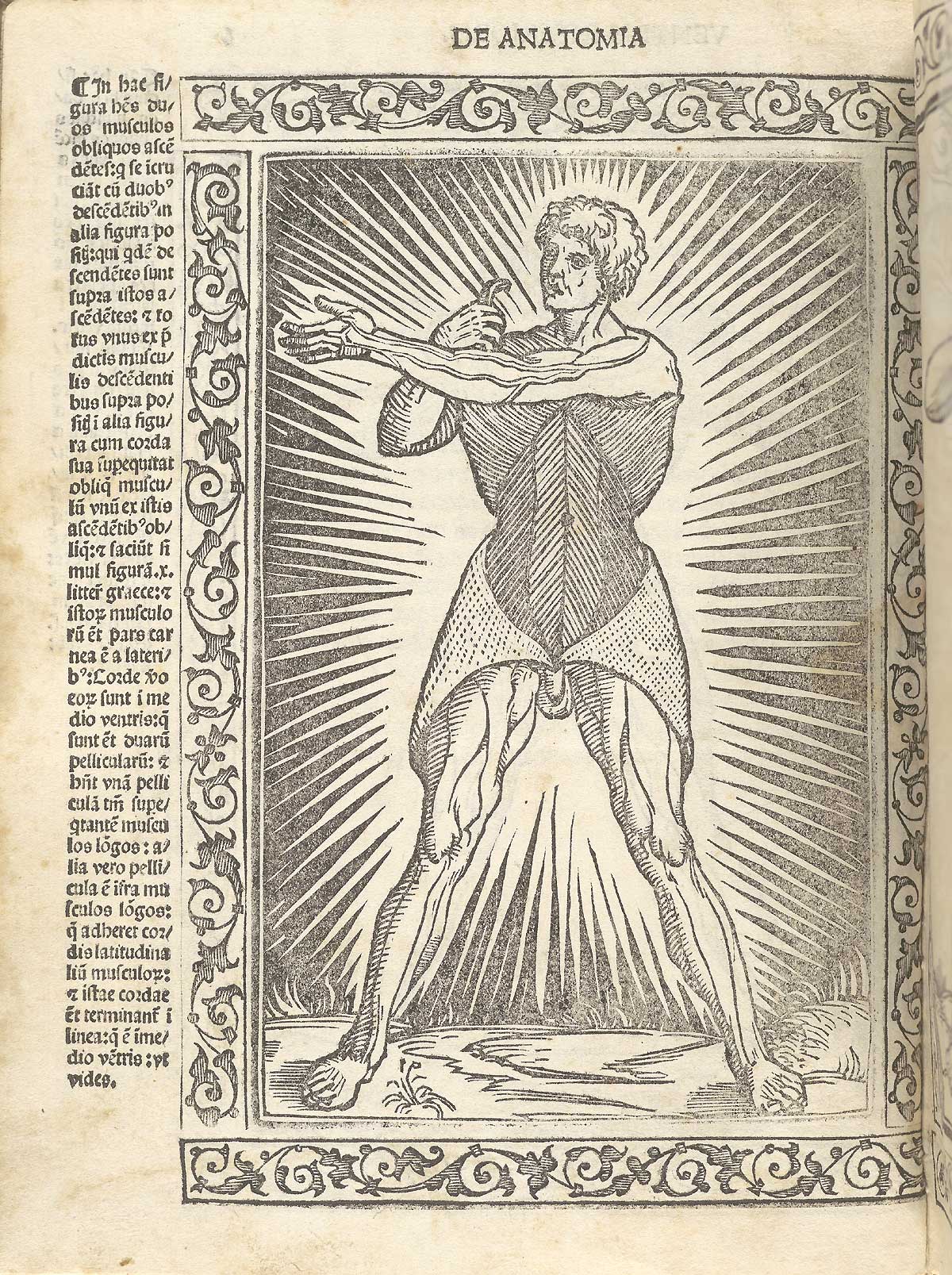
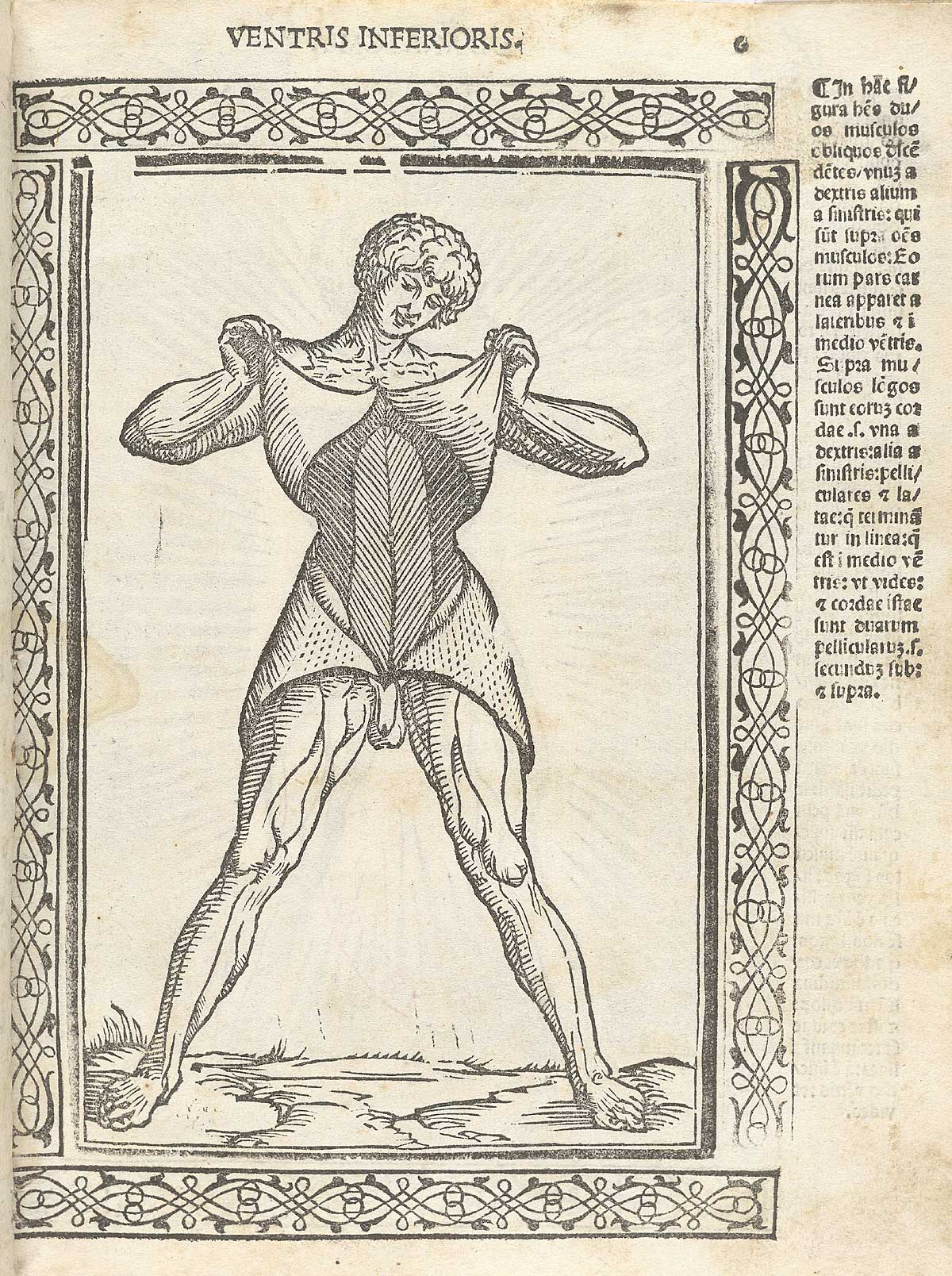 Some of the predecessors weren’t
so rigorous, as with Jacopo Berengario
da Carpi’s (ca. 1460-ca. 1530) Isagogae breues, perlucidae ac uberrimae in anatomiam humani corporis, who used several of the same images to illustrate different anatomical aspects. (In the two examples right and below show the same anatomical display–the difference is the rather extraordinary background, and that’s it.) An other example is
Charles Estienne’s 1545 De dissectione
partium corporis (“On the dissection of the parts of the human
body”) who simply ran out of scientific steam int the preparation of some of its
many (lavish) illustrations—he used existing artwork of torsos and simply performed
a printectomy on them, replacing some of the sections of the print with some anatomical
detail. The practice worked well enough,
but the overall effort did not make it a landmark in the history of medicine.
I just wanted to touch very briefly on the rediscovery of the body in the 1490-1535 period. To that end I’ve constructed this table with data pulled directly from the National Library of Medicine pages
for anatomies on the web–all I did was place the records in a table so
that they could be listed chronologically. The numbers at left are
clickable and will take you directly to the images of the work at the
NLM site. This is just a sampling of anatomies, though it may prove to
be highly useful for folks in the science and the arts.

Chronological list:
Author: Mansur
ibn Ilyas (fl. ca. 1390). Title:
Tashrih-i badan-i insan. [Anatomy of the Human Body]. Publication Information: [
Author: Ketham,
Johannes de (15th century). Title:
Fasiculo de medicina. Publication
Information:
Venice: Zuane & Gregorio di Gregorii, 1494.
Author: Hundt,
Magnus (1449-1519) Title:
Antropologium de hominis dignitate… Publication Information:
Author: Berengario
da Carpi, Jacopo (ca. 1460-ca. 1530). Title:
Isagogae breues, perlucidae ac uberrimae in anatomiam humani corporis. Publication Information: