JF Ptak Science Books LLC Post 596 Blog Bookstore
HMS Ships Firing On London,
1909, Old vs. New Comparing Shipboard
Firepower: a Compelling Comparative Graphic Display from the Illustrated London News for 24 July 1909
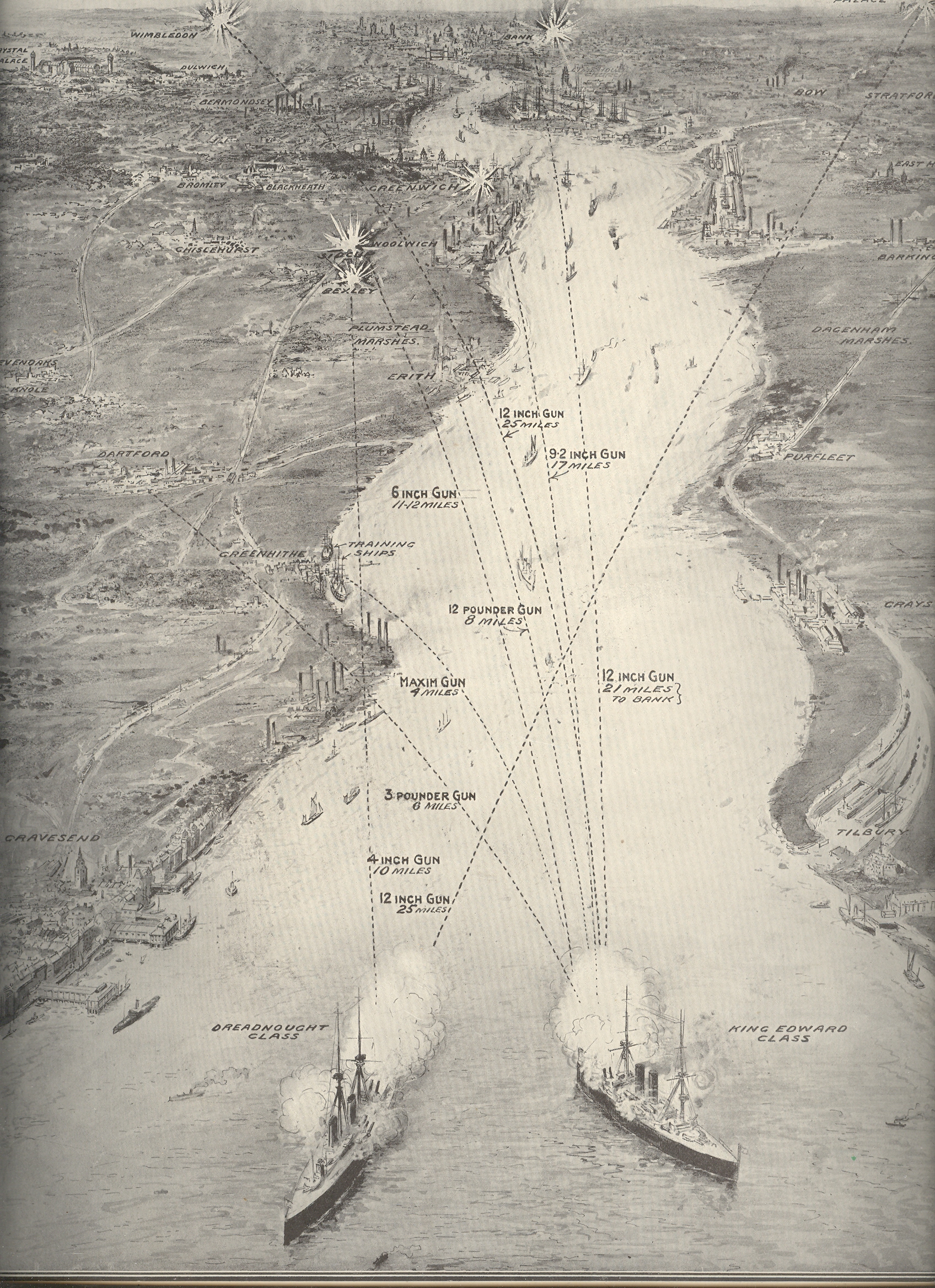 Without looking at the sub-title and explanation of this of this print (“Firing
from Thames Mouth to the Edge of Greater
London”) its purpose might be a fair mystery, given the ships and the targets
and all. The two large ships at bottom are a Dreadnaught Class battleship and a
(smaller) King Edward Class ship, and, yes, they are firing towards London—but they
are doing so to illustrate a point on modern weaponry and the vast, new
superiorities of British advances in the death/protection arts.
In June 1667 during the Second Anglo-Dutch War the British were set upon by
an running attack by the Dutch Admiral Michiel de Ruyter, who had advanced as
far up and into the coast as the mouth of the
though their secondary targets (so to speak) at Gravesend
and the River Medway proved a scorching defeat for the British, and propelled
the rocky war to a quick peace favorable to the Dutch.
This image shows what could’ve been the results of that engagement at
Gravesend had the Dutch fleet been outfitted with the HMS’ new 12-inch guns—de Ruyter
would’ve been able to reach the outskirts of London from that position, and
could’ve b=done so from a distance of 25 miles or so. Of course the artist and
editor aren’t really suggesting a “what if” scenario to the course of events of
the Second Dutch War—they were merely creating a very compelling, highly
illustrative comparison from old to new firepower, and to perhaps quite some fears
about the strength of the Navy as the unstable and rickety international system
limped its way into WWI, just five years in the future.