JF Ptak Science Books LLC Post 549
The prehistory of heavier than air flight is loaded with some fantastic ideas, some just generally fantastical and some prescient, or recognizably prescient from some advanced point in the idea’s future. There was an immediate and relatively massive published reaction to the Montgolfier brothers’ first balloon ascension in June 1783, much of which was useful and applicable, some of which was interesting if not practicable, and a little of which was just deeply problematic, not very considered, and all-around wrong–overall, it was interesting thinking, thinking about this brand-new issue, people trying to get their heads around new concepts and answering them with new- and not-so-new-thinking.
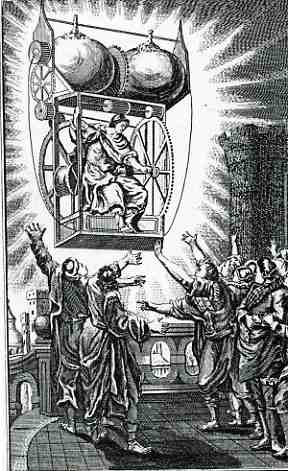
One lovely pre-Montgolfier example of fantastical thinking was Louis Guillaume de la Folie’s (1733-1780) La Philosophe sans Pretension, ou l’homme rare…, published in Paris in 1775. La Folie’s fictionall adventure is an example of early science-y sci-fi, coming as it did in the midst of the fabulous electric age of the mid-18th century. He tells the story of a Mercurian, Ormisias, who by his own trivial care winds up flying a chariot fitted with electric balloons from Mercury to Earth. This was more believable than previous works on space flight, which saw the vehicles powered by whirlwinds, fireworks, horses, beasts, catapults and (hello Johannes Kepler!) demons.
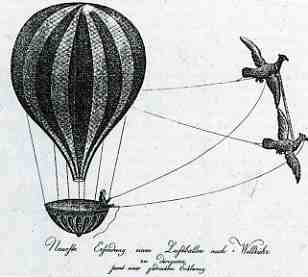
An example of the very charming and not effectual peep-into-the-future approach to modifying the Montgolfier effort was by Jakob Kaiserer, who in 1801 published his Ueber Meine Erfindung, einen Luftballoon durch Adler zu regieren. Kaiserer, a bookseller, confronted the issue of steering, featuring s aero-craft by using a pair of tethered eagles. His was a picturesque
answer to the steering and propulsion issue, meant in a way to be taken seriously, and was not really too far from the ordinary offering. (Kaiserer really was thinking, because he also had a spare pair of eagles in the gondola, waiting to replace those in flight when exhausted.) Leashed birds wind up in a number of designs over the years to come, not to mention bird-inspired flying machines designed to function as a bird, the most famous example of which was piloted by Otto Lilienthal to his death.)
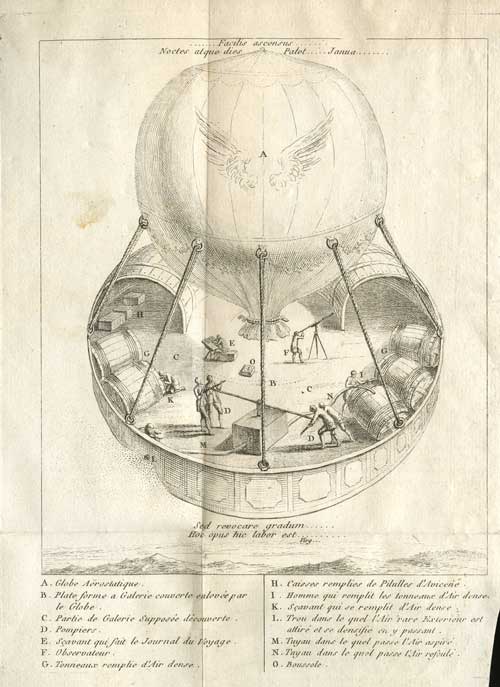
A more prescient image was the wonderful flying observation platform shown in Sur son projet de voyager avec la sphere aerostatique de M. de Montgolfier, published in Paris (“Aeropolis, chez Zephirolin”) in 1783. (The images I’m using at left and below are from the Lilly Library.) It is perhaps the first such suggestion in print of such a device–the balloon is powered by “dense air” which is evidently being pumped by the four men at the air pump in the foreground, and is host to a myriad of scientific activities, not the least of which is the astronomer and his large telescope. It really is a remarkable effort, looking into the future of possibilities for the spanking-new invention of flight. A space station it is not, but it was certainly within the realm of the possible, and for its time must’ve seemed like an impossible bit of fancy brought very close to reality.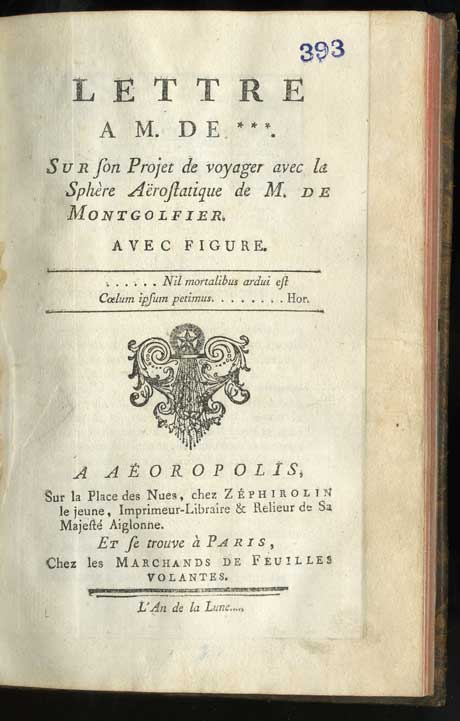

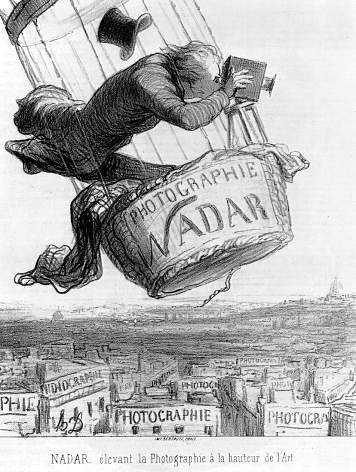
(This image reminds me of Honore Daumier’s 1862 caricature of Nadar “elevating photography to the condition of art”.) Nadar’s issue here is not only using photography from an elevated platform, but is also using the camera as a tool, and not an artistic element.)