JF Ptak Science Books LLC Post 506
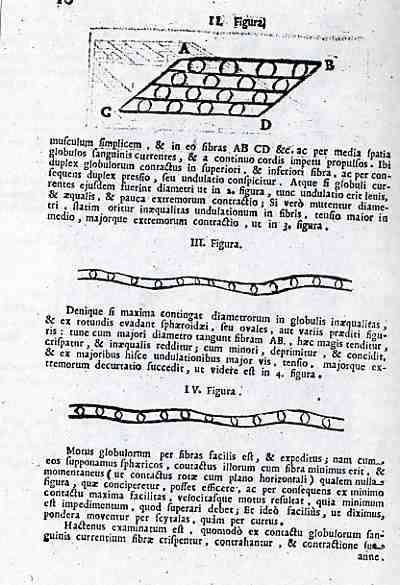 In a rare confluence of odd bits, today’s post joins the categories of Blank and Missing Things with A History of Dots to form a probably-not-to-be-used-very-often category of A History of Blank and Missing Things: Dots. These text illustrations come from (page 10) of the great Girogio Baglivi’s De Fabra Motrice et morbosa..., a 58-page section found in Alessandro Pascoli’s Il Corpo-Umano o Breve storia…., all published in Venice in 1700. Baglivi (1668-1707) was an ethnic Armenian raised in Italy who rose to the rank of physician to Pope Innocent XII, and who was also a distinguished author and professor of anatomy at the Sacred College at Rome.
In spite of living only 39 years (dying, probably, from the consequences of a severe malarial attack) Baglivi had a long list of accomplishments, primary among these was his description and distinction of the smooth and striped muscle, the subject of the engraving at left. This is one of the giant milestones in the history of physiology in general, also making crucial contributions to medical/clinical education. It is the illustration of these muscle types that display the “empty dots”, not so much empty, of course, but just devoid of detail for the sake of illustration–but for my purposes, these simple empty spheres signify so much with so little. Nothing, really.
Some sort of interesting and perhaps overall numbing quotes of Baglivi:
Let the young know
they will never find a more interesting, more instructive book than the patient
himself. …
The doctor is the
servant and the interpreter of nature. Whatever he thinks or does, if he
follows not in nature’s footsteps he will never be able to control her.
De
Praxi Medica (1696).
The origin and the causes
of disease are far too recondite for the human mind to unravel them.
The two fulcra of medicine
are reason and observation. Observation is the clue to guide the physician in
his thinking. — Giorgio Baglivi Praxi
Medica (1696)