JF Ptak Science Books LLC Post 496
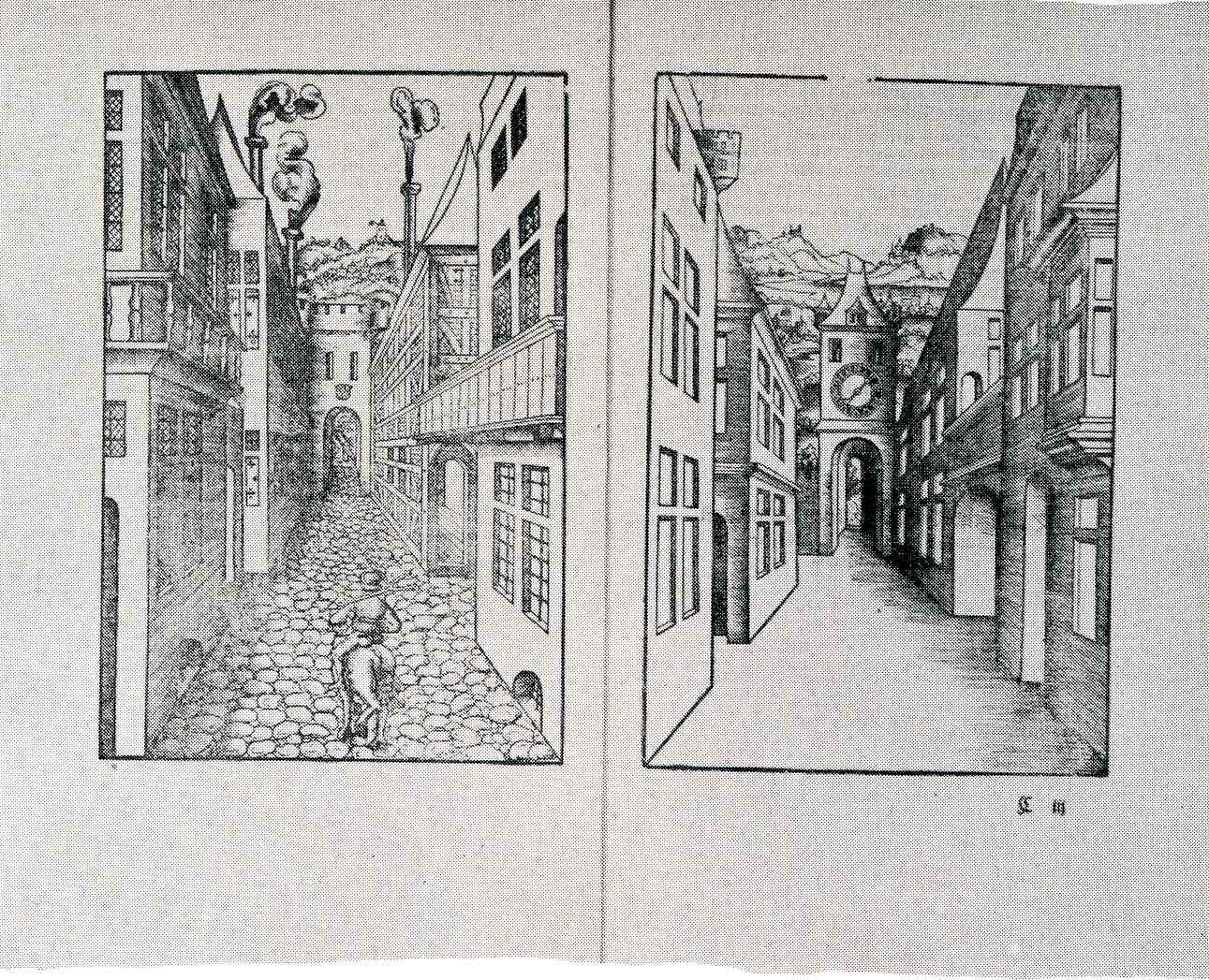
Hieronymus Rodler (who died in 1539) wrote one of the greatest books of the Renaissance on the use and care of the relatively-newly-discovered practice of perspective. Perspectiva, Eyn Schon nuetzlich buchlin und underweisung der Kunst des Messens...(Useful Booklet and Instruction in the Art of Measurement), published in Frankfurt a.M. in 1546 (as a second edition following the 1531 first). I say “newly” because Rodler wrote his book to help explain, or at least somewhat simplify, the 1525 Underweysung der Messung (Instruction in Measurement) by Albrecht Durer, a great work of some substantial complexity and difficulty.
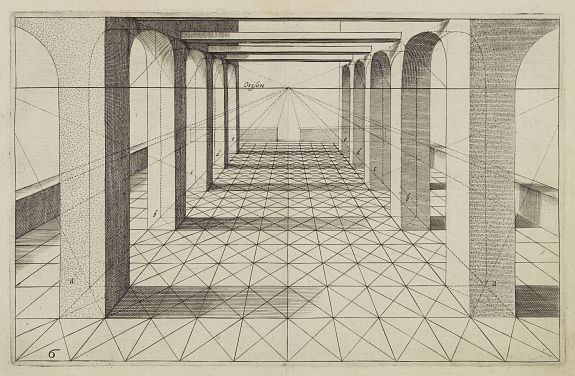
The works of Wenzel Jamnitzer (1564 and 1568), Heinrich Lautensack (1564) and Hans Lencker (1567), all fine examples of earlish work in perspective and al quite lovely–but it is Hans, or Johannes Vredeman de Vries (ca.1527-1604, “The King of Architects” among the Dutch, at least), whose Perspective of 1604 rises to the greatest heights, a book filled with superb copperplate engravings of the master’s work, vanishing points into which all the lines of the engraving converge, sucked as it were into a perspective Black Hole. That, and of course there are so many of them that look exactly at the center of a receding horizon. (And this continues two earlier posts written along the same vein, here.)
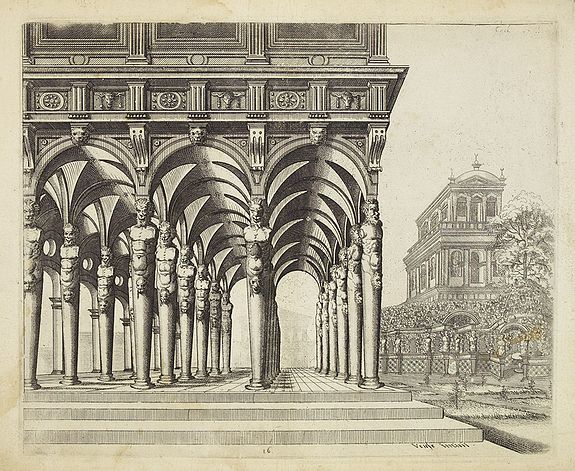
In his dedication to the reader (“To the Studious Viewers of Optics”), Vredeman de Vries writes that
“My eyes and mind took pride
In Sacred Optics. Thereunto allied
was a fructifying labor, forty years
I plied this art devoutly, Here appears
a doctrine worn by time. That art is famed
For trustworthiness which trusty rules have framed…
This art, which guides the eye and soothes the brain,
with images, but never cheats the sight
with lying views…”
I have purposely not said anything about early artists (like Uccello, Filippo Brunelleschi, Leone Alberti (Optics), Piero della Francesca, Piero della Francesca, Federico Commandino, Jan van Eyck, Leonardo, and Serilo and Vignolla, Raphael, and so on) and the development of perspective in painting because, well, I can’t figure out how to do it in a paragraph. But you can certainly consult fine books like Samuel Edgerton The Renaissance Rediscovery of Linear Persepctive (1975) and Hubert Damisch The Origin of Perspective (1994) for a bigger taste of teh issue. Me, I just wanted to look straight-on at some 16th century perspective illustrations…