JF Ptak Science Books LLC Post 455
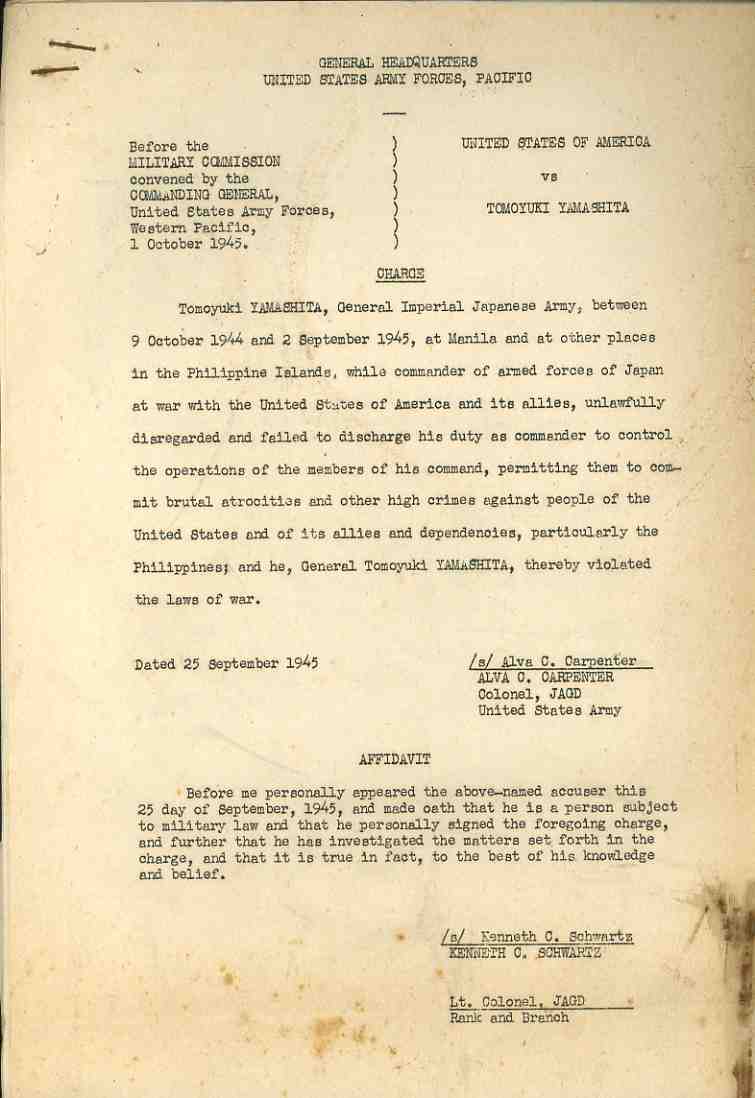 This is a rare offset printing of the statement of charges
and “outline of particulars” against the Japanese Imperial Army General Tomoyuki
Yamashita (1885-1946), a man accused of war crimes against humanity. After he was captured 2 September 1945,
General Yamashita was arraigned principally for failing to control his troops,
segments of which had acted brutally in their treatment of residents of
captured
against
charged with “unlawfully disregarding and failing to discharge his duty as a
commander to control the acts of members of his command by permitting them to
commit war crimes.” This was in
direct violation the doctrine of “command responsibility” which was established
by the Hague Conventions IV (1907) and X
(1907), and—after in re
Yamashita—would also become known as the “Yamashita standard”, in which courts
clearly accepted that “a commander’s actual knowledge of unlawful actions is
sufficient to impose individual criminal responsibility”. Yamashita would be
found guilty by the U.S. Military Tribunal and was sentenced to death, for “vengeful
actions are widespread offences and there is no effective attempt by a
commander to discover and control the criminal acts, such a commander may be
held responsible, even criminally liable.”
It was a death sentence for a crime of omission. (As early as the 6thcentury BCE, Sun Tzu,
in his Art of War, stipulated that it was a commander’s duty to ensure that his
subordinates conducted themselves in a civilized manner during an armed
conflict.)
after Yamashita captured Singapore in February 1942, accepting the
surrender of General Arthur Percival and 100,000+ British Army soldiers, a
steel wind policy was instituted, with thousands of people—soldiers and
civilians—finding their end at the point of Japanese soldiers’ bayonets.
concerted, pervasive and prolonged ethnic cleansing of
anti-Japanese “undesirable” elements.
Among these groups were included (and this list is taken from a rather
good contribution to the dubious Wikipedia):
- Persons who had been active
in the China Relief Fund. - Rich men who had given most
generously to the Relief Fund. - Adherents of Tan Kah
Kee, leader of the Nanyang
National Salvation Movement. - Hainanese,
who were believed to be communists. - China-born Chinese who came
to
War. - Men with tattoo
marks, who were believed to be members of secret
societies, specifically Triads. - Persons who fought for the
British as volunteers against the Japanese. - Government servants and men
who were likely to have pro-British sympathies, such as Justices of the Peace, and members of
the Legislative Council. - Persons who possessed arms
and tried to disturb public safety.
In short, it didn’t take all that much to be considered for
elimination, and a long and frozen fear and ruthless hearts-and-minds- campaign
was instituted which lasted until the
of his long and terrible reach across
Most
of the British and Australian prisoners incarcerated in Singapore’s Changi Prison would never
make it out. Other segments of the POWs
would be transported on hell ships for forced slave labor throughout the
Japanese Empire. The Siam-Burma death
railroad (surfaced in the Pierre Boullee novel The Bridge on the River Kwai) received other portions of these
POWs; on that 258-mile railroad upwards of 180,000 Asian slave laborers and
60,000 Allied POWs were put to work in horrific and desperate conditions—90,000
of the Asian and 16,000 of the Allied would be killed during the construction
(though many estimates are markedly higher than this). The Sandakan
airstrip in North Borneo was another death receptacle
of these POWs: 3,600 Indonesian slave
laborers and 2,300 Allied POWs were set to work here—only 6 Allied POWs
(Australian escapees) survived.
In re Yamashita focused
on the
population more than 100,000 lives. Tomoyuki Yamashita was hanged on 23
February 1946 at Los Banos Prison Camp, 30 miles south of the city in which he
caused so much misery.