JF Ptak Science Books LLC Post 458
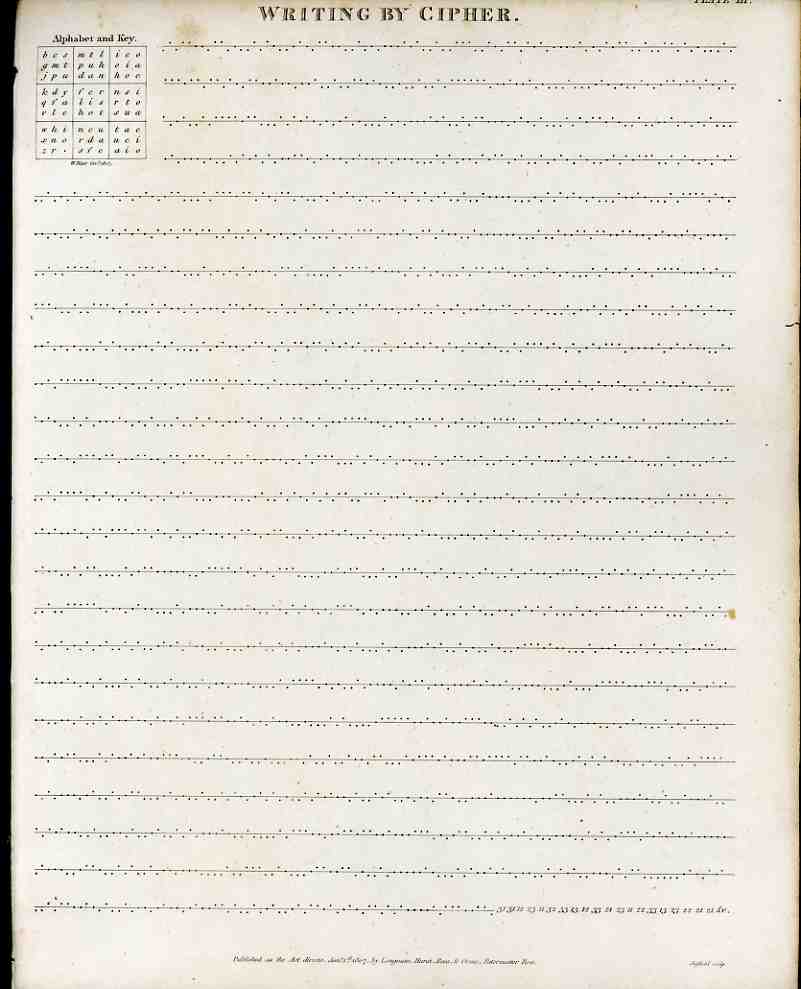
This is
the second in a series on the History of the Dot. This engraving of the ingenious and very
once-upon-a-time difficult-to-break cipher appeared in the mammoth (45-volume) Cyclopædia,
or The New Cyclopaedia, or, Universal Dictionary of the Arts and Sciences, edited by Abraham Rees (1743-1825). The
book was published between 1802 and 1820, and was the work of 100 contributors,
who generally wrote monograph-length entries, as the completed effort ran close
to 40 million words. I’ve particularly enjoyed
the illustrations—some of which have become iconic—and especially the fine and
deep engraving of Wilson Lowry.
The engraving, “Writing by Cipher”,
employs dots placed above, on and below a line, representing the numbers 1,2
and 3, respectively, which in turn form one of four numbers which are letters;
a key would then be transmitted to reference the letters formed by the dots to
the alphabet. It was a tough bugger to
break, and survived most of the 19th century without being
broken.