JF Ptak Science Books LLC Post 419
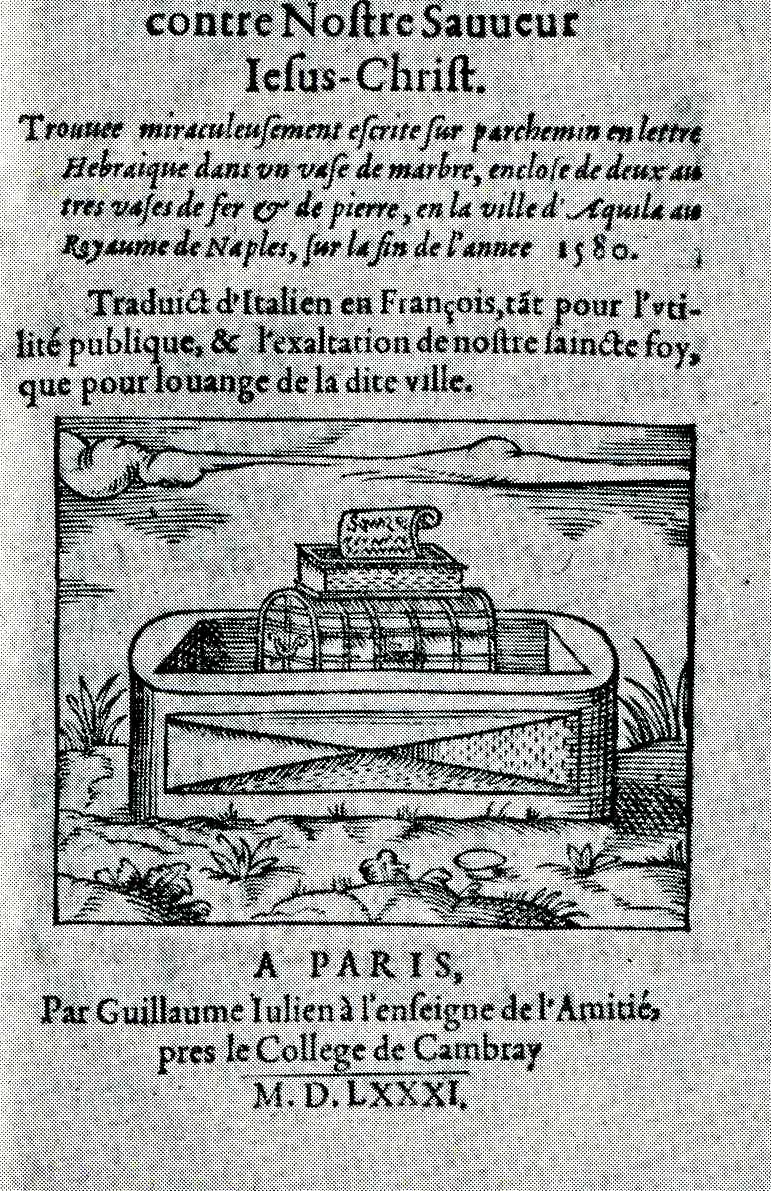
One of the most remarkable literary frauds testing the published boundaries of religious merit was this remarkable publication, the death sentence for Jesus Christ by Pontius Pilate. Printed in Paris by Guillaume Juliene for Jean Stratius at Lyon, the Thresor admmorable, de la senstence prononceepar Ponce Pilate, contre notre Sauveur Jesus-Christ, (translated from Italian into French), was a work of great audacity if for nothing else than in its reach. (I’d like to restrict these comments on religious-mythological writings to the more-obvious and modern forgeries and hoaxes, and leave the question on the “authenticity” of other religious works like “divinely-inspired word-of-god transcriptions” for another time.) The book is about a parchment that was supposed to contain a rather touching, and naive account (in Hebrew) of Pilate’s death sentence of Christ, a document found in a successive, nesting marble containers which protected it from time’s enemies. As a matter of fact, the vignette illustration on the title page shows the parchment and the open containers as “proof” of the hoax’s merit. Another very nice, light touch was the remark that this work was translated from the Italian (and that from the Hebrew) edition; it is most likely that this is the original edition, beginning its fictional life as a third-generation translation, a claim adding to the document’s possible authenticity.
It is not possible to leave remarks on religious forgeries/hoaxes without mentioning the talented and odious murdering forger Mark William Hofmann, the man who lead the most productive life of any American forger, and who late in his career was said to be attempting to fabricate the missing first 118 pages of the Book of Mormon. In addition to his very accomplished literary and political forgeries, Hofmann came upon an evil and brilliant idea–the devout Mormon would forge unseemly documents from the earliest periods of Mormon history and sell them to the Mormon Church, which was evidently very interested in obtaining such documents for its not-public archive. Hofmann’s plan was remarkable–at first blush the offending documents that he “tracked down” were donated to the Church. As the troublesome finds became more interesting (read “damaging”) he needed money (and lots of it) from Church officials to secure the documents from their “enemies”. Having established goodwill and a sort of loyalty, and being terribly gifted and of course deeply knowledgeable about early Mormon history, Hofmann (a sixth-generation Mormon) created his own market, his own clientele, and his own product. (The “product” being very well researched and radiocarbon dating-proof documents for which he also forged their own provenance (!); even though fairly elementary stuff it was very well constructed, and Hofmann’s forging ability was exceptionally high.) Outside the messing around with people’s belief system and committing major frauds all over the place and stealing millions of dollars, the biggest problem with Hofmann (perhaps some of you will remember his from the “Salamander Letter” of the mid 1984) was that in the course of doing business and protecting himself he bombed and killed two people in cold blood. He didn’t answer his own religion’s hushed call for “blood atonement” and was sentenced in his cowardly way to life imprisonment in the state of Utah, where he lives to this day.