JF Ptak Science Books LLC Post 449
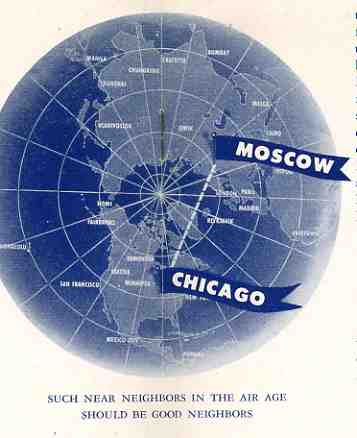
This hopeful and terrifically unbalanced homage to wistful loveliness of the Soviet Union, The Businessman’s Stake in American-Soviet Friendship,
by Harland Allen, was published in Chicago in 1944, and seems to me a
small prayer for what the post-war world might bring about. Allen
forced the then-popular economic thought that the people dangling from
the visor of Uncle Joe Stalin’s cap were money angels rather than
Russian corpses, and that the air lane shown in the trans-polar map at
right would soon be filled with American exports headed to Moscow.
(Little did he know that in a decade this line would be the distance
traveled by ICBMs, or close enough to it.) At least that seems to be
the hope here, Stalin forcibly melted into the Big Board, the Soviet
Union trading on the DOW as CCCP (Inc.).
The small pamphlet
received some spirited review support from the Northwestern University
School of Law, the Des Moines Register and Tribune,the Society for the
Advancement of Management, the Meadville Theological School, and Laird
Dell Attorney at Law. And that’s about it. But these were ripe times
for this sort of pro-Soviet thought: after all, dozens of millions of
Russians had been killed in the fight in the East against their former
Nazi allies, and without all of that blood sacrifice I have no doubt
that the war would’ve lasted for some years to come.* The U.S. had a
powerful ally in the Soviet Union regardless of what had happened there
in the 1930’s and regardless of their attack on Finland and regardless
of their Pact with Hitler–from 1942 onward they would hinder and halt
the Nazi army and nearly ground the whole thing down to a nub, crushing
the German capacity to fight in the west. The atomic bomb was to be
untried until July 1945, and the outcome of the war was not yet known.
Love for the Soviet Union was high in the sky at this point, FDR making
many airy and superior statements about our new ally, while the rest of
the propaganda machine was lubed and oiled for the coming fight. LIFE
magazine went so far as to pronounce Lenin as “perhaps the greatest man
of modern times” and that the NKVD was analogous to the FBI. Even old
anti-Soviet hawks like MacArthur publicly pronounced their admiration
for the new regime. (George Patton famously did not.)
Back to
our pamphlet: aside from some romantic vision of the Soviet Union,
Allen maintained that the U.S. needed to deal with the CCCP because of
its enormous army (which he did not want to annoy and fight) and its
impending “mastery o the air”–it would be better to trade and make
money than it would be to make war. Allen pointed out that some of the
problems of Americans dealing with the political system in the Soviet
Union were inadequate reports on what he described as the country’s
economic “principle of national planning“. .(I hardly know what
George Orwell might’ve said about the supremely understated summation
of the Soviet system as “national planning” and the fruitless and
embarrassingly weak attempt at controlling language to describe the
monstrously repressive regime.) He continues: “Journalists have been
positively fearful of open-minded reporting in Russia lest they get
tagged–or tarred–with the familiar epithet “communist”, and then goes
on to describe the similarities of the “two great peace-loving
peoples”.
And so it goes, on and on in this pamphlet–it just
isn’t worth going into any further than this. The euphoric sheen of
pro-Soviet sentiment and appreciation wore thinner as the war
progressed, truer feelings becoming more exposed as the German army
retreated westward, reproducing the famous Minard chart of Napoleon’s
disappeared army in a war 130 years earlier. The endgame for European
real estate, fumbled badly by the dying FDR at Yalta, brought out the
cardboard smiles between the US and the Soviet Union, relations
strained to the point that the military employment of the atomic bomb
was in some not-minor sense made to bridle Soviet intentions.
But that was still two years hence for Mr. Allen, who I guess couldn’t see into the future that far, even if his work was heralded by the Des Moines Register. He just didn’t do a very good job of withstanding the test of time, even though that test ended in 1946.