JF Ptak Science Books LLC Post 290
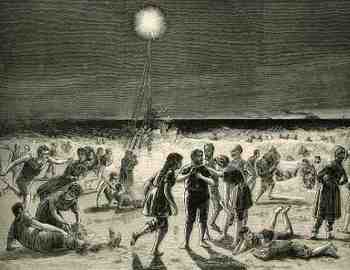 This woodcut is from the Leipzig equivalent of LIFE or The Illustrated London News: Illustrirte Zeitung, and was published in August 1878. It appeared in the same issue as the very first image of Edison’s phonograph in a European publication (just two pages away) It was a big issue for Edison in Germany, as he was of course principally responsible for not only integrating minor discoveries of others into a revolutionary discovery of his own (the electric light and light bulb), but was also reasonable in the largest part for the physical distribution of energy to those light bulbs. And so it came to be that the beach at Coney Island–one of metropolitan New York’s greatest recreational sites–was lighted by a portable electric “floodlight” (though I don’t know what the illuminating part was–perhaps it was a carbon-arc something or other, as I’m pretty sure it wasn’t a light bulb” as we would think of it…nevertheless the source was electrical). It had never in human history happened before that people could frolic in the surf under an artificial source of illumination–it had to have been an extraordinary sensation. The light appeared in the same year that the The Camera Obscura
Observatory was established (borrowed from 1876 Philadelphia
Exposition) and just nine short years after the “great” Charles Feltman
invented the Coney Island hot dog (though my favorites of the boardwalk
was Nathan’s big crinkly french fries in a paper cone).
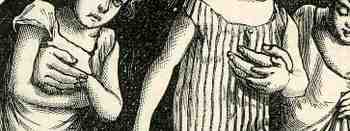
Right above this image was this extremely emotional wood engraving of blind children being taken to the beach for the first time (at Sheepshead Bay)–my German is pretty rough, but it seems as though they were on a field trip from their institutional home, which was something like a “waif” school for the “deaf, dumb and blind” or something 19th-centuryish like that.
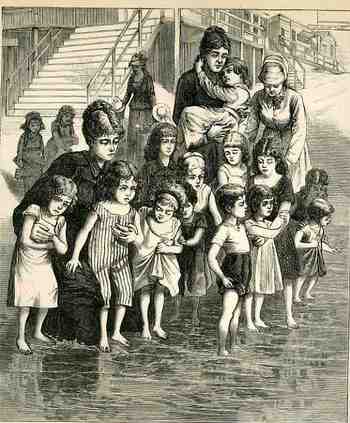
It is a deeply touching image to me, showing tremendous touch and care…these children, drawn tightly together, feeling and smelling the vastness of the ocean, feeling the full sun on their faces, experiencing it together and separately, overwhelmed, gentle–thirteen children and three matrons and not a smile, all deep in a private world flooded with feeling.