JF Ptak Science Books LLC Post 210

This engraving (s small section of which is highlight from the full image below), plate I/74/B.7 (yes, an incredible but true plate number) from Johann Georg Heck’s masterpiece, Iconographic Encyclopedia, (American edition), 1849-1852, is a 12×12 grid basically showing the progression of the orders of earthly life. It is a result years of zoological thinking, a systemic exposition of animals created by Aristotle, Pliny, Galen, Belon, Rendeletius, Gesner, Aldrovandi, Mouffer, Linneaus, Cuvier and etc. Most were scientists though many repeated the fables and imagined observations of earlier, less scientifically-fortunate colleagues (like Pliny, whose fantastical assertions took root over 15 centuries). 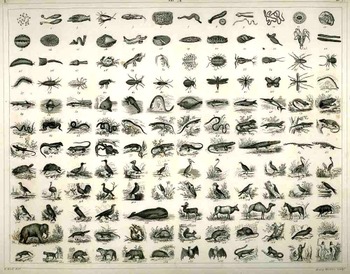
This fine and minutely-detailed work packs an incredible amount of data on a sheet of paper just 8×10 inches big (or small), 145 (don’t forget Eve in the 12-square grid!) elegantly arranged and easily identified images in 80 square inches. It is a beautiful and remarkable accomplishment, and Heck’s artists did 435 times throughout the length of the work. (I wrote a post about Heck’s illustrations of the construction of the Thames Tunnel back in June.)
Life is arranged—here in 1849—along four division and 18 classes, from Radiata to Mollusca to Articulata to Vertebrata (ending with Adam and Eve, even though the couple is simply classified as Homo in the text, standing virtually next to Simis). It is a classic (or should be) of scientific illustration, the net effect of which is similar to a flip book or nickelodeon–the images seem to just roll past and through the brain.