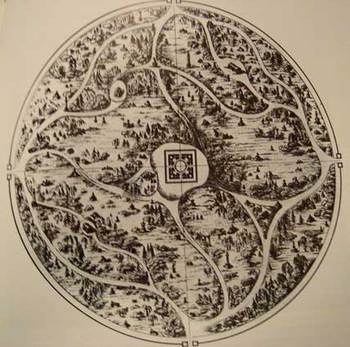
While sitting at the edge of a stream in a flowing dress and shading herself with a yellow parasol, my wife and the jewel in the crown, the brilliant Patti Digh, wrote a superb essay on following the paths less marked. (Maybe I’m making up the parasol bit. And the stream. And flowing dress.) I’ve always been a happy observer of found geometries, and her essay heightened my awareness to them, along with the conscious efforts that we may daily make to enforce these lines or follow a new, multi-dimensional geometric path.
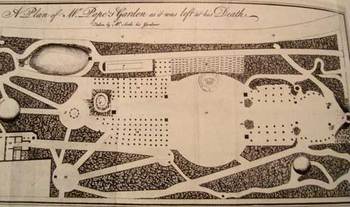
So when I stumbled across this map of Alexander Pope’s garden and noticed the odd paths winding their way through it, and how much in contrast this was to the very sniffy upper crust English garden of the 18th century, Patti’s essay lit instantly to mind—and also because in addition to being a geometer of emotion and thought she was in a past life a U VA English Master.
Pope’s garden was an irregular path in an irregular garden, that garden being his leased property at Twickenham, where he came to live in 1717, along with his mother and his boyhood nurse, Mary Beach, and his dog Bounce.
Pope’s garden was an irregular path in an irregular garden, that garden being his leased property at Twickenham, where he came to live in 1717, along with his mother and his boyhood nurse, Mary Beach, and his dog Bounce. (Actually that would be a series of dogs as he named them all “Bounce”.) Pope was a poet and satirist and
critic and general taste-maker-the social influence extending even to garden-making, as his was famous even during his lifetime, and not for the reasons that most English gardens were famous.
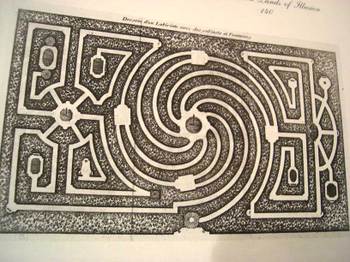
His was not the planned regularity of the gentility (and far of course from the suffocating, critically flawed gardens at places like Versailles, “Is there anything more shocking than the regularity of a planned garden?” asks Batty Langley in his New Principles of the Gardening… 1728), and were removed from the “normal”, more articulated garden. I’ve never really understood the formal garden, especially as it relates to the ancient analogies of gardens and paradise-the Garden of Eden, Pliny’s Garden of Venus, Lucretius’ Earthly Paradise, seem as though they might be some sort of paradisical thing (though we won’t address Bosch’s Garden of Earthly Delights) , but the formal gardens and its paradise relationship seems odd, what with the removal of nature’s “chaos” and all, unless that was indeed the Master Plan.
But the mathematical garden was a desirous thing—still is—and none other than Christopher Wren wrote that it was “naturally more beautiful than any irregular figure” (1750). There were some critics of the math garden, like Mr. Langley, but most garden designers wrote and argued in favor of it, coming to the similar conclusion of John Dennis, in that the Universe, being “regular in all its parts” would dictate that its beauty be found as regular in other things too, “and it is that exact regularity that [the mathematical garden] owes its admirable beauty” (1704).
Pope didn’t seem to address (in print) the garden idea formally except for a few places– Pope praised ‘the amiable simplicity of unadorned Nature’ in a famous essay, published in The Guardian in 1713, and then again in his message to Burlinton in 1731.
The plan of Pope’s garden was somewhat irregular, but to me the most appealing aspect was the irregularity of the paths that curled and snaked their way through the garden.
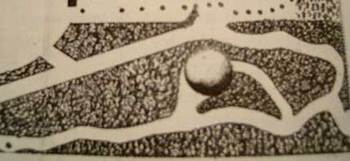
And particularly, what about the lower part of the path along the bottom of J. Serle’s 1725 engraving? What was that path in Pope’s garden leading to, or from? Was there a particularly nice tree there, a favorite spot, a cool shade, an odd bit of sunshine at sundown? Or was this wall-clinging path just the workman’s route?
Perhaps these weren’t Pope’s principal desire lines in the garden—in fact, the garden desire lines weren’t the garden at all— they might’ve been under it. Pope’s famous grotto at Twickenham may be better known than his garden-it certainly sounds much more interesting. Followed his own desire line, underground, in his famous grotto, which he began to build shortly after arriving at Twickenham, and which was still under construction at the time of his death.
The unseen desire lines of Alexander Pope seem more fitting to me, more poetic, what with Pope needing to dig out the earth in order to find what he was looking for, rather than a more simple wandering around his fine, rustic garden.
Have a look at the materials house in the grotto/cabinet of curiosity here, along with a commendable plan of the grotto itself.