JF Ptak Science Books LLC
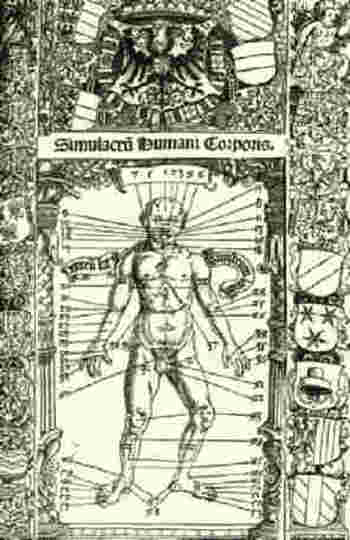
I couldn’t let yesterday’s bloodletting images pass without reference to this excellent woodcut for Johann Stoeffler’s Calendarium Romanum Magnum, printed in Oppenheym by the redoubtable Jacob Koebel, (24 March) 1518. It is a glorious display (entitled Simulcarum humani corporis) of seasonal (!) purgative and bloodletting locations on the body, meant to accompany a longish essay by Stoeffler on the practice in general. The bulk of the book, however, had very little to do with this practice and was actually commissioned as a reform to the Julian calendar, provided with the impetus of the Lateran Council (1512-1517). The result was a series of forty-one propositions on the calendar and calendar-related practices, including work on eclipses, the zodiac, the occurrence of leap years, the Alexandrine and Roman calendars, the calculation of the occurrence of Easter, and so on, including the seasonal practices of bloodletting.
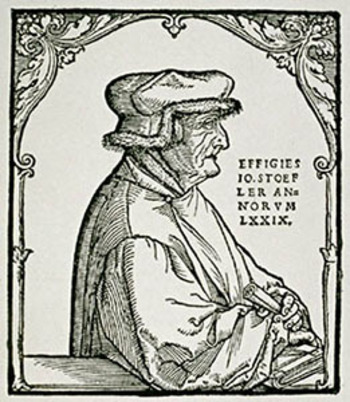
Stoeffler was an astronomer and map maker, and among his other works are included 1482’s Ephemerides (being allocations for eclipses and astrological events to the year 1518), and the Elucidatio fabricæ ususque Astrolabii, published in Oppenheim in 1513, in which he presents a new astrolabe design and usage that was extremely popular throughout the 16th century. Later, in 1536, he invented the Stoeffler quadrant, publishing on it in On artful measurement of all sizes, planes and declines in length, height, breadth and depth (1536), and which became a staple instrument in the surveyor’s intellectual and practical arsenal. (Stoeffler’s portrait is on the right.)