Some of the most striking things in my collection/store/accumulation are the hundreds of images that portray data for display purposes–even more so, those that use a vernacular setting to bring closer to home an understanding of a statistic or finding.
(One of the most popular books on this subject is The Visual Display of Quantitative Information by Edward Tufte, which uses a number of interesting images (good and bad) for the purposes of his book. Another, by fellow Asheville resident Peter Turchi (director of the MFA program for writers at Warren Wilson College) is Maps of the Imagination, the Writer as Cartographer, which hosts a large number of interesting images the stories of which are richly and elegantly woven–this is a real piece of craftsman, and pretty, and useful, too.)
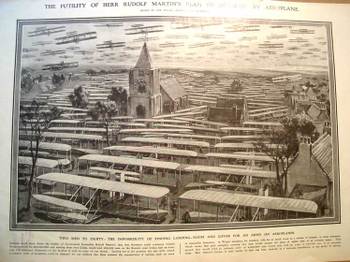
The print that we’re looking at here appeared in the 19 December 1908 issue of The Illustrated London News and is entitled “The Futility of Herr Rudolf Martin’s Plan of Invasion by Aeroplane”. This fantastic piece of annonymous artwork graphically depicts what the author maintained was the impossibility of Germany to invade England by landing 50,000 flying machines and 100,000 men on the Kentish coast of England–impossible (quantly though realistically) because “of the impossibility of finding landing-room (for the planes) and cover for an army on aeroplanes”. The artist depicts a small town and what I guesstimate to be 60 planes in the air and 75 or so on the ground, leaving it to the imagination of the reader where the other 49, 875 might go. He DOES make a point, and very vividly.
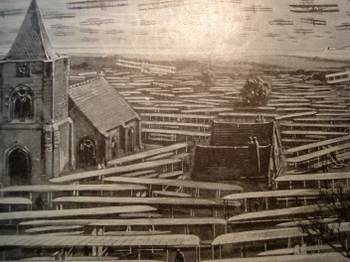 “Nothing could show better the futility of Government Councillor Rudolf Martin’s idea that Germany could construct 50,000 flying machines for 50-million pounds…and land 100,000 men on the Kentish coast from Calais within half an hour.” Evidently Mr. Martin was very concerned with the invasion of England by Germany via airplane, and it was the editor’s job at the ILN to show him
misguided. I would imagine that this illustration drove the point home
to the folks who didn’t actually bother to read anything about the
Martin defense plan. (It was in a similar way that Thomas Nast was able
to control public opinion and sway political refuge and protection away
from Boss Tweed. Tweed famously boasted that he didn’t care what the
newspapers said about him because his power base didn’t read–he
might’ve been and probably was correct here, so Nast took after Tweed
via the political cartoon, and big too, and frequently; and the
cartoons, even if the people looking at them couldn’t read, told the
whole story graphically, and it was this that brought an end to Tweed
more than anything else.)
Martin fueled vast public concern with his procurement. Again in 1908 he granted an interview to the Daily Mail in which he outlined another plan by which he felt Germany could launch 3,500 “specially design” airships (I’m guessing dirigibles) and land 350,000 (!) men in England in, again, that half-hour time period. (I have no idea how you would do this, even today.) His speculations were well-discussed in the British press, and then found their way to Germany and Berlin,
The airplane flown by the Wrights, the first powered heavier-than-air flight, occurred barely six years prior to these frantic events–the invention was still fresh (and basically “foreign”, as the Brits lagged well behind the other major powers in flight until WWI)–and understandable in a way that the fears were not understandable, not really, because of the newness and exotic aspect of the threatening invention.