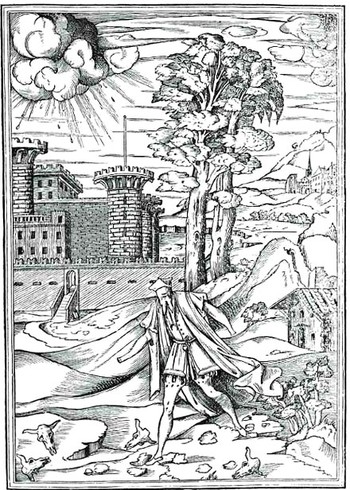
Philibert de l’Orme’s book, Le Premier Tome de l’Architecture,
printed in Paris in 1568, contains a singular illustration. L’Orme (who lived ca. 1515-1570), was perhaps one of the first modern
architects, not only because of his superior engineering skills, but also because
he was a superb organizer—a superior architectural tactician.
He worked for Henry II and Charles IX, supervising the construction
of Fontainebleau, Saint-Germain-en-Laye—where he built the
Château Neuf, and the other royal buildings. As well as the Tuileries,
in collaboration with Jean Bullant.
The text explaining the illustration reads something like “to
guard against persons who can do nothing right, cannot see what is to be done
well, cannot hear what should be understood…” Perhaps l’Orme was talking about people in general; or, perhaps, as I
suspect, he was referring to someone in his own profession, a builder, an
engineer, an architect? In any event,
this singular image is one of the few that I can recall in which a person is
allegorically represented without hands,
eyes, ears or, perhaps a nose.
There’s quite a bit of imagery showing unusually-featured faces–and I’m talking about emblemata rather than monsters or mythological/hypothetical beings meant to go creaking into the night. I’m also excluding medical images 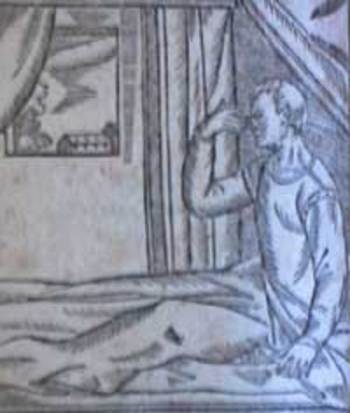
(like this for an early form of rhinoplasty) and people who have suffered injury or are differentially abled (as in this image of the great Tyhco Brahe and his silver nose). I’m 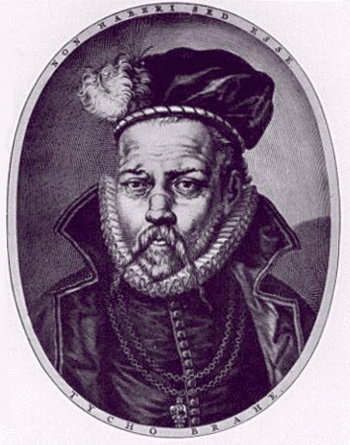
hard put to think of other examples of representational humans with such features existing in the technical or scientific world, though–I think that l’Orme’s designer/engineer here is a very scarce creation.