JF Ptak Science Books Post 278
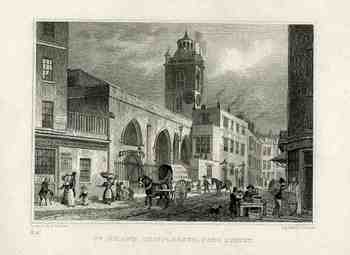 St. Gile’s Cripplegate, Fore Street, London, is ostensibly the major subject of this engraving (printed in 1842 (?)), though there is a great amount of interest and art to be found in the incidental human characters sprinkled through this small (4 x 7 inch) print. St. Giles Church (the center feature with the tower) was built in 1550 very near by old Roman ruins and basically upon the site of a Norman church. St. Giles is an interesting guy–born, probably, in Greece, he wound up in a cave and a Saint in France, the patron of beggars breastfeeding hermits, horses, the physically disabled and blacksmiths.The Cripplegate part has to do with, I think, the location of the church made for the ease of the physically disabled to attend.
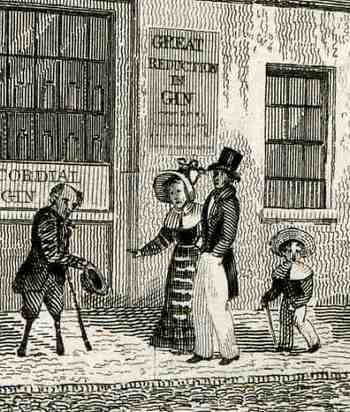
And so it comes to pass that a double leg amputee is seen begging at lower left, hat in hand, who may or may not be getting a little relief from the approaching gentleman and lady. They stand in front of a sign promising “Great Reduction in Gin”, which I take for sales advertisement.
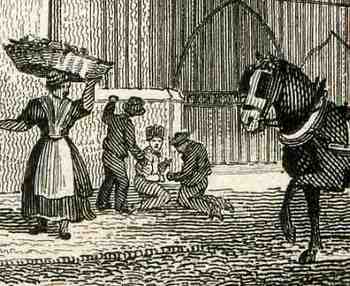
Just behind this family we see a street vendor and behind her three boys who are, I hope, at play.
In the bottom right corner is a fairly elaborate stand attended by a woman with three baskets of good which must be food, judging from the interest of the little black dog.
All in all there’s quite a bit of unnecessary, superfluous, lovely and detailed action in the print, a geography of small human actions: people at work, play, in idleness, with potted plants and billowing chimneys, and just a look of a city street being lived-in. This is the category of blog entry where I’ve wondered why the artist bothered himself with these tertiary characters of uncommon and unusual stature (see HERE for example). The artist could’ve just left the street fairly bare and essential, with couples strolling and doing, well, nothing of observable interest. Instead, time after time, the artist have included these little jewels of observation of common life, and we are lucky to have had them do so, coming perhaps as close to a pre-photography “snapshot” as can be.
(**I’d just like to point out that the poet John Milton was laid to rest in St Giles in 1674, though (some contend) his sleep was deeply, horribly disturbed about a hundred years later when his grave was robbed–the great poet lost a rib, had some teeth punch out, and was missing some of his hair.Undoubtedly the work of a critic. T.S. Eliot, no lover of Milton, was said to have cleaned his boots on a mat of Milton’s teeth. Just kidding (about Eliot).)