A Daily History of Holes, Dots, Lines, Science, History, Math, Physics, Art, the Unintentional Absurd, Architecture, Maps, Data Visualization, Blank and Missing Things, and so on. |1.6 million words, 7500 images, 4.9 million hits| Press & appearances in The Times, Le Figaro, Mensa, The Economist, The Guardian, Discovery News, Slate, Le Monde, Sci American Blogs, Le Pont, and many other places… 5000+ total posts since 2008.

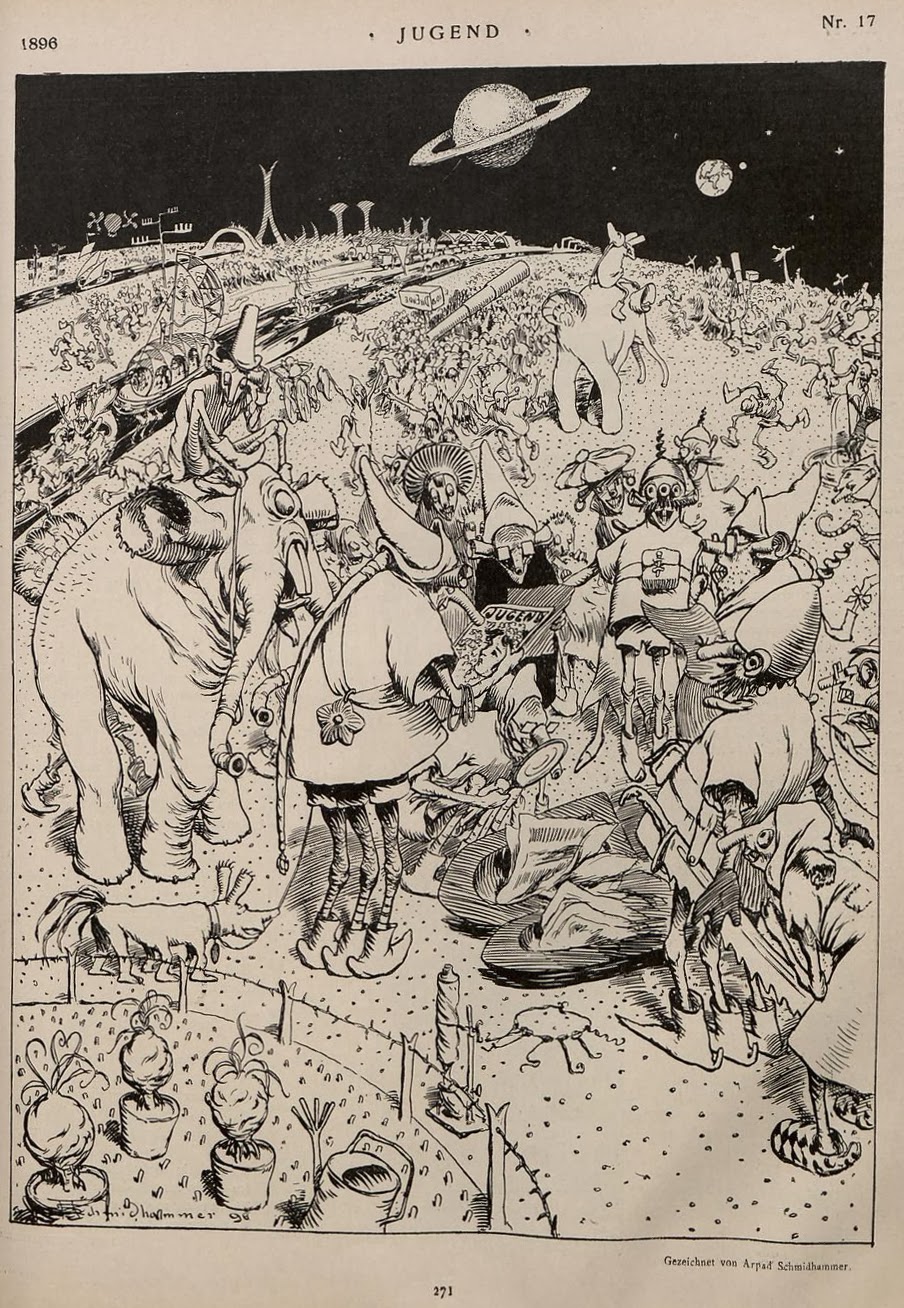
  • An Extraterrestrial Society Views the Earth, 1896

    JF Ptak Science Books   Quick Post

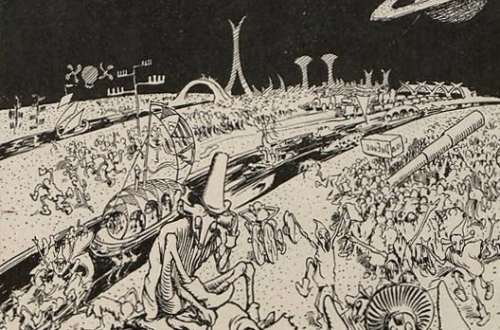
    The Munich-based Jugend magazine (1896-1940), founded by Georg Hirth, was host to an entire generation of art nouveau artists, lending its name (“Jugendstihl”) to a movement of expression of German Art Nouveau.  In the April 25, 1896 issue we find an unusual image of extraterrestrial life within our own solar system, drawn by the artist and illustrator Arpad Schmidhammer. It depicts life on a  planet beyond Saturn–complex life, complete with what we’d imagine automobiles of the future from 1935 to look like, as well as cities, and large crowds very engaged in receiving an object from a world alien to their’s.  The commotion seems to be a space-shell of some sort, and of course it carries issues of Jugend magazine.  There is all manner of action around the magazine in the foreground, and slightly beyond that we see another large group of people crowding around a telescope, hoping for a view of the Earth, while another dense crowd farther in the background swells around another Earth-intent telescope.  It is intended as a humorous scene, no doubt, but the fact is that there weren’t all that many scenes of alien life forms taking an interest in a floating Earth in the background.  Perhaps Wilhelm Roentgen’s newly-discovered X-rays helped an image like this along with the idea of entirely unseen worlds made visible…

    Alien art Jugend 1896

    [This image found thanks to an image-share by the Ephemera Society USA. Image Source: University of Missouri libraries, http://muspeccoll.tumblr.com/post/144371190257/jugend-1896-no-17-katya-s-jugend-mu-nchen utm_content=buffera68da&utm_medium=social&utm_source=twitter.com&utm_campaign=buffer]

    And just for the record, “extraterrestrial” finds life in English as far back as 1868: 

    1868   W. Lockyer & J. N. Lockyer tr. A. Guillemin Heavens (ed. 3) 188   Bodies situated in the extra-terrestrial regions.
    1882   Nature 21 Dec. 173/2   The oblique direction of the meteor..is another evidence of its extra-terrestrial origin.
    [Oxford English Dictionary]
     
    The detail from the busy upper-left corner:

    Alien art Jugend 1896 detail

  • A Great National Moment Hidden in a Single-Sentence Description (1814)

    JF Ptak Science Books    Post 2624

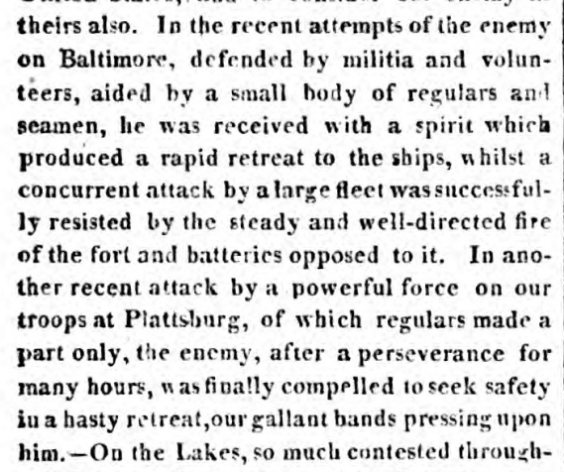
    I was working my way through a stack of volumes of  William Cobbett’s Political Register containing reporting for the war years for the War of 1812–this magazine/newspaper was  a weekly journal of news and interpretation by an American-sympathizing radical journalist reformer Brit.  Looking for one event in particular, I came across it in an official report of September 19, 1814, dated from Washington City, in the November 14, 1814 issue of the  Register, Nestled in the “official reports” section is this summation of the action of September 13, 1814, in the city of Baltimore, which was under siege by a large British fleet, which was “successfully resisted by the steady and well-directed fire of the fort and batteries opposed to it”.

    Here’s the snippet:

    Cobbett Ft McHenry

    • Source: William Cobbett, Cobbett’s Political Register, London, printed for the author and sold by Richard Bagshaw in Covent Garden, volume 26, November 5, 1814.  

    Much of the critical bombardment of the fort occurred at night, and for one observer–an official U.S. representative then being held in custody by the British on board a ship in the harbor–the outcome of the battle would not be known until the first light of day.  What he saw that morning by dawn’s early light was what he had seen in the evening, hailed at the twilight’s last gleaming,–a U.S. flag (a “star-spangled banner”) flown above the fort, meaning that the fort had survived, the defense maintained, with a victory in hand. 

    The fort was Fort McHenry, and the U.S. representative here of course was Francis Scott Key, who turned his experience into a national witnessing, presenting it in a poem later to to music that would become the national anthem.  

    There was no mistaking the victory described here at Baltimore (and also the mention of the major victory at Plattsburg), though there was not much flavor to the reporting. But here it is, a great national moment, appearing as a single sentence with four commas. Given the scanty capabilities of overseas reporting perhaps these were the scant public facts that were presented to the British people buying Cobbett’s two-penny weekly (much scorned by the wealthy/well-do-do and much read by the actual working class), so the emotive significance of the event was lost to detail and translation. The impact of the victory was certainly felt very quickly in the U.S. 

    This is one reason why it is so interesting to read the original reports and publications of historical social and scientific events.


  • A Steampunk Clown Robot, Generational Robots, and a Vision of the Future, 1866

    JF Ptak Science Books  (Expanding an earlier post, not having previously noticed the robot baby)

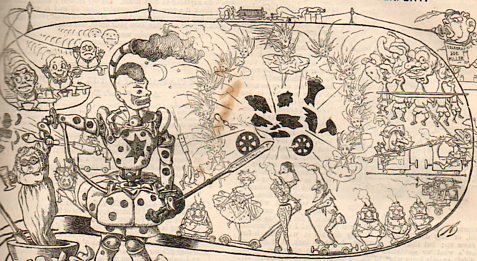
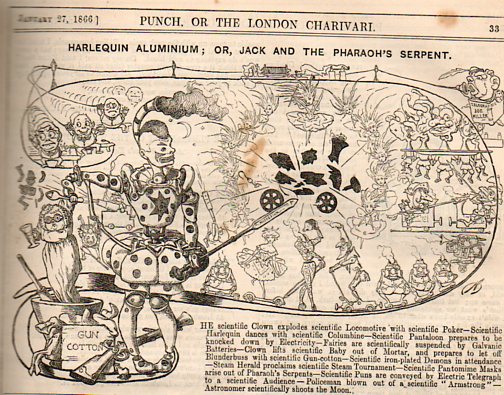
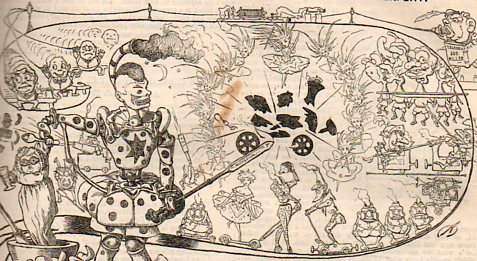
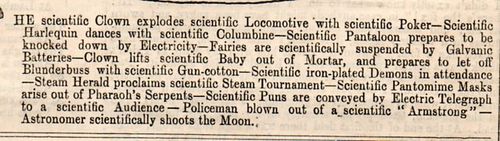
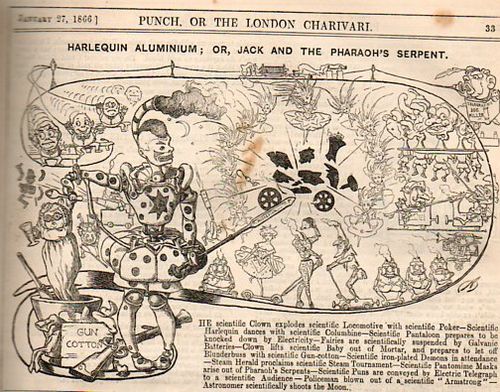
    Punch, or the London Charivari published this delightful and somewhat prescient illustration  (“Harlequin Aluminum; or, Jack and the Pharaoh’s Serpent”) in its 27 January 1866 issue.  It is for me an excellent, sort-of early depiction of a steam-man, a steampunk man, a steam-driven clown robot person, that is very deeply and frequently hinged, with smoke belching from a curved smokestack coming from the back of its head, and controlling its own destiny enough so that it is actually attacking and blowing up a steam locomotive.

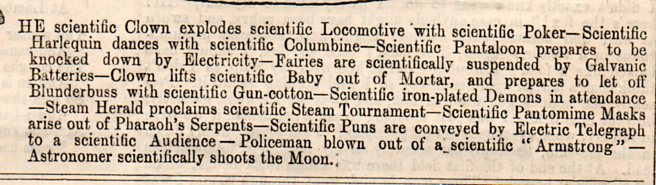
    And that’s what this image is all about–in the age of steam, the future looks more so; that, and given its extraordinarily frequent use (16 times) in the very short text, things in the future are going to get very “scientific1“.  
    Sci clown694
    And what the (aluminum2) robot seems to be doing with its scientific poker is exploding a scientific locomotive, for reasons unknown, except that the application of the poker was very successful, if that is the proper word to describe this action–it does act to control its steam technology is busting the new technologies of the era, a rub and at the same time a statement of hope or expectation in a high-Victorian manner, a rationalism of all things via technological means.  And at this time, in the mid-1860’s, the new wellspring of hope was being found in electricity-based solutions–moving away from the pervasive steam-driven technologies–though as the cartoon suggests those expectations might be too soon, too fast and too deeply placed.  After all, these things are being exploded by a “scientific clown” with a “scientific poker”–and that clown is being driven by steam. 

    Further, the steamrobot clown is pulling a scientific baby from a mortar–this is something that is unique to my experience, a robot generating a newer, younger, baby-robot in some undescribed manner. This is a generational moment among robots and something that is certainly not common in the history of early robots.  
    Sci clown695

    In the background-right we see a string of “scientific fairies” suspended by electricity, and beyond them, center-rear, is a comedian reading from Joe Miller’s joke book (of “scientific puns”)  into a telephone-like device, with an audience to his mirth sitting and listening on the other end of the line–and this still 11 years away from the invention of the telephone. And so on.  It is a marvelous piece of work, especially considering what was probably an ephemeral status.  
    Sci clown692

    (Also, the “Pharaoh’s Serpent” part of the title of the illustration refers to a three-year-old phrase: “1863   W. Allingham Jrnl. 3 Oct. in H. Tennyson Mem. Tennyson (1897) I. 513   Mrs Cameron showed a small firework toy called ‘Pharaoh’s Serpents’, a kind of pastille which when lighted twists about in a wormlike shape”–from the OED.)

    Notes:
     
    1. It is well-known that William Whewell created the word “scientist” relatively recently, in 1834 (see below). “Scientific” goes back quite a bit further, deep into the 18th c in some uses; farther back in others. 
    “Scientist” in the OED: 1834   W. Whewell in Q. Rev. 51 59   Science..loses all traces of unity. A curious illustration of this result may be observed in the want of any name by which we can designate the students of the knowledge of the material world collectively. We are informed that this difficulty was felt very oppressively by the members of the British Association for the Advancement of Science, at their meetings..in the last three summers… Philosophers was felt to be too wide and too lofty a term,..; savans was rather assuming,..; some ingenious gentleman proposed that, by analogy with artist, they might form scientist, and added that there could be no scruple in making free with this termination when we have such words as sciolist, economist, and atheist—but this was not generally palatable.
    1840   W. Whewell Philos. Inductive Sci. I. Introd. p. cxiii,   We need very much a name to describe a cultivator of science in general. I should incline to call him a Scientist. Thus we might say, that as an Artist is a Musician, Painter, or Poet, a Scientist is a Mathematician, Physicist, or Naturalist.”
     
    2. “Aluminim” is a word created by Humphrey Davy in 1812. 
  • Ukrainian War Casualties Released and Sent to the Gulags or Death in the USSR (1945-6)

    JF Ptak Science Books   Post 2627

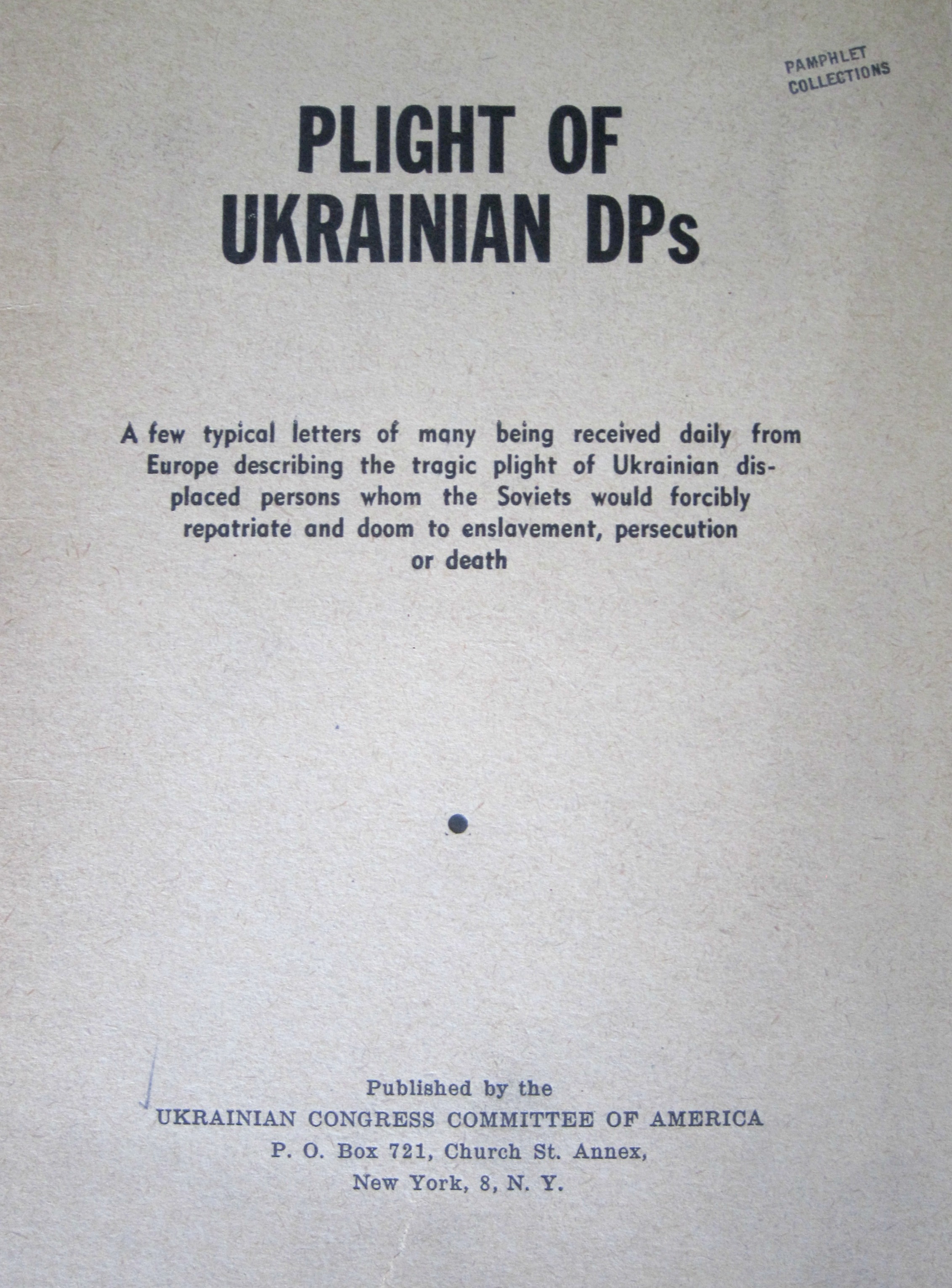
    This pamphlet–published not after March 26, 1946, with the latest letter in the text being September 25, 1945–describes the “plight” of Ukrainian “DPs” at the end of WWII. “Plight” is a very weak word for their situation, as is the term designated them, “DP” or “displaced person”. These people–several million of them–had been slave laborers, taken by the Nazis in the advance through Central Europe, and sent to work in German factories and fields. Many were theoretically and semi-practically paid a wage, though in general much of that went to providing themselves food and clothing and such that enabled them to work. These people were known as Ostarbeiter (Eastern Laborer), and at the end of the war, many were repatriated to their country of origin. Of the 3-5 million Ostarbeiter, about 2.5 remained alive at war’s end, with the vast majority–over 2 million–being from the Ukraine. This pamphlet details some of the terrible accounts of Ukrainians being repatriated to the Soviet Union and being treated as plagued outsiders, criminals, and worse, some simply executed, while hundreds of thousands of others were sent on for “re-education”, with many winding up in the Gulags. It was a terrible position to be in–the slave returned home after the war to be treated as a criminal, and slave again. The conditions for repatriation to the Soviet Union were so bad that by October 1945 General Eisenhower forbade this action in the U.S. Occupied Zones. 

    I’ve reprinted the full text below. (Plight of Ukrainian DPs : a few typical letters of many being received daily from Europe describing the tragic plight of Ukrainian displaced persons whom the Soviets would forcibly repatriate and doom to enslavement, persecution or death, ca. 1945/6, or 1945 according to WorldCat/OCLC.)

    IMG_7602

    NOTE: good, clear images are available when you click on the page images; double-click for giant images. 

    ·Posted by :

    ·in:

  • Targeting Communism in Cover Art, 1930’s

    JF Ptak Science Books  Quick Post

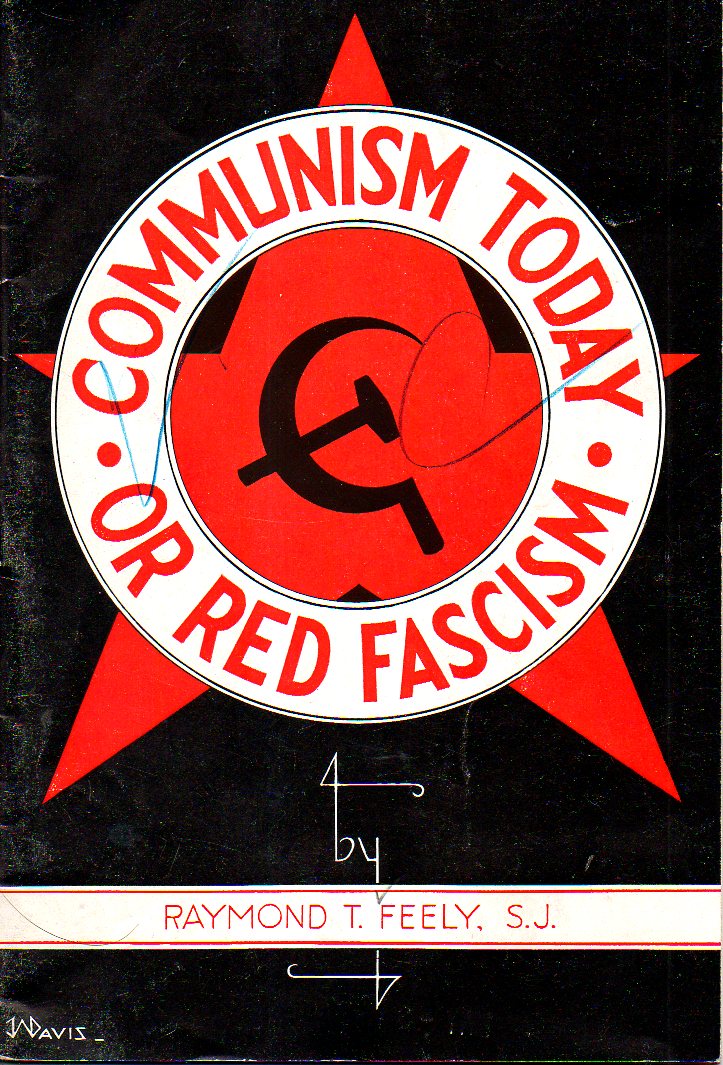
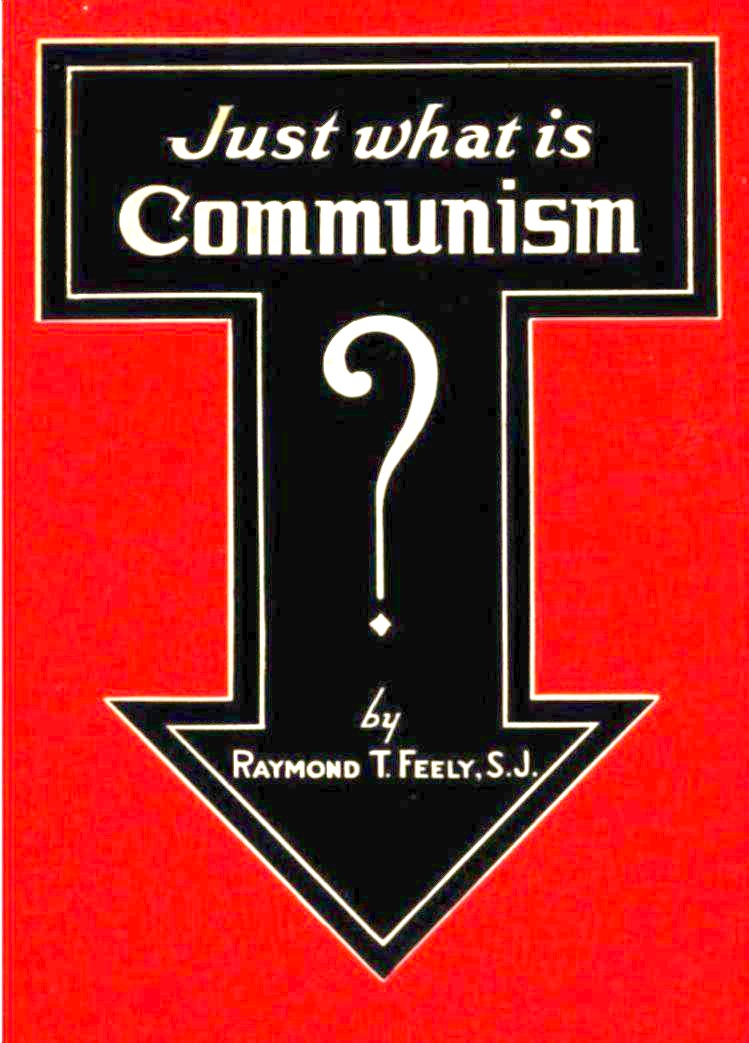
    This is just a quick picture-post sharing the cover art for anti-Communist works by the Jesuit priest, Raymond Feely.  Fr. Feely was not a fan of the Communists, who he felt amidst all other things raised the importance of the state to a religion and beatification of the State, and that of course just would not do. He wrote these in the mid-1930’s before the bestial stuff of Joseph Stalin had come out popularly in the West, and also before the Great Terror enveloped the U.S.S.R. There was still some interest in Stalin’s brand of Communism in the U.S., though that was the left-over mythological and chromed-over trumpian gilted Communism that people thought existed earlier, but actually didn’t.

    Anyway, Feely had no use for that, and wrote about it–you can pretty much tell by the cover art what he thought of Communism.  

    Communism Today or Red535


    JustWhatIsCommunism1935_0000

  • Mustachioed Number People in the History of Blank and Missing Things

    JF Ptak Science Books

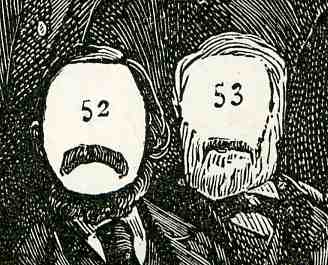
    0 blog dec 29missing men326

    I have been surprised by the strength and endurance of this series on blank and missing people–astonished, really, that there would be so much that would present itself in such incidental ways.  I do not go out of my way to find these things, they just come to me in the course of daily living; perhaps if I looked for them I would see them less frequently.

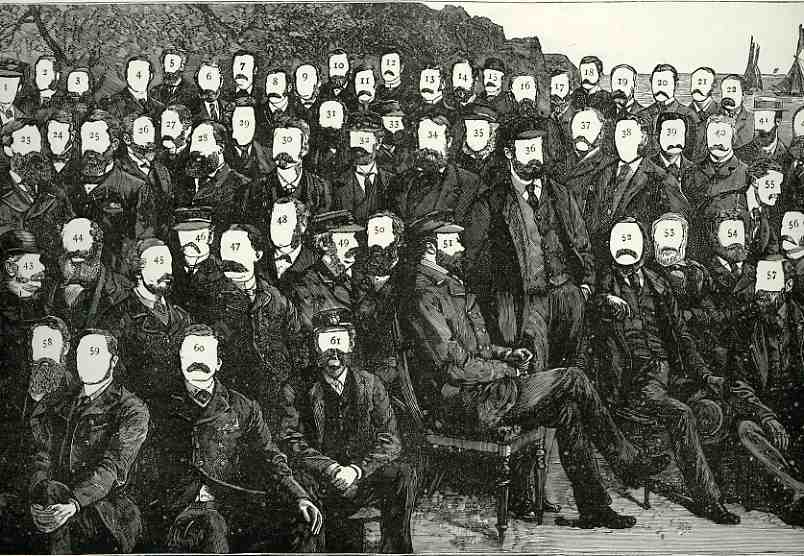
    Mr. 52 and Mr. 53 are part of a group picture of Esteemed British Yachtsmen in the 24 August 1884 issue of The Graphic magazine–it is actually a smartly-conceived thumbnail image index of a double-page photo, an easily-readable key to a complex photo.  The effect of taking it out of context, though, is remarkable, turning the index into a wood engraving of number-only-blank-faced people with facial hair attributes. 

    0 blog dec 29missing men325

  • “Why Must the Agony of the Jewish People be Prolonged?” (1944) Another Episode in the Abandonment of the Jews in WWII

    JF Ptak Science Books  Post 2627

    Goldstein _1_543 detail

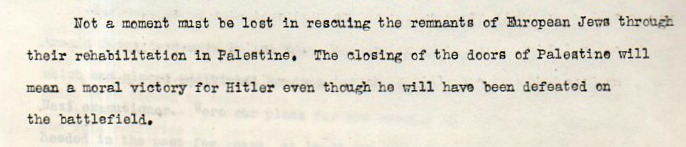
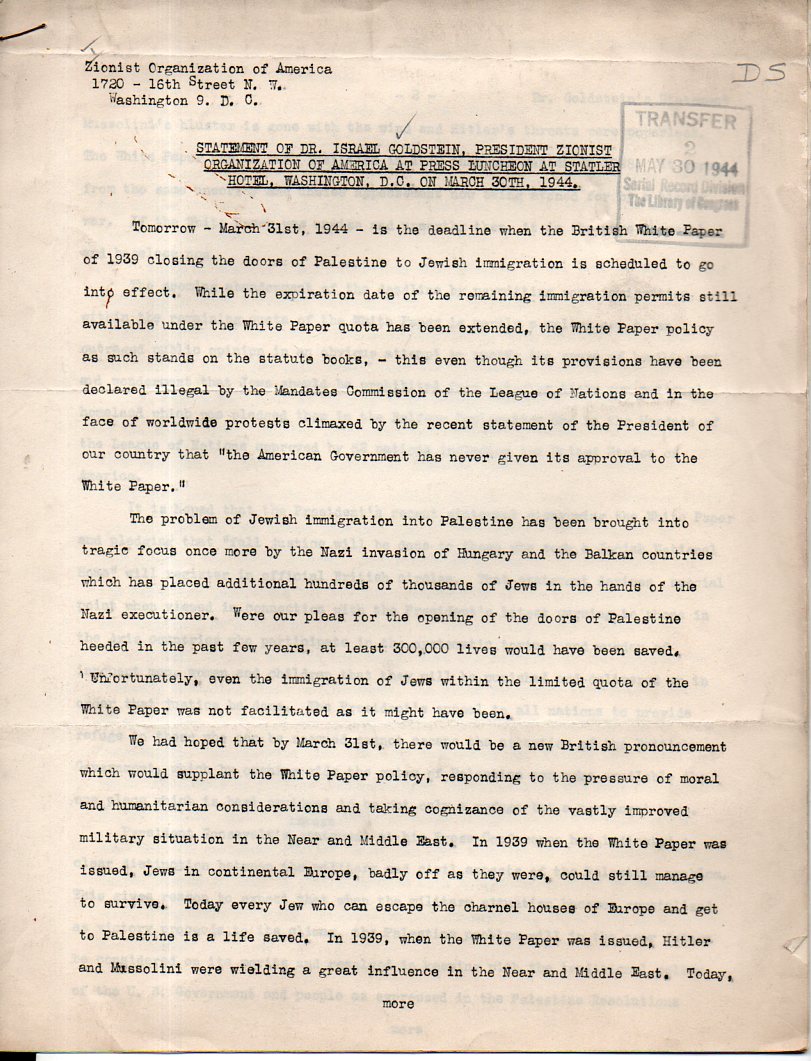
    This quote is from (Rabi) Israel Goldstein as head of the Zionist Organization of America appeal and addresses the British White Paper of 1939 on Palestine and allowing Jews to immigrate to escape “the hands of the Nazi executioner” in Europe, which amongst many other things  limited Jewish immigration to 75,000 for 5 years (1939-1944) with limits of further immigration to be determined by the Arab majority. “Were our pleas for the opening of the doors of Palestine headed in the past few years, at least 300,000 lives would have been saved. Unfortunately, even the immigration of Jews within the limited quota of the White Paper was not facilitated as it might have been” wrote Goldstein in this address.  

    There is a long and complicated history to the White Paper but suffice to say that while millions of Jews were being slaughtered in Europe the restrictive White Paper remained in place, which meant that the haven for escape to Palestine was largely closed relative to the numbers of people needing to be saved, and that at the end of the war there were still 3000+ visas that hadn’t yet been granted. Goldstein makes the case for the extreme peripheral usefulness of the Paper in 1939, but in 1944 when the Axis influence in the Middle East was  extremely minor adhering to the white Paper was a tragedy: “if the White Paper was unwise and unworthy then, it is more shameful and baseless now” he wrote.1 (“The Provisional Council of Israel’s first constitutional act [in 1948] was a Proclamation that “All legislation resulting from the British Government’s White Paper of May, 1939, will at midnight tonight become null and void.”–Wiki on the White Paper of 1939.) 

    Goldstein hoped for a change in the policy–there would be none.

    • Israel Goldstein (June 18, 1896 – 1986) was an influential Jewish leader in the U.S. and worldwide as a Rabi (and head of the New York Board of Rabis), head of the Jewish National Fund (elected in 1933), head of the Zionist Organization of America (elected 1943), and one of the founders of Brandeis University.  The full text of the publication–which was printed sometime between March 30, 1944 and May 30, 1944–is included below.  I can find no mention of the communication online.  

    Notes

    1. Goldstein wrote in his memoirs that the rules and restrictions of the White Paper on Jewish immigration were being “rigidly and brutally enforced”. —My World as a Jew: The Memoirs of Israel Goldstein, Volume 2, pg 47.

    [“Like another black curtain about to be rolled down upon the last hope of escape, the White Paper of 1939 ominously threatens to close all further migration to Palestine,”–Judge Morris Rothenburg, Jewish Telegraphic Agency, http://www.jta.org/1943/09/13/archive/dr-israel-goldstein-elected-president-of-zionist-organization-of-america]

    Goldstein _1_540

  • Computers, Nuclear War, and Afterwards (Full text document, 1964)

    JF Ptak Science Books   Post 2628

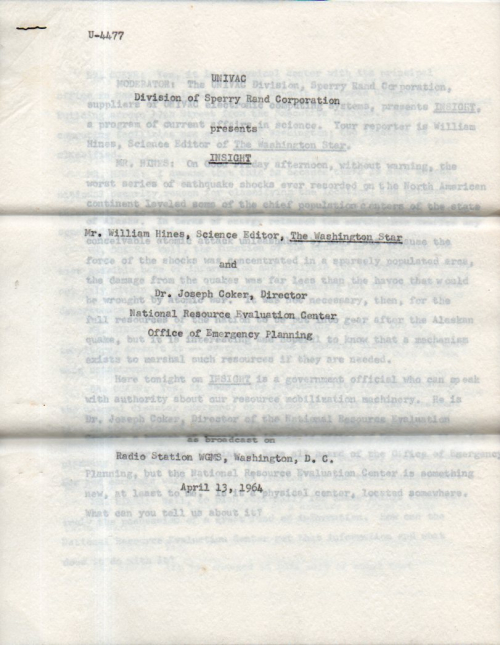
    This title may sound overly dramatic, but it really isn’t. As part of the Mutually Assured Destruction game plan there was an absolute necessity for calculating the leftovers from a nuclear exchange in order to convince the aggressor nation (which of course in 1964 would be the Soviet Union) that in spite of massive destruction the U.S. would be situated to carry out acting as a government/society/military in the post-war world. Part of figuring all of that out would entail a massive amount of bean counting for personnel, materiel, natural resources, and so on in a nearly endless list of stuff that runs the U.S., and then figuring out where it all was, and how it would/could be affected by a nuclear strike at XX locations, and that with different yields, and weather patterns, and so on, on into the night, of how a nuclear attack of x-capacity would affect the tactical and strategic and social base of the U.S.  So you’d have to gather all of that data, and then lay it all on in XX scenarios that would all be played out in computer simulations.  

    And that is what this interview is all about–explained on the radio to a general listening audience by Joseph Coker, who was at the time chief of the NREC (the National Resource Evaluation Center). All of this made its own crazy sense, and all of it had to be done, running both towards and away from the black hole that did and didn’t exist.  

    UNIVAC Coker544


  • Inside and Outside the B-19 (1940-1)

    JF Ptak Science Books   Quick Post

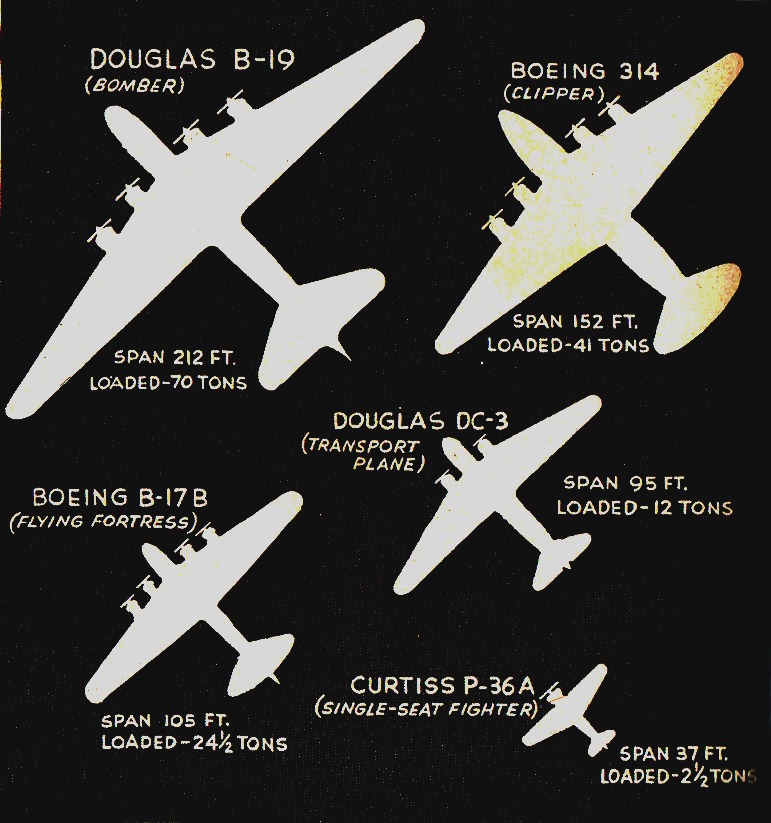
    The massive B-19 bomber built by the Douglas XB-19 (originally designated XBLR-2, the eXperimental Bomber Long-Range 2) was a prototype for a U.S. Army Air Corps transcontinental bomber–a striking and revolutionary plan when it was begun in 1938. So far as I can tell this is an early public discussion of the aircraft–it must have been an intimidating piece of propaganda so far as Axis forces were concerned.  It was about the size of a 747 and carried an extended crew of 24 for the long mission, which could see the plane to Europe and back over a 24-hour-long flight as it lumbered out and back at about 180 mph (which would explain the crew rotation and size). At the heart of the aircraft was its 18-ton payload–dwarfing the then-huge payload of the B-17B’s 3 tons (and later 17G’s 4.5 ton), which was deliverable in a flight range of over 7,000 miles, which was more than three times that of the B-17.The aircraft first flew experimentally in 1941, but even then it was seen as being of an obsolete design, and wound up being discontinued by 1949. The development of the plane served its purpose in aiding design for other aircraft, and it never saw service during the war.  

    The article that sparked this post is below, found in Popular Science Monthly for December, 1940.  

    B-19548

     Here’s a remarkable video found on youtube on the B-19–notice the size of the tires and the enormous cockpit (and so on):

    ·Posted by :

    ·in:

  • Heavy Metal, 1918

    JF Ptak Science Books   Quick Post

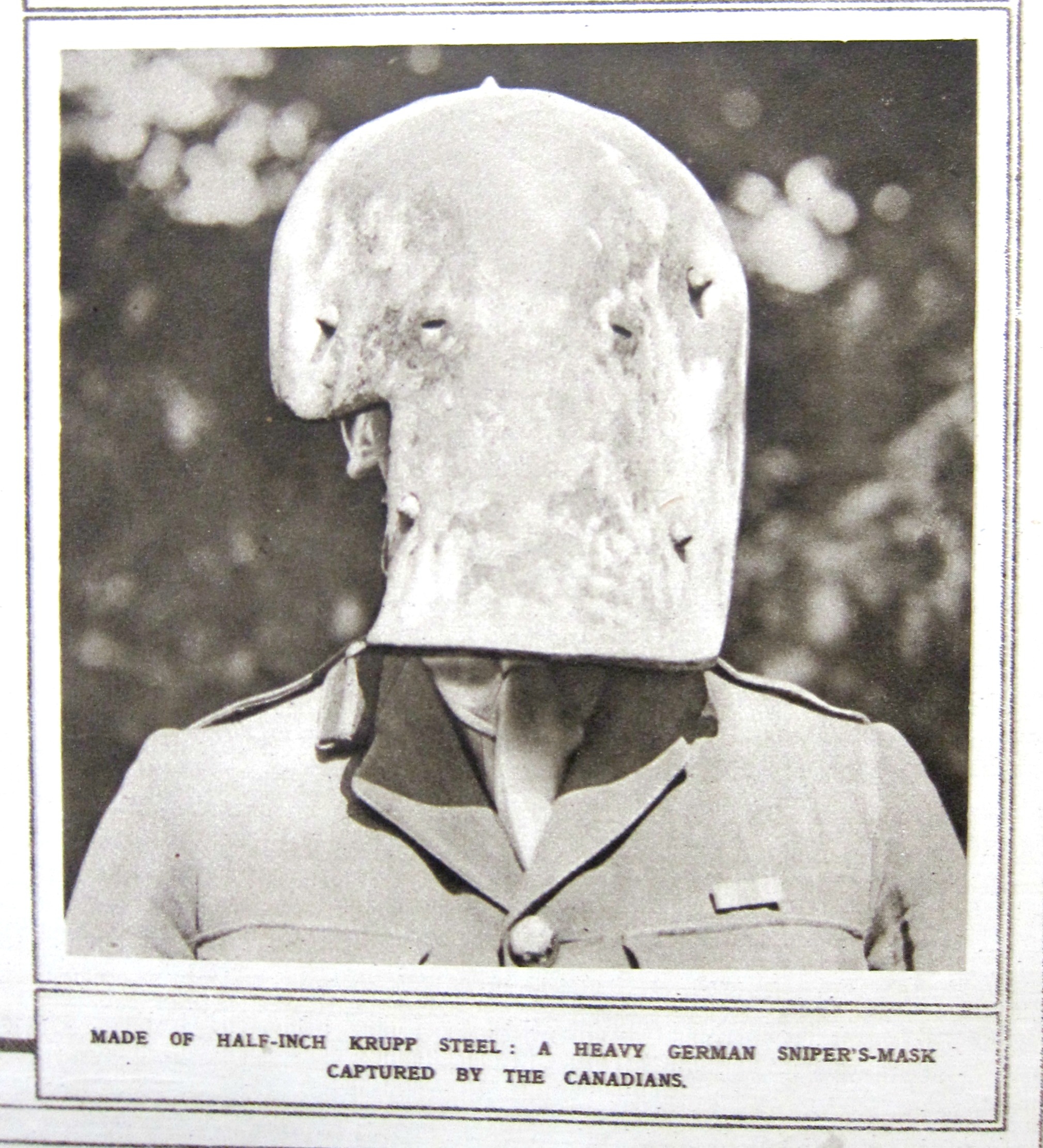
    The title for this post is a little shiny and slippery for its subject, which was anything but that–this was cold, hard, heavy metal, with the dual purpose of killing and preventing a killing. This was a sniper’s face mask and helmet, and as the caption says it was captured at the front by a Canadian contingent. Snipers operating from the trenches were in a precarious position–needing a field of view the sniper would necessarily risk some amount of exposure to a sniper on the opposite side. Hence the heavy mask to protect the face and head from incoming fire. There were more elegant versions on this idea, some of which were borne out to full body renaissance-y armor. This mask was no doubt home made, and probably made right there in the trenches.  

    WWI pROJECT sniper mask

    ·Posted by :

    ·in:

  • The Only Radium Cure that You Can See in the Dark–1900

    JF Ptak Science Books  Quick Post 

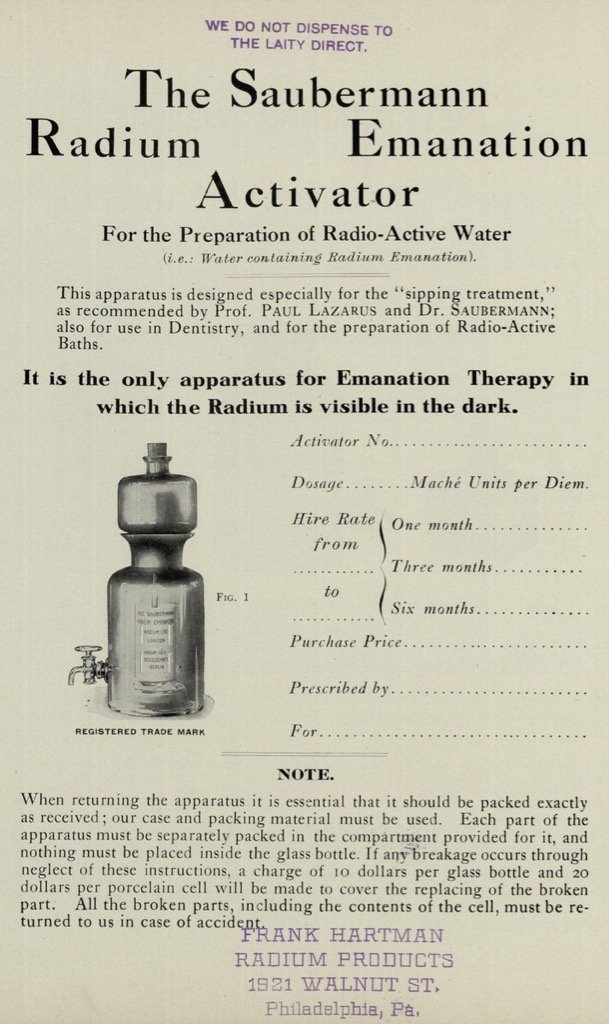
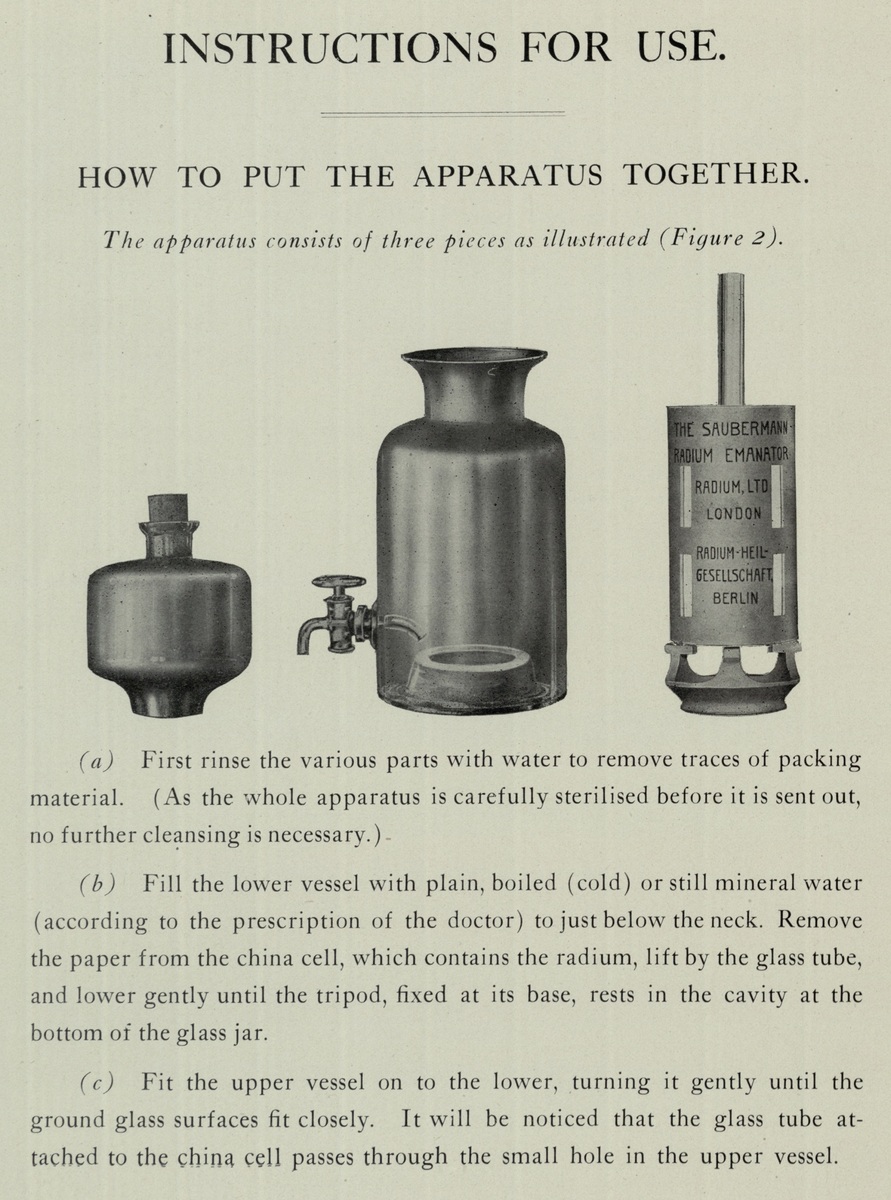
    I found this very arresting image on the wonderful Whewell’s Ghost history of science/medicine/tech roundup (https://whewellsghost.wordpress.com), edited by Thony Christie (of the excellent The Renaissance Mathematicus blog, https://thonyc.wordpress.com/ and twitter account @rmathematicus).  This cure-all was being sold by Radium Limited U.S.A. (25 West 45th St, NYC1) around  1900, which means that like many quake devices it hit the shelves for public consumption not long after a scientific discovery it sought to exploit–in this case the discovery of radium by Marie and Pierre Curie in 1898. The toxicity factors of radium at this stage was not yet known, though the new-remarkableness of radium led some to establish a for-profit belief that the stuff in all of its glorious newness should be taken internally for the treatment of whatever quack-inspired ideas came to mind. One shriveling aspect in the text is that when used in therapy the radium-infused radioluminescent elixir was the only one of its kind to be visible in the dark. Modern knowledge aside, it is probably a good thing to abide the anonymous non-soliphisms of (1) never drinking anything that you can’t lift with one hand, and (2) never drink anything that glows. 

    Radium Emanation

    The full pamphlet is reproduced by the College of Physicians of Philadelphia http://www.cppdigitallibrary.org/exhibits/show/radium/item/4351

    Notes:

    1.  The pamphlet has a hand-changed address of 22 W. 45th St, the original building now evidently gone, replaced by the Berkeley Building in 1917. Post-appropriately right across the street is the Cock and Bull Pub.) 

    Radium _2_[Source: College of Physicians of Philadelphia http://www.cppdigitallibrary.org/exhibits/show/radium/item/4351]

    ·Posted by :

    ·in:

    —

Recent Posts

Archives

Categories