A Daily History of Holes, Dots, Lines, Science, History, Math, Physics, Art, the Unintentional Absurd, Architecture, Maps, Data Visualization, Blank and Missing Things, and so on. |1.6 million words, 7500 images, 4.9 million hits| Press & appearances in The Times, Le Figaro, Mensa, The Economist, The Guardian, Discovery News, Slate, Le Monde, Sci American Blogs, Le Pont, and many other places… 5000+ total posts since 2008.

  • History of Children, 2/7–the First Illustrated Rendering of the World for Kids: Anatomy

    JF Ptak Science Books  Post 1286    Continuing the post 1285

    “Taking the Scarecrows out of Wisdoms Gardens”

    This is Part 2/7 of John Comenius’ great work, the first illustrated instructional to children, first written in 1676 and then translated into English in 1726–it is from this translation that all of the images (below) are taken.  This is the second of seven installments on introducing 17th and 18th century children to wide ideas, the other sections including: Part 1, Occupations; Part 2, Anatomy; Part 3, Books and Book Arts; Part 4, the Sciences; Part 5, Morals and Philosophy; Part 6, Games and the Arts; and Part 7, the Military.  

    The work itself: John Amos Comenius’ Orbis Senfualium Piélus: Omnium Principalium in Mundo Rerun/ &f m Vita АШопит,  translated as Pictura et Nomenclatur, the Visible World, or A Nomenclature, and Pictures of all Chief Things that are int he World, translated into English by Charles Hoof…1726.

    The purpose of the book, writes the translator in the introduction of the 1726 12th edition, is:  

    To entice witty children to it, that they may not conceit a torment to be in the school, but dainty/are., For it is apparent, that children (even from their infancy almost) are delighted with Pictures, and willingly please their eyes with these fights: And it will be very well worth the pains to have once brought it to pafs, that fcare-crows may be taken away out of Wifdom’s Gardens…”

    Even at this early stage of publishing books for children it was easily recognized that children learn better when eased into their subject with pictures.  This is not so far off the mark with the moderns, and in its own way a precursor to the Dick and Jane and Dr. Seuss books–not so much for subject matter, but for the very act of putting a book into the hands of a child and getting them comfortable wit the idea of reading.  It seems to me that this is by far the most important lesson-the actual content at tis point is secondary to the act of holding a book.  

    [graphic]

    Septan Mtaies Hominis. A Man is ßrjt un Infant, 1. j Homo di primum Infasts, 1.

    tien

    [ocr errors]

    [merged small][merged small][ocr errors][ocr errors][merged small][graphic][merged small][merged small][ocr errors][ocr errors][ocr errors]
    [graphic]
    [ocr errors]
    [ocr errors]

    [merged small][graphic][ocr errors][ocr errors]

    a Tongue and Palate,
    and Teeth, 16.
    in the Cheek-hone.

    A Man s Chin
    is covered ivith a Beard, 14.
    mnd the Eye
    {in •which is the White
    and the Apple)
    •with Eye-lids,
    and an Eye-hrow, 15.

    The Hand heing clofed, is a Fift, 17. heing of en ira palm, i8, in the midß is the hollow, 19. of the Hand i the extremity is the Thumh, 10.iviehfour Fingers, the Fore-finger, 2s. the Middle-finger, гs. the Ring-finger, 23 and the Little-finger, 24. .

    In every one are three ]o\ms, a. h. C. and asman knuckles, d. e. f. ivith a nail, 25.

    [ocr errors][ocr errors][ocr errors]

    [merged small][graphic]

    In the Body are the Skin .nvith the Membranes, the Fleih ivith the Mafcles, the Chanel;, .,

    the Griffles,
    tie Bones andthe Boweli.

    The Skin, i: heing puttV ef, the Fleih, 2. appeareth, vol in a continued lump, Lut heing diftnhuled, es it ‘were in ßufi puddings, fuihuh they callMukks, ivhireof1here aie reckoned four hundred and five, heing the Chañeis cf the Spirits to move the Members.

    The Bowels are the inward Members:

    As in the Head,th.rBrains, 3. heing compajfed «bw with a Skull, and

    In Corpore funt Cutis cum Mimhranis, Caro cum Mufcults, ..’

    Canales,
    Cartilagines,
    Oßi & Vecera.

    Cute, 1. detraíla,
    Ca”o, 2. appaiet,
    non continua raafsâ,
    fed dil.tributa,
    tanquam in farcimina,
    quos vocant Mu/tules,
    quorum numerantur
    quadringenti quinque,
    canales Spirituum,
    ad movendum Memhra,

    Vijcera funt Memhra interna:

    Ut in Capite, Cerehrum, 3. cire umda tum Crem», Sc
    [ocr errors][ocr errors][ocr errors][graphic][merged small]

    The Arteries currying Blood from the Heart;

    4’he Veins returning the Mood to the Heart}

    The Nerves carrying Setife and Motion throughout the Body from the Brain.

    You jkallßnd thefe three, 1. t’very inhere joined together.

    Beßdes, from the Mouth into the Stomach it the Gullet, 2,

    the way of the meat and drini, and-hy it to the Light!, the Wezand, 5. for hr.athing; f cm the Stomach to the Arfe it a great Gut, 3. to purge out the Ordure; from the Li-ver to the Bladder, the Ureter, 4. for making ‘wJter. .

    Tie Bones are in the Head, the Skull, 6. the ttuo Cheek-bones, 7. with thirty tTvo Teeth, 8. Then the Back-bone, 9. the Pillar of the Body, tonfifling of thirty four turning Joints, that the Body may hend itfelf

    The Ribs, re. ,uihereof there are twenty four.

    The Breaft-bone, 11. the five Shoulder-blades, ii. the Buttock-bone, 13.. the bigger Bone in the . Atta, 15. *W/¿/kfi’crBone inthi Arm.

    V-Л ù •;

    vi;

    [ocr errors][ocr errors][merged small]

    [merged small][merged small][merged small][merged small][graphic][merged small][merged small]

    Mußcal Типа.

    The Nofe, 3. fcenteth fmelh and ßinhs.

    The Tongue, 4. •with the reef of the Mouth taßet Favours, •what is fweet or hitter, keen or hiting, four or каф.

    The Hand, 5. hy touching difcerneth the quantity and q: ality of things; the hot and cold, the moifl and dry, She hard andfft, the fnooth and rough, the bsavy and light. The in•ward Sen fes are three. . The Common Senfe, 7. under the forepart of the head, afprehendeth i

    t/.ings taken from the oufward Senfes.

    The Phantafye, 6. under the crown of the head, judgeth ofthefe things, t hinket h and drcameth

    The Memory, 8. under the hinder part of the head, layeth up every thing end fctcbeth them out; it Ufethfome, and this is forgetfulnefs.

    Sleep, is the reft of the Senfes.

    [ocr errors][ocr errors]

    [merged small][graphic]

    The Soul is the Life tf the Body, oie in the ivhole. Only Vegetative in Plants;

    Withal Seníltive in Animals;

    And alfo Rational in Men.

    This confifteth in three things;

    In the Underftanding, wherehy it judget h, and underßandethy – a thing good and evil, or true, or apparent.

    In the Will, •whereby it choofeth, and deßreth, tr rejeéleth, er mißiketh a thing knovn.

    In the Mind, •whereby it purfueth

    Anima eft vita corpoiii, una in tota.

    Tantum Vegetativa In Plantis;

    Simul Senßtinsa in Ahímalibus J,

    Etiam Rational is in Hernie/i

    liaec coniiftet in trihu»;

    In Mente (Intelleflu) qua cognofcit, & intelligit, honum ac malum, vel verum, vel apparent»

    In Voluntate-, qua eligir, Sc concupifcit, aut rejicit, & averfatur cogniuim.

    In Animo, quo prpfequituv

    [merged small][merged small][merged small][graphic][merged small][table]


  • What Color “Is”–an Unintentional Modernist Masterpiece of Book Illustration?

    JF Ptak Science Books Post 1282   [With 20 extra images in Continued Reading section]

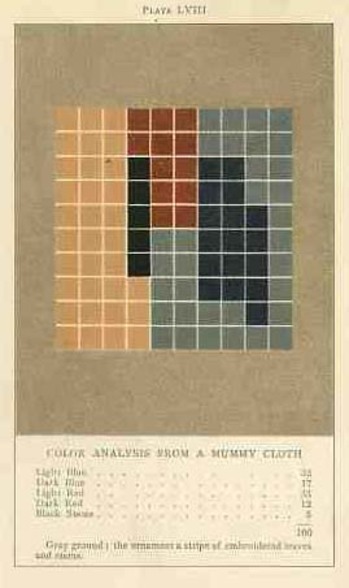
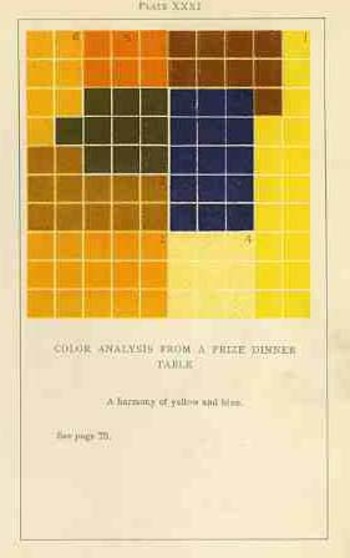
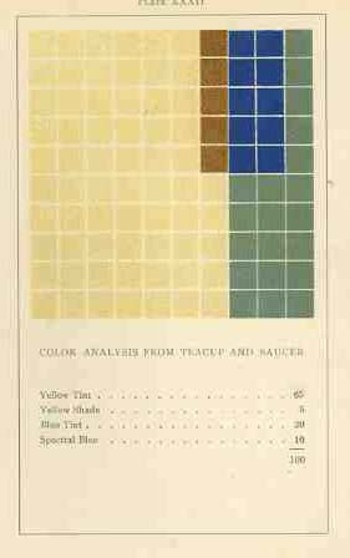
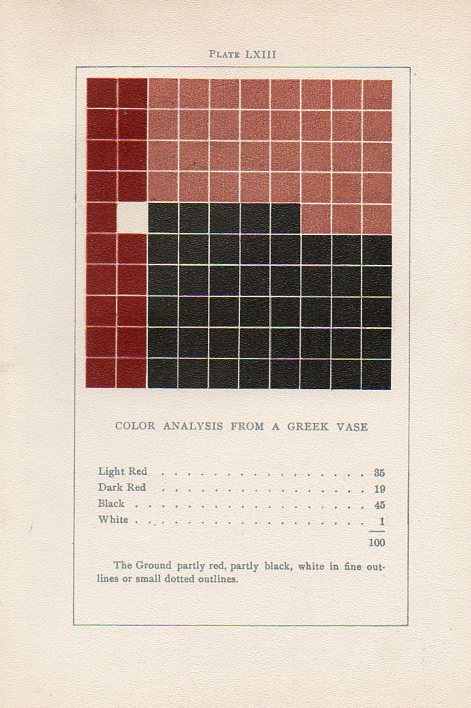
    [Earlier in this blog, about 1200 posts ago, a million words ago, I wrote about an extraordinary book by an aesthetician named Emily Vanderpoel.  It is “extraordinary” in a narrower sense, and that “extraordinary” might not actually be positive for its original intent.  The extra-intent of the book, what has come out of it for me, was something that was unintentionally accomplished by the author.  The images that she used to illustrate her color theory ideas–the basis of which are not really comprehensible to me–turn out to be artwork in themselves, a found art, the artistry of the images taking over the original intention for the arrangement of their color.  And so I’ve returned to the post, to add a bit to the test, and to also add 20 of the original images of this incredible work for sale at our blog bookstore..]

    The idea of how we put parameters to something like the visual field is a gargantuan topic—it is something that architects and geometers and physicists and mathematicians (in general) have dealt with forever.

    Blogcolorvander_2poel_063


      Mapmakers have perhaps the most visualized aspect of this on paper, performing the semi-miracle of translating three dimensions into two; physicists have a more difficult time, taking the opposite approach, sort of , and translating two or three dimensional space into x-number of dimensions.  Anatomists had a difficult time of their subject until relatively recently in human history, what with the sublime religious curfews on messy knowledge and all coming into play, poking around into the heart and such as though it was an affront to the sanctity of the creator (M Servetus’ ideas on the circulation of the blood via the heart, making the heart a tool and not the brain or some odd conjunction of creative divine power, cost him his life, burning slowly alive at the stake…how mysterious the whole world of RNA Genotype-Phenotype Mapping and such would seem to him if he could have a peek into the future/present from wherever he is.)

    Blogcolorvanderpoel_062


    Color theory is old and pretty—as a matter of fact there is a very attractive gathering of color theory models (in black and white, though) displaying some two dozen or more color models from the last 400 years.  People like Della Porta (1593), our old friend and resident oddball polymath crank Kircher (1646), the smarter-than-you-could-believe Newton (1660), Waller (1686), Lambert (1772), the wide ranging and again polymathic Goethe (1792), Herschel (1817, who also ushered in our understanding of the other light-sensitive shape spacing medium of photography in 1840), the semi-forgotten Chevreul (1835), the beautiful Maxwell (1857), Wundt (1874, the early experimental psychologist who also looked for spirits/spiritmus and ghosts), von Bezold (1878), Rood (1879), Munsell (1918) Kandinsky (1914 and not decipherable by me) and Klee (1924), and so on towards the present, all tried to analyze the prospects of color.

    Not in this list is the very highly problematic Emily Vanderpoel, who in 1901 and 1903 produced (in two editions) a lovely but mysterious book called Color Problems for the Layman, in which she sought not so much to analyze the components of color itself, but rather to quantify the overall interpretative effect of color on the imagination.  I know this sounds begging and vague, but I really haven’t been able to make much headway in the work.
    Blogvanderpoel_2058


    I’m attracted to this effort because of its attempt at quantifying such abstract thoughts.

    By virtue of this effort, though, Vanderpoel had produced a strikingly illustrated book, with 118 color plates, all very intense, and beautiful, and in its way exceptional—unique for it time perhaps.  Had the book been written thirty years or so hence we’d call it some sort of constructivist/constructionist artform.  But since the artwork in the book comes a decade before the first non-representational artwork in human history (or so), I don’t know exactly what to call it. 


    I really don’t know what it is, but I know that it is not entirely accidental, this pre-non-representational artform, because controlled geometrical color art is not accidental. 

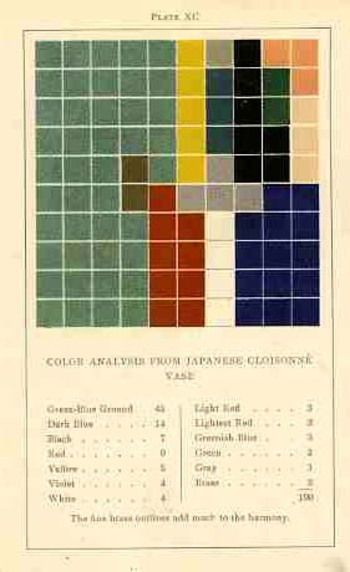
    In trying to quantify the color images of the objects in her study, Vanderpoel establishes a 10×10 square grid, dividing all of the color in that object into individual units numbering to 100.  Then, somehow, she identifies the major colors and places them according to a system that I cannot understand within the grid.

    Blogvanderpoel_3059

    The net effect is glorious.  I just don’t know how she got there—which isn’t normally a consideration in art, except that this work is an instructional on how to understand color in art and nature, and the explanation of the procedure is ethereal.  Vanderpoel was and remains a respected author on porcelains and other applied and plastic arts.  In this work she looked at her fair share of porcelain, limogues, clay pots, burial urns, glass shards, and the like; she also analyzed clouds, mummy cloths (and casings), dew on morning grass, brocade, the eye of a blue jay, feathers, and another hundred or so poetic arragenments of the stuff of teh world.  I still do not know what this book is trying to tell me, but I do know that it is remarkable.   

    Art-vanderpoel174


    ·Posted by :

    ·in:

  • The History of Children, 3/7: Books, Book-Making and Booksellers

    JF Ptak Science Books  Post 1287    Continuing the post 1285

    “Taking the Scarecrows out of Wisdoms Gardens”

    This is Part 3/7 of John Comenius’ great work, the first illustrated instructional to children, first written in 1676 and then translated into English in 1726–it is from this translation that all of the images (below) are taken.  This is the second of seven installments on introducing 17th and 18th century children to wide ideas, the other sections including: Part 1, Occupations; Part 2, Anatomy; Part 3, Books and Book Arts; Part 4, the Sciences; Part 5, Morals and Philosophy; Part 6, Games and the Arts; and Part 7, the Military.  

    The work itself: John Amos Comenius’ Orbis Senfualium Piélus: Omnium Principalium in Mundo Rerun/ &f m Vita АШопит,  translated as Pictura et Nomenclatur, the Visible World, or A Nomenclature, and Pictures of all Chief Things that are int he World, translated into English by Charles Hoof…1726.

    The purpose of the book, writes the translator in the introduction of the 1726 12th edition, is:  

    To entice witty children to it, that they may not conceit a torment to be in the school, but dainty/are., For it is apparent, that children (even from their infancy almost) are delighted with Pictures, and willingly please their eyes with these fights: And it will be very well worth the pains to have once brought it to pafs, that fcare-crows may be taken away out of Wifdom’s Gardens…”

    Even at this early stage of publishing books for children it was easily recognized that children learn better when eased into their subject with pictures.  This is not so far off the mark with the moderns, and in its own way a precursor to the Dick and Jane and Dr. Seuss books–not so much for subject matter, but for the very act of putting a book into the hands of a child and getting them comfortable wit the idea of reading.  It seems to me that this is by far the most important lesson-the actual content at tis point is secondary to the act of holding a book.  


    [merged small][merged small][graphic]

    The Ancients nvrit /яTables done over with wax ivith a hrazen Poitrel, i. ivith theJharp end, i. ivhereofletters ivereengraven, and ruhhed out again with the hread end, 3.

    Afterwards they writ Letters with a fmall Reed, 4.

    We ufe a Goofe-quill, 5. the Stem, 6. of which tue mabe with a Pen-knife, i7. then ‘wt dip the Neb in an Ink-horn, 8. which is ßopped wit h aStopple, 9. andiiie put our Pens into /rPennar, 10.


    [merged small][ocr errors][graphic][merged small][merged small]

    makttjfik a Paper-mill, 4. of Linen nigs, 5. fiampedto Malh, 6. ‘which heing taken up in Frames, 7. . he fpreadetb into Sheets, 8. andfetteth them in the Air that they may he dried.

    1 vsenty -ßve cf thefe make a C¿iure, д. t•wenty Squirts a Ream, 10. and ten of thefe a Bale of Paper, 11.

    That iwhich is to laß long is written on Parchment, 12

    [merged small][ocr errors][merged small][graphic][merged small][merged small]

    taketh them out one hy owe,and according to the Copy,(•which he hath faßened hefore him in a Viforum, 2.)compofeth •words in a Compoíing-ftick, 3. tilla Line he made; he putteth thefe in a Gaily, 4. till a Page, 6. he made, and thofe again in a Form, 7. and he locket h them up ., •. in Iron Chafes, 8. •with Quoins, 9. leß they Jhould drop out, and putteth them underthe Prefs, 10. Then the Prefs-man heateth it ever •with Printers Ink, hy means of Balls, 11. fpreadeth upon it the Papers put in the trinket, 12. •which heing put under the Spindle, 14. on the Coffin, 13. and prejfed down -with a Bar, 15. he maieth to taie mprejjton.


    [merged small][merged small][graphic][merged small][merged small][merged small][ocr errors]

    [merged small][graphic]

    In times paß they g hued Paper to Paper, and rolled them up together, into one Roll, 1.

    At this day the Book-hinder bindeth Rooks, ivhilß he ivipeth, 2. ever Papersßcrpt in Gum-water, and then foldeth them together, 3.

    hec.teth ivith a hammer, 4.. J hen ßitcheth them up, ç. prefj’eth them ii a Prefs, 6. .ivhich hath tivo Screws, 7. glueth them on the hack, cutteth off the edges ivith a round Knife, 8. and at laß comer et b them ivith Parchment o/Leather, 9 maketh them handßme, andfetteth on Clefps, 10.

    Olim agglutinahant Chartam Chartae,. convolvetiantque eas in unum Volumen, 1.

    Hodiè Compaclor compingit Lihros, dum tergit, 2. Chartas niaceratas aqua glut tnef я, deinde complicat, 3. rr.alleav, 4.tum confuit, 5. cemprimitPrtlo, 6. quod hahet duos Cochlea!, ~. conglutinat dorio, demr.rginat rotundo Cuttro, 8. tandem veftit Membrana, vel Corio, д. efTormat, Scafiigit Unchndcs, 10.

    A Book

    [merged small][ocr errors][merged small][graphic]

    A Book, as to its outtuard Shape, is either in Folio, i. er in Quarto, i, in Oitavo, 3. in Duodecimo, 4. either made to open Side-ways, ç er Long-ways, 6. ivith Bra2en Clafps, 7. or Strings, 8. and Square-boflês, 9.

    Within are Leaves, 10. nvithfwo Pages, fometimes divided ivith Columns, 11. and Marginal Notes, 12t.

    [ocr errors][merged small]

    [merged small][ocr errors][graphic]
    [ocr errors]


    [ocr errors][ocr errors][merged small][ocr errors][ocr errors][graphic]

    7 he Study, 1. ii a place -where a Student, 2 apart ftоm Men, fttteth alene, addicted to his Studies, ‘whilji he readelh Booki, 3. luhith heing within hit reach be laytth open upon a Deflc, 4 andpickttb all theheß things out of them into hit ozvii Manual, 5.  cr market h them in than  with a Daih, 6. cr a little Star, 7. m the Margin.


  • The History of Children, 4/7–the Sciences and Learning /”Infinite Islands float in the Seas”

    JF Ptak Science Books  Post 1287    Continuing the post 1285

    “Taking the Scarecrows out of Wisdoms Gardens”

    This is Part 4/7 of John Comenius’ great work, the first illustrated instructional to children, first written in 1676 and then translated into English in 1726–it is from this translation that all of the images (below) are taken.  This is the second of seven installments on introducing 17th and 18th century children to wide ideas, the other sections including: Part 1, Occupations; Part 2, Anatomy; Part 3, Books and Book Arts; Part 4, the Sciences; Part 5, Morals and Philosophy; Part 6, Games and the Arts; and Part 7, the Military.  

    The work itself: John Amos Comenius’ Orbis Senfualium Piélus: Omnium Principalium in Mundo Rerun/ &f m Vita АШопит,  translated as Pictura et Nomenclatur, the Visible World, or A Nomenclature, and Pictures of all Chief Things that are int he World, translated into English by Charles Hoof…1726.

    The purpose of the book, writes the translator in the introduction of the 1726 12th edition, is:  

    To entice witty children to it, that they may not conceit a torment to be in the school, but dainty/are., For it is apparent, that children (even from their infancy almost) are delighted with Pictures, and willingly please their eyes with these fights: And it will be very well worth the pains to have once brought it to pafs, that fcare-crows may be taken away out of Wisdom’s Gardens…”

    Even at this early stage of publishing books for children it was easily recognized that children learn better when eased into their subject with pictures.  This is not so far off the mark with the moderns, and in its own way a precursor to the Dick and Jane and Dr. Seuss books–not so much for subject matter, but for the very act of putting a book into the hands of a child and getting them comfortable wit the idea of reading.  It seems to me that this is by far the most important lesson-the actual content at tis point is secondary to the act of holding a book.  

    [ocr errors][merged small][graphic][merged small][ocr errors][ocr errors][ocr errors][table]

    [merged small][ocr errors][ocr errors][graphic][ocr errors][ocr errors][merged small]

    [graphic]
    [ocr errors]
    [ocr errors]
    [ocr errors]
    [ocr errors]

    [merged small][ocr errors][ocr errors][graphic][merged small][ocr errors][ocr errors][ocr errors][ocr errors]

    [ocr errors][ocr errors][merged small][graphic][merged small][merged small][merged small]


    [ocr errors][ocr errors][merged small][merged small][ocr errors][graphic][ocr errors][ocr errors]

    into the ßadotv oftheEatih,». it is darkened, nvhich ive tall an Eclipfe, or defeil.

    But when the Moon runutth hetwixt the Sua and the Earth, 3. it covtilth it -with it 1 Jbaàomi; and this toe call the Eelipfe of the Sun, hecaufc it takethfrom us the ßght of the Sun, and its light;

    neither doth the Sun/br all that fuffer any thing, eut the Earth.

    [ocr errors][ocr errors]
    [merged small][ocr errors][graphic][merged small][ocr errors]

    is 360 degrees’, (“•whereof every one maketh 60 Engliih Miles) or 2 1600 Miles, and yet it is tut a prick, compared •with the World, •whereof it is the Centre. – 4″hey mea/иrе the Longitude «fit hy Climates, 1. and the Latitude hy Parallels, *•

    The Ocean, 3. cempajjeth it ahout, and ßve Seas voafi it, the Mediterranean Sea, 4. the Baltick Sea, 5. the Red Sea, 6. the Perfian Sea, 7, end the Calpian Sea, 8.

    [ocr errors]

    ей graduu»k CCCLX. (quorum quifque facit LX. Milliaria Anglica) vel 21600 Milliarium, & tamen eft puncbm, collata cum orhe, cujusCentrum eft. – Longitudinem ejus dimetiuntur Climatihus, 1. l-atitudinem, lineis Parallelis, 2.

    Occanus, 3. amhit earn Se Maria V. perfundunt, Mtditerraneum, 4. Balticum, 5. Erythraum, t Perßcum, 7. … _ Caffium, 8.

    [merged small][ocr errors][graphic][ocr errors][ocr errors][ocr errors][ocr errors]

    art uninhahitahle }.

    the II. Temperate ones, 10. .10.

    end the Torrid one, 11.

    hahitable»

    Beßdes it is divided into three Continents; thh of ours, 12. ‘which isfubdividedinto Europe, 13. Afia, 14. Africa, 15. America, 16. … 16. fivhofe Inhahitants are Antipodes to us) and the South Land, 17.. .1 7. yet unkno•wn.

    They that d•well under the North Pole, 18. have the days and n’gbts 6 months long.

    Inßnite Iflands float in tht Seas.

    [merged small][ocr errors][merged small][merged small][merged small][graphic][graphic][merged small][ocr errors]

    [merged small][merged small][merged small][graphic][ocr errors][ocr errors]

    [ocr errors][merged small][merged small][merged small][merged small][graphic][ocr errors][merged small][merged small][ocr errors]

    [ocr errors][ocr errors][merged small][merged small][graphic][ocr errors][ocr errors][merged small][ocr errors]

    The Afp, 4. in the ßelds. The Boa ^rMild fnake)5.in Houfes. The Slow-worm, 6.

    is hlind.

    The Li2ard, 7. mid the Salamander, 8^ (that liveth long in ßre) have fee(.

    The Dragon, 9. 2 winged Serpent, killeth ivith his Breath,

    The Bafiliik, 10. with his Eyes;

    And the Scorpion, 11. ,ivith his poi/onous tail.

    [ocr errors]
    [ocr errors]
    [merged small][graphic][ocr errors][merged small][merged small]

    fhe Earth-worm, i. the Earth.

    The Caterpillar, 2. the Plant.

    The Grafs-hopper, 3. the Fruit:.

    The Mite, 4. the Gern.

    The Timher-worm, 5. IVood.

    The Moth, 6. a garment.

    Tbe Book-worm, 7. я Book.

    Maggots, 8. FUß and Cheefe.

    Hand-worms, the Hair.

    Thefiipping Flea, 9. the Loufe, 10. ostd the ßinking Wall-loufe, (Bug) 11. hite us.

    The Tick, 12. it a Bkod-fucker.

    The Siik-worm, 131 makethßlk.

    The Pifmiie, 14. is painful.

    SVSpider, ijy •wearveth a Cob•weh, nets for ßies.

    The Snail, 16. tarrietjf about her Snail-horn.

    . Lumbricns, 1. Terra m.

    TL rue a, 2. Plantara.

    Cicada, 3. Fruges.

    Curculh, 4. Frumento»

    Teredo (coffis) 5. Ligna.

    Tinea, 6. vefiem,

    Blatta, 7. _

    Lihrum.

    Tir mites, 8. Camem & Cafeum.

    Acari, Capillum,

    Saltans Pпlex, 9. Pediculus, 10. foutens Cimex, 11. mordent поз, ‘Ricinus, п. fantruifugus eft.

    Bombyx, 13. facit fericum.

    Formica, 14. eft lahoriofa. ч Aranea, 1J. texit Araneum, retia inufcis. .

    Cochlea, \6. Icircumfert Teftarbi

    [ocr errors][ocr errors][merged small][merged small][ocr errors][graphic][ocr errors][ocr errors]

    [ocr errors][ocr errors][merged small]


    [merged small][merged small][graphic]

    The e¿/e/rKingdoms qf In Europa noftrâ

    Europe, are I funt Rtgna primaria, Spain,Spain, i. France, 2. Italy, 3. England, 4. Scotland, 5, Ireland, 6. Germany, 7; Bohemia, 8. Hungary, 9. Croatia, 10. Dacia, 11. Sclavonja, 12. Greece, 13. Thrace, 14. Podolia, 15. Tartary, 16. Lithuania, 17. Poland, 18. The Netherlands, 19. Denmark, 20. Norway, 21. Swedeland, 22. Lapland, 23. Finland, 24. Lifland, ?ç, Pruffia, 26. Mufcovy, 27, W Raffia, 28. .


  • The History of Children, 5/7–Morals and Philosophy

     JF Ptak Science Books  Post 1289    Continuing the post 1285

    “Taking the Scarecrows out of Wisdoms Gardens”

    This is Part 5/7 of John Comenius’ great work, the first illustrated instructional to children, first written in 1676 and then translated into English in 1726–it is from this translation that all of the images (below) are taken.  This is the second of seven installments on introducing 17th and 18th century children to wide ideas, the other sections including: Part 1, Occupations; Part 2, Anatomy; Part 3, Books and Book Arts; Part 4, the Sciences; Part 5, Morals and Philosophy; Part 6, Games and the Arts; and Part 7, the Military.  

    The work itself: John Amos Comenius’ Orbis Senfualium Piélus: Omnium Principalium in Mundo Rerun/ &f m Vita АШопит,  translated as Pictura et Nomenclatur, the Visible World, or A Nomenclature, and Pictures of all Chief Things that are int he World, translated into English by Charles Hoof…1726.

    The purpose of the book, writes the translator in the introduction of the 1726 12th edition, is:  

    To entice witty children to it, that they may not conceit a torment to be in the school, but dainty/are., For it is apparent, that children (even from their infancy almost) are delighted with Pictures, and willingly please their eyes with these fights: And it will be very well worth the pains to have once brought it to pafs, that fcare-crows may be taken away out of Wifdom’s Gardens…”

    Even at this early stage of publishing books for children it was easily recognized that children learn better when eased into their subject with pictures.  This is not so far off the mark with the moderns, and in its own way a precursor to the Dick and Jane and Dr. Seuss books–not so much for subject matter, but for the very act of putting a book into the hands of a child and getting them comfortable wit the idea of reading.  It seems to me that this is by far the most important lesson-the actual content at tis point is secondary to the act of holding a book.  

    [ocr errors][ocr errors][graphic]

    This Life is a way, or a place divided into two ways, iike

    Pythagoras’/ Letter Y. i road, i. on the left-hand track; narrcw, 2. on the right; that helongs to Vice, 3. this to Virtue, 4. Mind, young Man, J. imitate Hercules; leave the lift hand чыaу, turn from Fice i the Entrance, 6. is fair, hut the End, f. it ugly andßetp down. Go on the right hand, though it he thorny, 8. no ‘way is unpaffahleto virtue; follow -whither Vitha Itadeth


    [ocr errors]

    ,

    [ocr errors]
    [merged small][ocr errors][merged small][graphic][merged small][merged small][ocr errors][merged small]

    and doeth, fptaketh, Or thinketh nothing in vain.

    She looks backwards, j. as into a Looking-glafs, 4. to things pad; and feeth before her, 5. as with a Perfpe&ive-glafs,7. things to come, or theEnd, 6. andfo fie perceiveth ivhat foe hath done, and -what remaineth to he dene.

    She propofeth an Honeft, Profitable, and -withal, if it may he done, a Pleafant End to her Ail ions.

    Haxing forefeen the End, fie looketh out Means, as a Way, 8. ,which leadeth to the End; hut fach as are certain and eajy, and fewer rather than more, lefl any t^ing Jhould hinder.She ivatchethOpponaahy,g. (ivhich having a buihy Forehead, 10. and heing bald-pated, il, and moreover, having wings, 12. doth quickly ßip aviay,) and catchet h it. .i„ ti jS ht goeth on her ivay ivarily, for fear fie fiould flumhle er go am¡/s

    [ocr errors]
    [ocr errors]

    [merged small][ocr errors][ocr errors][merged small][graphic][ocr errors][ocr errors]

    A

    [ocr errors][ocr errors][merged small][ocr errors][merged small][graphic][ocr errors][ocr errors][merged small]


    and fo moderateth all thing!,leß any thing too much ее done. ftevellersare made drunk, 4.they flumhle, 5.they fpue, 6.and hrahhle, 7.From Drunken nefs froceedeth Lafciviouinefs; from this, a lewd Life amongfl Whoremafters, 8. and Whores, 9.. in killing, touching, emhracing, and dancing, 10.


    [merged small][ocr errors][merged small][graphic]

    Fortitude, 1. i Fortitude, t/’/ undaunted in Adwrßty, I impavida eft in Adverlis,and a u J hold as a Lion, 2.¿e/ ns/ haughty in Profperity,leaning en her oivn Pillar, 3.c/”Conftancy; and being the fame in all things, ready to undergo both eftates иith an even mind.

    She reeeiveth theßrokes e/.Misfortune •with the SHield, 4. of Sufferance: and keepeth off the Paffions, the enemies ofquietnefs, 4vith theSword, 5. a/”Valour,


    [ocr errors][ocr errors][ocr errors][merged small][graphic]

    Patience, 1. I Patient la, 1endvrtth Calamities г. !tokrat Cal»mitatts, 2.and Wrongs, 3. meekly like a Lamh, 4. as the fatherly chaftifement of God, 5.

    In the mean while fie hattet h upon the Anchor of Hope, 6. {as a Ship, 7. tiffed hy •waves In the Sea) /he prayeth to God, 8. •weeping,and expeBeth the Sun, ГО. after cloudy weather, 9. fuffering evils, and hoping hetter things.

    On the contrary, the impatient Perfon, 11. Koaileth, lamtnteth, rageth again ft himfelf, 11. grumhl»th like a Dog, 13. and yet doth no good i at the laß he defpaireth, and hecome!h his own murtherer, 14. Being full of ragt it äeßrtth to revenge wrings.

    [merged small][merged small][graphic]

    Men are made for one another’s good; therefore let them he kind. Be thou/iveet ana’ lovely in thy Countenance, i. gentle and civil in thy Behaviour and Manners, 2.affahle and truc-t’poken ivith thy Mouth, 3. ajfeBionate and candid in thy Heart, 4. So live, and Jo ßialt thou heloved; a r d there ivili he * »i/WFriendihip, {. as that of Turtle-doves, 6. hearty, gentle, andivijhing nuellrn hoth p arts, Frcivard Men are if auf id, t/ly, unplea/ant,


    [ocr errors]

    [merged small][merged small][merged small][merged small][ocr errors][graphic][ocr errors][ocr errors][merged small]


    to he referred J”or the other party; Holding in her right Hand a Sword, ç. und a Bridie, ó. еo punißu und reßrain evil men;Beßdes, a pair of.Balances, 7. in the right fcale, 8. whereof, Deferís,and in the left, ci. Rewards heing put, are made even one vjith another, andfo good Men are in- cited to virtue, as it ivereivith Spurs, 10. In Bargains, 11.let Men deal candidly:let themf tand to their Covenants яWPromifes;let that which is given oneto keep,and that which is lent,he reßored:let no man he pillaged, 12.er hurt, 13.let every one have his очиn:thefe are the precepts efjußice. Such things as thefe are forhidden in God’s 5th and7th Commandment,and difervedly puni/h’don the

    [ocr errors]
    [ocr errors][merged small]

    [merged small][merged small][graphic]

    Liberality, r. keepeth a mean abcut “Riches, •which fie honeßly fecket h, that fie may have fomeivhat to hejfaw c?:thi.i.i that want, 2.

    She clothetii, 3., nourimeth, 4. and enricheth, 5. thefe •with a chearful Countenance, 6. and a winged Hand, 7.

    She/ubmittethhersvealih,2. to herfelf, not herfelf to it, as the covetous man, 9. doth, •who hath, that he may have, and is not the Owner, hut the Keeper of his goods, and heing unjatiable, ahvays icrapeth together, ib. •with his Natis.

    [ocr errors][merged small]
    [graphic]
    [ocr errors]

    [merged small][ocr errors][ocr errors][ocr errors][merged small][merged small][merged small][graphic][merged small][merged small]

    either •with Wealth, er a Trade and Science, ivhich mayjerive for getting a living; »hai he may he ahle to maintain a Family.

    Then he chcofeth him/el/ a Maid that is Marriageahle, (or a Widow) •whom he loveth; neverthelrfs a greater Regard is to he had of Virtue,and Honefty, than ^/”Beauty or Portion.

    Afterwards, he doth not hetroth her to himfelf clofelj, tut entreatethfor her, as a Woer, firß to the Father, i. and then the Mother, 2. er theGuardians, tr Kinsfolks, byfuch as help to make the match, 3.

    When fie is effous’dto him, he hecometh /¿¿Bridegroom,,.).. end fie the Bride, 5. and the Con traft is made, aid an Instrument of Dowry, 6. is •written.

    At the laß  the Wedding is made,  inhere they are joined together  ly the Prieft, 7» gi-ving their Hands, 8. one to
    another,and Wedding-rings, 9. ihm they.ftaß •with the ivitneffes that are invited. After this they are called  Hulhand tWWife; ivhen fie is dtad\ he hecmeth * Widower.

    [merged small][merged small][graphic]

    In Confanguinity there touch a Man, i in Lineal Afcent, the Father {the Father-in-taw) 2. and the Mother (the Mother-in-law) 3-.; the Grand-father, 4.. ana the Grand-mother, 5. the Great Qrand-father, 6. ßW/^eGreatGrandmütliersj.. the great great Grandfather; 8. the great great Grandmother, 9. the great great Grandfather’s Father, 1 o.thegreatgreatGrandmotheris Mother, grandfather’s Grandfather, i2. thegreatgreatGrandmother’s Grandmother, 13.4″hofe heyond thefe are called Anceftors, 14. In a Lineal defcent, the Son (the Son-in-law) 15. and the Daughter (the Daughter-in-law) 16. the Nephew, 17. und the Niece, 18. the Nephewis Son, 19. «»i•//¿eNephewsD aught еrs о. the Nephewis Nephew, 21. and the Nieceis Niece, 22. the Nephewis Nephewis Son, 23.the Niece’s Nieceis Daughter, 24. the Nephewis Nephew’s  Nephew, 25./w-NïeçeisNieceisNiece, 26. Thife heyond thefe are called Pollerity, 27. . . 27. In a Collateral Line are the Uncle hy the Father’s fide, 28. and the Aunt hy the Fatheris fide, 29. the Uncle hy the Motheris fide, 30. endúit Aunt hy the Motheris fide, 31. the Brother, 32. and the Sifter, 33. the BrotherisSon, 34. the Sifteris Son, 35, and the Coufin hy the Brother and Sifter, 36.


    [graphic]
    [ocr errors][ocr errors]

    CXXII.

    The Society betwixt Pa- Societas Parentalis.

    rents and Children.

    [ocr errors][ocr errors][graphic]

    Married Perfoni, (hy the hlcjßng of God J haie Ifiue, and hecome Parents.

    The Father, i. hegetteth, and the Mother, 2. heareth Sons, 3. ar.d Daughters, 4. (fometimes Twins.) The Infant, 5. is •wrapped in Svvaddling-clothei, 6. it-laid in a Cradle, 7, is fuckled by the Mother ivithher Brenfts, 8. and fedtuUth Pap, 9.-.iftcrit:rrds it learneth to go by a Standing-flo&l, io.

    [merged small][ocr errors][ocr errors]

    [merged small][merged small][merged small][merged small][graphic][merged small][merged small]

    the Miftrefs, (the good wife of the Houfe) 3 Maidens, 4* They appoint thefe their . Work, 6. end divide them their talks, 5. ‘which are faithfully to he done hy them without murmuring У lofs ; for iv h ich their Wages, and Meat and Drinkis allowed them. A Seivant ‘was heretofore a Slave, euer ivhom the Maßer had Jioiver of life and death. At this day the poorer fort ferve in a free, manner, heing hired for Wages,


    Set vus olim er&tMancipiumy in quem Domino poteftas fuit vit


    ·Posted by :

    ·in:

    — —
  • History of Children, 6/7–the First Illustrated Rendering of the World for Kids: Games and the Arts

    JF Ptak Science Books  Post 1290    Continuing the post 1285

    “Taking the Scarecrows out of Wisdoms Gardens”

    This is Part 6/7 of John Comenius’ great work, the first illustrated instructional to children, first written in 1676 and then translated into English in 1726–it is from this translation that all of the images (below) are taken.  This is the second of seven installments on introducing 17th and 18th century children to wide ideas, the other sections including: Part 1, Occupations; Part 2, Anatomy; Part 3, Books and Book Arts; Part 4, the Sciences; Part 5, Morals and Philosophy; Part 6, Games and the Arts; and Part 7, the Military.  

    The work itself: John Amos Comenius’ Orbis Senfualium Piélus: Omnium Principalium in Mundo Rerun/ &f m Vita АШопит,  translated as Pictura et Nomenclatur, the Visible World, or A Nomenclature, and Pictures of all Chief Things that are int he World, translated into English by Charles Hoof…1726.

    The purpose of the book, writes the translator in the introduction of the 1726 12th edition, is:  

    To entice witty children to it, that they may not conceit a torment to be in the school, but dainty/are., For it is apparent, that children (even from their infancy almost) are delighted with Pictures, and willingly please their eyes with these fights: And it will be very well worth the pains to have once brought it to pafs, that fcare-crows may be taken away out of Wifdom’s Gardens…”

    Even at this early stage of publishing books for children it was easily recognized that children learn better when eased into their subject with pictures.  This is not so far off the mark with the moderns, and in its own way a precursor to the Dick and Jane and Dr. Seuss books–not so much for subject matter, but for the very act of putting a book into the hands of a child and getting them comfortable wit the idea of reading.  It seems to me that this is by far the most important lesson-the actual content at tis point is secondary to the act of holding a book.  

    [ocr errors][merged small][merged small][graphic]

    In a Play-houie, i. fivhich is trimmed ivith Hangings, 2. andcoveredivith Curtains,3.) Comedies and Tragedies are ailed, ivherein memorable things ere reprejented; as here, the Hißory of the Prodigal Sun, 4. and his Father, 5. hy килnm he is en/ertaiu’d, heing return d home. The Players kß heing in difguife; the Fool, 6. makith Jtßs.

    [ocr errors]

    [merged small][merged small][merged small][ocr errors][ocr errors][graphic][ocr errors][merged small][ocr errors][merged small][ocr errors][graphic][merged small]

    [ocr errors][ocr errors][merged small][ocr errors][graphic][merged small][merged small][merged small][ocr errors][ocr errors]

    [ocr errors][merged small][merged small][merged small][graphic][ocr errors][merged small][ocr errors][ocr errors]

    [merged small][merged small][merged small][merged small][ocr errors][ocr errors][graphic][merged small][merged small]


    [ocr errors][ocr errors][ocr errors][ocr errors][ocr errors][graphic][merged small][merged small]

    [ocr errors][ocr errors][merged small][graphic][ocr errors][merged small][ocr errors]


  • History of Children, 7/7–the First Illustrated Rendering of the World for Kids: the Military

    JF Ptak Science Books  Post 1291    Continuing the post 1285

    “Taking the Scarecrows out of Wisdoms Gardens”

    This is Part 7/7 of John Comenius’ great work, the first illustrated instructional to children, first written in 1676 and then translated into English in 1726–it is from this translation that all of the images (below) are taken.  This is the second of seven installments on introducing 17th and 18th century children to wide ideas, the other sections including: Part 1, Occupations; Part 2, Anatomy; Part 3, Books and Book Arts; Part 4, the Sciences; Part 5, Morals and Philosophy; Part 6, Games and the Arts; and Part 7, the Military.  

    The work itself: John Amos Comenius’ Orbis Senfualium Piélus: Omnium Principalium in Mundo Rerun/ &f m Vita АШопит,  translated as Pictura et Nomenclatur, the Visible World, or A Nomenclature, and Pictures of all Chief Things that are int he World, translated into English by Charles Hoof…1726.

    The purpose of the book, writes the translator in the introduction of the 1726 12th edition, is:  

    To entice witty children to it, that they may not conceit a torment to be in the school, but dainty/are., For it is apparent, that children (even from their infancy almost) are delighted with Pictures, and willingly please their eyes with these fights: And it will be very well worth the pains to have once brought it to pafs, that fcare-crows may be taken away out of Wifdom’s Gardens…”

    Even at this early stage of publishing books for children it was easily recognized that children learn better when eased into their subject with pictures.  This is not so far off the mark with the moderns, and in its own way a precursor to the Dick and Jane and Dr. Seuss books–not so much for subject matter, but for the very act of putting a book into the hands of a child and getting them comfortable wit the idea of reading.  It seems to me that this is by far the most important lesson-the actual content at tis point is secondary to the act of holding a book.  


    [merged small][ocr errors][merged small][graphic][ocr errors][ocr errors]

    [ocr errors][ocr errors][merged small][ocr errors][merged small][graphic][ocr errors]

    When aDeíign is undertaken, the Camp, i. is pitched, and the Tents if Canvas, гor Straw, Jarefaßened •with Stakes; and they entrench them aient, fer ßcurity’s fake, •with Bulwark?, 4. and Ditches, 5. Sentinels, 6. ere alí’ofel; and Scouts, 7. arefent out.SaUyings-out, 8.ere made for Forage and Plunder-fake,where they often cope with the Enemy, 9. infiirmijhing.. The Pavilion of the Lord General is in the midßoftht Camp, 10.

    [ocr errors]
    [ocr errors][graphic][merged small][subsumed][merged small]

    il to hi fought, the Army is/et in order, and divided into the Front, 1.the Rear, 2.and the Wings, 3.The Foot, 4. mre intermixed •with the Horfe, 5,That is divided into Companies, this into Troops.Thefe carry Banners, 6. tho/e Flags, 7. in the midft of them.Their Officers are, Corporali, Enfigns, Lieutenants, Captains, 8. Commanders of the Horfe,9, Lieutenant Colonels, Colonels, and he that is the chief of all, the General. The Drummers, 10. and the Drumílades, 11. as alfo the Trumpeters, 12. call to Arms, and inßame the Soldier, At theßrß Onfet the Mofitets, 13. and Ordnance, 14. areßot off. After•wards thtyfight, 15. hand to hand •with Pikes and Swords. They that overcome are flain, 16. tr taken Prifoners, ,r run away, 17. They that are for the referve, 18. come upon thtm

    [ocr errors]
    [graphic]
    [merged small][ocr errors]

    [merged small][ocr errors][merged small][ocr errors][graphic]

    A Sea-fight « terrihle, ,when huge Ships, like Caftles, run one upon another ivith their Beaks, 1 , or ßiatter one another with their Ordnance, 2. und/o, heing hored through, they drink in their own Deßnition, and art funk, 3. Or when they arefet on ßre, mid either hy the ßring of G un-powder, 4.

    [ocr errors][merged small][merged small][ocr errors][graphic][ocr errors][ocr errors][ocr errors][ocr errors][ocr errors]

    sr hreaking them doivn with Battering-engine!, 3, er demolifiing themwith great Guns, 4.or breaking through the Gates with a Petard, 5. er caßing Granadoes, 6. tut of M01 tar-pieces, 7. tuto the City,hy Engineers, 8. (ivho He hehind Leaguer-ha&ets, 9.) er 0 uerthroivingit avith Mines hy Pioneers, to. They thait are hefieged defend thtmfelves from the Walls, 11. •with ßre and ßones, &C or hreak out hy force, iz. A City that is taken hy Horra is plundered, deßroyed, andfomelimes laid evtl •with the ground.


  • History of Children, 1/7–the First Illustrated Rendering of the World for Kids: Occupations

    JF Ptak Science Books  Post 1285

    This is the first of seven installments on introducing 17th and 18th century children to wide ideas.  The text and images all come from the 1726 English translation of John Comenius’ Orbita Pictus, and cover the following territory: Part 1, Occupations; Part 2, Anatomy; Part 3, Books and Book Arts; Part 4, the Sciences; Part 5, Morals and Philosophy; Part 6, Games and the Arts; and Part 7, the Military.  

    “O Babees yonge, my Book only is made for youre lernynge” says what well may be the first book made in the West for children, written in the 14th century.  It was made for the eyes of noble blood, of course, and was basically a contribution towards how the children should act and behave, rather than teaching them anything outside of their immediate interactions with each other or their parents.  Books of manner and behavior was the dominant—if perhaps the only(?)—category of books for children until the late 16th century.

    John Locke, in his Thoughts on Education (1691), suggests that “when a child begins to read, some easy, pleasant book, like Aesop’s Fables or Reynard the Fox, with pictures if possible, should be put into his hands”. He adds, “What other books there are in English of the kind above-mentioned, fit to engage the liking of children, and tempt them to read, I do not know, but am apt to think, that children, being generally delivered over to the method of schools, where the fear of the rod is to enforce, and not any pleasure of the employment to invite them to learn, this sort of useful books, amongst the number of silly ones that are of all sorts, yet have had the fate to be neglected; and nothing that I know has been considered of this kind out of the ordinary road of the hornbook, primer, Psalter, Testament, and Bible.” (This quote from C.M. Watkins article in The Atlantic Monthly, 1880.)

    Preview

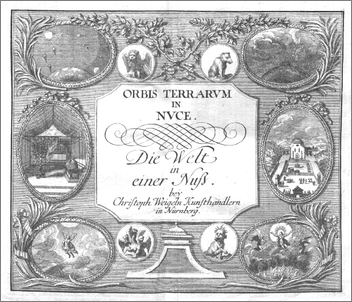
    Perhaps the most beautiful of early books for children is found behind this deeply designed title page, brought to us by Christoph Weigel (German, 1654-1726), the author, illustrator and engraver of Die Welt in einer Nuss oder die Historien vom Aufgang der Welt…1 published in Nurnberg in 1726.  The book was a tall, thin production, with 16 pages of text and 43 engraved plates, much like this one, emblazoned with emblematic studies and dedicated to a particular point in the historical continuum.  And it was intended, believe it or not, for children—the title can be basically translated as “The World in a Nutshell” and was absolutely intended for kids, compressing all of the human story into 16 terse pages and a whole bunch of gorgeous illustration. This image shows the second millennium after the birth of Christ, illustrated with seven engravings (secula septem).


     But the first of all of the encyucloepdia-like books fasiohioned for children–and the first with illustratiions–belongs to the very well studied 13. The fteeple-crowned, 15. add te thefe The bald-pated, 14.

    [ocr errors][merged small][graphic][merged small][merged small]

    [graphic][subsumed][subsumed][subsumed][subsumed][ocr errors][subsumed]

    [ocr errors][ocr errors][merged small][graphic]

    The Plow-man, i. yoketh Oxen, 3. to a Plough, 2. and holding the Flow-Rïlt, 4. in his left hand, and the Plow-ftaff, 5. in his right hand, ivith ‘which he remcveth Clods, 6. he еutteth the Land {ivhich ivas manured afore ,uiifh Dung, 8.) with a Share, 7. and a Coulter, and makethFurrows, 9. Then he foweth the Seed, 10. and harroweth it in with a Harrow, 11. The Reaper, I2. jheareth the ripe Corn with a Sickle, 13. gatheteth up the handfuls, 14, und bindcth the Sheaves, 45.<t¿í Threiher, 16.; threfieth Corn en the Barn-floor, 17. ,with a Flail, 18. .*. toffeth it in a winnowing bafket, 19.andfo ivhen the Chaff’, and the Straw, 20. are ßparatedfrom it, heputteth it into Sacks, 21 ,The Mower, 22. maketh Hay /я я Meadow, tutting do’wn Grafs with a Scythe, 23. and raketh it together üvith a Rake, 24. andmaketh up Cocks, 26. nvith a fork, 25. and carrieth it on Carriages, 27. into the Hay-barn, 28.

    [merged small][ocr errors][merged small][graphic][merged small]

    [graphic]
    [ocr errors]


    [ocr errors][merged small][merged small]
    [graphic]

    Vhe Bees find ota ¿r/warm, i. andfiet over it «Leader, 2. That Jkxiarm heing ready to fly away, is recalled hy the Tinkling ef a braaen Vefl.el, 3. and is put up into a neiv Hive, 4. They make little Cells nvith ßx comers, 5. and Jill them with Honey-dew, and make Combs, 6.cut of ivhich the Honey runneth, 7.The Partitions heing melted -with ßre, turn into Wax, 8.

    Grinding

    [merged small][ocr errors][ocr errors][graphic]

    In a Mill, i. « ft’one, 2. runneth upen a ft one, 3.A Wheel, 4. turning them ahout, end grindeth Corn poured in by a Hopper, 5. endparteth the Bran, 6. falling into the .Tro ugh, 7. from the Mealßipping through aBolter, 8.Such a Mill voasßrft a Hand-mill, 9. then a Horfe-miil, 10.. then a Water-mill, 11. anda Ship-mill, i2. amdatlaßt a Wind-mill, 13.


  • Jackson Pollock’s Fractals

    JF Ptak Science Books    Rapid Post

    Thinking about the “evolution” of music, I came to the 1940’s and 1950’s , and then to Jackson Pollock, and then to thinking about how his artwork evolved, and then, about how it might have truly evolved in a classic sense, like an evolutionary period.  None of this made much sense to me until I started thinking about the representation of Pollock fractally–and then things started to get interesting.  Could this work come about, again, as a result of the evolution of fractals?

    Obviously the Pollock drips aren’t self-same, not easily observably, anyway–but what about statistically, especially under magnification?  

    It turns out that someone has taken a look at this: Richard P. Taylor, et al, in “The Construction of Jackson Pollock’s Fractal Drip Paintings”1This team concludes that–after analyzing paintings and films of Pollock painting them–“the painting process that…Pollock used a remarkably systematic method capable of generating intricate patterns that exhibit fractal scaling criteria”.  

    I’ve never been comfortable with mid-century modern, but I must say that this Ollock/fractal business is interesting to think about, though I’m not sure it has anything to do with art. 

    Notes:
    1. Found in: Johnson, Colin G. Romero Cardalda, Juan Jesus.  “Introduction: Genetic Algorithms in Visual Art and Music–a Supplement”,  Leonardo, Volume 35, Number 2, April 2002, pp. 175-184 (Article)

    Here’s another interesting book: The Art of Artificial Evolution: A Handbook on Evolutionary Art and Music by Juan Romero and Penousal Machado (Editors)bSpringer – Natural Computing Series Hardcover: 458 pag

    The introduction to the Johnson ‘02 Leonardo article: “Leonardo has a long tradition of publishing work at the mutual frontier of art and science. We are pleased to present in the pages of Leonardo a special project that

  • Electronic, Santa and Reagan Cancers–Selling Cigarettes at Christmas & the Cigarette Highway

    JF Ptak Science Books  Post 1293

    Mmmmm…Can’t you just taste the goodness, the frivolity, the downright holiness of these seasonal ads?  What an odd set of emotions these images are able to surface on quick-boil.  Who knew (in this first image) that this LIFE magazine ad from 1954 would reveal the true value of electronics–managing cancer sticks?  (These same folks are today working on quantum computing multi-universe porn–stay tuned.)  The model still has pearly-white teeth while smoking and drinking coffee, radiant in her  half-a-halo of cigarettes. The lit cigarette between her fingers is at first almost invisible (or at least it was to me), seeming to be just another of those rolling off the AccRay Electro-conveyor belt, an endless supply for her pleasure. (The “electronic” part of this ad are also Lilliputian; its a nonsensical drawing with no scale, unless the cig company wanted to get across to its potential smoking community how “big” their cigarettes are.)

    . Cigarettes--electronic cancer193

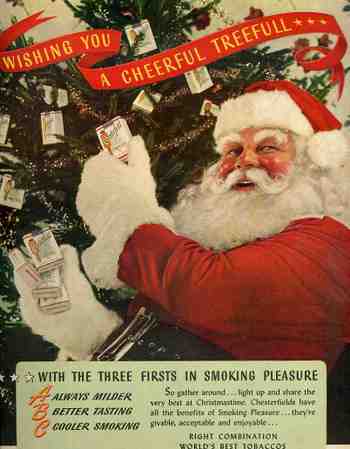
    Blogsanta_cigs317And could poor old Santa get any lower than this?  Out of all the things he has carried in his sack over the years, Chesterfield Cigarettes may very well be the worst of them.  Plus, not only is Santa delivery them as presents, he’€™s decorating the tree with them as well, and hardly acting the camera-shy sort that he is.  Chesterfield (Leggett & Morris Tobacco Co.) combined some of the best loved elements of childhood (the ABC’s “€œAlways Buy Chesterfield”) and Santa Claus to not only convince adults to think of the product as a Gift(ing) Unit, but also to lull children into a sleepy, memory-clouding  impression of Chesterfields being somehow good (what with these two primary associations and all).  “€œChesterfields have all the benefit of Smoking Pleasure (capitalized in the original) “they’re givable, acceptable and enjoyable¦”  I wonder what they, meant, exactly, by using the word “€œacceptable”? 

    I’€™ve seen Santa in other embarrassing poses like this in the pages of LIFE magazine for this period:  €”flying through the air in his sleigh loaded down with boxes of cigarettes, placing boxes of them under the tree, stuffing stockings with cartons, and the like.  I’€™m sure that he regrets it now, though.

    All sorts of people were pressed into the service of selling tobacco products like this—sports figures, movie stars, doctors, adventurers; an entire alphabet of personalities and personality types got into the act.  A sitting president had never been involved, though a person who would become president was. Blogsanta_lreagan_chesterfield_ad
    I’m sure Ronald Reagan regretted this ad at some point in his life as well (“beautiful Christmas Car Carton” or not), though I suspect that he would’ve kept that close to the vest. 

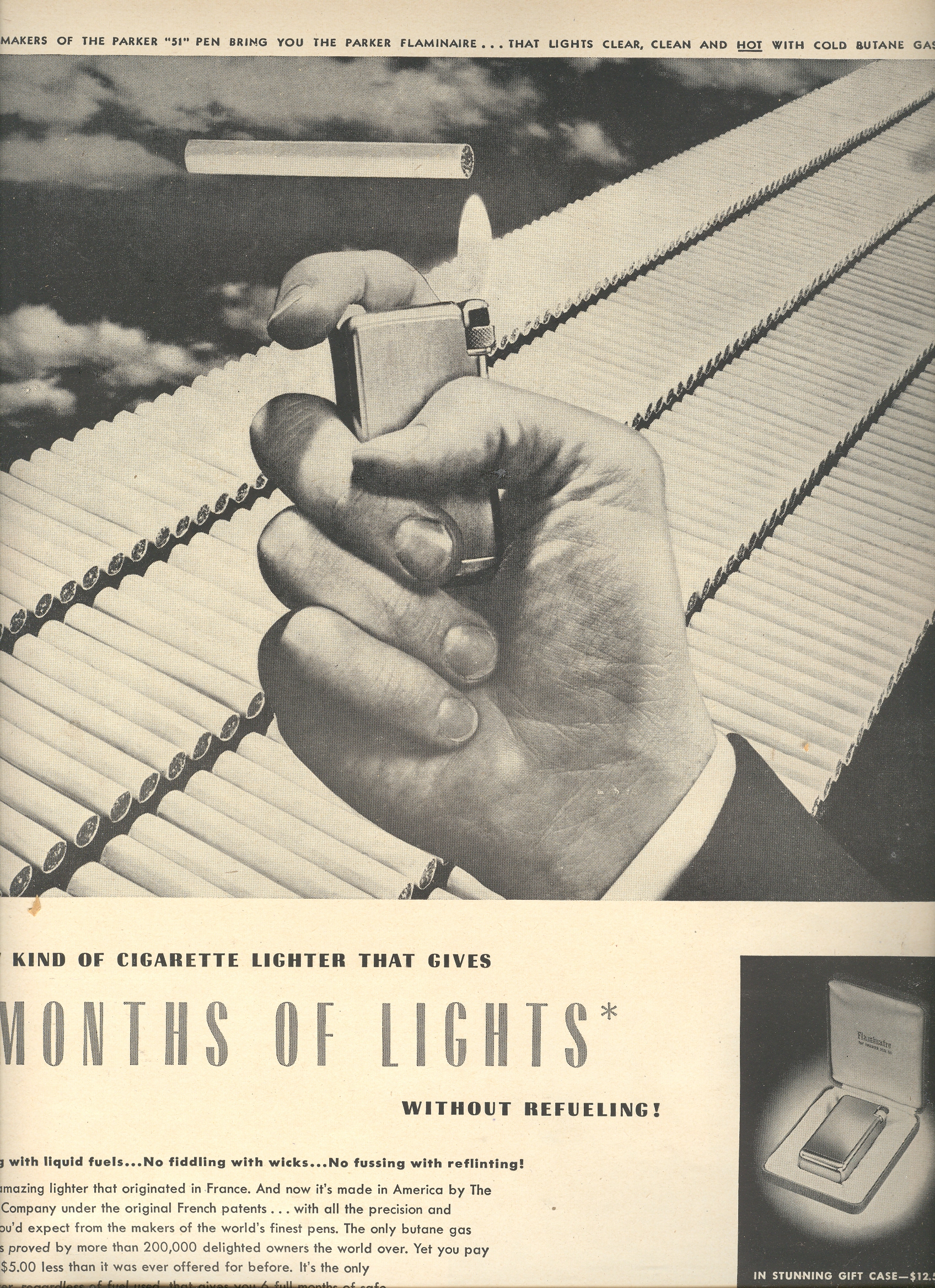
    This is a simple ad for a butane-based lighter (appearing in LIFE magazine for 18 December 1950), lighting the way down Cigarette Road.  Actually, it was more a highway than a road, and a superhighway at that. Government-sponsored warnings about tobacco health issues was still more than a decade away:  medical doctors were part of the advertising machine, as were actors (including RWR), sports figures, and virtually anyone else with a mouth.

    This is a simple ad for a butane-based lighter (appearing in LIFE magazine for 18 December 1950), lighting the way down Cigarette Road.  Actually, it was more a highway than a road, and a superhighway at that. Government-sponsored warnings about tobacco health issues was still more than a decade away. 

    ==Blog July 27=cis It seems to me that there are about 300 cigarettes in this ad, and that looks like a lot—point of fact though is that in 1950, the average American (of 18+ years) smoked about 3,522 cigarettes a year, which means about 10 cigarettes a day for everyone in the country.  Not 10 per smoker; 10 for everyone in the entire country, smoker or not, who was over 18 years of age.

    The average smoker in 1950 smoked about 2.5 packs a day, or 50 cigarettes or so—that’s equal to this line of cigarettes being smoked every six days. 
    There were virtually no brakes.


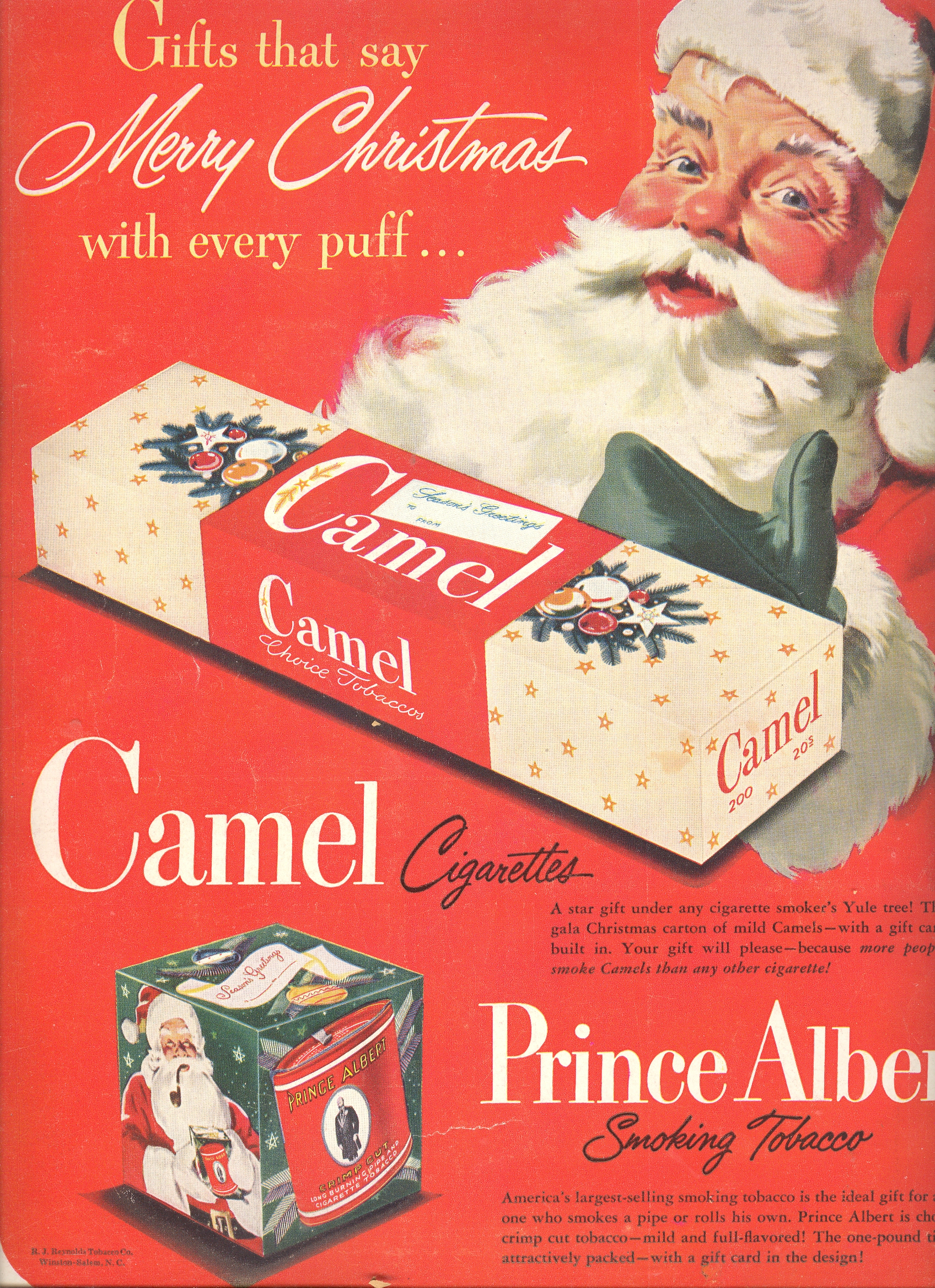
    Even Santa (a pipe smoker) got into the business. This was a standard, acceptable, vanilla-packaged advertisement.

    ==Blog July 27=cigs xmas


     United States Cigarette Consumption, , 1900–2007

    First number is total consumption in billions; second number is per capita yearly consumption for people 18+.


    1915   17.9   285

    1920   44.6   665

    1925  79.8  1,085

    1930 119.3 1,485

    1935 134.4 1,564

    1940 181.9 1,976

    1945 340.6 3,449

    1950 369.8 3,522

    1955 396.4 3,597

    1960 484.4 4,171

    1965 528.8 4,259

    1970 536.5 3,985

    1975 607.2 4,123

    1980 631.5 3,851

    1985 594.0 3,461

    1990 525.0 2,827

    1995 487.0 2,515

    2000 430.0 2,092

    2005 376.0 1,716

    2007 360.0 

    Source: Tobacco Outlook Report, Economic Research Service, U.S. Dept. of Agriculture. 

    JF Ptak Science Books LLC  Post 699  Blog Bookstore


  • Warsaw Ghetto Uprising–Full Text of a Rare 1944 Pamphlet

    JF Ptak Science Books  Post 1294

    “There will be a dawn.”–Dorothy Thompson, 1943

    “The former Jewish quarter in Warsaw is no longer in existence”–Jurgen Stroop, liquidator of the Warsaw Ghetto.

    Dorothy Thompson got that one wrong–or so at least got the “dawn” wrong when it comes to the Jewish uprising in the Warsaw Ghetto in 1943.  There wouldn’t be a dawn, there, mainly because there would be hardly any Jews, or Warsaw.  [This battle took place about three years after the Nazis established it as a means of control for the city’s 400,000 or so Jews. In the intermediary years hundreds of thousands of Jews had been “deported” (that is, sent to the concentration camps to be exterminated or worked to death), so that by the time of the Uprising only 60,000 people remained in the Ghetto.  And by this time there was no doubt in anyone’s mind who lived there (and perhaps too in Warsaw as a whole) what the euphemism of “deportation” actually meant.  The battle started off well for the home defence (the ZOB) but, ultimately, with little access to resource and with nowhere to actually retreat or regroup in the few acres that remained of the original Ghetto, whoever was left in the Ghetto were either killed or captured by 16 May.  The German commander, SS Brigadefuhrer Jurgen Stroop reported on that day that “the former Jewish quarter in Warsaw is no longer in existence”.]

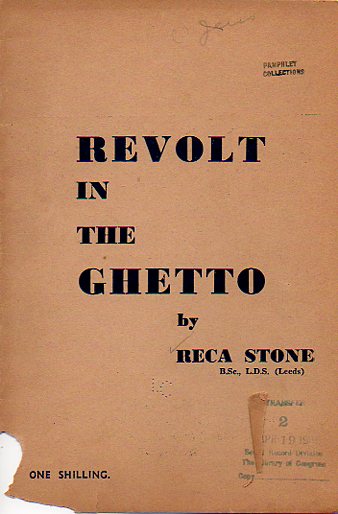
    This small pamphlet was written by Reca stone in 1944 on the Jewish counter-attack against the Nazis in the ghetto of Warsaw. It is one of not-many that documented not only the resistance in Warsaw, but also of the wholesale liquidation going on in that city and in the concentration camps. in general.  (Again, this was written in 1944. )

    There weren’t many accounts like this, but there were enough, certainly enough to have made a difference, I think, in how the leaders of the war effort approached whether concentration camps existed or not.  Franklin Roosevelt had exactly one meeting on this topic (which I wrote about here), while many others decided that the idea of exterminating all of European Jewry was so enormously bad and so gigantic that it could not possibly be true.  

    Felix Frankfurter famously replied to a first-hand report on the extermination from the great Jan Karski that he just couldn’t “beieve” Karski’s story–not because the Supreme Court Justice (and Jew)  thought Karski wasn’t telling the truth, just that the story itself was unbelievable.  And whether people thought that the stories were the truth but unbelievable (like Frankfurter) , or whether they thought they to be exaggerations, or whether they thought it was impossible, the responses and the subsequent actions mostly seem to have come to the same end of nothingness. Even after years of reports of extermination and brutalities and millions of people missing (as FDR was warned of in that 1942 meeting), the actual eyewitness accounts of the concentration camps were still received as being unbelievable.

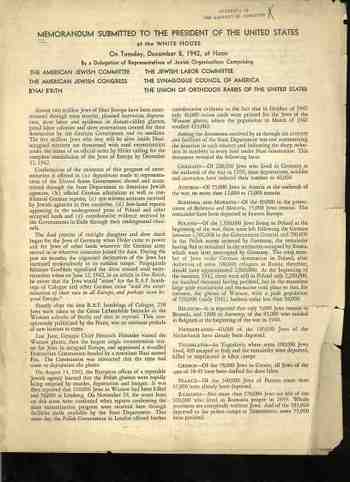
    Blogsept5_memorandum_1494_2

    This is one of the reasons why General Eisenhower–when viewing the  concentration camp at Ohrduf in April 1945 with Generals Patton and Bradley–suggested that world leaders and other high-rankers come to the camps to bear witness so that future generations would know that such a thing actually existed.  And so we come to the Reca Stone pamphlet.  There are many other accounts of course of the uprising, and many of those are available on-line–but the Stone account, which is a rare thing in itself (only seven libraries worldwide having a copy of the work) is not on-line, but it is now.  I think that it is a significant report, and it should have a wide audience–things like this should reach as large a readership as is possible. 

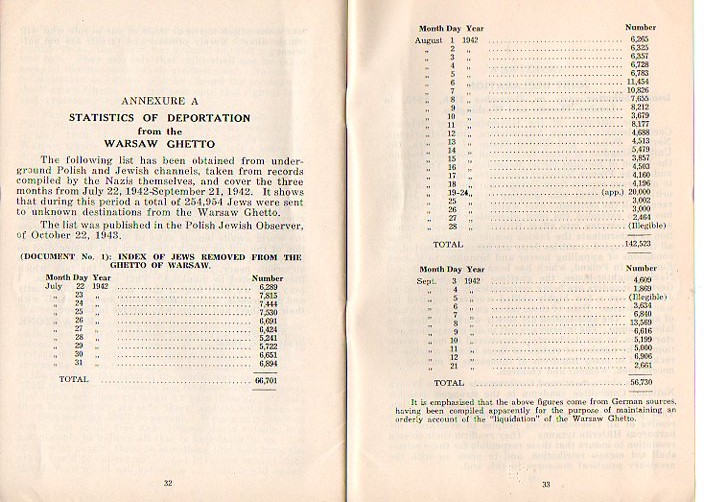
    An example of Stone’s reporting, coming from Underground sources and the Polish Jewish Reporter, on the number of Jews “removed” from the Ghetto of Warsaw between July 22 1942 and September 21, 1942–254,954 over a period of about three months:

    A--warsaw ghetto213

    But Stone gives no sentiment to the idea of Jews “perishing”.  On page 20 she describes the death camp Treblinka, and how thousands and thousands of Jews met their death in the gas chambers, or by suffocation and scalding, or by execution, or by live burial.  

    She writes boldly: In this manner 250,000 Jews were transported from the Warsaw Ghetto…and in this manner tjhey met their death”.  Period.  No euphemism here.

    She also quotes Washington sources that “two million” Jews had “perished” (the Federal term, not Stone’s), and that “five millions were imminently threatened with death”.  She pretty much got everything correct, as unbelievable as it sounded, then.  Or now.  

    A--warsaw ghetto196


    The original pamphlet is available for purchase here.

    The full test, below–all of the images are expandable:

Recent Posts

Archives

Categories