A Daily History of Holes, Dots, Lines, Science, History, Math, Physics, Art, the Unintentional Absurd, Architecture, Maps, Data Visualization, Blank and Missing Things, and so on. |1.6 million words, 7500 images, 4.9 million hits| Press & appearances in The Times, Le Figaro, Mensa, The Economist, The Guardian, Discovery News, Slate, Le Monde, Sci American Blogs, Le Pont, and many other places… 5000+ total posts since 2008.

  • 1905, Poincare, Relativity and All That.

    JF Ptak Science Books   1310

    Poincare I really don’t want to make a post here on the pre-history of the special relativity theory (SR)—I really just want to post the English translation of a paper that came late in the career of the polymathic Henri Poincare (1854-1911) and in the same year as Einstein’s epochal paper (1905). It appeared in the quirky/odd and cellularly-strange journal called The Monist in January 1905, and is remarkable for its brevity (only 24 pages), accessibility (plainly and simply written, and without a single footnote) and vastly sweeping ideas.  It is so nearly powerful that there are many who claim that Poincare preceded Einstein’s relativity paper in it–they are a strict minority, and I ,ust say that I’m not one of them. (Poincare would republish this paper in a more technical form in 1906 as  “Sur la dynamique de l’electron”, published in the Comptes Rendus volume 140–both can be found in the 1905 entry in Lecat’s Bibliographie de la Relativite # 2269, the second paper of which can be found in a fine translation here by an old friend of our store, Scott Walter.  ( I should also say that you may buy the rare original offprint of this paper at our blog bookstore, here.)

    I’ve made two word clouds of the 1920 EInstein relativity book posed against the Poincare 1905 paper, here.

    (This photo shows Poincare seated next to Mme Curie at the first Solvay Conference in 1911.)   

    It has been resident here on the computer for a long time and thought to publish it here.  This is not by any means the only effort by Poincare in this area—in addition to technical papers Poincare had earlier published his “Science and Hypothesis” in 1902 which included some basic philosophical investigations on the relativity of space and time, the questioning of the existence of the aether, and some other pertinent SR-related topics—again, addressed to an advanced general audience. 
    There were of course many others who made important contributions to to development of SR:  Joseph Larmor, Wilhelm Wien, Heinrich Hertz, HA Lorentz, W. Voigt, Michelson Morely, Walter Kaufman, Max Abraham, GF FitzGerlad, Herman Minkowski, and many others.  (A nice place to start on the history of this topic is  The Genesis of General Relativity Vol. 3: Theories of Gravitation in the Twilight of Classical Physics; Part I (Boston Studies in the Philosophy of Science 250), 253-271, Springer, 2007.

    Although a strong case can be made for Poincare being one of the last of a breed that “knew everything”(like Arnold Sommerfeld, Herman von Helmholtz, JC Maxwell, Goethe, and so on) he really didn’t get to SR before Einstein, in my opinion.  At the very least it was Einstein who correctly reinterpreted Lorentzian electrodynamics and finally did away with the ether, not Poincare.

    Also see a fine physics blog dealing with Poincare here.

    And so the paper:

    THE PRINCIPLES OF MATHEMATICAL PHYSICS.
    by Henri Poincare

    Reprinted from The Monist, volume 15, Number 1, 1905.

    WHAT is the actual state of mathematical physics? What are the problems it is led to set itself? What is its future? Is its orientation on the point of modifying itself ? Will the aim and the methods of this science appear in ten years to our immediate successors in the same light as to ourselves; or, on the contrary, are we about to witness a profound transformation? Such are the questions we are forced to raise in entering today upon our investigation.

    If it is easy to propound them, to answer is difficult.

    ·Posted by :

    ·in:

  • Dividing by Zero: David Byrne and Herman (“the Fat Man”) Kahn Sing the Future Blues

    JF Ptak Science Books  Post 1312

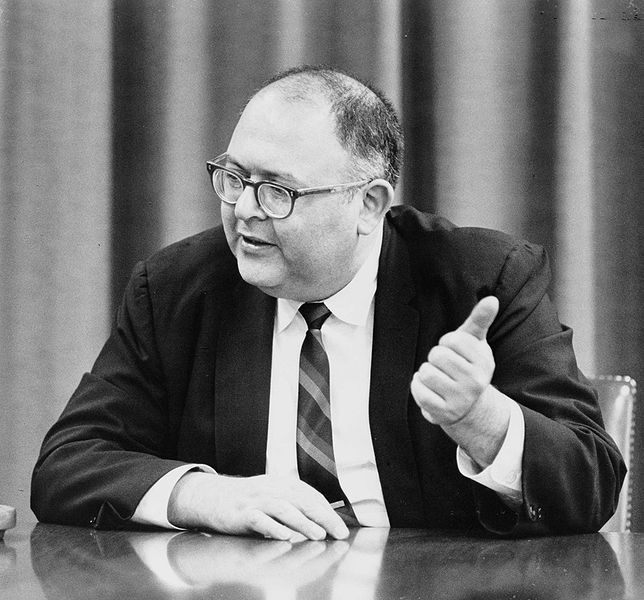
    Earlier in this blog, about two years ago, I wrote a piece on David Byrne’s beautiful Knee Plays, which included a song “In the Future”.  The post was about Byrne’s vision of the future which was bounced off the belly of “futurist” Herman Kahn, a man who was widely influential and whose thinking (I do believe) was widely incorrect.  He was also a proponent of possible first-strike (that is, American-initiated) nuclear warfare, deeming the scenarios “winable”., a broad thinker on Thinking-the-Unthinkable, and coiner of the word “megadeath” when used in conjunction with his nuclear end-game games. A main component of the template for Dr. Strangelove in Kubrick’s movie by that name,  Kahn and the think tank he helped found (the Hudson Institute) had the ear of the Reagan administration, among others, and it shows.

    Here’s the revised post, expanded some.

    0-blog-dec 3 byrne David Byrne, former Talking Heads member, produced a series of twelve short pieces to be used in the Philip Glass (and Robert Wilson*) Opera CIVIL warS  in 1985. (“Opera” may not be the right word for this piece, as I think it was one only in so far as the composition needed an opera house to be performed in.)   The Byrne pieces, called ”Knee Plays”, were meant to fill in the spaces, the spaces in-between,  place holders, between the sections of the day-long multimedia production..  Glass had used this idea of inter-pieces to the whole earlier in 1976 in his at-the-edge Einstein on the Beach, in which the connective elements were meant to not only join the pieces of the production together, but were also meant to stand alone, as a cohesive unit, if removed from the opera.  (Glass said they were “short connecting pieces which appear throughout the work much as prelude, interludes and post-ludes. Taken together they form a play in themselves”)

    0-blog-Dec 3 David_Byrne1991

    One of the Knee Plays, “In the Future” (Knee Play Number 12) is a slippery, stacatto brass section accompanying Byrne’s 51 sophisms about life in the future.  About thirty years earlier, “futurist” and think-tank-filler (or maybe it was “Think Tub”?) Herman Kahn (1922-1983), occupying a lot of space at the RAND and Hudson Institutes  (he was also known in many circles as the “Fat Man”), diligently recorded his myopic views of the future. He is generally regarded as a systems theory and military strategy guy, and is most remembered for (as he claims, perhaps) introducing the term “Vietnamization” which described the ultra-failed de-escalation (?) process and withdrawal for the United States from Vietnam (attention Obama administration).  Superluminarily speaking though his contribution to thought on constructing and implementing thought regarding nuclear weapons exchange (pointless to refer to this as “war”) in several books, including On Thermonuclear War (1960), Thinking About the Unthinkable (1962) and, On Escalation (1965), where he famously put The Bomb on the table of use possibilities.  In addition to these books—which he is busily trying to forget out there in his afterlife, somewhere, maybe in a penitential place where you are forced to think endlessly about paths-to-bad-decisions) is that 1967 peek into the future, The Year 2000.  Petroleum and oil are not issues.  Computers are of minor societal importance.  And then other things of no importance happen.

    0-blog-dec bryne kahn When you take Byrne’s Knee Play 12 and place it next to Kahn and other mis-spent prognosticators, the musician looks positively brilliant.  Some of the stuff has come to pass, some hasn’t; some will, and some won’t.  Some are open to a little interpretation, and some, a lot.  Overall, though, if you think through these little future bullets a little carefully, David Bryne looks very good.  Byrne’s lyrics/list is below.

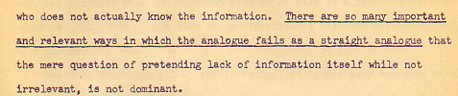
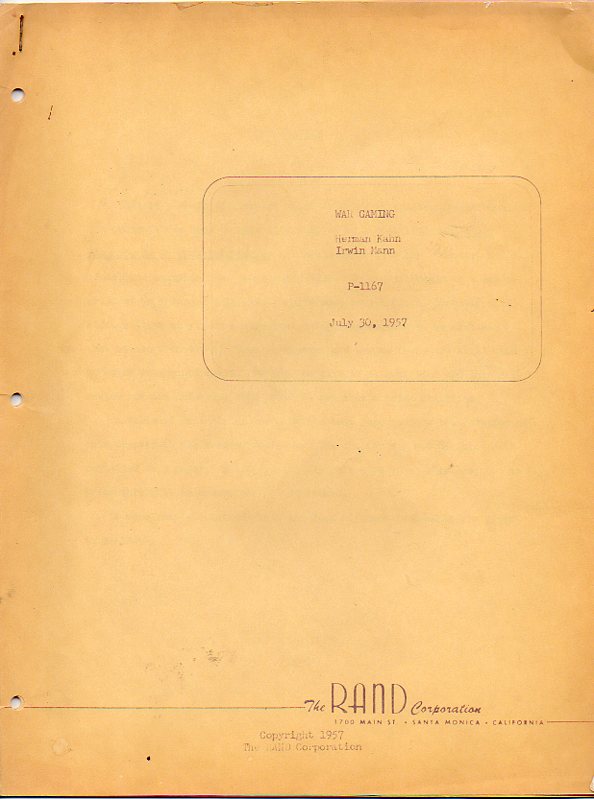
    Kahn’s writing is necessarily less elegant than Byrne’s, and probably less elegant than most other people in general including those who don’t write, though it does lower itself to some height of governmental semi-speak.  For example, from his July 1957 RAND paper “War Gaming” (available at our blog bookstore, HERE), we find this nugget:

    Kahn314

    Kahn315

    I have no doubt that Kahn looks like a warrior to many people–he no doubt was something of one, so long as that warrior could wear a white button-down shirt and not get dirty.  Simply because a person is thought of as a “warrior” doesn’t make them a ‘good” one, either, and I think that I would nominate Herman Kahn as an example of one:  in my own approximation of Kahn-speak, he would  “generate the apparent non-non appearance in definable though undefined parameters as  a non-good non-warrior in circumstances that defined or not define him/them in this semi-stable manner”.

    I think it is important to look at documents like this–documents that helped establish military policy–to see how their authors were able to convince people in government that they could divide by zero.


    *Robert Wilson is a phenomenal conceptualist and theatrical designer.  On the liner notes to CIVIL warS is found the interesting note on Wilson and Byrne:  “At first, Robert Wilson asked David to compose pieces for several sections of The CIVIL warS, but on account of David’s limited time, he composed only The Knee Plays part. The CIVIL warS was supposed to be played in its complete form at the Olympic Games in Los Angeles, but if one plays every part, it takes at least eight hours. There was also a financial problem for playing every part. So only some parts of it were staged there. David himself was very interested in composing for such a play and dance and this time again he enjoyed this work very much. Last time, for The Catherine Wheel, he used recorded tape, but this time he made musicians play on the stage.”

    (Featuring a prominent role for The Tuba)

    IN THE FUTURE (KNEE PLAY 12)

    In the future everyone will have the same haircut and the same clothes
    In the future everyone will be very fat from the starchy diet
    In the future everyone will be very thin from not having enough to eat
    In the future it will be next to impossible to tell girls from boys, even in bed

  • A Short Note on the History of Indoor Stink: Buffalo Flaps vs. Perfume

    JF Ptak Science Books   Lucky Post 1313    

    For sweetest things turn sourest by their deeds, Lilies that fester smell far worse than weeds–Wm Shakespeare

    In the long history of indoor stink,  few things have succeeded (prior say to the year 1800) in eliminating odor like a piece or  two of Buffalo hide.  Actually its a piece of metal tubing that probably gets top billing for stink-eliminator, but that’s getting ahead of the story.

    And the story is an easy one:  people for thousands of years have been living indoors, and in climates where you need to keep warm in the winter, and to be able to see stuff in the dark, people have needed to burn things for their heat/light sources that basically emit rotten odors.  This is a gross generalization*, but there have been many nomadic cultures whose housing consisted on things like tents and yurts, simple structures with people living inside and burning a fire with nowhere for the smoke to exist. Tens of  millions of people–maybe hundreds of millions–have lived this way, in a small, contained space, living with their sooty smoky fire, and the rancid fat or whatever that was burning in their lamps, all of which was mixed with cooking and living smells, all heated up and kept in the small space.  Like an oven of sorts.  (Dante commented frequently on the smell of Hell in the Inferno, and it wasn’t a pretty thing, what with the heat and the decay.  I don’t think he had much to say about the ‘taste” of place, but definitely had other things to say about how they felt, and looked, and sounded. Probably people coul drelate quite closely to the smells portion.) 

    I’m not saying that this is a global assertion, but it certainly applied to a lot fo people. Some of this unpleasant odor was masked with perfume, but I would say that this was probably not terribly effective, especially when compared to the methods that were effective. 

    Many Indian tribes in the North American Plains had tepees that were vented, holes in the tepee skin that were covered with Buffalo hide (or some sort of leather) that would allow smoke to escape; also there would be lower vents to allow air to come in.  Fires in enclosed spaces do consume oxygen, just like people, and so at some point the fire and the people would compete for O2.

    Kivas in New Mexico also were vented , and many would also have an under-the-structure tunnel devised to allow air to come and feed the fire from underneath.  Great, workable ideas that were healthy, not to mention very effective in combating stink. 

    Perfumes and scents, herbs and the like just didn’t stand a chance against the overwhelming odors that were produced by internal fires and lamps, but it really wasn’t until the invention of the proper (and lined) chimney that relief was found.  Well, that and the Franklin Stove–it was Benjamin Franklin’s idea to have an iron stove with a roaring fire, the smoke being captured in pipe above the heating element and vented immediately outdoors.  That was really one of the earliest methods by which nominally-monied people could afford to heat their environment in a healthy way, removing smoke form the environment as well as other nasties that were the direct consequence of unvented and tight indoor living.(“fish and visitors smell after three days”)

    _____

    *really, this is a roomy approximation.  Romans (with the hypocaust), Chinese, and Koreans, among others, used  sophisticated systems in antiquity.  This is just a general conversation.

  • Dictionaries as Cookbooks of Lexigraphic Taste: Comparing Bierce & Johnson, #1 “Art”

    I’m making semi-daily posts comparing words defined by the great collectors of ideas, Ambrose Bierce and Samuel Johnson.  Bierce wrote a scathing, cynical book in which he defined things for his own needs, feeling like a firey, filling, sumptuous soup.  Johnson’s effort was a spectacular effort of a novelesque-dictionary–its almost a cookbook for the lexi-gourmand, the ultimate descriptions of savories by one of English’s great chefs. I thought it would be interesting to compare words that they defined in common.  Try it here.

    ·Posted by :

    ·in:

  • The First American Government Publication on Gassing at Auschwitz and Its High-Ranked Google Deniers

    JF Ptak Science Books   Post 1314

    In November 1944 under the direction and auspices of the War Refugee Board the first official U.S. government acknowledgment of the gassing of Jews at Auschwitz and Birkenau was published.  German Extermination Camps-Auschwitz and Birkenau1,  received scant distribution, and despite its rather splashy appearance in the New York Times2 of 26 November 1944, it seems to have been directly, immediately relegated to various archives, a scarce thing when it was new3.  Dusty On Arrival, DOA–a disappearance that looks like a censorship.

    Auschwitz Birkenau317 Reports of mass killings were not new in 1944; indeed in Roosevelt’s only meeting of the war with Jewish leaders in late 1942 he was told in no uncertain terms that millions of Jews were being rounded up and killed. There were no other meetings.  In spite of other evidence and hundreds of newspaper articles, November ‘44 was the best that we could do in saying something about the gassing.

    When I was researching a French edition (which I have available for sale at my blog bookstore) of this publication, which was published in Paris in mid-1945, I did a quick Google search under its title, “Les Camps d’Extermination Allemands Auschwitz et Birkenau” .   I was surprised to see that about half of the hits were for references to crackpot Holocaust deniers who fancied themselves as “revisionist historians”–the sites looked “normal”, and had sort-of academic-y names with “truth” and “accuracy” in their titles.  They looked like any other web/blogsite, even calling up references from other web/blogsites, though those sites were just more of the same.  And there’s one of the major problems of info-gathering on the internet–vetting accuracy. 

    This search result is not achieved if you remove the quotation marks and search in general under the title’s words as single entities–but for the title as a  phrase in itself, the results of the search were crackpot-heavy. 

    Searching Google for “Holocaust” and “Auschwitz” and similar words buries the denier-people, though not deep enough for my taste.  Still it is very disturbing to search the title of the publication and find all of these looney people–what does that mean, exactly?  Is this result due to these sites writing more about this particular title than respectable sites?  Or–since these people regard this pamphlet as the key publication in beginning what they call the ‘myth” of the Holocaust–they have somehow constructed their use of the phrase to better appease the Google algorithm?  My guess is that the denier people have simply written more on this one title than on any other, and have written on it more than bona fide historical sites, and thus come up higher in Google findings.  But whatever they’ve done these sites have managed to occupy a hefty percentage of Google hits when searching for the title of perhaps the first prime indictment against the Nazis as extraordinarily vicious murderers with that counter claims that the publication is nothing but a fraud.  And that’s nothing but disgusting.

    ____________

    1. The original, government publication was reviewed thus at the Simon Wiesenthal site:  “THE FIRST REPORT ABOUT AUSCHWITZ by JOHN S. CONWAY. At the Nuremberg trials, one of the principal documents used was a fifty-nine-page mimeographed report published in November 1944 by the War Refugee Board in Washington, D.C.1 It consisted of two eyewitness accounts, “both received from a representative close to the scene,” the first based on the experiences of two young Slovakian Jews who escaped from Auschwitz in April 1944 (Part 1, pp. 1-33), and the second by a non- Jewish Polish major (Part II, pp. 1-19). “

    2. U.S. BOARD BARES ATROCITY DETAILS TOLD BY WITNESSES AT POLISH CAMPS, New York Times, 26 November 1944.

    3. “Copies of the English edition are to be found in Yad Vashem, Jerusalem (in Hungarian), in the files of the World Jewish Congress, Geneva (in German), and in the Roosevelt Library, Hyde Park, New York: War Refugee Board report, Box 61: General Correspondence of R. McClelland: F: Miscellaneous Documents and Reports re Extermination Camps for Jews in Poland (in German).” And not many more other places. 

    Only four copies of the French version are located on WorldCat OCLC: WAKE FOREST UNIV; France AIX-MARSEILLE1-BU LETTRES; France    BIBLIOTHEQUE NAT & UNIV STRASBOURG; France    BIBLIOTHEQUE NATIONALE DE FRANCE     
    France;  BNU STRASBOURG, RCON PROJ

  • The Future of Sucking: Vacuum Express Train, NYC to Philly, 1945

    JF Ptak Science Books    Post 1315
    Follow Me on Pinterest


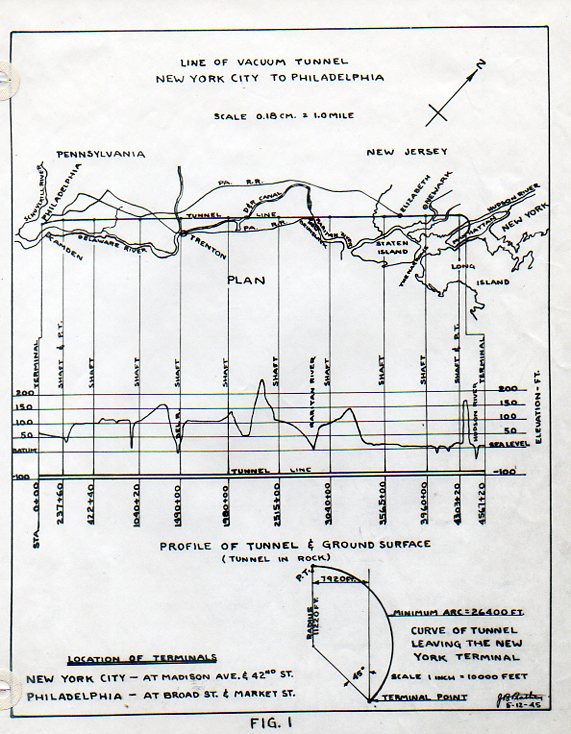
    John B. Prather launched an idea in 1945 for building a high-speed pneumatic passenger/freight train connecting New York City to Philadelphia.  His New York-Philadelphia Vacuum Tunnel, Preliminary Design Features and Economic Analysis (the original available on our blog bookstore) was exceptionally hearty. The idea is interesting in a removed, lets-not-do-it way because, well, it just doesn’t seem to make sense in the long run, at least beyond the building of the thing to show that it could be done.  And I don’t doubt that could be the case–I just don’t know why it was necessary. 

    Vacuum tunnel318 Mr. Prather’s approach seems to be the work of an engineer, or at least he had some help.  I doubt though that he had any help from a structural engineer or site geologist–his proposal was to build this tunnel 100′ down through bedrock when it could be found, a level hundred-feet  below the surface, from NYC to Philadelphia.   The tube would accommodate an aluminum-shelled  400′-long train that would be hauling 350 people and 175 tons of freight at speeds of 400-600+ mph, making the run between the two cities in about 20 minutes.  Not bad.  He figures too that all of the freight could be offloaded in 7.5 minutes.  This would make for  a very busy train, though Prather doesn’t tell us how many runs a day it would be making. This was all preliminary.

    The 16.2′-wide  tunnel would be 456,720 feet long, and would cost $173 million to excavate and $41 million to line with cement–according to the author.  The total cost for the ordeal would be about $334 million and would take 6 years, start to finish–that includes all of the tunneling, which would swallow/excavate/face 300′ per day. 

    I don’t see, really, how this could be so narrow a tunnel–I’m not an engineer but it would seem that wear, heat and the abuse and so on that a massive and dense 400′-long missile going 400+mph would require something that was more than 125% of the width of its trains. 

    There is however  precedence for a massive tunnel of something like this size being built in something like this time–the Delaware Aqueduct is 82 miles long and 13 feet wide, and was built during the Second World War (1939-1945) , so, perhaps if enough people and money were thrown at a project like the vacuum tunnel could actually be built (barring geological problems). 

    But it would all be worth it:  Prather suggests that the overall revenue from the operation of the train to be $196 million/year with $32 million in yearly operating expenses.  Which means that the whole thing could be paid for in three years or thereabouts.  So if the things was started in 1946, it would all be finished and paid for by 1956.

    I can understand his thinking, though, especially when you consider the impact of the year (1945) in which this paper was written.  The U.S. was came away from WWII by far more strong than any country on Earth, with its GDP being about 50% of that of the entire world–on the other hand, the federal deficit was 125% of the GDP, so perhaps in addition to being in an extraordinary position, investment was also somewhat gunshy.  And of course there’s the problem of whether Prather’s idea made any sense at all.  But I can understand the high times during which his project was announced. 

    I’ve looked at a number of proposals like this over the course of this blog–like almost filling up the Narrows between Staten Island and Manhattan with an airport and seaport, and making a series of transoceanic airports for flights between the continents, and dropping a gigantic shell filled with people from the top/interior of the Eiffel into a narrow hole filled with water, and covering Midtown Manhattan with a rooftop airport, and covering Midtown Manhattan with a glass-ish dome, and so on–and I know that it is good for at least one thing:  superb classroom discussion fodder of why something like this does or doesn’t make good physical/economic etc. sense.


  • What Free Things Cost–The Washington Times and the Eugenics Society

    Years ago when I lived in DC a new, upstart newspaper, The Washington Times (a conservative, Sun Yung Moon Unification Church organization-owned entity that is painful to italicize) spent years trying to establish a toehold in the area readership.  For years they spent a dollar per daily reader trying to get their message out–the cult leader himself, Rev. Moon, has stated that the paper has cost over a billion dollars to keep “competitive”. Since its founding in 1982 the paper has always lost money but has kept its focus on target–recently though there have been breaks in its rigid far-right exterior, changing some of its rhetoric to be more accommodating, like for example in 2009 deciding to use the word “gay” rather than “homosexual”.  The paper was owned by New World Communications–a branch of the Unification Church–from 1982 to 2010, when the paper was sold directly back to Moon for $1.  The paper is still in publication a,most 30 years later.  And even though the Unification Church says that the paper is independent from editorial control, former editors of the thing have said otherwise.  [New World Communications owns UPI by the way. Happy Happy World World]

    Eugenics soc316

    For several years running as a matter of fact the Washington Times threw their newspaper onto my lawn, a freebie, news gratis–they just kept coming, day after day, even after I called them requesting that they stop the free delivery.  They didn’t.  I simply didn’t want to be included as a statistic as a “reader”, because grass-reading was evidently a statistic they could deal with. Had I been a lawyer I think I would’ve sued them for littering, as that was about the extent of the value of their newspaper, to me.  I guess if you give something away long enough, people get used to it, and then, after many years, they are guilt ridden to buy, or–like a phantom song from the radio that you’ve heard so many times that you know it by heart even though you don’t like it–it becomes part of your routine.

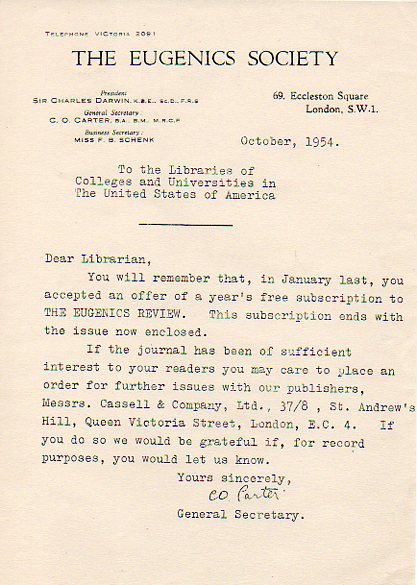
    That’s what I thought of when I saw this circular slide out of one of the volumes in the warehouse of the Journal of the Eugenics Society.  It warned librarians that the free ride their library had been given by the society was about to end–maybe–and that if the institution wanted to receive any further issues, they would need to buy them.

    Unlike  the Washington Times–still in business today–the Eugenics society didn’t make it.  It died decades ago. Died a death long overdue, died in its seventh decade.  Pieces of it lived from ancient times, famously with Plato, developing in more modern times into a societal, philosophical, scrapingly biological branch of pseudoscience, aimed generally at improving the human population through a more-or-less longitudinally dreamed belief system.  It was squared away and rounded up with social stats of Karl Pearson and number crunching of Francis Galton (who misunderstood the writing of his cousin, the beautiful Charles Darwin). And in spite of coming into a sort of Renaissance in the early twentieth century, it was mostly put away by Nazi monsters, who broke whatever basis in reality that eugenics had, almost entirely dealing the belief system a mortal blow.  Some people still felt comfortable with it enough to use it to continue a practice of population control by sterilizing anti0social elements–including prostitutes and drug addicts, and people of low IQ, but mostly, almost entirely, poor people–up until the 1970’s. 

    It looks like a desperate thing to me, this flyer (available from our blog bookstore, here).  It may well have been real, it may have been the case that it wasn’t this piece of propaganda that I see  it as to help sell a fatal science…but I don’t think so.  It looks pathetic, paper collar and starched shirt and doctorates and cufflinks and privileges notwithstanding.  And it reminds me of the desperate attempts of propaganda machines like The Washington Times to get its message across–even when it is very clear that there are not nearly enough people to fund it, a message machine in desperate search of an audience.

  • A Map of the Kingdom of Corsets or of Lost Laughter?

    I’ve revisited an older post on this blog, from October 2009, on a pamphlet about selling corsets.  It has a beautiful map of a corset department:

    In part:

    I should think that I would like to make a Kingdom Map for his image, some day.  It looks to me ready to accept the responsibilities of landforms or ideas or statistics or changes or comparisons in place of its plain nature of counters and countertops and display cases, empty boxes waiting for something a little more invigorating to depict.  Or maybe not, maybe the chance of display of transformations is enough to suit its peculiar, perhaps singular, needs.

    Or maybe on the Corset Map  instead of  substituting land and sea for corsets and boxes, one could substitute the noises of a quiet house at night, or the sound of heavy boots in a brittle-dry snow in the deep cold.  Or maybe a map of the discovery of children’s laughter, or inconvenient pauses in conversations through the history of human speaking…or a map of lost ways.

    Continue reading here.

    ·Posted by :

    ·in:

  • The Big Lie Department: Japan and its Version of Chinese “Aggression”, 1937

    JF Ptak Science Books  Post 1319

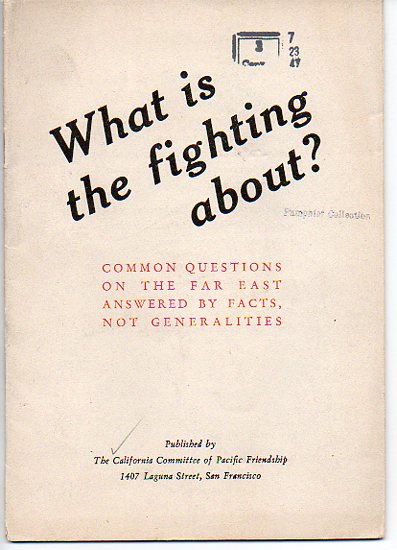
    This little  pamphlet is a great example of The Big Lie–propaganda so vast and so vicious and so far from the truth that people tend to believe it because, well, because no one would or could tell lies so Gargantuan and Pantagruelian and expect to get away with it. They were statements so spectacular and seemingly untrue that their very reverse weight gave them weight enough to necessitate “truth”.  Mostly on this blog the Big Lies I’ve dealt with came out of Germany–these had to do with the International Jewish Conspiracy, the plot of Poland to attack Germany, the resettlement that was going to be provided for French workers who came to the Nazi’s side to do technical work for the Wehrmacht, and so on. 

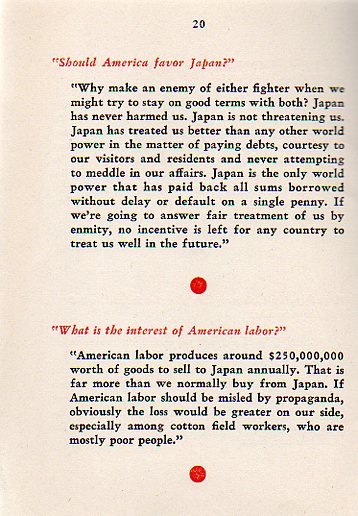
    Big Lie--Japan319 In this case it is Japan’s turn at The Big Lie to make its case to justify its already long and very bloody attack and occupation of China.  In short, what the publishers–the California Committee of Pacific Friendship (located at 1407 Laguna Street in San Francisco, the site of which today is ironically occupied by the Chinese Consulate)–tell their American audience is: that the Japanese are not aggressive; that China was planning to attack Japan to help unify their own country; that Japan needed to occupy Manchuria to protect Japanese citizens; that at the same time Japan was invited into China and was not going to leave because no one else does; and that is it is in the best interest of the U.S. to continue its valuable trade with Japan in order to protect the  poor people who pick cotton that goes into essential American-Japanese trade.  Virtually everything in this report is nothing.   Thats what makes it a Big Lie. [This pamphlet is available at our blog bookstore.]

    Part of the issue of invading China’ was to prevent Chinese aggression towards Japanese citizens, which was “a politically attractive campaign” and a cause of :China’s backwardness”. 

    There is no mention of Japan’s invasion of Manchuria in September 1931 following the Mukden Incident, an earlier version of a Gulf of Tonkin incident, a manufactured bit of terrorism by the Japanese military perpetuated against itself to give the Empire a reason to attack China. .  Manchuria was subdued by 1932 and  renamed Manchuko, and then used by the Japanese for its fantastic assembly of raw materials.

    In the same vein it was alleged in this pamphlet that it was China which bombed itself at Shanghai (Songhu), not the Japanese, starting what would be months of fighting in one of the largest and bloodiest battles of the 1937-1945 war.  It doesn’t make much sense for this top be the case, as the  National Revolutionary Army of the  Republic of China was vastly over matched by the  Imperial Japanese Army of the Empire of Japan.  (The Chinese enjoyed a 2:1 advantage in troop strength, but totally overwhelmed by Japanese tank and aircraft numbers and tech superiority.)  This pamphlet was published in November 1937, so the end of this battle–the first really of that would be twenty-two or so major engagements of the war–was still months away.  No doubt that an updated version of this pamphlet printed in 1938 would note the 70,000 Japanese soldiers killed without mentioning their own belligerent status or the 200k Chinese killed during the same time.     

    Big Lie--Japan text320
       

    The Japanese wouldn’t have to bother with this sort of propaganda after 7 December 1941.  It would’ve been hard to explain it all, especially the 17,000,000 Chinese civilians being killed in the process. And the 3 million Chinese soldiers1. Quite a long and twisting road from protecting Japanese citizens in Manchuria in 1931.

    Notes       

    1. Nationalist Chinese military forces included 1,320,000 killed in action, plus 1,797,000 wounded, with another  120,000 MIA. The Communist Chinese forces included another : 500,000 total casualties. Japanese forces include about 396,000 KIA plus another 430,000 MIA and WIA. Another estimate from the Japanese side gives the figures for Japan’s losses at ( 1937–1941) 185,647 KIA. 496,000 wounded, and 430,000 incapacitated; plus for the  1941–1945 period,  another 202,958 dead.   Nationalist Chinese estimates for Japan’s losses for 1937-1945 were 1.77 million KIA and 1.9 million WIA

  • Brevity and Complexity–Radio Programming, 1940

    JF Ptak Science Books   Post 1320

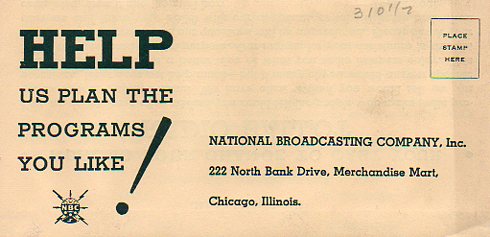
    Radio Ballot c cvr323   I think that if a grown-up kid in 1940 was offered the chance to have a working-man’s Super Power,to be suddenly endowed with a non-heroic Super Something, a popular choice could have been to possess  radio repair vision (RRV).  Or that’s what it seems like.  The popularity of radio was so fantastic that ownership of radio sets doubled in the United States from 1931 to 1938, when houses with radios rose from 40% to 80%. Radio was everything.  There were many contributory factors to this phenomenal increase in popularity, not the least of which was the Great Depression–once you got your radio the listening was basically free except for the power that it cost to run the radio.  Recorded disks on the other hand suffered tremendously, with sales falling from $75 million in 1929 to 23 million in 1938 (with a low point of $5 million in 1933), and that would be due to the Depression and the the popularity of free stuff on the wireless, as well as other things.

    Radio Ballot a321

    People maintained their radios, kept them in good order, tinkered with them, cleaned the tubes, replaced the tubes, kept things going.  Those early units were pretty hearty, overall, but there was a certain percentage of folks who couldn’t do the basics for themselves, and so would bring in their radio repair man.  He was an important fixture in a community–not quite like the milk man or the ice man, who would be seen everywhere every day, but popular enough.  TO be able to fix radios with supervision and kept millions of people connected would’ve been a big deal, especially if you thought about it with the mind of a ten year old.

    Radio Ballot b322

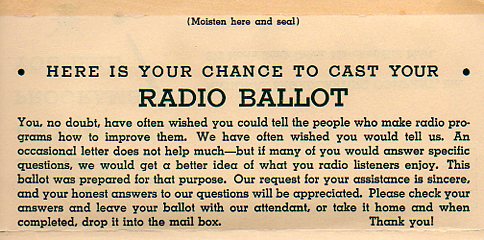
    I’m just trying to establish the popularity of radio with this aside to get at the main point of this post–how radio executives at NBC tried to access the common knowledge base of what people wanted to hear on the radio, and when.  And one aspect of that was seen on this single piece of paper: [The original is available for purchase at our blog bookstore.]

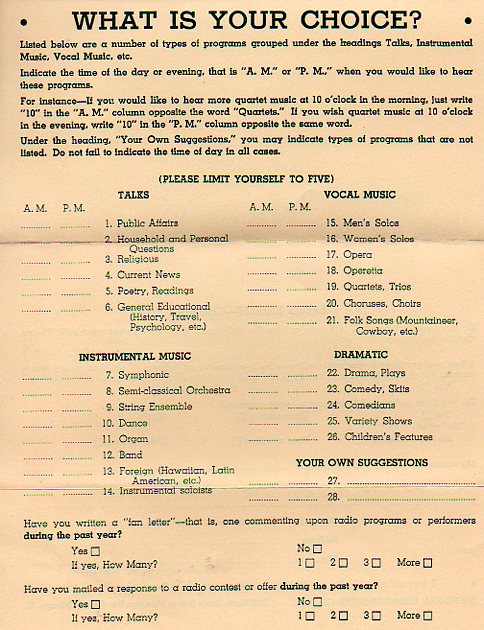
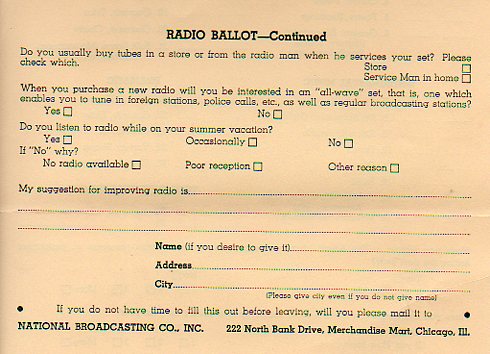
    The National Broadcasting Company sent out self-adhesive mailers to people to probe their listening needs.  This would seem prehistoric by today’s standards of estimating what television/video watching people were like and what they would want to see, and perhaps to pay for.  But in 1940*–or perhaps a little earlier–this was one method of making this determination, with a gentle survey about what the listener wanted to hear, and when.   And they were expected to pay for the privilege, as well, as these self-,mailers weren’t pre-stamped. 

    On the questionnaire of listed types of programs we find 26 examples, including six for “talk radio”, sixteen for music (eight for  instrumental and seven for vocal!), and then only five for the dramatic stuff (comedy shows, drama, variety shows, and even one for children. (An historian of radio programming would probably know instantly the age of this flyer given the number of slots slated for the drama shows, I’m sure.) The division  of the music is also interesting, particularly for me since “string ensemble”  is one of the 26 overall programming selections, though I doubt that they were talking about the late quartets of Beethoven–I think they might have been referring to sweeping, thousand-string “beautiful” music.  Also the division of “opera” and “operetta” is unusual.
    Radio Ballot d324

    The “brevity” part of listen surveys is certainly attained here–the complexity part will come a little later.  Radio surveys became very sophisticated in the mid-1950’s when radio’s existence was threatened by television, which completely dominated the market for talent and advertising dollars and listeners by the late’50’s. 

    Notes

    There’s no direct mention of FM radio, which came into some restricted use by 1938-1940 and which is not mentioned explicitly here.  Perhaps this means that this was issued before FM–or perhaps it is later, as I said, and simply just not mentioned.

  • World War I Photography–Soldiers at the War’s End, Germany, November 1918

     JF Ptak Science Books   Post 1321

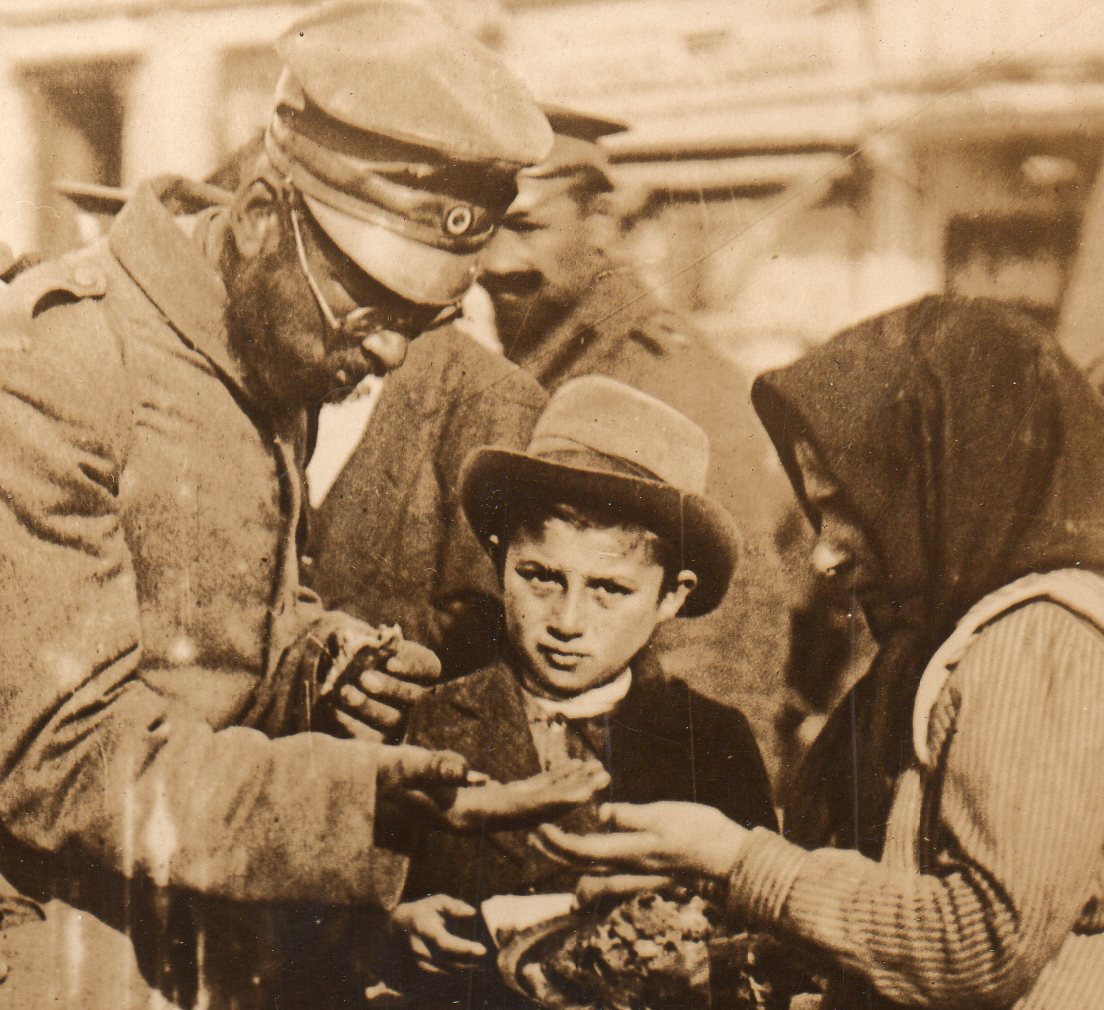
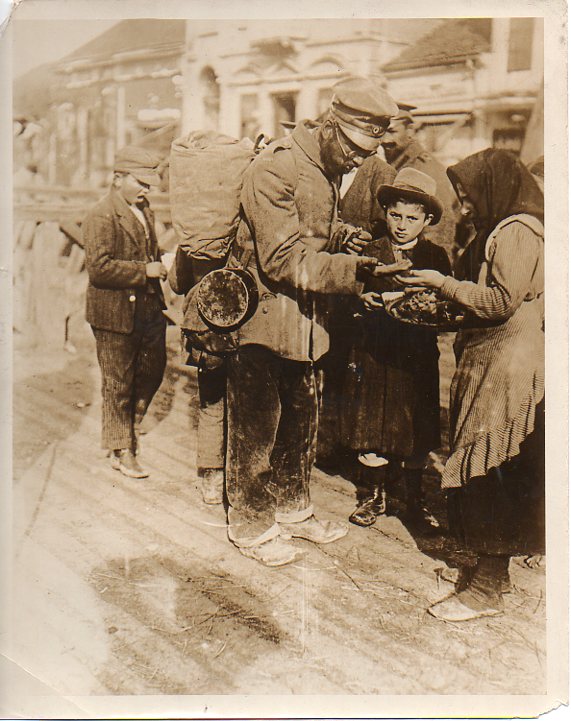
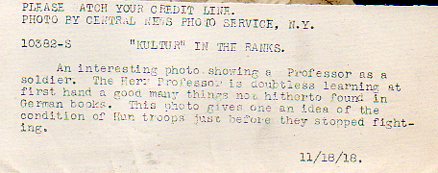
    I’m not sure what this photo depicts specifically but in general it sends an image of exhaustion and wear.  The caption for the image says that it shows “the condition of the Hun troops” and that the subject “Herr Professor” is learning “a good many things not hitheroto found in books”.  Maybe he was a teacher, maybe not.  Machts nichts. His pants looks velour-like and his boots (if that’s what his footware was) look very thin.  He is ragged, his double-fold glasses look like they’re at their limit, his face looks swollen behind his beard, and he just looks “done”, in general. 

    WWI--german--beggar det326
    [The original of this photograph is available at our blog bookstore.]

    I’m not sure what he is doing, or where he is.  He may be trying to figure out local currency to purchase whatever it is the vendor-woman has on the tray at her hip–she os holding out her hand, and looking at his.  The soldier definitely has something there, and he looks basically too weary to comprehend it.  the hand language is ambiguous to me.  He may have received something already, some sort of food, and he is staring at it now, thinking perhaps how little of it there was.  He’s eating, and already has taken a bite of whatever bread-like thing is in his left hand.  I’m not sure what attracted the attention  of the boy in the center–perhaps it is simply the camera, and he wanted to be in the shot. 

    WWI--german--beggar325

    There’s a shadow in the foreground-left of what looks like someone making a photograph of teh scene–probably not our photographer, but another, with a brownie or some such smaller camera.

    At the end of years of fighting every general soldier deserves respect and, at least, some free food–I hope this guy got his.

    And the accompanying text to the news photo service image, to be used if published:

    WWI--german--beggar text327

    ·Posted by :

    ·in:

    —

Recent Posts

Archives

Categories