A Daily History of Holes, Dots, Lines, Science, History, Math, Physics, Art, the Unintentional Absurd, Architecture, Maps, Data Visualization, Blank and Missing Things, and so on. |1.6 million words, 7500 images, 4.9 million hits| Press & appearances in The Times, Le Figaro, Mensa, The Economist, The Guardian, Discovery News, Slate, Le Monde, Sci American Blogs, Le Pont, and many other places… 5000+ total posts since 2008.

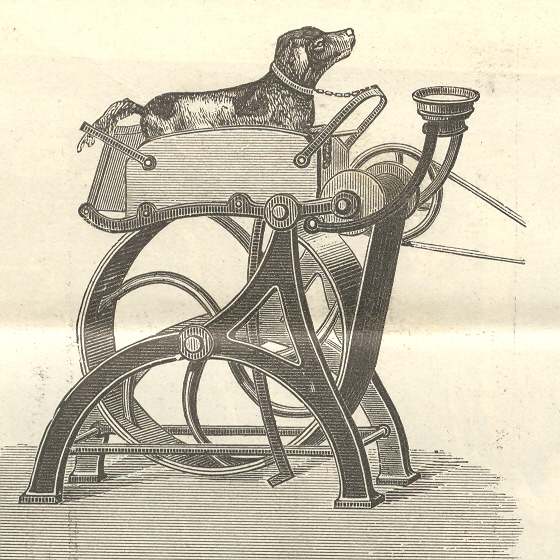
  • The Incredible and Useless Dog Engines of 1895 and 1939 (continued)

    JF Ptak Science Books   Post 797 (Sept 2009) Extended. 

    ++00++ 9.22 dog


    In 1702, at the beginnings of the Industrial Revolution, Thomas Savery (c.1650 – 1715) began the idea of calculating the work done by steam engines over that done by horses, writing in his book, The Miner’s Friend:

    “So that an engine which will raise as much water as two horses, working together at one time in such a work, can do, and for which there must be constantly kept ten or twelve horses for doing the same. Then I say, such an engine may be made large enough to do the work required in employing eight, ten, fifteen, or twenty horses to be constantly maintained and kept for doing such a work…”   But it was James Watt who first introduced the term ”horsepower” while trying to advertise and place forever the idea of his steam engine over than of the earlier Newcombe engine and, of course, horses.”


    See the full post here

    ·Posted by :

    ·in:

  • A Note on Tricycles in the History of Nothing

    JF Ptak Science Books   Post 1576

    Lbikes--tryke645
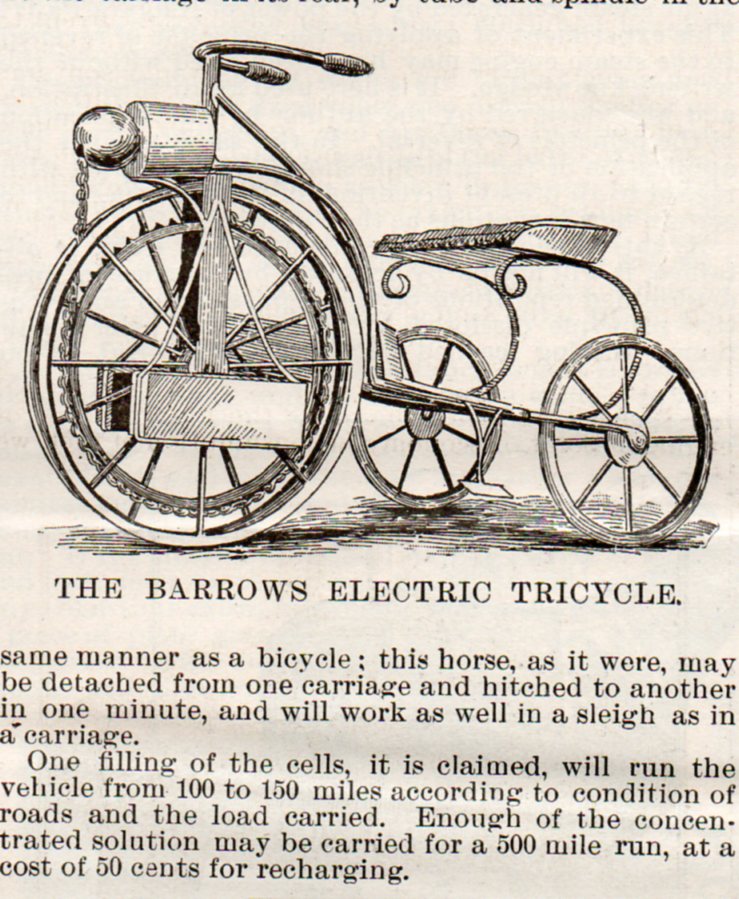
    This image–from the Scientific American Supplement for 25 September 1895–triggered an immediate reaction, though not for the electrification of what looks like a child’s toy. Charles H. Barrows of Willimantic, Connecticut patented this bike, which turns out to be a considerable object–it has a two hp engine which is powered by a hundred-pound battery that is “stored in the two cabinets” (measuring 24x8x8) on either side of the hub, making the wheel I guess somewhere around 34-36″ in diameter. After everything was said and done, the trike was a big, heavy, thing, in spite of a fairly spartan design in the rest of the bike.

    What the woodcut remind me of was William Eggleston’s quiet, odd, iconic and enigmatic portrait of a tricycle, which  I think launched a new photographic experience for the suburbs–a kind of Robert Frank for people doing “okay”.

    Tricycle

    Eggleston’s work, including this s image above (Untitled, Tricycle and Memphis, 1970), was a subject at a MoMA show in 1976, William Eggleston’s Guide.  It was received with long glances down long noses–seen as a banal exercise in the portrayal of everyday stuff in everyday settings, critics saw the semi-nothingness in the photos as simple all-nothingness, with one critic asking “a guide to what?”  But the Eggleston show was far more than that, showing the bits–in color–of American cultural life in middle class seclusion, a splendor of small Americana. 

    Bill Owens, working at about the same time as Eggleston, also shared his vision on the restricted glory of the suburbs in his Suburbia, spreading his discoveries of new-found cultural diversity.

    http://adventurepatches.files.wordpress.com/2010/05/suburbia-boy-with-gun.jpg

    The critics saw basically nothing in these works when they were first shown, though they had a lot more going on for them than the electrified tricycle, which was far too big and heavy to have done any good for anyone (though the design of the sprocket/wheel was pretty interesting).  The only nothingness that are in the photos of Eggleston and Ownes was the nothing that the critics chose to see.  Sometimes new, different ways of looking at things as in the cases of these two photogrpaher makes it seem as though it is a newness of nothing, but only for a short time, until everybody else showed up. 

  • Before “Cosmos” 2012 there was “Cosmos” 1845

    JF Ptak Science Books  Post 1577    

    http://images.ha.com/lf?source=url%5Bfile%3Aimages%2Finetpub%2Fnewnames%2F300%2F5%2F2%2F6%2F7%2F5267792.jpg%5D%2Ccontinueonerror%5Btrue%5D&scale=size%5B220x350%5D%2Coptions%5Blimit%5D&source=url%5Bfile%3Aimages%2Finetpub%2Fwebuse%2Fno_image_available.gif%5D%2Cif%5B(%27global.source.error%27)%5D&sink=preservemd%5Btrue%5D

    Before the Neil deGrasse Tyson version and update of Carl Sagan’s landmark tlevision series, Cosmos, there was Alexander von Humboldt, and his enormously influential book of the same title, printed in 1845-1862.  Well, von Humboldt’s (1769-18591) book was actually Kosmos when published in German, which is where it started its life (and which von Humboldt suffered mightily for in it English translation).  Von Humboldt was enormously studied and educated and of a high scientific mind over many subjects, one of those 19th century figures who seemed as though they could know everything, a polymath of high order (along the lines of Goethe and von Helmholtz and Thomas Young and others).  He was a meteorologist and biogeographer before those sciences existed; a naturalist, geographer, archaeologist, and explorer, a natural philosopher of magnitudes.

    Kosmos reflected his lifelong interest in order, and what he did was astonishing–he attempted to unifying the complexities of nature in one book (of five volumes), binding the various branches of science together in a cohesive whole, attempting to show how the laws of the universe acted here on Earth.  It was a very influential work, very progressive, a masterwork of scientific method.  Kosmos.

    Sagan (and Tyson, soon) tried to explain what the universe was all about; 160+ years ago, so did von Humboldt, and for his time he came damned close to doing so, or as close as anyone could possibly come. 

    Notes:

    1.  von Humboldt died six months before the On the Origin of Species was born–an enormous pity. 

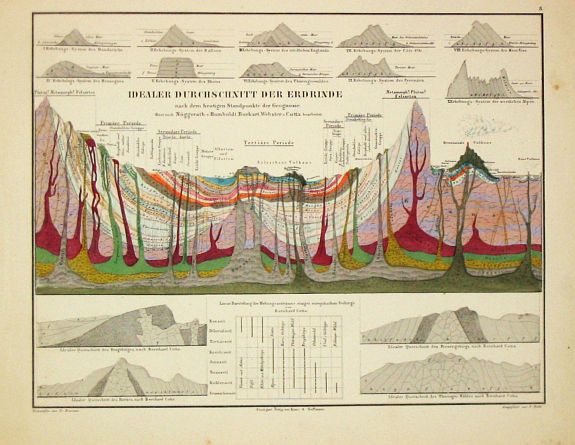
    Map from the atlas to accompany  Kosmos, a masterpiece of physical geography and the display of quantitative data:

    Old map by Humboldt, A. von. - Atlas zu Alexander von Humboldt's Kosmos.

    From the bibliography, Printing and the Mind of Man, which colelcted the epochal books in the history of science and medicine, we read this about Kosmos:

    ·Posted by :

    ·in:

  • History of Lines: the Desire Lines of William Blake

    JF Ptak Science Books   Post 1578    [Part of this blog’s History of Lines series}

     The post dedicated to Patti Digh, brilliant writer and birthday girl, who wrote a lovely, image-filled  essay on Desire Lines back in December 2005 on her award-winning blog, 37days. I think the idea of Desire Lines is one of her favorites, and so I tried to imagine my own in her honor, a small Festschrift for the birthday girl.  Happy Birthday, P.D.!
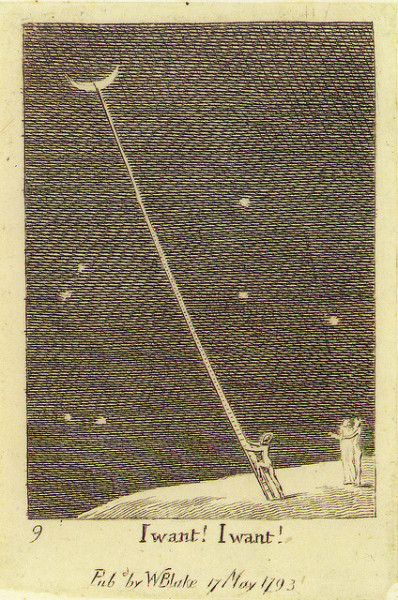
    ‘I want! I want!’ (1793) by William Blake Alastair Sooke examines Blake’s endearing engraving documenting the stages of man’s life This sweet engraving by William Blake is a vision of rudimentary space travel created centuries before Neil Armstrong was even a twinkle in his father’s eye. It isn’t hard to imagine the mystical poet and artist in his Lambeth garden, gazing at the starry sky and dreaming of a slender ladder propped up against the moon. A memorable image of aspirational zeal, I want! I want! is one of 18 tiny engravings, measuring 6cm x 5cm, that document the different stages of man’s life, published together as For Children: The Gates of Paradise in 1793. It is on show at Compton Verney in Warwickshire, part of an idiosyncratic exhibition which examines the ways in which Western artists have grappled with the cosmos since the days of Galileo. The astronomer’s Sidereus Nuncius (The Starry Messenger), published in 1610 and on loan from Corpus Christi College, Oxford, gives the exhibition its name, and can be seen alongside work by contemporary artists such as Glenn Brown, Steve McQueen and Wolfgang Tillmans.

     William Blake had a hard time of things, what with being thought of in unflattering terms of crazy vs. insane by many people rather than, say, being though of as “creative”.  He led a good and relatively long life (1757-1827), and by his artistic and poetic creations inspired generations of other creatives, though he was very little recognized during his lifetime.  He was a seeker, and was somehow able to do his art and printmaking and poetry without a substantial income, living mostly on adequate income and patrons, slowly advancing to semi-poverty as he aged , but dying without a debt to his name.

    The “line” that I site above to his unusual work, The Gates of Paradise–not the Baptistery doors by Ghiberti–, was actually a ladder and a collection of lines, but with the application of perspective becomes one combined line quicker and longer than it could ever be a ladder.   Blake’s character, as with Blake himself, wants whatever it is that he can have, conceivable or not; and som, if he wants the Moon, he just goes to get it.  This version of The Gates of Paradise, which is largely a story of pictures and a few words as legend, was intended for children, perhaps–or at least that’s what the title says.  In any event, its an interesting message to send to children whether it was actually intended for children of the chronological age, or not.  The “I Want, I Want” legend really wasn’t necessary, as the image stands on its own.

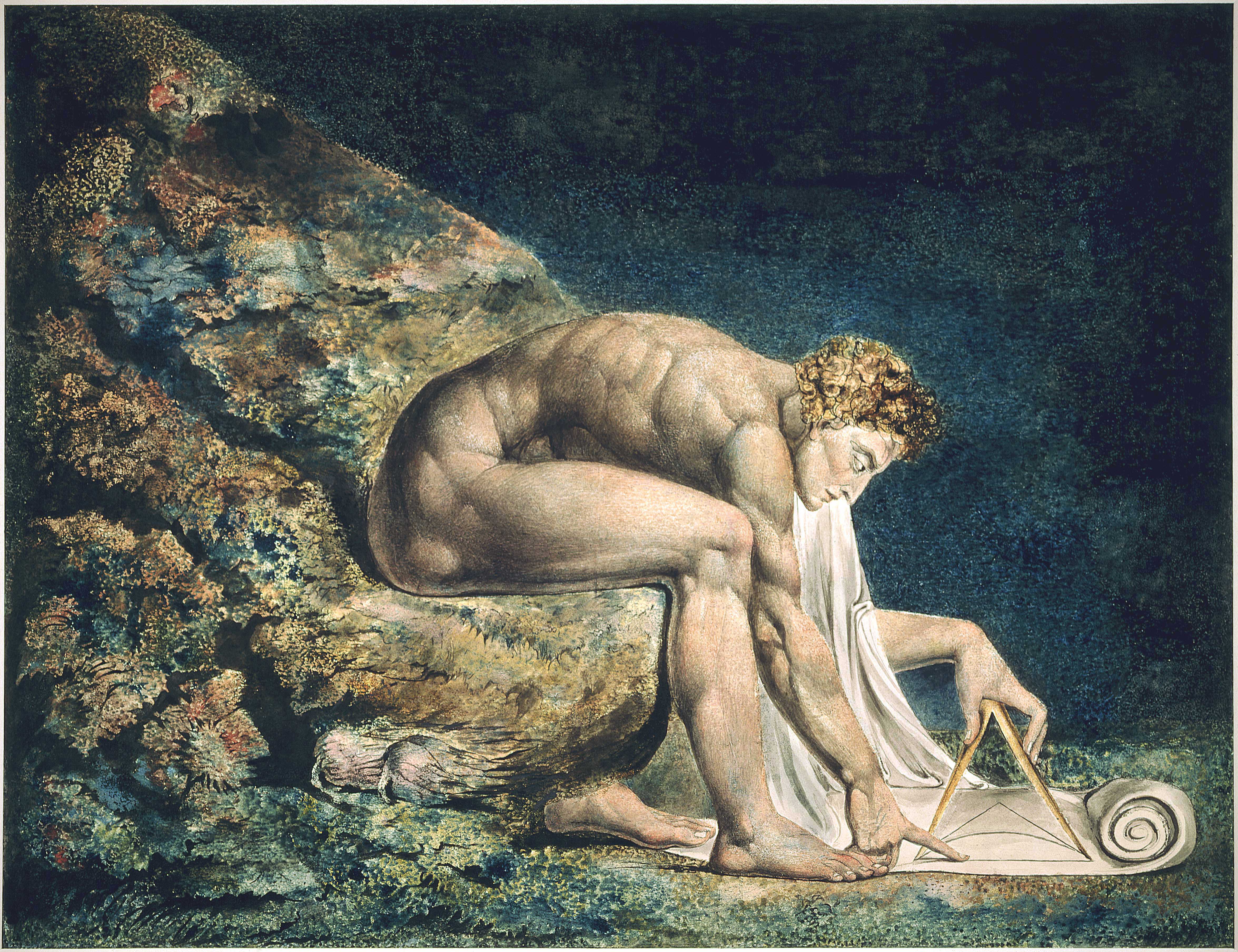
    Blake liked to tell a story with lines like this, as we see in this famous image of Newton:
    File:Newton-WilliamBlake.jpg

    Blake was an impossible anti-Newtonian–at least in my limited reading of the man–making a career of being a spectacular and beautiful anti-rationalist,  a weaver of smoke, playing with and distorting images like a theramin player of words, using language to produce dichotomies in even the most standard of sensate ideas.  Blake was the poster child for thing anti-tech, an anti-scientist out to save the world from its scientific self,  the rationalist world set to destroy imagination, the “Antichrist science” hell bent on destroying the soul of art and religion. 

    “Art is the tree of life; Science is the tree of death” wrote Blake, and so he chose the “Athesistic”  Sir Isaac to stand for the beast, depicting him in art as a naked geometer intent on subjugating the world with a compass and a keen brain, reducing glory to quantification, the work of Satan..  For most of my life I thought that this image by Blake was celebrating Newton—I knew little of the poet/artist/poet, and thought the painting a reverence.  When I understood Blake a little,  I saw that the image was intended as a mockery of Newton and the idea of science—this was an unusual sensation, because absent the unspoken intention of the artist,  you could still take the subject matter of the artwork two ways. 

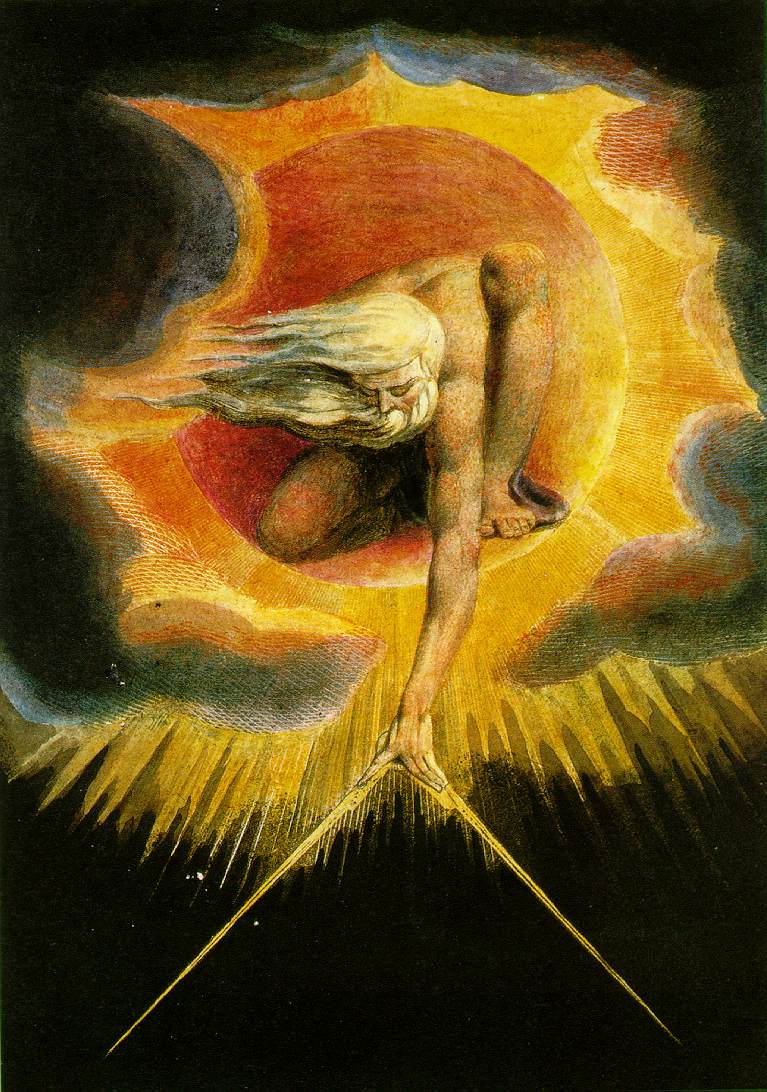
    And of course the Creator:
    http://upload.wikimedia.org/wikipedia/commons/a/ae/Blake_ancient_of_days.jpg


    God is presented as the Great Geometer, the creative power of the universe issuing forth with compass/dividers, was perhaps a kind of Greek conception of the rule of the universe and its interaction with all things on Earth. 

    But it is interesting that in the end, Blake displays the sublime reasoning powers of Heaven and Earth, in the forms of God and Newton, both with desire lines.  I think he enjoyed doing that. 

    The Series “For Children” of 1793:
    ·Posted by :

    ·in:

    — —
  • Present at the Creation–“Physics Today”, 1948

    JF Ptak Science Books   Post 1579

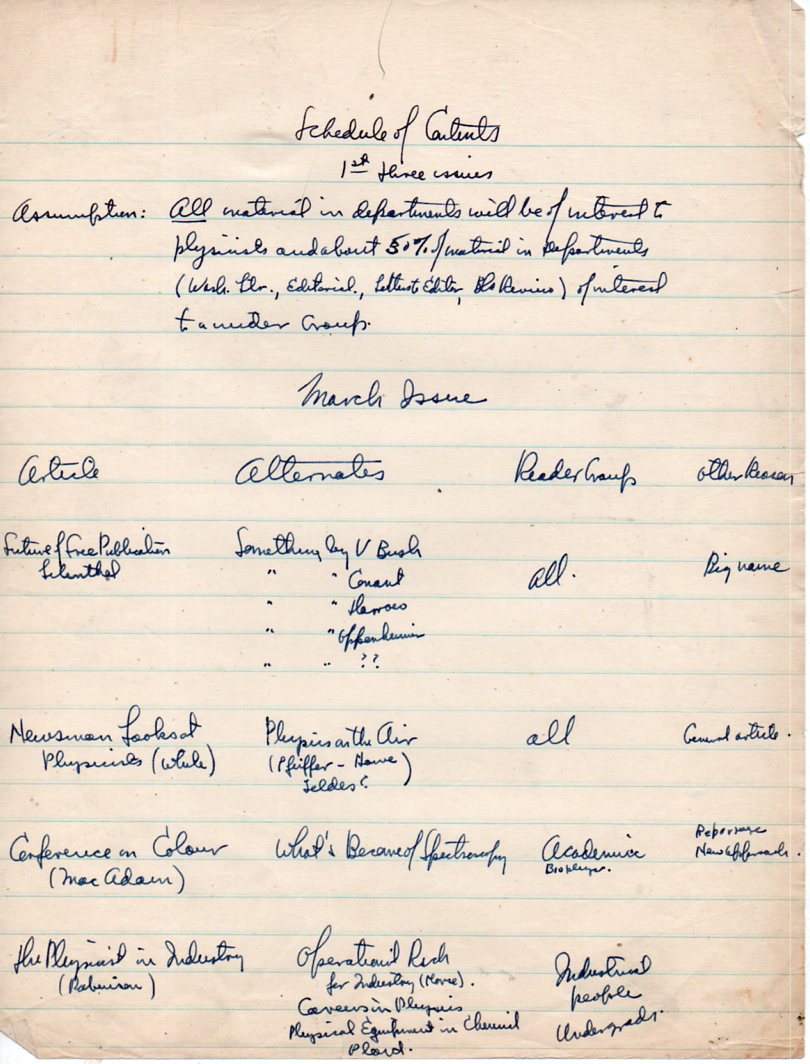
    One of the real pleasures of being a bookseller is the discovery of the unexpected source–in this case it was a small group of papers that at one time belonged to David Katcher, who–among many other things–was the first editor of the American Institute of Physics’ magazine, Physics Today.  It was started in 1948 to help bridge the gap between good science writ bad and hard science writ even worse for the world of the general reader. These are a few of the fragments from the editor’s desk, as Katcher was organizing his thoughts about what the magazine would be about, who would write for it, and how the ideas would be presented. 

    For example, this worksheet for the first issues of the magazine outlined articles by some of the heaviest names in physics, with “something” by Bush, Conant, Oppenheimer; as well as who would be the target audience (“all”);  and who the contributors would be (‘big name”).  Quite a different world and pace, then, and one in which a forceful man like Katcher could do a lot in, and quickly. 

    Physics today646
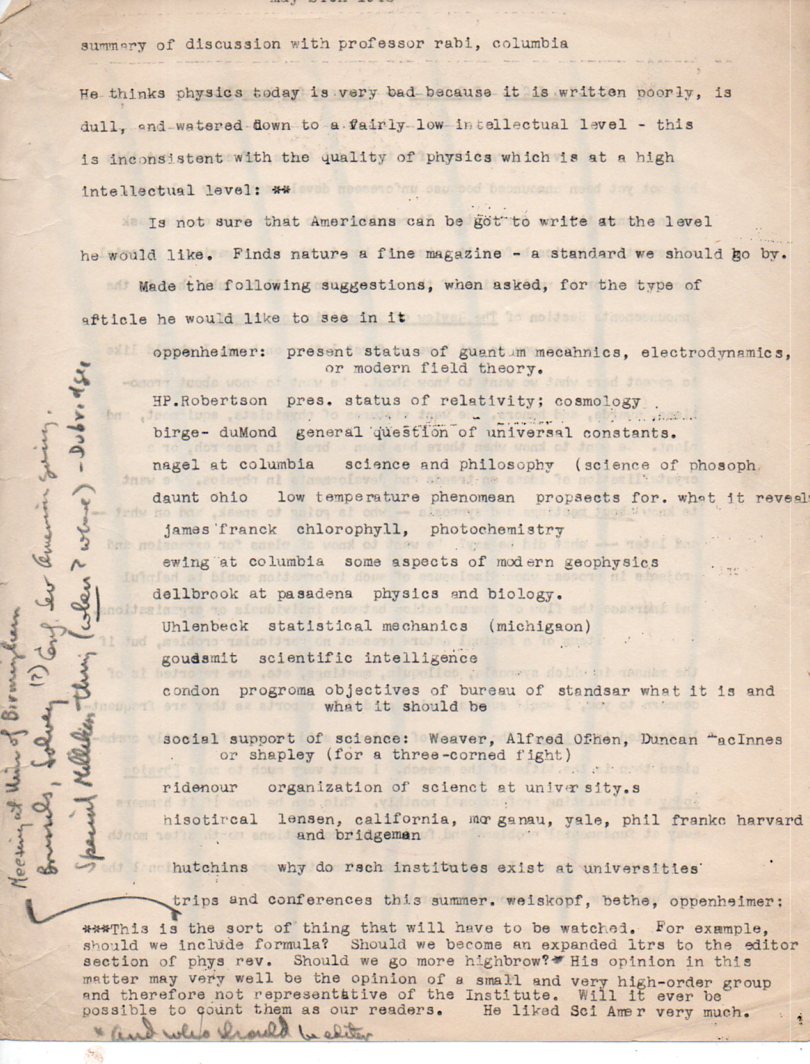
    Then there’s this interesting page of notes of a conversation between Katcher and the great I.I. Rabi, who offered some suggestions and insights about what might appear in the new magazine:

    Physics today649 And this, Katcher’s very clear statement on editorial policy (for 28 July 1948):

    ·Posted by :

    ·in:

    —
  • History of Lines: the First Heart Catheterization, 1928

    JF Ptak Science Books  Post 1580   [Part of the History of Lines series.]

    Werner Forssmann (1904-1979) was a tough man.  He had an idea for injecting drugs into the heart quickly for certain emergencies and came up with the idea of cardiac catheterization, thinking that it might be possible to pass a catheter through the veins of the arm and into the right side of the heart.  In 1928 he acted on the idea, on himself: he applied a local anaesthetic and with a cannula inserted a catheter into the antecubital vein of his arm, sliding it 65 cm into his body; then he walked (with the aid of a nurse) into radiology and completed the journey of the catheter into the right auricle of his heart.  He had tried this procedure earlier with the aid of another physician, who wound up alarmed because of the pricking something in along the way, not to mention the possible danger of inserting a foreign object into a living heart. Forssmann met success alone on the second attempt, though he did make an x-ray of his experiment:

    Forssmann654

    That’s some pretty significant self-experimentation.  Forssmann would be awarded the Nobel Prize for Physiology or Medicine in 19561, 28 years after the publication of this epochal paper, and 13 years after the end of Forssmann’s career as a surgeon-major during WWII, also during which he became a Nazi. 

    Notes:

    1. “The Nobel Prize in Physiology or Medicine 1956 was awarded jointly to André Frédéric Cournand, Werner Forssmann and Dickinson W. Richards “for their discoveries concerning heart catheterization and pathological changes in the circulatory system…”

    The above image is a detail from the illustration used in the publication of Forssmann’s results “DieSondierung des rechten Herzens” in Klinische Wochenschrift (1928):

    ·Posted by :

    ·in:

  • History of Lines: Looking Straight Down from Straight Up, 1786

    JF Ptak Science Books   Post 1581

    Looking down656
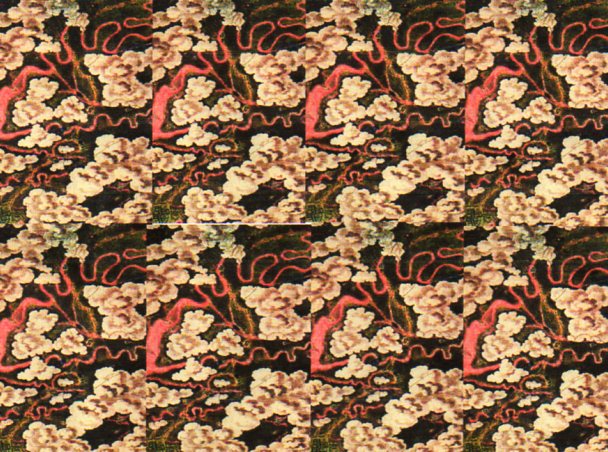
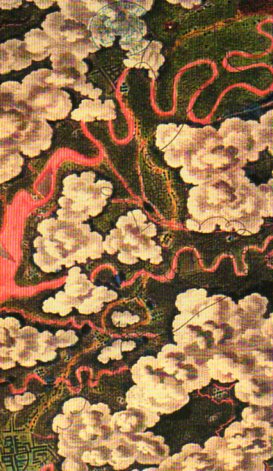
    I was struck by the mosaic possibilities of the image (below) found in Thomas Baldwin’s Airopaidia (printed in 1786) and so made it into one.  But what the engraving is,m really, is a view from a balloon, looking straight down.

    Looking down655

    We’re looking straight down, through the clouds, seeing two towns (at bottom-left and top-center)–why the rivers are red, I don’t know.

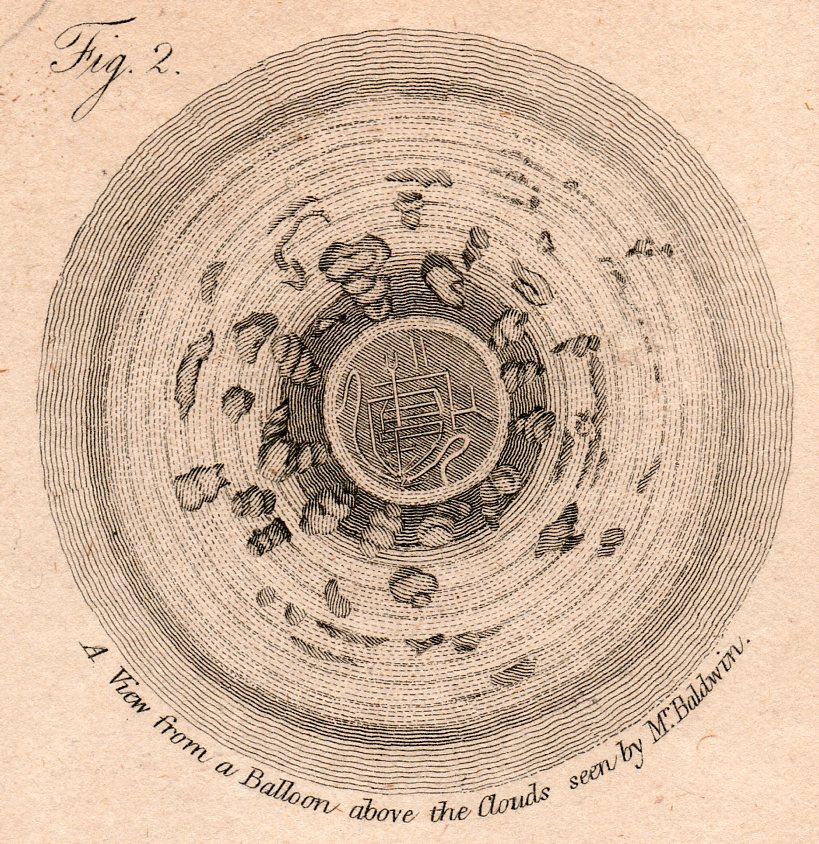
    There are other posts on this blog on looking straight down, which is an attractive subject–to me, at least. First-hand images of looking straight down fro a balloon are rare things, even through the early 19th century, and offer a prospective seldom seen in human history.

    Another view from this work attempts to show some depth:

    http://vintageprintable.com/wordpress/wp-content/uploads/2010/09/Science-Flight-View-from-Balloon-18thC.jpg

    Here’s another view of that same image from the Baldwin experience, reprinted around 1810, and left in black-and-white:”

    Looking str8t Diwn-balloom det220

     Halton Tuner makes these observations on Baldwin’s flight in his iconic Astra Castra: Experiments and adventures in the atmosphere 1(published in 1864 in London): 

  • History of Holes: the most Famous Hole in Art?

    JF Ptak Science Books  Post 1583   [Part of the History of Holes series]

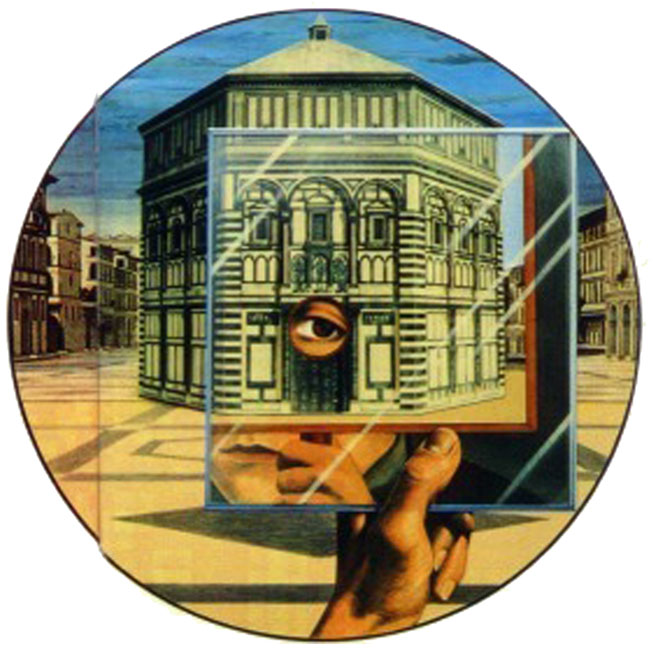
      Holes--brunelleschi2_large

    Filippo Brunelleschi is most often credited–from Vasari to Kemp–as the modern discoverer of linear perspective (or re-discoverer in the eyes of Samuel Edgerton Renaissance Rediscovery of Perspective, 1975 or John White, The Birth and Rebirth of Pictorial Space, 1987).  The Greeks most certainly had mastered some aspects of perspective as is in evidence in their surviving architecture (though not artwork remains exhibiting this), but Brunelleschi for all intents and purposes1 discovered it for the rest of humanity. 

    Edgerton remarked that the discovery “marked an event which ultimately was to change the modes, if not the course of Western history”, with one reason for this magnitude being that technological and architectural ideas could be far more easily intellectually-transmitted as societal property rendered in perspective than had they not been issued so.  (I wonder, for example, if this might have been the reason why there was no Chinese technological renaissance during the Renaissance–because the idea of linear perspective was not adopted until relatively late, meaning that transmitting complex technical ideas was far more difficult.)

    Brunelleschi employed a brilliant method to capture the depth of his scene–in this famous case, the Baptistery in

    peepshow.gif

    Florence.  Employing this method helped the architect to understand the mathematical principles of perspective and to become its earliest master. 

    Perspective is the romance of balance and the mathematics of proportion, at the center of which is the vanishing point, an interestingly-named point of departure and similarity, where parallel lines not parallel to the image plane appear to come together, in an early singularity.  So it is this great and famous hole helping to establish a great and famous dot (which I guess could make an appearance of its own in this blog’s series on The History of Dots). 

    Perspective c

    Another famous hole that comes a little later (a hundred years or so later) belongs to Albrecht Durer (The Painter’s Manual, 1525)

    http://www.oneonta.edu/faculty/farberas/arth/Images/ARTH_214images/Durer/durer_perspnude_large.jpg

    where Durer illustrates the artist at work using a perspective device along with a vielo. 

    There are other holes in the history of art to be sure, but these are perhaps the most significant ones that appear in the Renaissance–there are others in architecture, for example, but my thinking is that the Brunelleschi hole takes precedence.  Other interesting and significant holes begin to appear a little later on, for the development of peep machines, and the camera obscura, and then of course photography, but they will come in a later post. 

    Notes: 

    1. Earlier though not complete efforts were made in Alhazen’s Perspectiva, c. 1000 A.D., Roger Bacon’s Opus Majus, c. 1260 A.D., John Pecham’s Perspectiva communis, c. 1270 A.D..,  and Alberti’s  Della pittura (1435).

    Another perspective machine of Durer: 

    ·Posted by :

    ·in:

    — —
  • History of Lines, #17: the Artist Painting the Negative, Camille Corot, 1874

    JF Ptak Science Books   Post 1584   [Part of the History of Lines series]

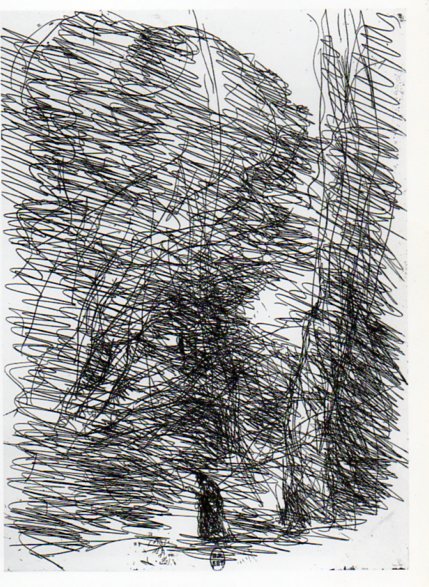
    Corot657 An interesting appearance of lines in art that seemingly crosses several disciplines and chronological development is Jean-Baptiste Camille Corot’s The Dreamer and the Large Trees (1874).  It is vivid artwork full of motion, expressing itself in an impressionistic sense that seems almost more abstract expressionist than mid-early Impressionist. (As an Impressionistic work it would be well into the second decade of the movement; if Abstract Expressionist, it is three decades early.)  It is a brusque, almost savage portrayal of a somber person in a deep wood, though the lines that is is composed of say anything but that. 

    The print was made via the cliche verre process1–Corot used a semi-photographic medium in which there was no camera, as it was the artist who drew the negative, who created the image from nature without a lens and without a camera body (thus eliminating lensless photography like pinhole), drawing directly on the medium (which in this case is glass, insinuated by the cliche) and then exposed/printed onto a photo-sensitive paper (the verre).  The artist is in a sense making a photograph directly of the image in their mind, recording it on the medium, and then printing it from there. 

    Of course there are other important lines in the history of art: Vincent Van Gogh Starry Night (1889), Giacomo Balla, Street Light (1909), Umberto Boccioni States of Mind (1911), Michael Larionov’s Rayonist Painting (1913),   Robert Delaunay Windows, (1912), Roberto Crippa (1921-1972), Jackson Pollock (1912-1956, particularly Number 1, 1948), and any numbers of works by Barnet Newman.  And of course the Cubists: Braque, Gris, Picasso, and the rest; the Constructivists like Malevich, and on and on into the sunset.  But the reason I’ve chosen Corot is because of the unexpected, wildish impressionist qualities that seem so far out of place, even with the movement. 

    Notes:

    1.  Cliche Verre was quite popular with French artists of this period, used by Theodore Rousseau, Charles Daubigny, Charles Jacques, Francois Millet and others.  The process itself appeared very early on in the history of photography, being described in Robert Hunt’s technical manual on artistic photography as early as 1841, two years after photography’s beginning.

    The images:

    ·Posted by :

    ·in:

    — — —
  • Apocalypse Then–World War III, The 36-Hour War of 1948

    JF Ptak Science Books   Post 1585  [Part of a long series on atomic and nuclear weapons]

    This is also part of a sub-series on the invasion of attack on America; examples of other posts include: Mapping the Invasion of America, 1942 (which is the most-viewed post from this blog, with over 500k readers), The Invasion of America, 1935,  Bombing Manhattan and the Amerika Bomber, 1943, and The Invasion of America, 1942, Part II .

    In the very near wake of the bombing of Hiroshima and Nagasaki, the editors of Life magazine published a prescient bit of propaganda on the coming of the Cold War.  I guess though that the Cold War had already begun by Yalta1, when the sick and basically-terminal FDR seems to have been corralled by Bloody Joe Stalin, leaving the new President Truman on alert for the possible coming aggressiveness of the Soviet Union.  The article appeared in the 19 November 1945 issue (pp 28-39), and it was a longish one, with nine illustrations (by A. Leydenfrost), and as articles go in Life from this time, this one was heavy. 

    It built itself up on a report generated from the offices of General Hap Arnold, and reckoned a new war, a New War, World War III, to occur in 1948–except that this time there were no natural difficulties that the U.S. could hide behind. (Arnold said: “…with present equipment an enemy air power can without warning, pass over all formerly visualized barriers and can deliver devastating blows at our population centers”.) The threat would come from above, and there would be little accurate defenses against them. 

    There would be survivors but massive destruction and death–and remember that this was at the point of the simple atomic weapon, before the development of the big stuff.  In the opening images of the article, a chilling two-pager showing eight major American cities being struck by atomic weapons, resulting in at least 10,000,000 casualties.

    But as grisly as all of this was, the American reader was told the the United States would prevail, and that our rockets “would lay waste” to the enemy’s cities; “the U.S. wins the atomic war”.

    [Image sources:  I’ve used the image from the Drexel University site as my copy of this issue of Life is in a massive half-yearly bound volume, impossible to scan.]

    This is what New York City was supposed to look like, afterwards, with inspectors sizing up the radiological waste of what was left of the NYPL at 412nd Street:

     Notes:

    1. The Yalta Conference was the third meeting between the leaders of the U.S., the United Kingdom and the Soviet Union, held 4-11 February 1945.  It came after the Tehran and Cairo Conferences, and preceded the final Potsdam Conference on 17 July- 2August 1945.

    More illustrations:

  • Heavenly Chinese Space Program Posters

    JF Ptak Science Books  Quick Post

    I don’t know quite what it is about these poster for the Chinese space program, but they are magnificently bad, or simply beyond what I can consider “good” color sense and design.  Perhaps they are all just “something else”. 

    The source for the images:  Chinese posters.net.

    Little guests in the Moon Palace, early 1970s

    Roaming outer space in an airship, 1962

Recent Posts

Archives

Categories