A Daily History of Holes, Dots, Lines, Science, History, Math, Physics, Art, the Unintentional Absurd, Architecture, Maps, Data Visualization, Blank and Missing Things, and so on. |1.6 million words, 7500 images, 4.9 million hits| Press & appearances in The Times, Le Figaro, Mensa, The Economist, The Guardian, Discovery News, Slate, Le Monde, Sci American Blogs, Le Pont, and many other places… 5000+ total posts since 2008.

  • Battlebots of the First Mobile Computers: 20 Tons of Fun

    JF Ptak Science  Books      Post 1741

    Well, perhaps not “fun”, unless that was an acronym for “fabulously understated nomenclature”.   The first mobile computers–as science fiction-y

    The Mobile Digital Computer was intended to be a transistorized van-mounted computer used to store and route data as part of the U.S. Army’s Fieldata system.  The machine was indeed built and deployed by 1959–as were the MOBIDIC A,B,C,D,E and 7a by the early 1960’s–and it was a successful component, even though the overall network was not successful.  Fieldata was supposed to integrate all manner of information and distribute it to battlefield recipients. My friend (Dr.)  Carl Hammer (1914-1904), who I knew from being in the neighborhood in Georgetown, was a delightful man who had long and significant history in the development of the modern computer.  He told me one afternoon–stopping in to visit on his constitutional–in his sly and amusing way about working on the MOBIDIC while he was at Sylvania. (He had just finished heading up Remington Rand’s UNIVAC European Division before going to Sylvania.) Anyway he started his story about the MOBIDIC by telling me that it was the world’s first portable computer (sitting in a 42-foot-long semitrailer) and that it had gun racks.  The reason for the gun racks was simple–if something was made by the U.S. Army, and it had wheels, then it had to have a gun rack.  Case closed.

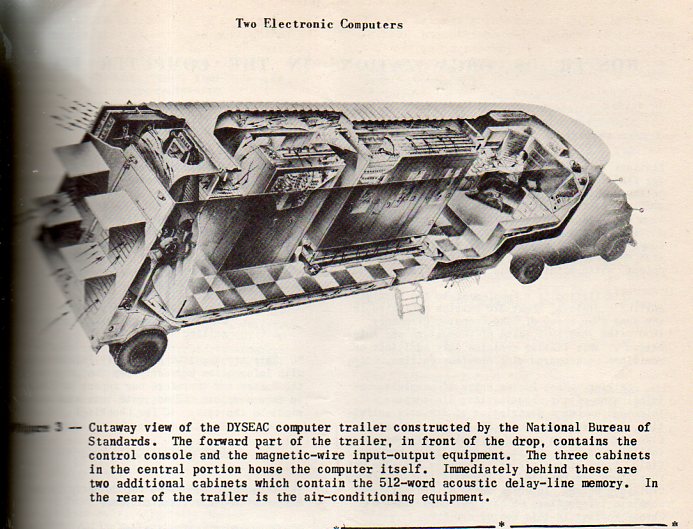
    Now, to the contender, the “other” first mobile computer, the DYSEAC on its computer trailer.   Most of what I have read places the MOBIDIC with priority, but others clearly place the machine in operation in 1954, years before the MOBIDIC became operational.  In any event the DYSEAC was the Second Standards Electronic Automatic Computer, a first generation National Bureau of Standards computer built for the U.S. Army Signal Corps. Here’s the cross-section cutaway for it:
    Dyseac334

    And so on to the battle between the two, outfitting them perhaps with crunching and sawing devices, metal biting bits, and so on, I wonder which might be the one to come out on top?  I think I’d like to claim the MOBIDIC, if for no other reason than it was armed.  And the name, of course.
    ·Posted by :

    ·in:

  • The Underground Memory Vaults of Harper & Brothers, 1855

    JF Ptak Science Books   Quick Post  [Part of the History of Memory series.]

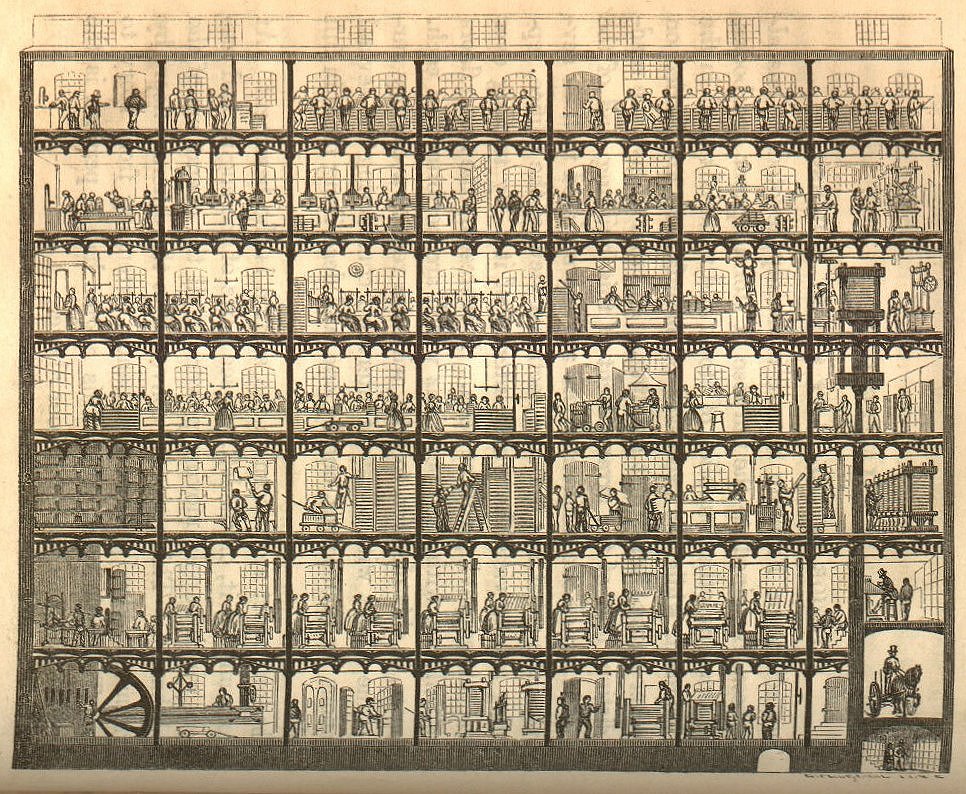
    I found this fantastic cross-section of the Harper & Brothers publishing house in Jacob Abbott’s The Harper Establishment, or, How the Story Books are Made, published of course and thankfully by Harper in 1855, and found in its entirety here

    Sectional view of the Cliff Street building.The whole of the enterprise is explained on pp 43-49 (here).  I’d really like to return to this image at some point, because there are more detailed engravings in the book to match every section of the building, and to me it looks like this image could be turned into a 19th Century Printing and Publishing Board Game.

    What I was interested in right now was the box on the extreme bottom-right, which turns out to be The Vaults–this is the central memory core of this publisher, a 200-foot-long, 8×8′ corridor lined with the original plates for all of the publications of the firm.  The plates for their single-volume version of Herman Melville’s Moby-Dick would’ve been put down there just a few years ago. 

    Interior of the Vaults.

    “The plates are stored in subterranean vaults built under the streets that surround the building. The entrance to these vaults has already been shown in the sectional view of the Cliff Street building, on page 42. A more enlarged view is shown on the preceding page. The vaults extend under ground for two hundred feet in length, and in dimensions are eight feet wide by eight feet high. They are shelved on both sides, and the shelves are loaded with plates–stereotype or electrotype–representing all the works published in the establishment. There is one plate for every page of every one of the many hundreds of volumes which the house publishes, making from fifty to seventy tons in all.”

    “When a new edition of any book is required, the plates are brought out from these vaults and put upon the presses. When the work is finished, they are taken back again to the vaults.”

  • Blank, Empty and Missing Things: Stone and Wood

    JF Ptak Science Books   Post 1742  [Part of the series on Blank, Empty and Missing Things.]

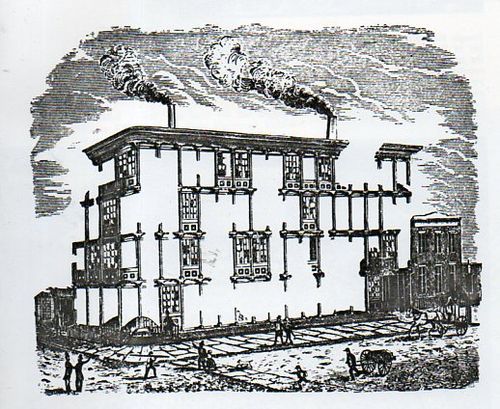
    Ogardus335
    This short post is about this remarkable illustration from a 16-page pamphlet by the inventor, architect and cast tion pioneer James Bogardus (1800-1874, Cast Iron Buildings, their Construction and Advantages, 1856 and 1858 second edition). 

    But before I get to that, I started to wonder about why it was that NYC developed up rather than out, vertically rather than horizontally? There was plenty of room for outward growth–and in mid-1850’s, the period that this post addresses, most of the city had already been laid out, or at least up to 96th street.  But in the city of about 900,000 people, there were few people living that far north (and not that many structure), with half of the population living below 42nd street.  So, the largely flat, largely unoccupied island could well have been developed northward rather than skyward.  My feeling is that the reason for vertical development was “running”.  That in the pre-telephone days and the earliest days of electrical telegraphy, that in order to conduct business rapidly messengers were used to take documents and communication back and forth. And so for the sake of speed of business, rather than have messengers traveling for 20 or 40  or 80 minutes to a more-removed uptown location, that it made more business sense to keep businesses together; and to do that on limited land, one needed to go up.  Not out.  I’ve never thought about this, ever, but this seems to make sense to me…

    Now, getting back to the Bogardus illustration: what was missing was the building, or the pieces of the building that had previously been thought of as being absolutely essential for a structure of this size to maintain itself.  But what Bogardus had done was to figure out a way of using cast iron rather than other building materials–a building tool that was stronger and with greater engineering chops than anything else that had been previously seen, which meant that there were different forces at play in structures using it, and which meant therefore that even though there were large pieces of the building’s shell that were “missing”, that this structure could and would still stand.  It was a fabulous way of communicating a new idea. 

    What happened with the Boagardus idea is that it developed into the use of steel-framed buildings, which made for very light, very strong structures, which led to skyscrapers, which led to modernity.

    The Harper Brothers building (built in 1854 at 331 Pearl Street) was an iron-facade building that was engineered by Bogardus (with the architect John B. Corlies) and was built in response–and partially as a safe, fire-proof building–following the devastating fire (and enormous liability payout) in the previous Harper building.  One thing that was certainly different in the face of this building–owing to the efficiency of the cast iron, there could be plenty of windows in place of where there used to be building materials.  And there was certainly plenty of glass in the Harper building.

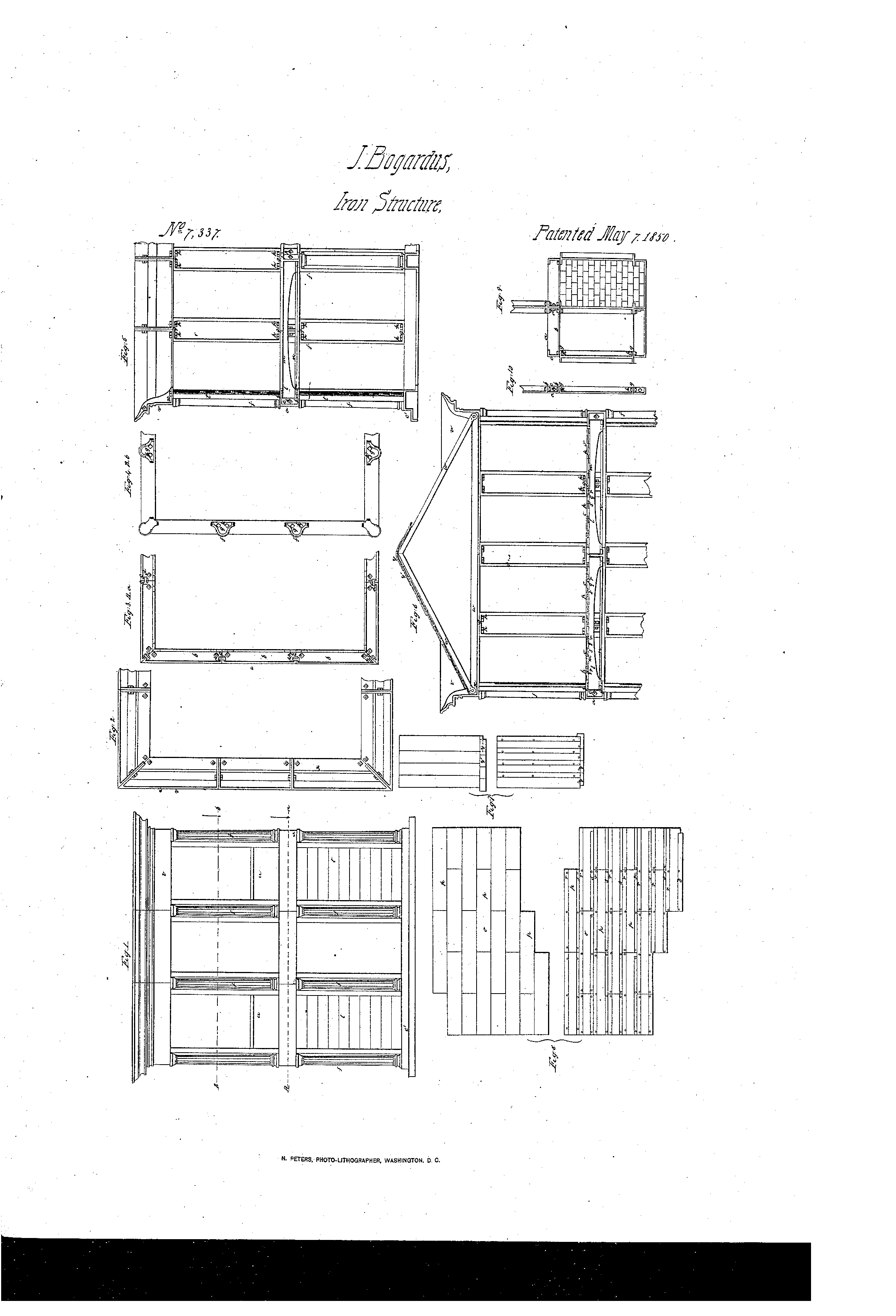
    Bogardus patent

    [Patent source: the very easily usable Google Patents, much more nimble than the UST&PO, somehow.]

    The trip to modernity didn’t necessarily start here with Bogardus of course, but he was a considerable and significant chunk in the engineering developments necessary for the construction of tall buildings…and here it is interesting to note that another big piece of that development that came into being at nearly the same time (1854) as the publication of Bogardus’ pamphlet and the construction of the Harper building was the installation of Otis’ safety elevator int eh Haughtwout (five storey) store. And of course the elevator was necessary for the creation of tall buildings, just as the invention of the braking systems was essential for the creation of the elevator. And on the story goes. 

    The Bogardus achievement (patented May 7, 1850) was certainly an important step–it was pragmatic, efficient, and strong, and also led to the possibility of mass production and pre-fabricated structural elements.  And for the mid-1850’s, this was certainly a big deal.

    One of the few remaining Bogardus structures, at 254 Canal Street, today:

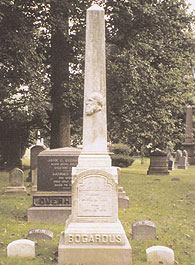
    And the Bogardus monument in the famous Green-Wood Cemetery, in Brooklyn:

  • Early & Satirical Poetry on Evolution–1862

    JF Ptak Science Books   Quick Post

    “The Gorillas Dilemma”, 1862.

    This poem, which appeared in the London Punch in October 1862, three years after the first edition of Darwin’s On the Origin of Species,  addresses the confrontation between Richard Owen and Thomas Huxley (and by extension, of course, Charles Darwin).  Owen had earlier attacked the Origin in an anonymous review in the Edinburgh Review (volume 111, page 521, 1860), and Thomas Huxley, of course, who was one of the earliest and who became the greatest of Darwin’s “disciples” (and known as “Darwin’s Bulldog”).

    Owen wrote with a very heavy and dark pen, in 1860:

    “To him, indeed, who may deem himself devoid of soul and as the brute that perisheth, any speculation, pointing, with the smallest feasibility, to an intelligible notion of the way of coming in of a lower organised species, may be sufficient, and he need concern himself no further about his own relations to a Creator. But when the members of the Royal Institution of Great Britain are taught by their evening lecturer that such a limited or inadequate view and treatment of the great problem exemplifies that application of science to which England owes her greatness, we take leave to remind the managers that it more truly parallels the abuse of science to which a neighbouring nation, some seventy years since, owed its temporary degradation. By their fruits may the promoters of true and false philosophy be known.”

    Tough stuff.  And Darwin took it personally and seriously, absorbing the blows against himself (and his supporters, especially Huxley and Hooker), as well as the spurious and ethically-challenged mistaken assertions that Owen tricked out in his piece.  “It is painful to be hated in the intense depth with which Owen hates me” Darwin wrote a few months later  (Darwin Correspondence, volume 8, April 1860, page 154.)

    Huxley and Owen would have it out over the years (though Darwin himself would not partake due to illness and such, preferring to respond through written help to Huxley and others).

    And so the poem:

    ” (To Professor Owen & Huxley)

    SAY am I a man and a brother,
          Of only an anthropoid ape?
    Your judgment, be ‘t one way or ‘tother,

    ·Posted by :

    ·in:

    —
  • Steampunk InnerNaughts of the 19th Century

    JF Ptak Science Books   Post 1743

     These creations weren’t so much about exploring the innerEarth than they were about surviving in the outermost, shallowest bits of its depth.  Survival gear for The Great Unpleasantness in disastrous adventures at sea was relatively scant for hundreds of years, although the nineteenth century did offer a number of new, Victorian technolust attempts for survival-at-sea.  

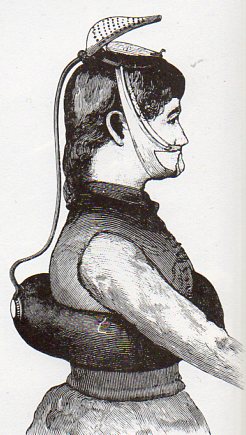
    I know that this first contrivance in some of its particular parts looks enormously compromised, but really the stuff attached to the woman’s head just allowed her to breathe about 10 inches higher than her mouth, though it seems to me that this air-catcher might catch more water than anything else.  Still, it was an interesting attempt at keeping people floating above the water when in peril.

    Innernaughts340In general though it seems to me that most of the big adventures in wearable life saving devices were big indeed, big and heavy–if there was just a little more room for a small engine, wed’ be in the Steampunk realm, as can be seen in this magnificent attempt by T. Beck in his 14 March 1876 patent:

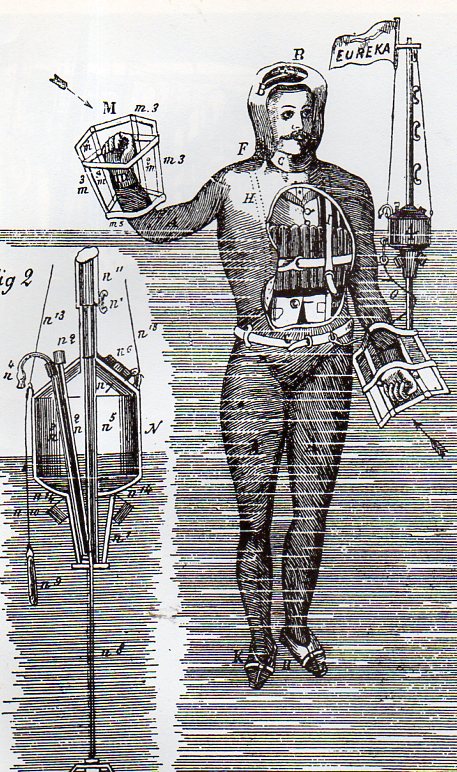
    This was somehow an improvement over a more complicated but still more sensible device that appeared earlier in 1869, the work of Captain John  Stoner.  He exhibited his creation in NYC off the piers in the East River as demonstration of the suit’s effectiveness, the whole of which was big news, appearing in the July 17, 1869 issue of Scientific American.  The suit was made of rubber, and was insulated and was equipped with a personal buoy which carried a “Eureka” flag and had a compartment filled with food, water, lighting materials, cigars, and of course reading material to help pass the time.  The hand-flippers on the other hand look like a very good idea. 

    Innernaughts339

    A more streamlined idea of the Stoner suit appeared in F. Weck’s patent application of 24 October 1876, again using a rubber suit, but this time the safety device was far less cumbersome, and equipped with little more than an interesting-looking breathing apparatus connected to a towed buoy which of course flew the American flag.

    Since I mentioned the possibility of cigars in the above-mentioned case, I should also point out that it took several decades for someone to patent a waterproof case for swimming with cigarettes, “in case the swimmer wanted to swim out to some rocks and then relax with a cigarette”.

    G. & C. Palmer came forward with another unusual idea in their 11 November 1873 patent, using chess-like figures to pus their idea of an expanding/collapsing life preserver vest, which would move in rhythm with ocean waves and theoretically protect the wearer from being overcome by bad swells.  I have my extended doubts about this one.

    Most of the patent applications that I’ve looked at tonight seem to lake one critical element–locomotion. Of course they’re assuming that the life vest is doing little more than keeping the wearer from drowning (though sometimes comforted with cigars and flags). A. McDonald went a little further with his invention (patented 17 January 1882) by putting a screw propeller on the belly of his life vest. It all looks very heavy and sinkable.

    F. Vaughan continued on the idea of a big, heavy wetsuit preserver by making his even bigger and heavier.  This 1879 creation looks to have about 10 inches (or more) or rubber in the suit, which means that if the thing wasn’t water-tight, and that if even a very slight leak developed, the wearer would no doubt sink like a stone. 

    A. Traub (in 1875) created something that was much less bulky and more accessible, a sort of unfolding life vest, that seems really not to do much of anything, but which was at least light:

    E.H. Brown (in 1884) had a somewhat different approach to the “life-saving” idea, turning the survival bit into a bucolic if ungainly adventure/romp device for the vacationer on the coast–the “hammock canoe”:

    \

    Though as cumbersome as this device seems it is quite in step with its contemporaries, at least so far as in being not-very-usable goes:

    And somewhere in all of this was the occasional good-looking idea that evidently got caught in the undertow of the heavier/punkier outfits–but in them you can see the beginning of the idea that would eventually work:


  • Not-Seen-Daily: Oscar Wilde in a Soldier’s Uniform, 1892.

    JF Ptak Science Books  Post 1744  [Part of the History of Goodbye series.]

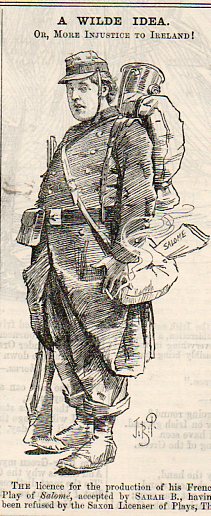
    Oscarwilde332There’s just so much in Punch magazine to pull out and have a think over.  This cartoon was poking fun at Oscar Wilde, sending him up in a French soldier’s uniform suggesting that he might have to serve if he exiled himself to France.  What had happened was that he had just written his play Salome, and in French, for production in Paris–unfortunately, there was a law in France prohibiting the portrayal of Biblical characters onstage, and so he ran into a large spot of bother..

    Wilde would wind up in France soon enough, but under tremendously changed circumstances, as the next eight years of his life would be mostly decline-and-fall, and then exploded in an exploding-hole, with nothing but Wilde-smoke remaining, and precious little of that.

    Wilde’s publishing career had started just four years earlier, really, with the appearance of The Happy Prince and Other Tales (1888).  He would enjoy major success over a period of five years, beginning in 1891 with The Picture of Dorian Gray, The Soul of Man Under Socialism, and Intentions, followed by Lady Windermere’s Fan, and Salome in 1892, A Woman of No Importancee  in 1893, the Importance of Being Earnest in 1894, and then, well, then came the beginning of the end.  After much success with his plays, everything would blow up in 1895 after Wilde decided to sue his lover’s father (the Marquis of Queensberry) for defamation received on February 18, 1895.  The suit went very badly, with Queensberry  acquitted on all counts in the course of a trial which dragged Wilde’s sexuality all the way through it.  Wilde was immediately arrested for gross indecency, was brought to trial within a month of the end of the Queensberry debacle (on April 26, 1895); he was crushed completely and found guilty on May 25, 1895, and sentenced to two years hard labor, which began immediately. 

    That was pretty much the end for Wilde., though he would write De Profundis in 1897 and The Ballad of Reading Goal in 1898. He would never see his two sons again, his mother would die while he was in prison, and his wife, too, would be dead in 1898.  Wilde was released from Reading Goal on May 19, 1897, and he would leave almost immediately for France, where he would spend the rest of his life.  A not-long life, as he would die a rather miserable death three years later, in France, on November 30, 1900. (He outlasted Queensberry, who died in January. His former lover, the Marquis’ son, Alfred Douglas, lived until 1945; he came to loathe and repudiate Wilde, rejecting their history.)

    So this cartoon was a little prescient, in a way–the near-future would find Wilde in France, though not in a France and not in a situation that Wilde could have possibly seen in 1892. 

    What lead to all of this bad business?  The Marquis was disgusted that his son was having a relationship with Wilde, and sought to put an end to it.  The end of it all came when the Marquis left his calling card addressed to an absent Wilde, “For Oscar Wilde, posing Somdomite [sic]”. And then everything for Wilde came apart, costing him his reputation and financial failure. 

    A rectangular calling card printed with "Marquess of Queensberry" in copperplate script.
    It doesn’t seem like much to hang your legal hat on, especialyl with a Marquis, but Wilde tried I guess to protect himself, and it cost him everything. Wilde won the laughs in his trial, but the prosecution won the case.

    ·Posted by :

    ·in:

  • Questionable Quidity: on Rowing Flying Boats, 1889

    JF Ptak Science Books  Quick Post

      This remarkable flying machine was patented by N.H. Borgfeldt (of Brooklyn, NYC) on 1 October 1889.  It really seems to be not that much more than the rowing-section part of a Roman galleon, except that it is in the air;  there are five “rowers” int his aircraft, plus someone to operate the rudder. And a flag.

    This certainly is not the most effective way of using human muscle, even in an odd application like this one:

  • Hydrogen Balloon Properller Pseudo-Steampunk Downton Abbey Airship, 1882.

    JF Ptak Science Books   Quick Post

    I think that there must have been a certain satisfaction for Mr. R.L. Downton when he had the idea for hydrogen-filled propellers–I mean, they must have made a lot of sense to him, sitting there in the Abbey, pondering the elegances of flight, while letting Maggie Smith walk away with all of the best lines.  Well, I’m kidding of course about Maggie Smith and the Downton Abbey remark, but I can well imagine Mr. Downton feeling as though he came to some sort of breakthrough by making the propellers for his flying machine its lifting device as well.  We can see in the first image that the “aerial ship” has side-by-side propellers and is driven by steam–the airship is still a little too refined and relatively light to fall into a classic “Steampunk” mold. 


    The second drawing shows a modification to the somewhat-large ship above, with the airship being a flying gondola, with the hydrogen-filled propeller being hand-cranked.  It wasn’t a great idea by any means, but it was very interesting, at least to me. 

  • Tech-Quiz–What is It? (#7, 1893)

    JF Ptak Science Books   Quick Post   [Part of the Tech-Quiz series.]

    Generally with these questions I provide a detail of a patent drawing and from that the application is supposed to be derived.  Here, though, is the full drawing, and is seems pretty straightforward, I think, though the ultimate use of the contraption might not be so obvious.  Or perhaps it is?   What was the intended purpose of this object?


    Answer in the “extended reading” section, below:

  • Autopsy of a Snow Man

    JF Ptak Science Books  Quick Post

    Found this in the “to do” list and am not sure if I posted it ever, or not.  Anyway, its a nice light way to start this Monday:

    ·Posted by :

    ·in:

  • On Recognizing Things: “Outsider” Art


    JF Ptak Science Books  Post 1684

    On an early use of the term, Outsider.

    Outsider b075

    Sometimes a word is just a word, and the elements of recognition sometimes inhibits that.  Except in this case that the word seems to be just what it is and also indicative of what it would become.

    Outsider074
    Outsider, or outside, outside the recognition of “official” art, of critiqued-art, is the English language equivalent/translator coined in 1972 (by Roger Cardinal) to illustrate the term art brut (“raw art”) created by Jean Dubuffet.  Dubuffet created with others Compagnie de l’Art Brut in 1948, which in some respect was a reaction to a new sort of displayed art that had begun its life in the early 1920’s, mainly as the efforts of doctors treating psychiatric patients who were expressing themselves through their art.  (Two famous examples include Dr. Walter Morgenthaler’s Ein Geisteskranker als Künstler (A Psychiatric Patient as Artist), published in 1921 on the work of perhaps the most famous people in the Outsider canon, Adolf Wölfli; and another being  Bildnerei der Geisteskranken (Artistry of the mentally ill) published a year later by Dr Hans Prinzhorn.)

    [Adolph Wolfi]

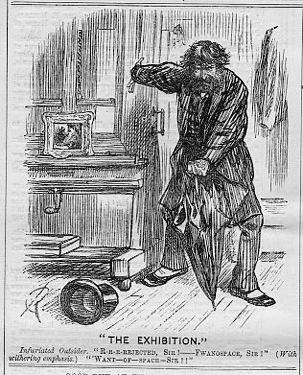
    Well, “outsider” as we  know it today in reference to the arts is definitely not what the editors of Punch magazine pursued in this cartoon for their issue of 6 May 1886.  The “infuriated outsider” was simply an artist left outside a show, whose work was not accepted for exhibition. (And from the looks of it, the small work on the huge easel, being rejected for the “want of space” might not have been the reason for the artist not making the list.)  

    Trenton Doyle Hancock, “AND THE BRANCHES BECAME AS STORM CLOUDS”, 2003, Mixed media on canvas. Photo courtesy James Cohan Gallery, New York and the American Folk Art Museum.

    [Henry Darger]

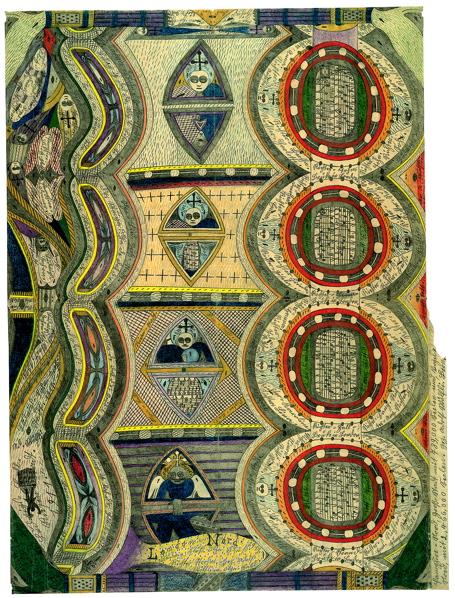
    This outsider was simply outside with probably-not outsider art.  Henry Darger (1892–1973), Martín Ramírez (1895–1963), Paul Gösch (1885–1940), Charles A.A. Dellschau (1830-1923), Willem Van Genk (1927–2005) and so on were Outsiders, their work being Outsider/Art Brut and also being left outside for a long time.  Far outside.  In the far-deep outsider, further and deeper outside than the more aesthete outsider varieties of “outsider” art–like Impressionist, Cubist, Dada, Constructivist, Futurist–ever got outside.  

    [Willem van Genk, detail]

    Anyway, I thought it curious to find the term stuck in the middle of a cartoon rant in an 1886 popular journal.

Recent Posts

Archives

Categories