A Daily History of Holes, Dots, Lines, Science, History, Math, Physics, Art, the Unintentional Absurd, Architecture, Maps, Data Visualization, Blank and Missing Things, and so on. |1.6 million words, 7500 images, 4.9 million hits| Press & appearances in The Times, Le Figaro, Mensa, The Economist, The Guardian, Discovery News, Slate, Le Monde, Sci American Blogs, Le Pont, and many other places… 5000+ total posts since 2008.

  • The Post-War Lives of the Nazis: Topf, Designer/Maker of the Auschwitz (and etc.) Crematoria

    JF Ptak Science Books  Post 1745

    The firm that produced crematroia for numerous Nazi death camps managed to stay in business in Wiesbaden  until 1963.

    What happened to the firm J.A. Topf & Sohn (of Erfurt), the company that supplied the mass incineration devices,  the crematoria, used by the Nazis at concentration and extermination camps (from 1939-1945) including Auschwitz-Birkenau, Buchenwald, Belzec, Dachau, Mauthausen and Gusen ?

    Well, in general, most of it dissolved, and the company’s CEO, Ludwig Topf, committed suicide in May 1945.

    Ludwig’s brother–Ernst-Wolfgang, 1905-1979–however, escaped prosecution and re-started the company in the late 1940’s, operating a crematorium business in Germany until the new Topf business went into bankruptcy in 1962. It sold mostly refuse/garbage grade incinerators, but, still, there it was.
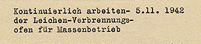
    Topf liste

    [Circular for Topf describing the crematoria they constructed for the Nazis; of particular interest in this page is the entry for May 11, 1942, for a crematorium for ““continuousoperation corpse cremation oven for mass use”. Source: here.]
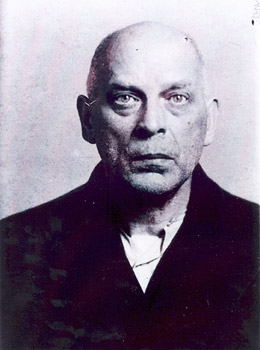
    Topf pruferThe leaders of Topf firm would argue after the end of the war that they did not know what the crematoria were really being used for, despite numerous visits for site inspection and repair to Auschqitz and Dachau. Karl Pruefer, the original designer of teh ovens, revealed on interrogation by Soviet officials just after the war that “I have known since spring 1943 that innocent human beings were being liquidated in Auschwitz gas chambers and that their corpses were subsequently incinerated…”  There can be little doubt that Topf knew exactly what was going on with their crematoria–in fact, at one point, Kurt Pruefer (pictured at left, in Soviet custody, undated, from Der Spiegel, Archiv) suggested that the use of his crematoria at the extermination camps actually saved lives by disposing of diseased corpses and preventing the spread of fatal diseases and epidemics.(The exact early reference was to preventing the spread of typhus in Buchenwald in 1939.  The Nazis adopted a practice in some of the mostly-Russian camps in the East of introducing typhus-laden prisoners into general population so that the disease would spread and aid in the extermination of the camp inhabitants.)
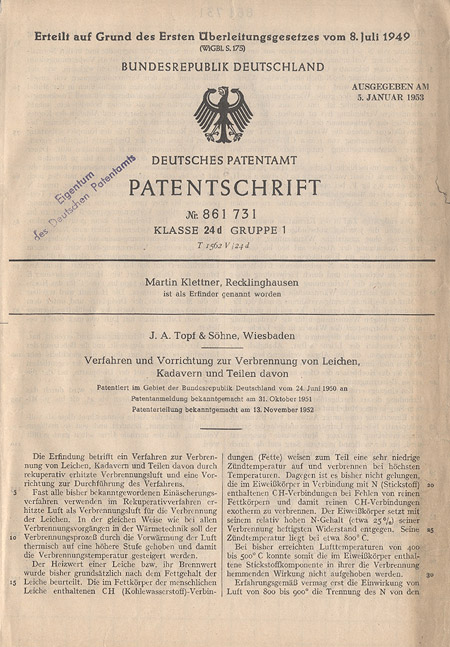
    Topf[Topf, still in business, 1953]

    The two Topf brothers claimed innocence for themselves and for their company; Ludwig committed suicide because he and his firm had done nothing wrong, and had felt beaten by lawless countries and did not intend to be taken captive by them; feeling that justifying his actions would be impossible, he killed himself  on 30 May 1945. The text from his suicide note is below.1

    The evidence against the firm was exceptional and substantial, an example of which (from the Nuremberg Trials, is seen below2), and their culpability overwhelming.  I’m not sure how Ernst -Wolfgang was able to survive the various net that he managed to wiggle through (unlike a number of other of the firm’s officials who wound up being captured by the Soviets and whisked away to cold justice far from Moscow), but he did; and not only that, but was able to start over in the business that he knew best, keeping it running until 1963, well into a time when it was recognized that the shell of buildings from his old business be kept intact as a memory to horror. 

    Notes

    1)  Farewell letter by Ludwig Topf, May 30, 1945 (excerpt, underlining in original) (from Topf und Sohne website)

       “If I have made the decision to evade arrest it is for the following reason: I have lost all belief in any law in this world now that my family has also done me so much wrong and harm. If I am arrested, the greatest of all wrongs will be done to me. I never consciously or intentionally did anything bad; instead it has been done to me.
    I was never cowardly – but I was proud. Handing myself over to the mercy or mercilessness of a foreign country is something I cannot do, because I have learnt the bitter lesson that there is no law and no decency left in this world. That is why I, as a decent person, today have one remaining opportunity to determine my fate as I see fit. And that means immediate departure from a world that in general has become unbearable, and in particular has persecuted and wronged me.”
    “If I ever believed that my innocence as far as the crematoria are concerned (and my brother is just as innocent) would be recognized and honoured, I would continue to fight for justification, as I always have until now – but I think people need a sacrifice. In which case the least I can do is provide it myself. I was always decent – the opposite of a Nazi – the whole world knows that. If I were still able to feel at peace in the heart of a family, the struggle would be worthwhile – but the Topf family that showed composure, integrity and self-confidence has ceased to exist. I was its sole representative as far as that was concerned. Indeed I am so alone that I have no need to ask anyone’s forgiveness, not even for a suicide.”

    2) From the Nuremberg Trials, Day 193, 2 August 1946 [Source, Yale University, Project Avalon]:

    “In the office records of the Auschwitz Camp there was discovered a voluminous correspondence between the administration of the camp and the firm of Topf and Sons. Among them the following letters:

    ” ‘I. A. Topf and Sons, Erfurt; 12 February 1943.

    ” ‘To Central Construction Of lice of SS and Police, Auschwitz.

    ” ‘Subject: Crematoria 2 and 3 for the camp for prisoners of war.

    ” ‘We acknowledge receipt of your wire of 10 February, as follows:

    ” ‘We again acknowledge receipt of your order for five triple furnaces, including two electric lifts for raising the corpses and one emergency lift. A practical installation for stoking coal WAS also ordered and one for transporting the ashes. You are to deliver the complete installation for Crematorium Number 3. You are expected to take steps to ensure the immediate dispatch of all the machines complete with parts.’ “

    “I omit the next document which deals with “bath-houses for special purposes” (gas chambers), and present to the Tribunal as Exhibit Number USSR-64 (Document Number USSR-64), a document which is appended to the report of the Yugoslav Government. This is a certified photostat of a document externally having all the official character of a business document from a “sound business firm.” The name of the firm is Didier-Werke. The subject of the correspondence-the construction of crematoria “designed for a large camp in Belgrade.” The document presented by me characterized the firm Didier as a firm with considerable experience in construction of crematoria for concentration camps and which advertised itself as a firm that understood the demands of its clients. For placing the bodies. into the furnace, the firm designed a special conveyer with a two-wheeled shaft. The firm claimed that it could fill this order much better than any other firms, and asked for a small advance, to draw up draft plans for the construction of a crematorium in the camp.
     

  • Living Aloft, 1920

    JF Ptak Science Books  Quick Post

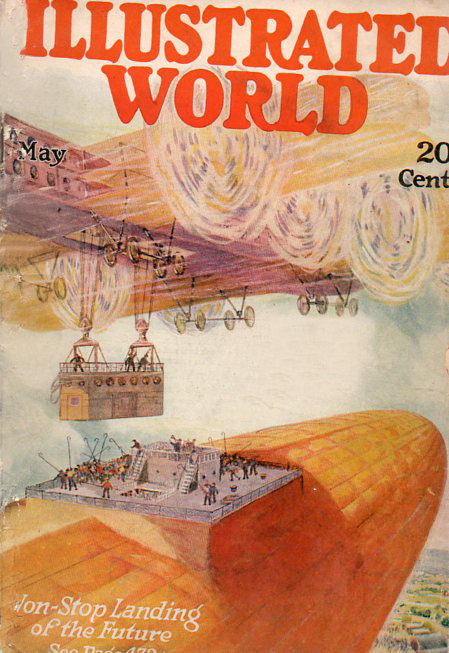
    Future flight108D.G. Lloyds certainly had an interesting–if not unique–vision of non-stop or uninterrupted cross-country aerial service, writing about Non-Stop Landing of the Future (Illustrated World, May 1920.)  And for Lloyds the future was soon, or tomorrow, because, frankly, the technology was there, if not the will.  Or the inclination.  Or the presence of a logic for creating such a service.

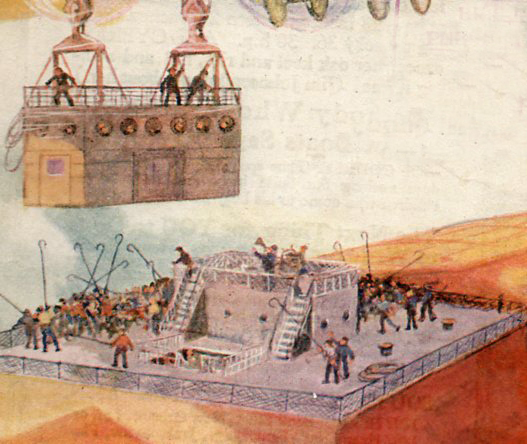
    It seems to me that after floating along for days at 75 mph (or thereabouts?) that, after finally getting across the country, a traveler might want to simply disembark.  But this behemoth envisioned by Lloyds wouldn’t have to actually stop–it was outfitted, designed to release/accept passengers while in flight.  Now of course take-offs and landings are the most dangerous parts of flying, and perhaps this is what Lloyds was trying to replace.  But to me it looks like he replaced one significant danger with, well, several other significant dangers. 

    Future flight111Look:  it just seems to me that any time you have a giant airplane synchronizing flying with an enormous dirigible to transfer exceptionally heavy cargo at an altitude of one mile that there is some substantial room for pilot(s) error.(s) and other freak whatevers.  Also, the issue of using dozens of men with shepherd hooks to grab a multi-ton object suspended from a moving platform to another moving platform seems to me, well problematic.  But it does make for a pretty picture.

  • On the Cowboy as the “New Indian”, 1876/7

    JF Ptak Science Books   Post 1711 

    [This is another in a series of posts prompted by a re-reading of Larry McMurtry’s novel, Lonesome Dove.  This particular addition was prompted by McMurtry’s character Capt. Angus McCrae coming to a realization that he and his partner, Capt Woodrow Call, at the pinnacle of their careers, were just another bit of landscape to be passed by; Texas Ranger/cowboy/adventurer becoming the “New Indian”.]

    Judge James Hall said early on (in 1835) that the frontiersman would only be clearing the way for another kind of pioneer who would settle down and farm the land properly, and make the beginnings of American civilization in the west. Thomas Jefferson saw the same future for “our semi-barbarous citizens”—the frontiersman—as did the explorer and botanist J.R.Poinsett, who said simply that “the frontiersman is doomed.”

    McCrae was very well aware of his own role in the paradoxical march of civilization on the frontier. He was the first of his type to see these new lands (on the cattle drive north from Texas to Montana); opening them meant that he would make them safe for other colonizers—farmers and bankers who would have a far more acquisitive sense of land and ownership than he or his partner Call would ever have. As the concept of private property grew greater, as more capital was invested, and as the land became more irretrievably “settled,” then the two Rangers would pose as much a threat to the monied land interests as the Indians had once posed to the earliest settlers. He knew that he was the first step in making the economics of the region as frictionless as possible, and that at some point, and pretty soon, he and all those like him would represent the friction in the cost of doing business.

    It didn’t take long for this to happen;  in the grand scheme of the development of the West the frontiersman’s shadow was almost instantly filled by that of the cowboy, with barely 75 years filling the time between the beginning of the Lewis & Clark Expedition and the end of the great cattle drives. The hungry frontier pulled the adventurers away and concentrated its efforts on its greatest foe—the worker. The Atlantic Monthly charged in 1877 that America was at risk from a new type of “Indian”—the “savage” working class. It made that statement—in an unsigned article—soon after the dangerous railroad strike of 1877, stating that these classes needed to be attacked and re-educated to understand the new culture of incorporating America. McMurtry’s self-medicating character McCrae understood the theory if not the extended history of the word “savage”—that it would be passed from one class to the next of any group that threatened to disturb the orderly march of culture and economic civilization, and that each preceding class of civilizer would, in turn, become the savage. “Savage” would pass from the Indian, to the unruly cowboy, and then on to the settlers of each successive (economic) frontier, as the competition turned from space to wages.

    In a book that Call and McCrae could (but were extremely unlikely to) have  read, The History of the United States, by George Bancroft (1866), it was said that the Indian was killed by civilization because he could not change “his habits.” Writing at the same time and for the same readers, Francis Parkman told his readers that the Indian is savage, but that the Indian is also part of a savage environment, though “he and his forest will perish forever” because he will be unable to learn the ways of civilization. Or, in the words of Senator Thomas Hart Benton, who would let nothing get in the way of westward expansion—“civilization or extinction.”

  • “Writing of the Insane”, 1876: Very Early Art Brute Images?

    JF Ptak Science Books   Post 1712

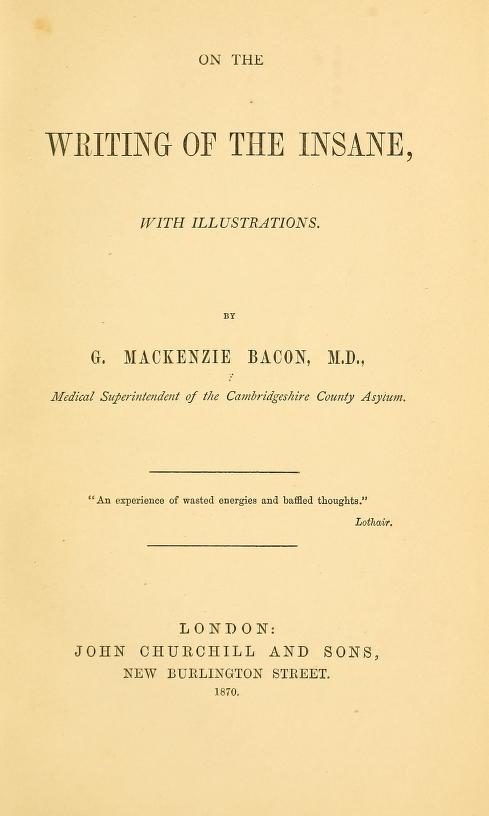
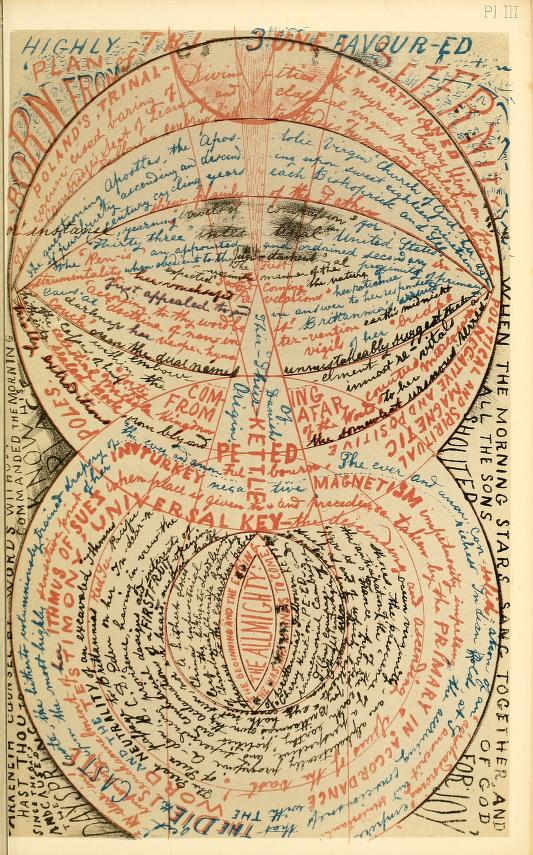
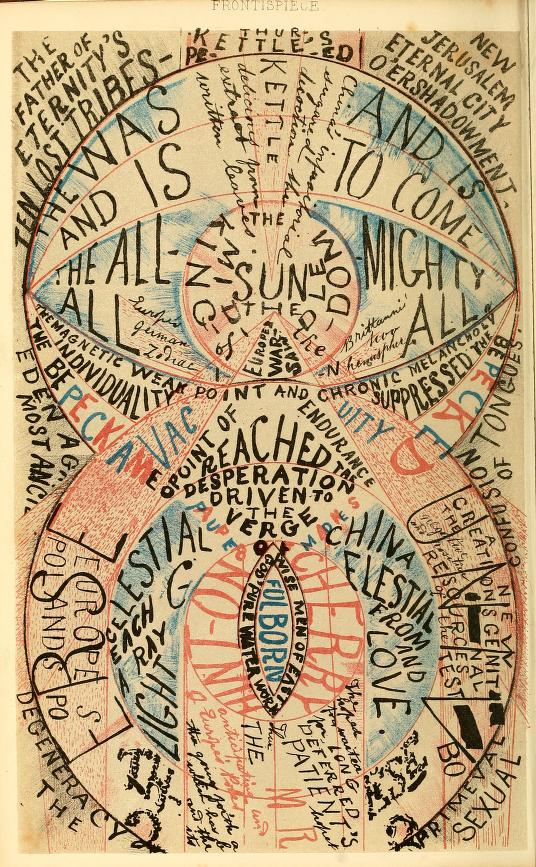
    Insane art 3 titke pageThis book–The Writing of the Insane, by George Mackenzie Brown, 1876– seems remarkable to me for the attention paid to the creative products of the insane. I am not sure when the first of these efforts occurred, but it seems to my experience that 1876 is an early production date for such an undertaking. It also seems to be a very early identification of the “special talents” of some of the observed individuals, including in the text of the book two remarkable (and remarkably “modern” looking) pieces of what today might be considered Art Brut/Outsider Art.

    The author is George Mackenzie Bacon (1836-1883), a doctor who took classes at Guys Hosptial and who had membership in the College of Surgeons in 1858.1 Bacon was the author of Primary Cancer of the Brain (1865) as well as an editing contributor of at least a dozen annual reports of the Committee of Visitors of the Cambridgeshire, Isle of Ely and Borough of Cambridge Pauper Lunatic Asylum (from 1869-1883 ro so). He definitely made improvements to the conditions of the inmates when he worked at Cambridegshire County Asylum (also known as Fulbourn Hospital, 1858-1992), where he provided those living there with more personal living space and patient-built work areas. This was certainly an interesting approach to take for the mentally ill, especially given the time and place.

    But in his (scant) published works it seems that the Writing of the Insane must be his masterwork for at least being among the earliest books to serve as an archaeology of deeply-different and illustrated thought:

    Insane art
    And this remarkable effort:

    Insane art 2

    [Source and full text, here.]

    This is certainly not a “celebration” of talent, but there are moments of recognition of such in the Writing of the Insane, which at the very least is a very early expose of the topic.  One of the earliest books written by someone who was admittedly “insane” (and this is very different from the many books written by insane, or brilliant, or misunderstood, or “complex”, or “different” author) came to us in 1846 by Green Grimes. thirty years before the Bacon work.  In  A Treatise on the Most Important Subject in the World: Simply to Say, Insanity…2 Grimes recounted his life at the Tennessee Hospital for the Insane, about which the blog Canton Asylum for Insane Indians writes:  “There are other Medical books which treat on Insanity, but comparatively few to the population, and none written by an Insane man,”

    Notes:

    1. There is scant personal information on Bacon available online. This data comes from the British Medical Journal, 3 March 1883, in an obituary on Bacon. 

    2. The full title is pretty full: A treatise on the most important subject in the world: simply to say, insanity: The only work of the kind in the United States, or, perhaps, in the known world, founded on general observation and truth. There are other medical books which treat on insanity, but comparatively few on the population, and none written by an insane man. This contains a short history of the author’s case, giving the general causes which produced the disease on him individually, manner of treatment and termination. Giving the only treatment by which a cure may be effected, the manner of detecting the disease, and the duties of sane parents towards the insane offspring of their bodies; with some general remarks upon idiotism, the jurisprudence of insanity, suicide, &c   

    The American Journal of Insanity simply states that the 94-page book is “very curious”.

  • Poe’s Brilliant Literary Criticsm and the Assault on his Memory

    JF Ptak Science Books  Post 1713 [Part of a series on the History of Memory]

    Poe is not so remembered today by the general public as an essayist, and less so as his almost-forgotten career as a book reviewer and literary critic.  Creator (perhaps) of the genres of science fiction and the detective form, a master of suspense, an agent of words, poet and short story writer, editor, yes; maker of taste and keeper of logical insight in literature, well, maybe not so much.

    But the weight of it all is that Poe may have been America’s greatest literary critic of the 19th century,–perhaps more than that. And it may have led to Poe being remembered for some not very savory things, some everlasting iconic and not-necessarily true I-cannot-tell-a-lie Poeisms that are known by the social mind. For example, a bad review may have bought him this obituary as a huge helping of pay-back:

    “EDGAR ALLAN POE is dead. He died in Baltimore the day before yesterday. This announcement will startle many, but few will be grieved by it. The poet was well known, personally or by reputation, in all this country; he had readers in England, and in several of the states of Continental Europe; but he had few or no friends; and the regrets for his death will be suggested principally by the consideration that in him literary art has lost one of its most brilliant but erratic stars…”–by “Ludwig”,”Death of Edgar A. Poe, New York Daily Tribune, October 9, 1849, page 2, columns 3-4. [Full text here.]

  • Philippine Announcement of one of the Last Japanese Surrenders, 15 September 1945

    JF Ptak Science Books   Post 1714

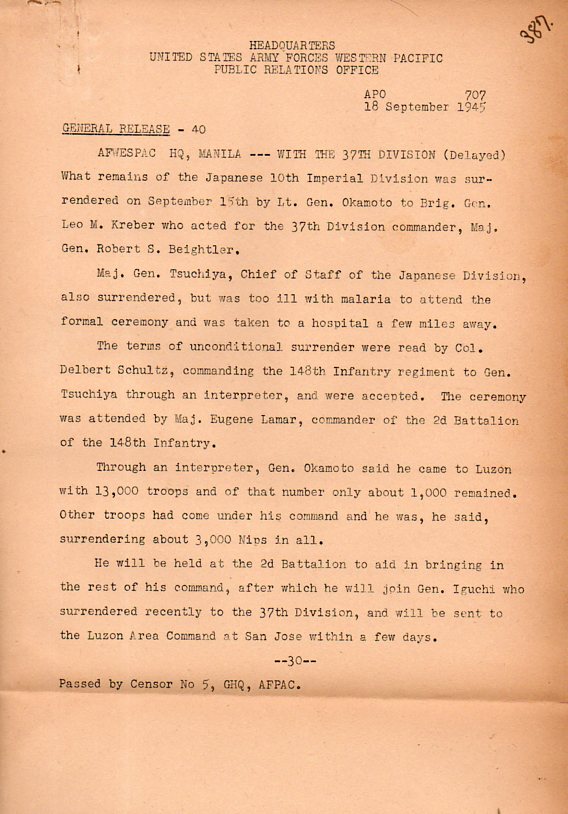
    This announcement comes from the U.S. Army public relations office in Manila (“General Relsease  – 40”) and dated 18 September 1945.  It states that “what remains of the Japanese 10th Imperial Division was surrendered September 15th by Lt. Gen. Okamoto to Brig. Gen. Leo M. Kreber”, this coming weeks after the formal signing of the Instrument of Surrender aboard the U.S.S. Missouri on 2 September 1945.

    WWII  Japanese surrender160
    The 10th Division of the Imperial Japanese Army (formed 1898) was transferred to the Japanese 14th Area Army in the Philippines from China. There it was involved in the Battle of Luzon (9 January to 15 August 1945), where the “what remains” of it statement comes from.  In that battle, more than 250,000 Japanese troops were engaged, with more than 205,000 killed (with only 9,000 captured). On the Allied side, 175,000 troops were engaged, with 8,000 killed and 29,000 wounded. 

    The surrender of the Japanese forces in Manila was one of the last of the major surrenders of armies and army groups would surrender: the Japanese army would surrender at Singapore on 12 September, Saigon on 13th September, and Hong Kong on 14th September. There were pockets of resistance that would hold out for years afterwards, but so far as large organized forces were concerned, this was pretty much the end of the fighting. 

    {The original is for sale in our blog bookstore, here.]

    ·Posted by :

    ·in:

  • Eve’s Ovum, “Unused” Sperm & Embryological Sex Wars of the 18th Century–a note

    JF Ptak Science Books Post 1715  [Part of the History of Dots series.] 

    I wanted to land this post (the title of which is nearly as long as the article) on this little island in a wide sea of similar islands in the complicated 18th century history of embryology.  Where we came from and how living things developed really wasn’t very clear at this time, and really wouldn’t be until Karl Ernst von Baer discovered the human ovum in 1827.1

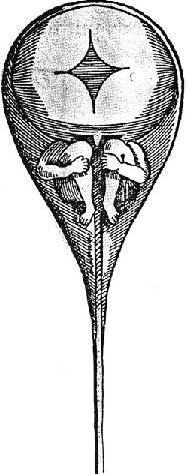
    HomunuclusThe issue of the ovaries as ovens–of homunuclus and palingenesis and epigenesis, the imaginary male-dominant anatomy of reproduction–was pretty much somewhat solved by the beginning of the 19th century.  Or at least the homunculus, the tiny but perfectly formed miniature human traveling along in sperm, was.  This character is pictured here, riding in the squinty-eyed imagination of researcher  Nicholas Hartsoeker2, who desperately wanted to see the thing, I think, and which found itself published in his book Essai Dioptrique  in 1695.  Spermatozoa was discovered earlier by the great Leeuwenhoek (1632-1723) and which was finally confirmed in its fertility hypothesis by Lazzano Spallanzani, who also happened to be an ovist, thinking that each egg contained a pre-formed embryo).

    The woman as a simple baker of a gift of preformed life was a medical belief that helped perpetuate the supposed inferiority of women, and that the woman’s part in the procreative process was a simple oven.  It was a difficult image/belief to resist, persisting well into the 19th century.  But there was another side of this debate as well, and that was that woman didn’t need the male sperm to proceed with the process of conception, with some scientists believing that coition had nothing whatsoever to do with the process.  And so there were battle lines drawn in the primordial embryological sand of the 18th century, each demanding a sex-dominant role in procreation. 

    And if sperm contained a perfect, pre-formed human being, waiting to be planted in the oven of woman, what happens to all of those-pre-forms in the sperm that went “unused”?  I imagine that if you were an 18th century pre-formationist that this would be a tricky and very uncomfortable question. If you could put on special sperm-specs that would allow you to see “ejected” and  “unused” sperm in the same sort of ways in which we can see non-visible light, that, well, you might want to watch your step and avoid smashing a fully-formed human being that had the potential of living for weeks on its own with the benefit of anything else at all. I have to admit that even for me this makes the picture of this Earth not very savory. The author of “A Brief History of Sperm” at SeductionLabs.org points out that at least one English country doctor, James Cooke, thought that this ejecta “might not die”, at all,

    “… but ‘live a latent life, in an insensible or dormant state, like Swallows in Winter, lying quite still like a stopped watch when let down, till [they] are received afresh into some other male Body of the proper kind’.”–from SeductionLabs.org, in its “A Brief History of Sperm“.

    It sounds a little like embryologico-guerrilla warfare.

    In the middle of the sides drawing themselves up for battle, choosing male- or female-dominant mechanics of procreation, or a combination of both, were the supra-ovists, who claimed that in this mess that every human who would ever be born on Earth was already present in the ovum of Eve.  There were some who tried to calculate the figure of how many people that ovum contained, but like the creation timeline of Bishop Wilberforce, the numbers were open to severe self-definign interpretations. 

    It is interesting to note these debates, though, because they weren’t really finally settled until just three generations ago. (Or four if you’re much younger than I.)

    Notes:

    1.  von Baer published his discovery in his Epistola de Ovo Mammalium et Hominis Genesi (Leipzig, 1827), followed by his two-part Ueber die Entwickelungsgeschichte der Thiere  in 1828 and 1837 on the history and evolution of animals.  The original paper did not catch on, immediately, and took some years to be established.  There was actually a paid competition going on in Europe at this time for the purpose of finding the ovum, and although aware of the award and thinking he had found the “prize”, von Baer was not well-doisposed to the idea of the “race”, and so really didn’t participate.  Jean-Louis Prevost (1790-1850) and Jean-Baptiste A. Dumas (1800-1884) also came to the conclusion that the “animacules” in the semen were responsible for fertilization.  The deal wouldn’t be solidified until Oskar Hertwig actually observed the fusion of the male and female material in the ovum of a starfish in 1876. 

    2. Hartsoeker (“heart seeker”) (1665-1725) was a microscopist of high order in addition to being a physicist and a medical doctor, never actually saw this thing in his investigations–he iterated that the little person must be there.  But he never did say that he observed it. 

  • Classifying Mind Clouds

    JF Ptak Science Books    Post 1716

    Luke Howard achieved some fame and did the world a great service by (finally) identifying and classifying some of the most-overlooked objects in the natural world–clouds.  Throughout the history of humans giving names to things, even in the groups of the greatest of the classifiers, like Aristotle, clouds managed, somehow, to escape their classifying grid-vision–until Luke Howard, which took until the early 19th century. (I wrote about him here.)

    Louis Lewin (1850-1929)–Dr. Lewin–classified another sort of “cloud”, more of the internal, botanically-induced psychoactive variety than the outside, high-in-the-actual-sky clouds.  Lewin was  a pharmacologist and leading toxicologist, and what he did, really,was help to establish the field of ethnobotany through his deep scientific investigation of drug use around the world.  This was an entirely new approach to this issue: by investigating how the plants produced their effects Lewin took another step into a new field apart from the prevailing anthropological approach, which looked at the methods and beliefs and such in the use of the drugs. Lewin experimented with peyote, te, heroin, coffee, annabis, alcohol, opium, kava and of course tobacco, as well as many other drugs, and published them in his book Phantastic, die Betaubenden und Erregenden Genussmittel fuer Artze und Nichtarzte (“Narcotics and Stimulating Drugs, their Use and Abuse) in 1924, expanding it in a second edition in 1927. 

    Lewin167

    Lewin organized and classified the drugs into categories that remained basically unchanged:  Inebriantia (inebriants such as alcohol or ether) ; Exitantia (stimulants such as khat or amphetamine) ; Euphorica (euphoriants and narcotics such as heroin) ; Hypnotica (tranquilizers such as kava); and of course the Phantastica (hallucinogens or entheogens such as peyote or ayahuasca). [This list with links transfered from an article on Lewin from wiki.]

    [The original of this interesting work is available on our blog bookstore site, here.]

    ·Posted by :

    ·in:

    —
  • What was Dropped from the Skies First, the Mails or Bombs?

    JF Ptak Science Books   Post 1717

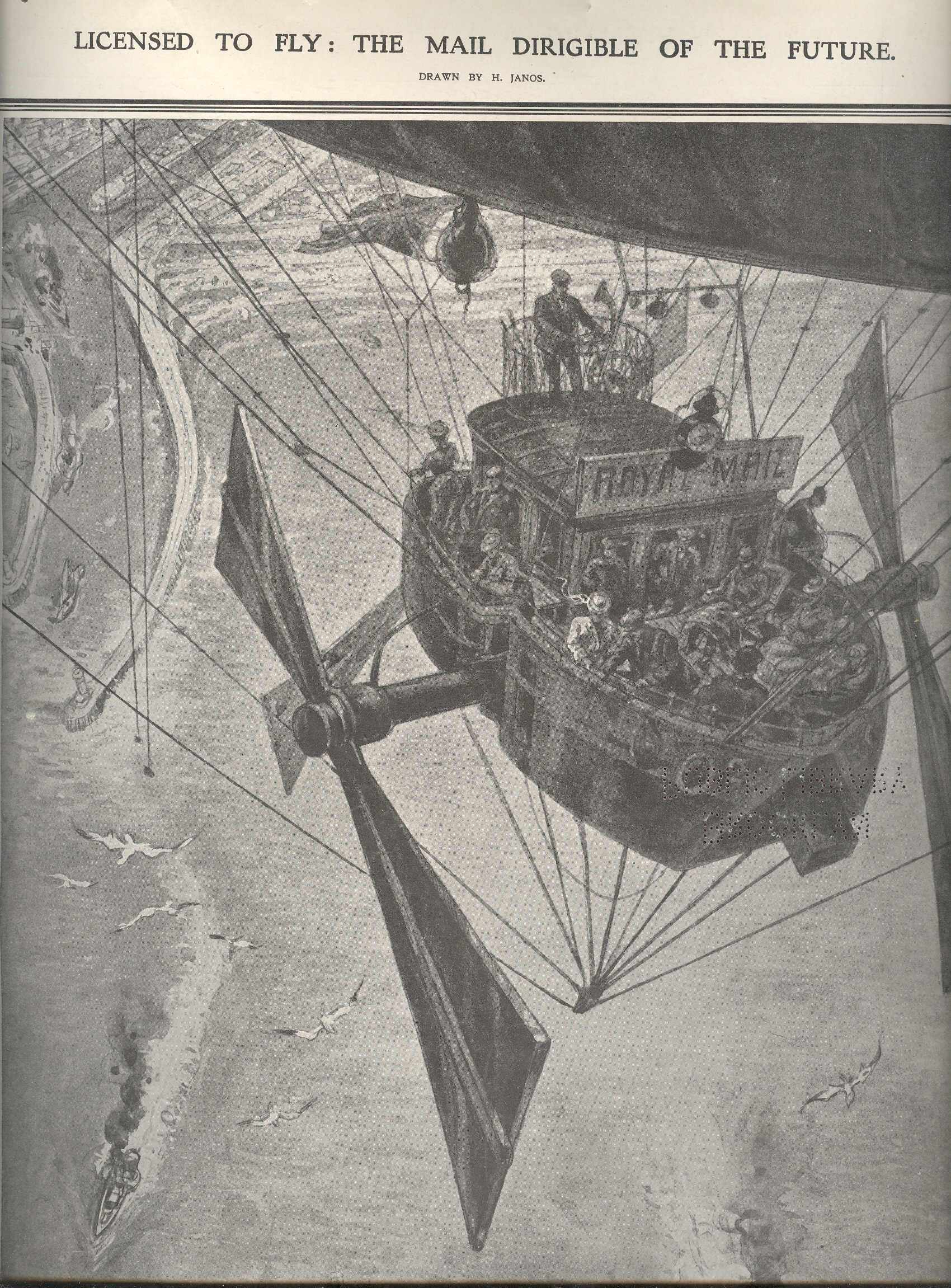
    Seeing this splendid image of the 1909 near-future forced a question into mind:  what came first, aerial delivery of mail or aerial delivery of explosives?  I suspected that “mail” would be the correct answer, but didn’t know how much deeper that went into the past than the history of aerial bombing.

    Mar 23 air mail ILN


    The first bits of mail were delivered among the first balloon flights ever made–in the U.S., the first quasi-official piece of airmail was a letter from president George Washington that went aloft in the first balloon flight (1793) in this country, deliverable to whomever it was that first came to greet the balloon in wherever it landed.  The first semi-regular delivery of mail in the U.S. was again by balloon, beginning in 1859, which still precedes the first sustained use of explosives dropped from aerial vehicles by five decades.

    Mar 23 air mail ILN det


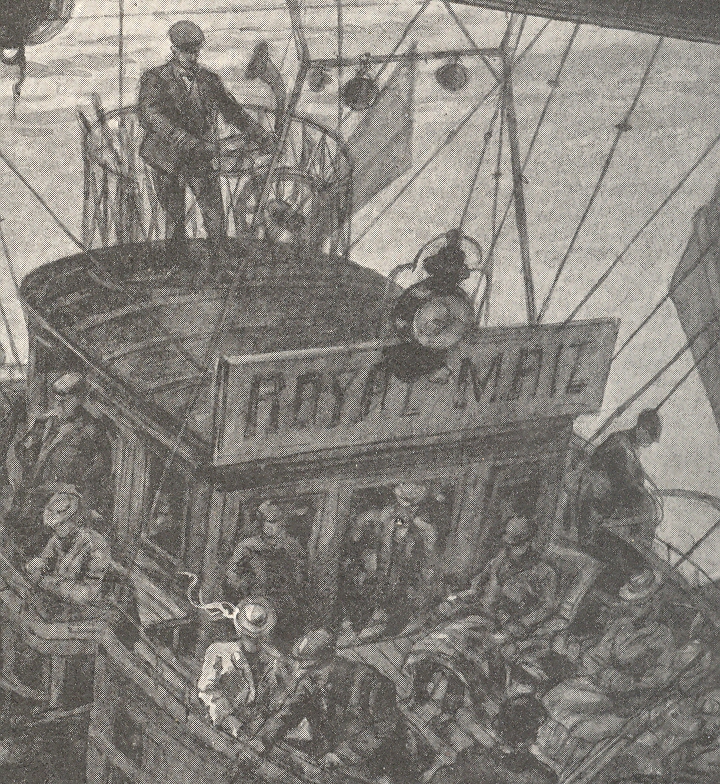
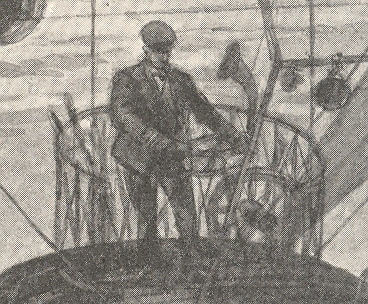
    This image was drawn by H. Janos for the Illustrated London News for 16 January 1909, and shows a futuristic balloon making its way from Dover to Calais with a cargo of mail and a dozen or two passengers (and whatever crew there was besides the captain, presumably belowdeck).  The article reads: “1910 may seem a very early date at which to fix the coming of such vessels, yet aerial navigation is progressing at such a rate that none can call the date impossible”. 

    Mar 23 air mail ILN det 2

    And so true;  it didn’t take but a few years to begin experimental air service routes for the mails by biplane, and less than a dozen to have instituted long-range flights by heavy aircraft, with the mammoth mail-delivering airships sent to the not-good ideas department. 

    In any event I just happen to like this image by Janos–for what was a not-essential piece to the weekly magazine, the man did produce an admirable work, not the least of which is his unusual airborne oblique bird’s-eye view to the shoreline. 

  • Anonymous & Famous: Great Works in the History of Thinking

    JF Ptak Science Books   Post 1718

    [Part of this blog’s series on the History of Blank, Empty and Missing Things:  Names.]

    http://ebooks.adelaide.edu.au/d/darwin/charles/beagle/images/section.jpg

    There was a brief point in Charles Darwin’s publishing life when the old (then young) man got stiffed.   Darwin’s magisterial contribution to Narrative of the Surveying Voyages of her Majesty’s Ships Adventure and Beagle between the years 1S26 and 1836…, (published in 1839) appeared in the third volume,  (by far and impossibly away the “money” volume), and was issued without his name on the title page, which as it turns out was okay by the standards of the day.  The real oddness turns up in  the publisher’s ads that appeared in the later issues of those volumes in late 1839 for what would be a separately-issued volume of Darwin’s contribution (Journal of Researches into the Geology…), where again there was no mention of the author’s name.   (Captain Fitz-Roy,  the man whose name adorned those early volumes, was the Captain of the Beagle a man with problems and some very interesting and early meteorological ideas; but both would be dead to one another soon enough.)  The recognition element was dismissed very quickly though when the work was actually published—his name was in the book but not in the advertisements. 
    Anonymouspaine
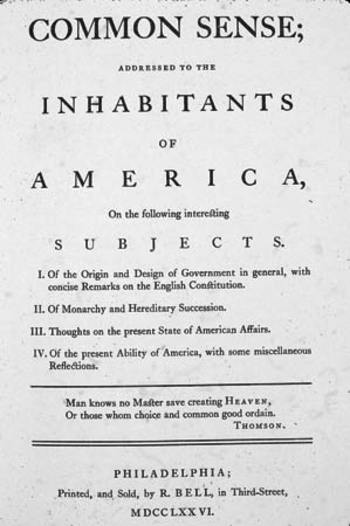
    This is really just a little fly in the ointment though in the publishing history of major scientific works–anonymous literature (or in the Darwin case, really, seemingly purposely forgotten) isn’t that deep and long in the sciences, especially when you excuse ancient and middle-Renaissance period efforts.  Certainly the sciences don’t compare with other disciplines, where works by anonymous or pseudononymous abound.  The history of world literature ancient and modern abounds in silenced or self-silenced authors—there is even a four volume encyclopedia to help you identify the unidentified. . Political and religious work are also particularly heavily laden with unattributed or disguised efforts—the U.S. Constitution and the Federalist Papers are of course both anonymous (and of necessity), as was the most beautiful work of Voltaire.  The Declaration of Independence, on the other hand, and also of necessity, was not.  What is that  they say?  Anonymity is the best defense against the tyranny of the majority”?  It still feels a little Orwellian to see the unattributed source in the newspaper or read an anonymous editorial.   On the other hand Thomas Paine’s sublime On Common Sense may not have made it into print if its author had been required to identify himself. 

    Art is perhaps the longest-lived area of anonymous work, the signed canvas being a relatively recent invention.  There are thousands of years of unknown hands and eyes represented in millions of works, but really we only get solid confirmation of the intellectual origin of a work through the invention of the ornament of the signature, and this just within the last 500 years.  And even after this defacement begins to appear there is still a relatively stout history of semi-anonymous works coming from painting studios doing work “in the manner of ____”.  Of course there were other considerations at play here, what with guilds and patrons and all—the artist was one person in a lengthy bureaucratic trail of aesthetic production.

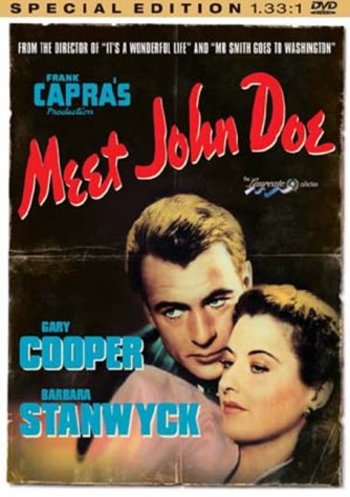
    Anonymouscooper Anonymous seems to come more into play in our present culture via the need for a place holder—when tallying and accounting the death of unknown people, for example, the name “John Doe” or “Jane Roe” is used (in the U.S.) to take up the forever empty space calling for The Departed’s name. (Our most famous “Jane Roe” is Norma McVorvey of Roe v. Wade; I think the Gary Cooper still ranks the highest for the male equivalent.)
    Something has to go there, and so it is.  The practice of using such names is actually pretty old, and is practiced worldwide.  (see HERE  for an entertaining look at multi-cross-cultural “John Doe” equivalents.)

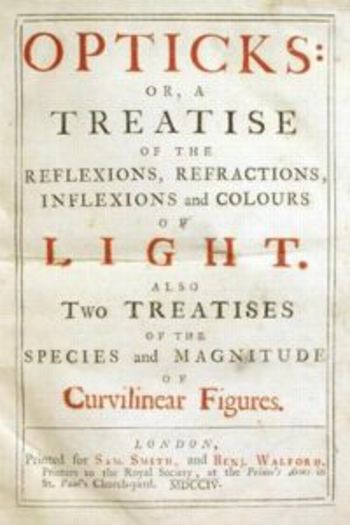
    And now that I’ve had some time to think about non-Darwins examples from the sciences, I’m a little stumped.  Robert Boyle is a good example, what with more than a dozen of his works (at least according to John Fulton’s bibliography) were published without his name carrying the title page-but these were the philosophical and political works of a great scientist, and not scientific.  Same too for Pascal, who wrote his Pensees undercover—and again, not scientific but by a scientist.  Isaac Newton published his fabulousAnnoymousopticks_2 Opticks without his name on the title and in fact only used his initials (sort of) in the preface as his personal identifiers.  He was though in 1704 when this book was published a decade’s-long acknowledged super genius, and I’ve never been very comfortable with any explanation over this unNewtonesque shyness for his big optics book.
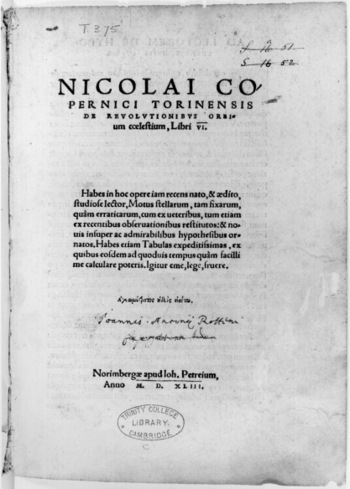
    That leads us lastly to Thomas Malthus, who really did publish the first printing of his massively important Essay on Population without his name—it would make an appearance soon after, though, in the second edition of this contentious work making the first edition of this great near-scientific work one of the most influential anonymously published science books of the last 250 years.   Laying Malthus aside though and lifting the time-veil for just a peek, the best example in this genre turns out not to be an example at all.  Copernicus was the ultimate anonymous author of a scientific work because he didn’t publish it—fearing reprisals for his horrifically challenging and revolutionary work, Nicolas waited until he was bAnnonymouscopernic asically dead to have his effort put into print.  Then, once he was safely assured of his snug bed with the worms, free from fear of all anxiety and moral espionage, did he see the work brought to public display—with his name very boldly displayed on the title page. 
  • Design and Undesign in Belief and Unbelief: Revivalism, Fasting and Flames

    JF Ptak Science Books  Quick Post

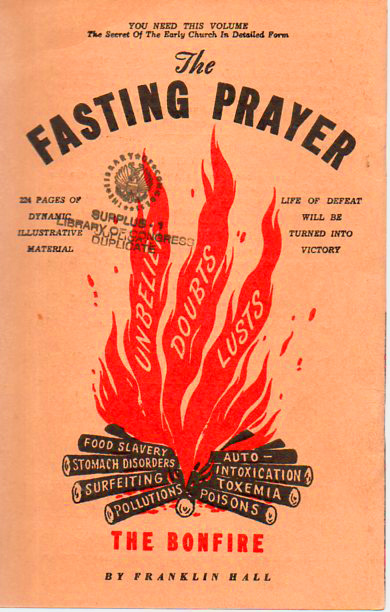
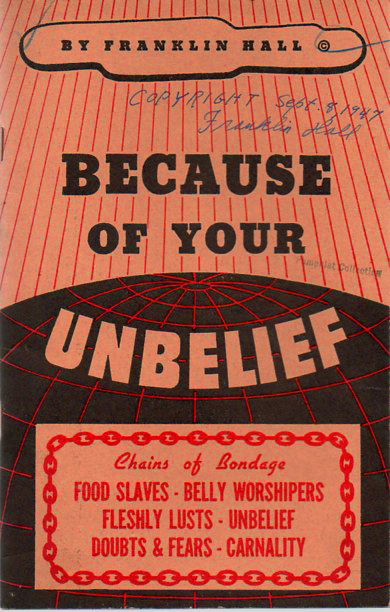
    I was looking through a stack of pamphlets here aiming to select something in red for St. Valentine’s Day, until I came upon this magnificently designed pamphlet by Franklin Hall, Because of Your Unbelief , Chains of Bondage, Food Slaves,m Belly Worshippers, Fleshly Lusts, Unbelieft, Doubts & Fears, Carnality.  I think though the attractiveness is in the pamphlet’s undesign–it has a distinct taste of revival-tentism to me, a message hammered out in a thumping repetitiveness and bass cadence. 

    Unbelief169
    The work has no title page, and starts with a foreword, and gets right into the message, which equates food and eating with a passage from the New Testament (Matthew 17:20, “And Jesus said unto them, Because of your unbelief: for verily I say unto you, If ye have faith as a grain of mustard seed, ye shall say unto this mountain, Remove hence to yonder place; and it shall remove; and nothing shall be impossible unto you.”)  Reading this for the first time, it seems to me that what Jesus is saying is that it doesn’t take much more than a mustard seed amount of faith to be able to move a mountain.  Which seems to be a great message on believing in something and having the confidence to achieve.  I’m not sure how it happens from there, but Mr. Hall gets right into the power of fasting (which is not an uncommon practice in the Old and New Testament so far as I can tell, though “fast” meant different things to different people), and that through fasting this “unbelief” in people can be revealed and blasted away. 

    Unbelief170
    As we see on the back cover,  in an advertisement for book of “224 pages pf Dynamic Illustrative Matieral” we see Fasting Prayer about to descent on the flames of unbelief, doubt and lust, fueled by “food slavery, stomach disorders, surfeiting, pollutions, auto-intoxication, toxemia and poisons”, perhaps insinuating that at the base of it all it is food that fuels unbelief.  Or not, I’m not sure.  But the entirety of the publication does have a very Elmer Gantryish aspect to it, to me.

    Mr. Franklin was also the author of Glorified Fasting, Because of Your Unbelief, and of course Atomic Power with God Thru Fasting and Prayer.

    ·Posted by :

    ·in:

Recent Posts

Archives

Categories