A Daily History of Holes, Dots, Lines, Science, History, Math, Physics, Art, the Unintentional Absurd, Architecture, Maps, Data Visualization, Blank and Missing Things, and so on. |1.6 million words, 7500 images, 4.9 million hits| Press & appearances in The Times, Le Figaro, Mensa, The Economist, The Guardian, Discovery News, Slate, Le Monde, Sci American Blogs, Le Pont, and many other places… 5000+ total posts since 2008.

  • “Teaching Britons When to Hide”, 1915

    JF Ptak Science Books  Quick Post

    Dirigible563
    This warning to the public appeared four months after Germany began to bomb the U.K. from the air using lighter-than-air airships. There’s also a section for identifying heavier aircraft, but bombing by that means didn’t start evidently until 1916. 
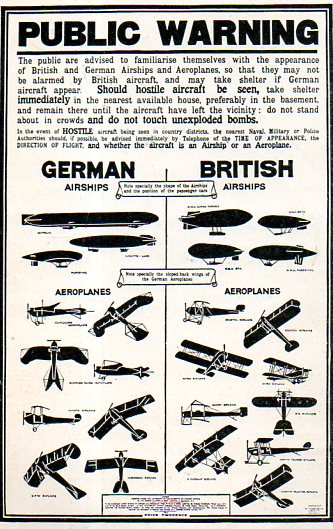
    Dirigible562[Source:  Technical World Magazine, May 1915, page 336.]

    “Zeppelins
    (airships) performed about 51 strategic bombing raids during World War
    I. These raids caused numerous civilian casualties, killing 557 and
    injuring another 1,358 people. More than 5,000 bombs were dropped on
    towns across Britain, causing £1.5 million in damage. 84 airships took
    part, of these 30 were lost, either shot down by enemy action or lost in
    accident. The raids, though disconcerting to civilian morale, were militarily ineffective.”–Wiki

    Bombing from Zeppelins was very problematic–in the beginning of the bombing raids, mostly throughout 1915, the Zeppelins were able to fly beyond the reach of anti-aircraft weapons, and at certain altitudes just beyond this reach they could carry a relatively heavy load of bombs.  The drawback was that bombing from this height was extremely haphazard, with little accuracy, which meant that most of the targets wound up being civilian areas, creating the term “baby killers” for the Zeppelins.  In the next year when British defenses against the machines improved, the Zeppelins flew higher, which necessitated oxygen and a lighter payload, and more inaccuracy.  Towards the middle/end of the war German command went more with bombing Britain from aircraft (like the Gotha) more so than Zeppelins.  The end result was not very militarily effective, causing 2,000 mostly-civilian casualties. I’m not so sure about the use of the word “strategic” in the Wiki description.

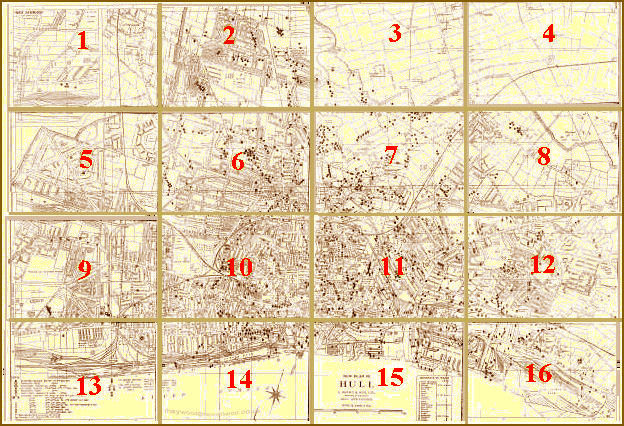
    Let’s remember the city of Hull, which received eight attacks during the Great War, only a prelude to the massive attacks it would receive during WWII. 

    Hull Blitz Map, WWII, here
  • On Freedom of the Press and Attacking Censorship from Prison, 1812

    JF Ptak Science Books   Quick Post

    1812572

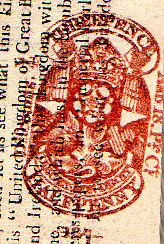
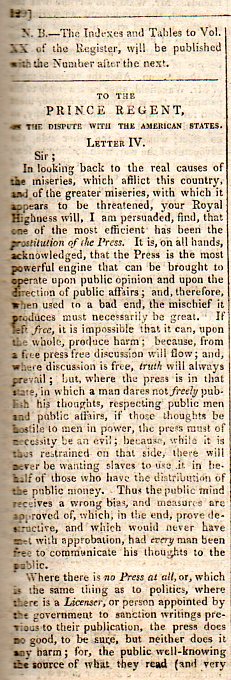
    This is really very good:  on distinguishing the free press with what it is and what it isn’t. The art icle appeared a few months before the official declaration of war between the U.S. and the U.K. (June 1812) in Cobbett’s Weekly Political Register. It was written by William Cobbett (1763-1835) and I think that this was a direct and very vocal reaction to the government’s instituting a tax on newspapers such as this–adding a tax made the journal not affordable to but a select class, thereby limiting circulation and being a de facto censor for the distribution of information. 

    He was also writing this from prison.  Cobbett was sentenced to a two years’ term in famous/infamous Newgate, sent their for treasonous libel after having written an anti-flogging article. He was also by that point a pain in the side of the government, and was paying for other perceived transgressions as well.

    Evidence of the ‘crime”–the limiting tax stamp:

    1812573

    And the article:

    1812571

  • What a Fascist Really, Really, Is: on Defining Things

    JF Ptak Science Books   Post 2096

    In the history of words and the history of writing them, the history of writing down what words mean came relatively late in the word game.  The first dictionary for the English language is difficult to establish–it wasn’t Dr. Johnson’s 1746 effort, as fabulous as it was.  There were more than a hundred earlier efforts, the earliest of which may be Robert Cowdry’s A Table Alphabeticall… as the first English dictionary, which was written in 1604. (Its more easy to determine the first American dictionary, Dr. Webster’s, 1828 .) It may be that dictionaries and assemblies of rogue/thieves language appeared well before Johnson, by perhaps as much as 175 years, providing the good readers and listeners in England with a ready tool for understanding “non-standard” (slang) words of the English language (with A New Dictionary of the Terms Ancient and Modern of the Canting Crew, by “B.E.”, being the best known of these early works, published in 1698.)

     It is interesting to me that in addition to Johnson et al another  writer–or rather set of writers–were responsible for the first Johnsonian-first dictionary in German, the  Deutsches Wörterbuch by the Brothers Grimm.  These are good examples of modernity, though there are earlier examples for other languages–Petrus de Alingio’s manuscript of 1286 and the Catholicon as the first printed alphabetical listing of Latin words appeared very shortly after Gutenberg’s Bible did on the same press.  But then these were both many centuries into the use of the language.

    WWII--Italy Fascist a042

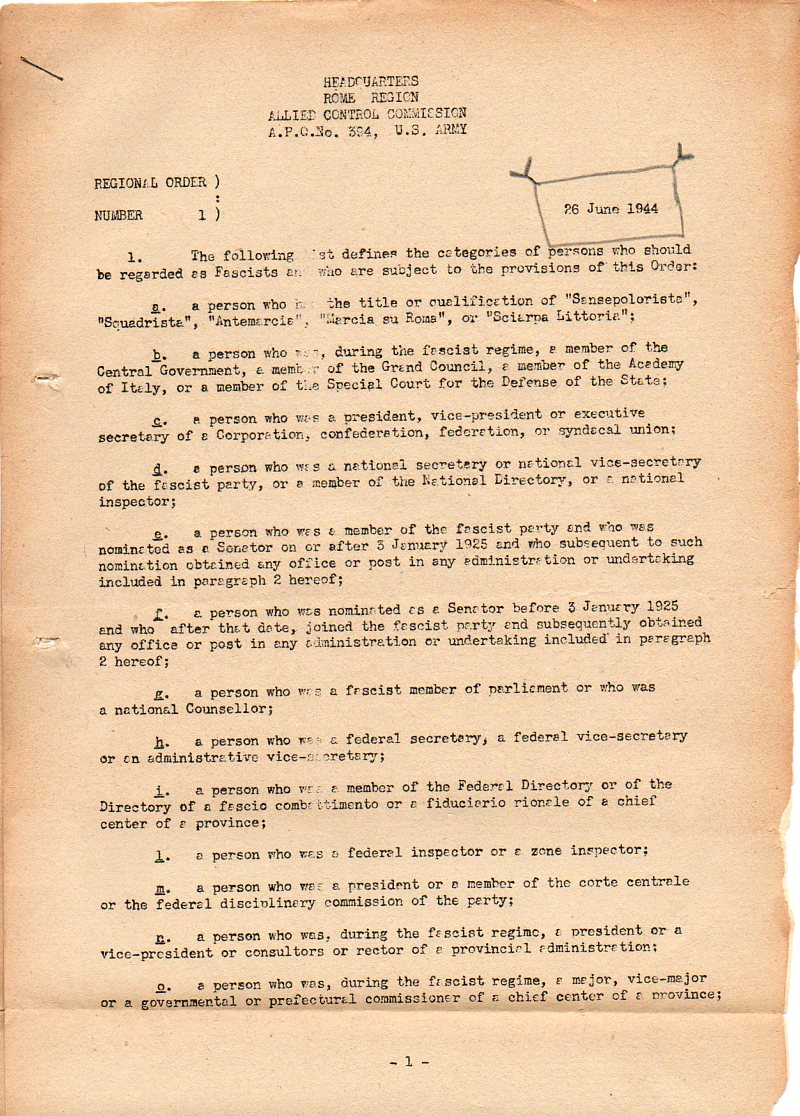
    {More detail in the “continue reading section”, below; also, the original is available for purchase from our blog bookstore.]
    And this just to say how much I like the road to words–especially when they come from unexpected places. One fine example of this is the directive below, issued by the headquarters of th Allied Control Commission (“APO No 394″) in Rome in the summer of 1944.  (This would actually be the American arm of the ACC, which was commission set up by the Allied Powers to deal with the administration of defeated countries at the end of the war.  Three weeks after D-Day the end of the war was in sight (Bastogne and Co. not withstanding), though far more so in Italy than just about anywhere else, and so the implementation of governing and occupying plans needed to be established.  One of the primary features here was to ensure that the old Fascists not be included in the new Italian governments (along the lines of denazification in Germany, which had a more laissez-faire approach to defining Nazis, especially wealthy and useful ones), and the primary issue in finding and excluding Fascists was to define what was meant by “fascist”1.  These are those working guidelines, at least on 25 June 1944. 

    ·Posted by :

    ·in:

  • Q: When is a Stringed Instrument a Trumpet?

    Marigini trumpet578JF Ptak Science Books  Quick Post

    A:  When it is a triangularly-based monochord called the “Trumpet of Marigni”.  It was designed 500 years ago to sound like a trumpet by virtue of the single string and the tremulations of the bridge.  I’m not so sure what it sounds like (though it sounded like a trumpet) but it certainly is a beautiful thing seen in profile. 

    This appears in A Course of Lectures on Natural Philosophy and the Mechanical Arts, by the encyclopedic polymath, Thomas Young.

    An 1845 version of the work and the engravings is available online–I’m using the engravings from the first edition that I have in hand, which are much cleaner than the later reprint. (I should say that the text is the same for the description of the illustrations so far as I can tell, though position and so on is different.)

    ·Posted by :

    ·in:

    —
  • The Faces–and Hats–of Texas Poker, 1930

    JFPoker584 Ptak Science Books   Quick Post

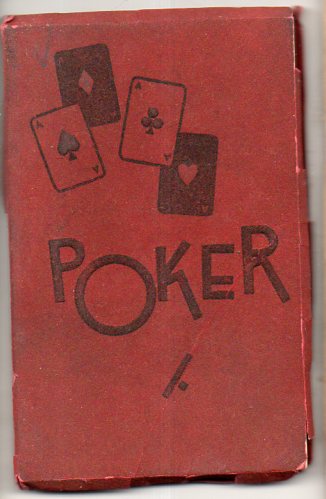
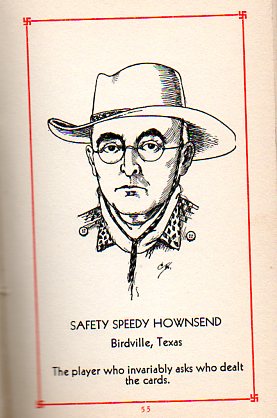
    I found a wonderful bit from 1930, a less-than-pocket-sized book on winning and losing in poker1–it has a fair amount of what might be either good or bad information, but mostly what it has of interest are 21 portraits of mostly Texas poker players from the late 1920’s.  I have no idea if these are real people, or not–but they come from real towns (Like Spur, Lufkin, and Birdville), and the one-line descriptions of them are wonderful and semi-priceless.  The portraits both have and lack a certain something–and at the very least everyone is pictured in a hat.

    And yes our Texas poker aces are featured in a design highlighted with swastikas–but this is before the world outside of Germany in 1930 knew what the NSDAP was doing with this ancient symbol. 

    Poker585A full list of the portrait entries may be found below.

    Also, if you wanted to own the original it is available from our blog bookstore.

    ·Posted by :

    ·in:

  • The Camera Obscura at War, 1885

    JF Ptak Science Books  Quick Post

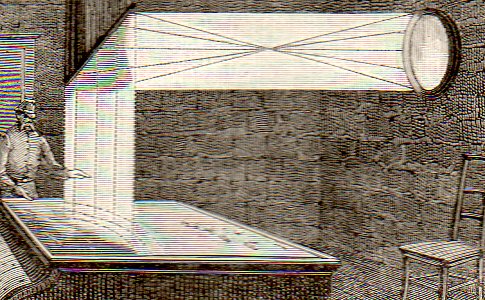
    I’m fairly well certain that I have never seen an image of a camera obscura being used for military purposes–until today.  I found “The Camera Obscura in Torpedo Work”, in the great scientific journal Nature, for 26 February 1885, pp 389-340.  Here’s a detail:

    Poker592
    the full article follows.  It makes sense, kind of a cyber-tool, a steampunk hologram in a way. And there it is.

    If you’d like to own the original article you may purchase it via our blog bookstore.

    ·Posted by :

    ·in:

    —
  • A Composite Photo of Mistakes, 1885 (Or: Imaginativeness vs. Comb-overs?)

    JF Ptak Science Books   Post 2097  
    Follow Me on Pinterest

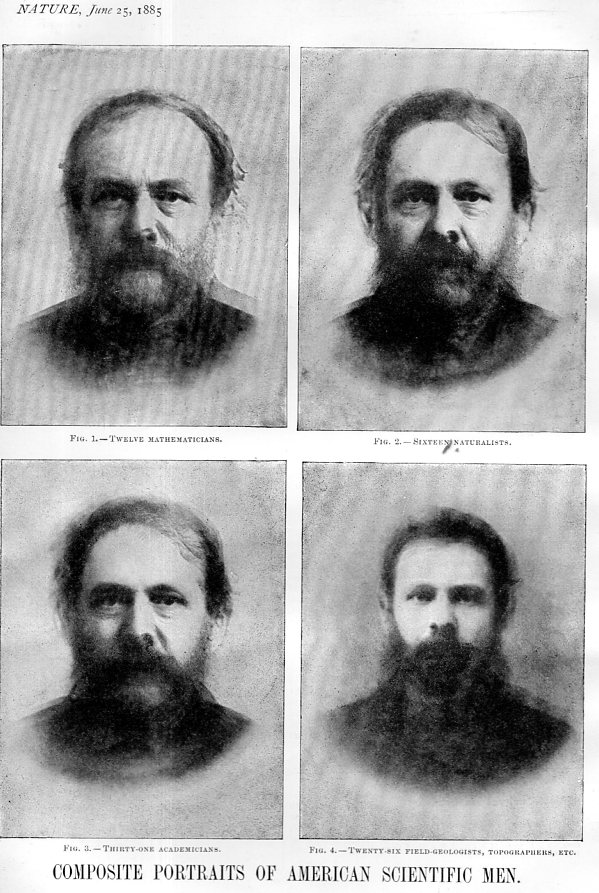
    Building on some reaching and questionable physical identification work of Sir Francis Galton, Raphael Pumpelly tried to make photographs of what scientists looked like. 

    At a scientific meeting of the National Academy of Sciences in Washington,  D.C.,  Pumpelly (along with Dr. (Thomas Mayo) Brewer and the Secretary of the Smithsonian Institution, (Spencer F.) Baird) undertook the experiment to determine whether or not there was a certain composite “type” in groups of academicians.  He employed the justly-named head of the photography department at the NAtional Museum, Mr. (Thomas Mayo) Smillie, to make a series of 2-second exposures of the scientists upon a single glass plate.  Two seconds per portrait was not long enough to make a defined portrait for a single sitter, but if there 15 or 30 such exposures on the same plate it was seen that collectively a strong impression would be produced.  The resulting portraits are interesting in their own way, but probably not so interesting without the backstory.

    Composite593
    The problem of course is the interpretation and what could come of classifying external characteristics for internal capacities, which would make this exercise as useful as cranial bump reading or body mole mapping. 

    Also it is unclear that if you didn’t identify these images as composites of leading American scientists but were told that they were pictures of murderers or meat thieves or sneak burglars, it would be as easy to believe.  Instead of identifying their characteristics of “intelligence” and “imaginativeness”, changing the grid-of-explanation to criminality would certainly change those readings to something else.

    [The original paper is available via our blog bookstore, here.]

  • On Using the Pocket Spectroscope to Foretell Weather, 1884

    JF Ptak Science Books    Quick Post

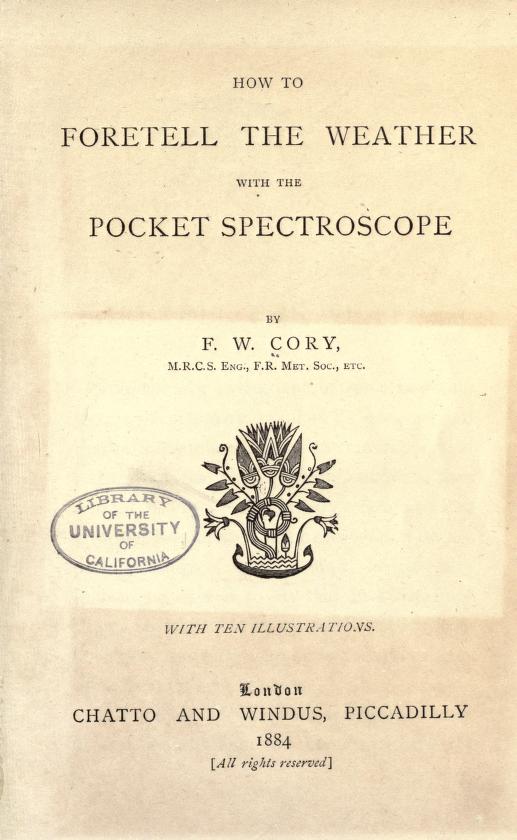
    I was working my way through an edition of Nature for 1884 (23 October, page 606) when I found a review of F.W. Cory’s How to Foretell the Weather with the Pocket Spectroscope (1884).  The title was enough, and the review even more so–I knew this was an obscure work, but not so much anymore, as the entire book is located online! Sometimes I get used to the sci-fi aspect of the intertubes, but when I make discoveries like this I am reminded all over again how magnificent all of this is. 

    Howtoforetellwea00coryrich_0005[Source:   University of California Libraries via Internet Archive, here.]

    ·Posted by :

    ·in:

    —
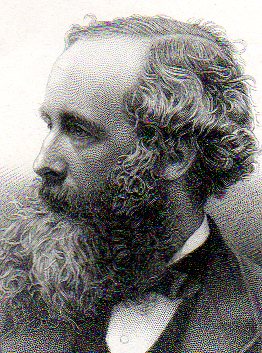
  • James Clerk Maxwell’s Library

    JF Ptak Science Books   Reference Tool series

    I found this fantastic list at the James Clerk Maxwell Foundation and wanted to include this with a list of other Maxwell items but simplycould not get a link to function directly to the most-interesting JCM personal library page.  http://www.clerkmaxwellfoundation.org/JCMLibrary.pdf

    Maxwell507


    ·Posted by :

    ·in:

  • A Note on the Fullness of Micro-Landscapes

    JF Ptak Science Books

    0 ebay 17 red cross fly282

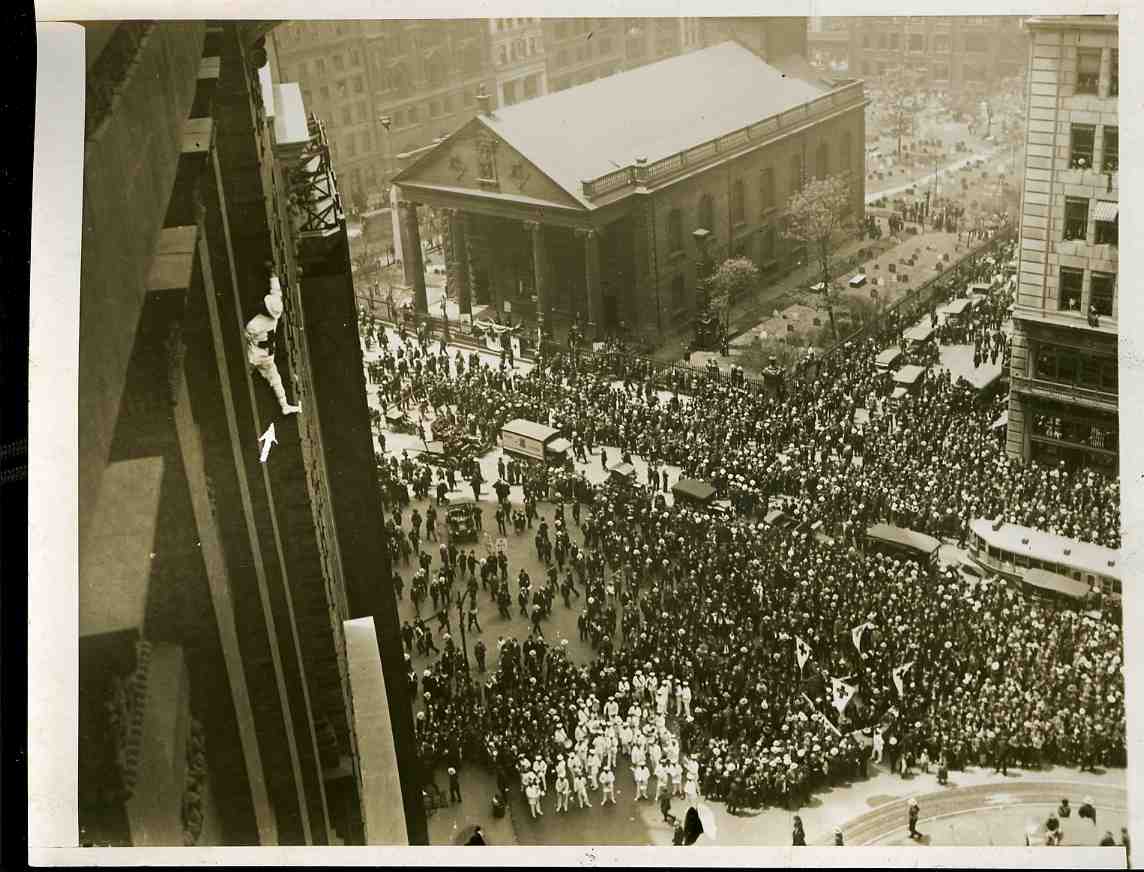
    Here’s another in the Looking (Really) Closely at Prints series–actually they’re more like a Inner Life of Prints series than anything, each mico-investigation leading to another entirely new world, each a new image, each a new view and vision, an orders-of-magnitude appreciation of one single object. 

    This photograph depicts a “human fly” making his untethered way up the side of a high rise in Manhattan (?), each foot of his success no doubt raising money for relief effort of American troops or displaced persons or orphaned children, probably in 1918.

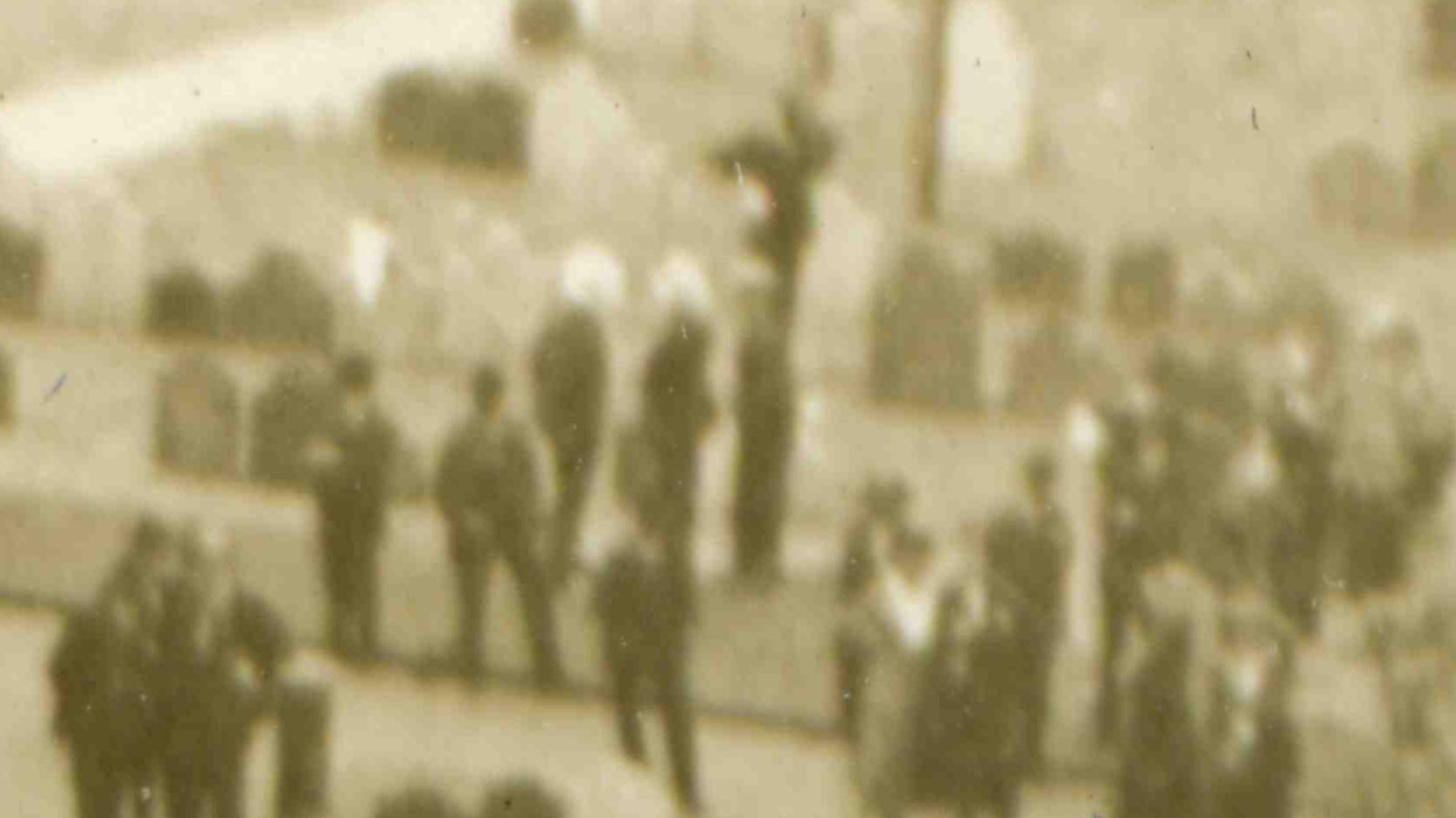
    Perhaps this is Mr. Harry G. Gardiner. the self-styled “human fly” who climbed many buildings in NYC and Boston and Philadelphia in 1918 and 1919.  I cannot identify the church (Episcopal?) in the background, sorry to say (though I’m sure that this will be easy for someone to do).  But I did have a very close and fairly thorough look at the crowd under some fair magnification, and found that not many were actually watching the climber.  On the other hand how interesting can it be to watch someone climb a building–slowly–observing it from hundreds of feet away?  I didn’t see any kids, I don’t think, and there are lots of people looking the other way.  Its difficult not to try and put yourself in the very shoes of these people under the ‘scope, trying to imagine what they were thinking, the heat of the sun on their boaters, the uncomfortable nature in general of wearing all of those clothes for the women, leaning against the black iron fence taking in the stubby sites of the graveyard next to the church….I stopped finally with the two guys in boaters (seen here in the enlargement, the original being just a specky bit at the rear of the cemetery  at the back of the church, to the right), looking very comfortable and relaxed, one with his hands loosely clasped behind, the other perhaps pointing.  Both are looking away from the climber, in the opposite direction, across the graveyard and above the gravestones.  The sun caught their hats perfectly.  They were enjoying a leisurely morning.  There are hundreds and hundreds of these mico-scenes caught in this moment, their suggested fullness revealed only under magnification, like looking through a telescope, in a way, back into a frozen moment of time, yet another photonic jewel.

    0 ebay 17 red cross fly284

  • The Spine of Society and the Beginning of the Grid, 1878

    JF Ptak Science Books

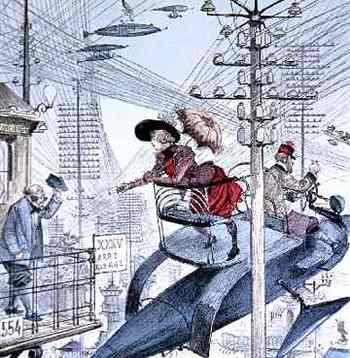
    Robida

    I’m interested to know what anyone might know about the use of
    metaphors relating large-scale societal techno advances and biological
    functions?  I have no doubt that they go back to modern-ancient times
    (say to William Gilbert (1544-1603)  and his vis electrica)—but I’m
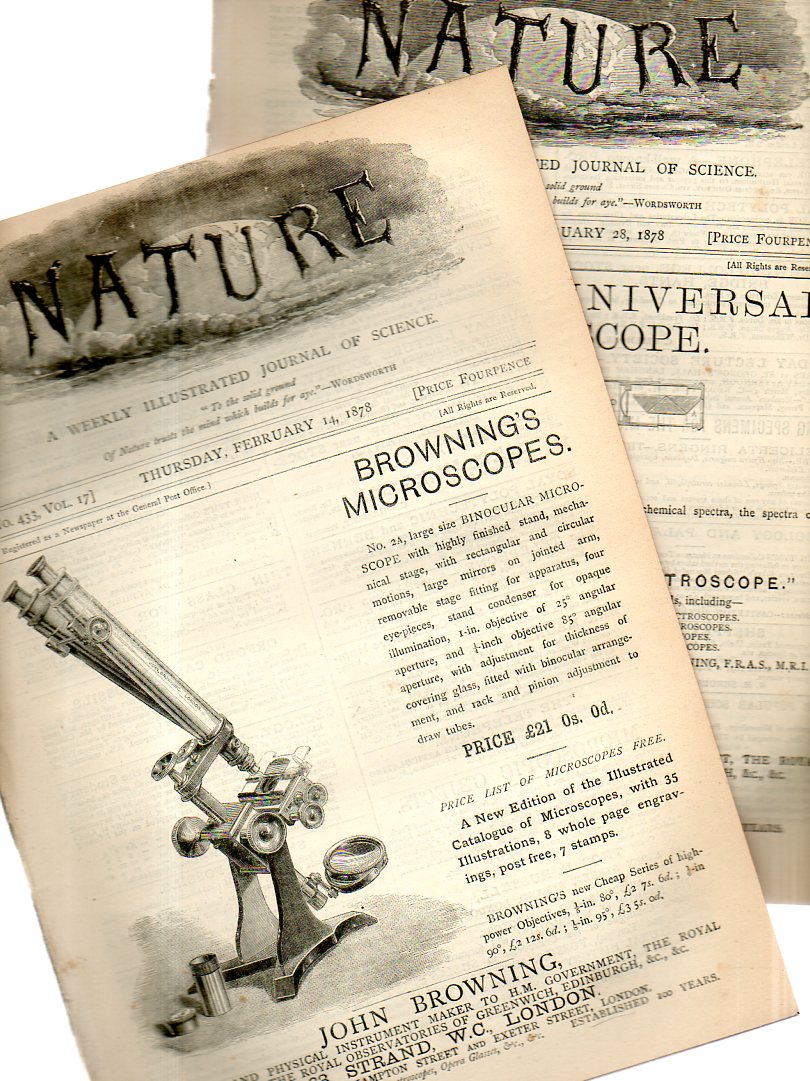
    stopped today by seeing this paper by J. Norman Lockyer called “Social
    Electrical Nerves” (in two issues of  Nature for 14 and 28 February
    1878).  In this paper the great astronomer looks at elements of the
    “grid” as it was and seeing how the new networks of police and fire
    communications via telegraph  interacts with the existing electrical
    systems.  It seems to me an early use of  nervous system/electrical
    grid, in spite of the fact the first “electrical highways” (as Lockyer
    puts it 120 years before our own “information superhighway”) appeared
    in England 32 years earlier though apparently without these biological
    metaphors. 

    • [This article,which appeared in two parts, is available for purchase via our blog bookstore, here.]

    Robidatelephone_lines
    The work pictured above is the electrically-draped world of the future,
    at least according to the vision of the wonderful Albert Robida, who
    was actually at work on these visions just at the time of the
    publication of the Lockyear paper . (Robida produced at least a trio of
    interesting and lovely and occasionally prescient works:  Le Vingtième
    Siècle
    (1883);  La Guerre au vingtième siècle (1887); and Le Vingtième
    siècle– La vie électrique
    (1890)).   Many of Robida’s visions of
    electrical connectivity seem to me to move beyond the nervous system
    metaphor and become a kind of societal “skin”—which is not terribly far
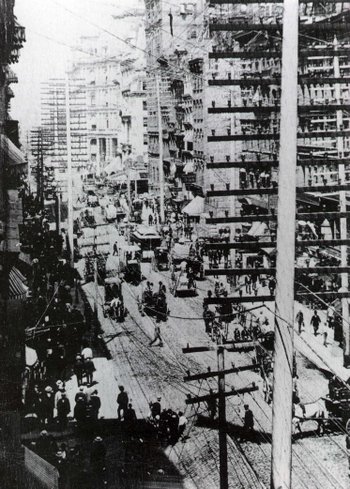
    from the truth, especially when looking at images of congested
    metropolitan centers ca. 1910, when utility poles fairly well sagged
    under 20 (!) horizontal crossbars carrying a dozen lines apiece.   At
    the very least, you knew that something or other was happening (fast
    forward to the massive ductworks of Terry Gilliam’s masterpiece,
    Brazil.) 

    Social electric616

    And now that the wireless age is starting to get ridges in its
    fingernails (the “wireless” age being at least 115 years old,
    beautifully borne by Heinrich Hertz and Marconi), are our bio-electrical  metaphors giving way?

    ·Posted by :

    ·in:

Recent Posts

Archives

Categories