A Daily History of Holes, Dots, Lines, Science, History, Math, Physics, Art, the Unintentional Absurd, Architecture, Maps, Data Visualization, Blank and Missing Things, and so on. |1.6 million words, 7500 images, 4.9 million hits| Press & appearances in The Times, Le Figaro, Mensa, The Economist, The Guardian, Discovery News, Slate, Le Monde, Sci American Blogs, Le Pont, and many other places… 5000+ total posts since 2008.

  • A Note on Graphical Display and a Mechanical Heart, 1876

    JF Ptak Science Books  Post 2138
    Follow Me on Pinterest


    Marey mechanical heart816

    This quick note comes as the result of a short chase on the detection of the pulse and the ability to determine death–as far back and even before Pliny life was determined by the audible heartbeat, which is where the trouble began, because one can still be very alive with a faint heartbeat. This was a major concern when dealing with folks who were thought to have expired, because in the mid-19th century and before the instruments necessary to make a careful and accurate appraisal of whether the heart was still working were yet finely developed.  Laennec’s stethoscope appeared around 1816, but as much of an improvement as it was this instrument awaited considerable refinements before a truly solid identification of a non-working heart could be established. The gaps in the determination of the arrival of death led to mortuaries where the supposed-dead were left to themselves at room temperature for three days, awaiting the ultimate determination of death which was putrefaction (as in the Munich and Frankfurt Leichenhaus and the Vienna  Zentralfriedhof). Earlier in the history of the determination of death methods were quicker and more brutal (if the patient was still alive) involving bellows-driven tobacco-smoke enema,  as well as tongue pulling and nipple twisting.  (See an earlier post here on the Worst Jobs of the Nineteenth Century for more on this.)
    Marey mechanical heart817

    This led to Etienne Marey (1830-1904), a versatile experimenter and premier instrumentalist who was a scientist, physiologist, and motion-picture/chronographer pioneer, who in the 1880’s created what was essentially the world’s first moving-photographic “slow motion” device. One iteration of Marey’s apparatus was basically a long series of ganged cameras recording a motion for a  simple task at a given time frame and presented on a continuous strip of photographic paper, sort of like a motion picture with the camera speed set at three frames per second. The resulting images were phenomenal and showed people for the first time the exactness of all manners of simple motions–motions that no longer looked so “simple” once all of its aspects could be studied from captured photographic evidence.  Even the act of hopping over a small stool or bending to pick up a bucket of water were enormously revealing in a way like Robert Hooke’s Micrographia displayed the great detail and complexity of the seemingly simple fly.

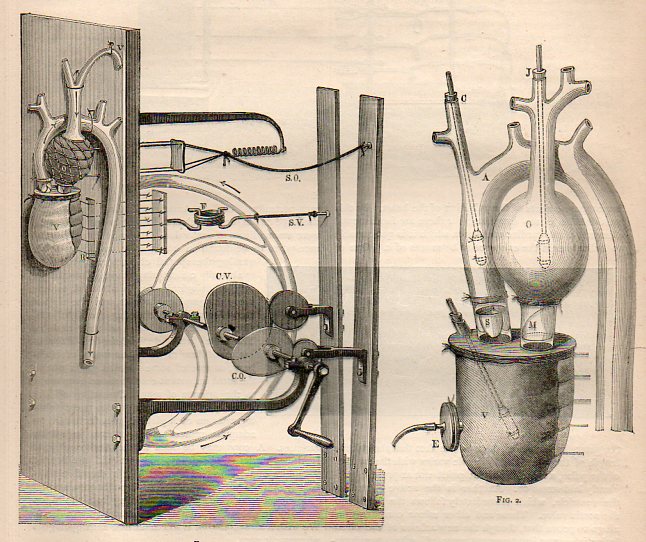
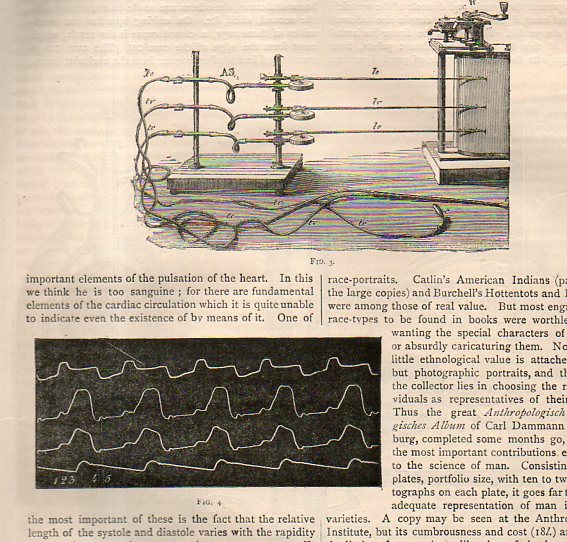
    Aside fron being one of the founders of cinematography, the other aspect of Marey’s interest in capturing and manipulating time was in medicine, where by the time this article of interest in this post was published in 1876 he had already established himself as one of the greatest cardiovascular physiologists.  What we find in this review in Nature (Thursday, January 6, 1876) of Marey’s Physiologie Experimentale (Paris, 1876) was the editor’s keen interest in the mechanical heart Marey had constructed to show the actions and functions of the heart–the first time, the article notes, that all aspects of the action of the heart were exhibited correctly in one model. 

      Of particular interest was the recording device for the pulse of the heart, which was one in a series of devices such as that improved upon, something Marey himself had done with the first-introduced sphygmograph (“pulse wrtier”) of Karl von Vierdodt in 1854.  The 1875/6 Marey instrument made major advancements in continuous graphical registration in instruments of continuous noninvasive arterial responses.
  • An Alphabet of Unexpected Stems of “Un-” from 1828

    JF Ptak Science Books    Post 2139 
    Follow Me on Pinterest


    Un detail2 copy

    Having just made a post of words using the prefix “un-” in Joyces Ulysses, I thought it would be interesting to see the unusual/unexpected un- prefixed words in Noah Webster’s classic 1828 An American Dictionary of the English Language.  It turns out that the created and unusual un-words in Joyce bear a similarity-in-strangeness and the unexpected in the Webster book.  Basically, “un-” is a negative prefix, creating (mostly in adjectives) reversal, release, removal.  It is distinct from the “non-‘” stem, and in some instances understood a little better (in some examples) than the “in-” stem. 

    There are some fantastic examples of words that become quite something else in the modern eye:  beautiful words like “unepitaphed” seem to want to mean that an epitaph would be removed, altered in some way, which is an interesting thought (!), but all it meant in Webster’s hand was to be a grave without an epitaph.  “Unbearded” too–all it means is to be without a beard,, and not to have a beard removed in some way.  “Unextinct”!  A wonderful word that brings visions of resurrection, but it means just to be not-extinct, which is still a little odd. 

    And so I have chosen a few examples of words that might as well have been chosen for their color, or musicality, or potential interpretations than anything else, though basically I like the idea of what the words could become.

    An Alphabet of Un-, 1828

    A. Unaccomplishment, unalmsed, unamazed, unappalled, unanswerableness, unartificial

    B.  Unbar, unbearded, unbeget (as a verb! found in Drden, “to deprive of existence”), unbit, unbenighted (“never being visited by dark”), unbestarred, unblameableness.

    C.  Incentrical, unchristianize, uncompact, uncounterfeit, uincommencement.

    D.  Undeaf, undefaced, undeceiver, undevout, undisappointed, undreaded.

    E.  Uneclipsed, unepitaphed, unexistent, unextinct.

    F.  Unfinisher, unfleshed.

    G.  Ungalled, ungod.

    ·Posted by :

    ·in:

  • The Similarity of a 16th c Cactus and a 19th c Futuristic NYC

    JF Ptak Science Books  Quick Post  
    Follow Me on Pinterest


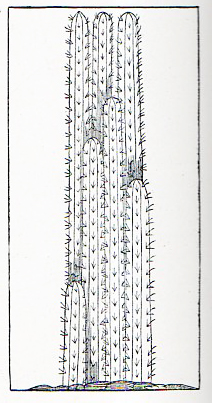
    Cactus818The future is everywhere and nowhere, hidden and obvious, localized and distant; and sometimes it is there when it really isn’t, and vice versa.  This image of the future is the last of these descriptions, though perhaps not even that, because it is a peep at a peep into the future, a reference to a reference.

    First, the cactus, seen here, from G.B. Ramusio’s (1485-1557)  Navigationi et Viaggi, printed in Venice in 1565 (and finally in three volumes, links to which are below).  Ramusio was a geographer and largely a scholar/reader/armchair-traveler, who collected travel accounts of explorers and published them together–the first such effort of its kind. 

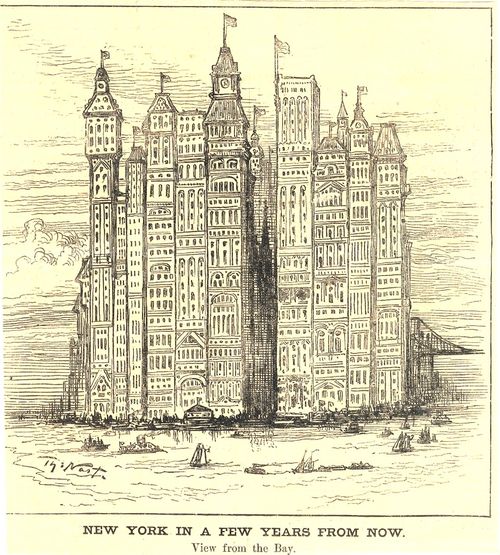
    The second image works better if you squint somewhat while looking at the cactus–it comes from the great and slightly problematic Thomas Nast, the Harper’s Weekly social/graphic warrior.  The image appeared in 1881, and depicts New York City in the near future, he result of newly-advanced building techniques, including the elevator (and importantly!) the elevator safety brake, which allowed the construction of buildings to great and fabulous heights.  Nast saw a little bit of overeager sky-scraping in it, and pictured variegated but probably dark future from the architectural commotion. 

    Nast skyscrapper

    I’m well aware of this being an enormous stretch, but I couldn’t think of anything else to get these two images together on a single post.  (Original article here for the Nast.)

    Notes:

    Full text for the Ramusio volumes from the Internet Archives site:


  • An Interesting Photo of False Safety and Loneliness, 1918

    JF Ptak Science Books  Quick Post  Part of the series on World War I    
    Follow Me on Pinterest

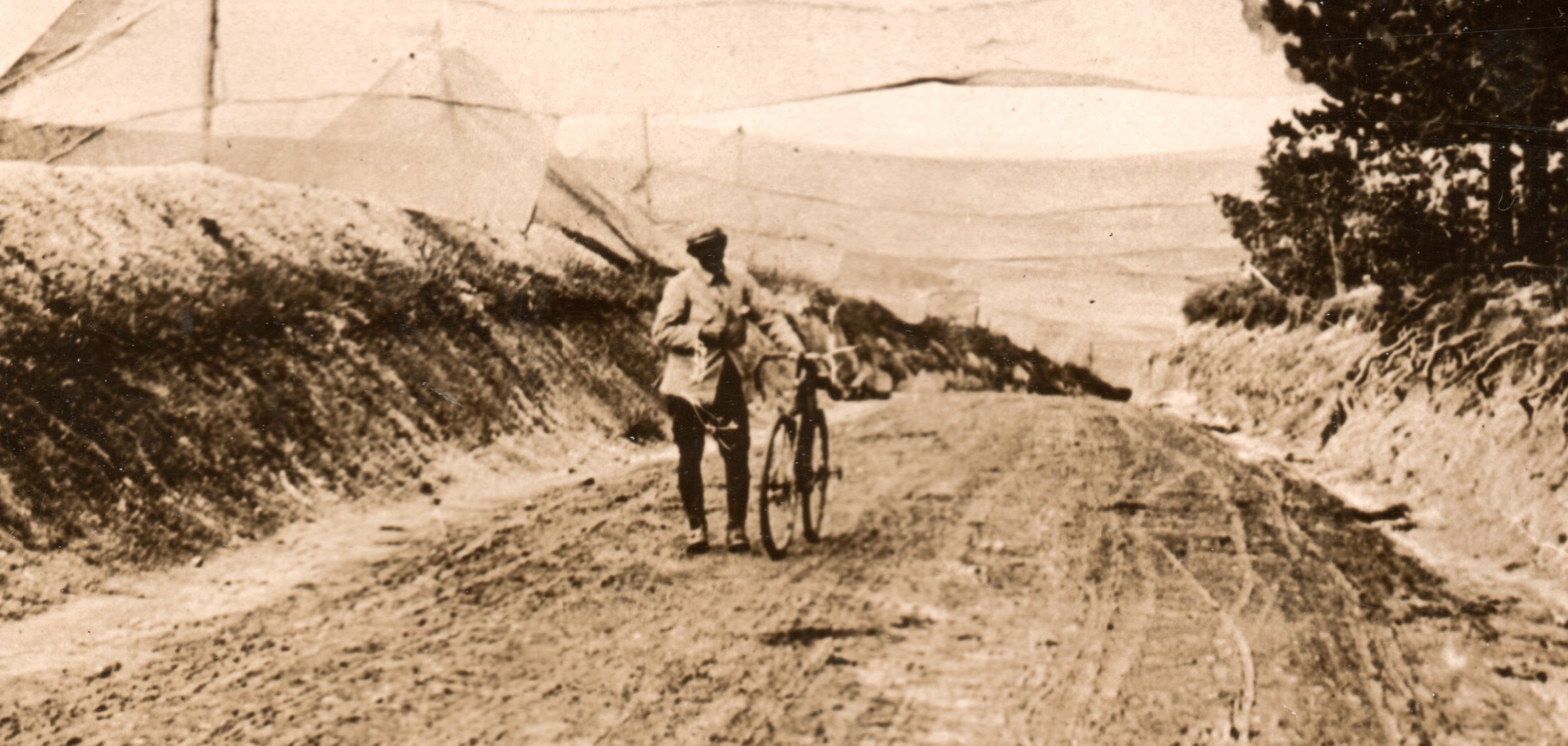
    This wonderful, contemplative, lonely, sad, and ultimately draining photograph depicts a camouflaged road somewhere on the Western Front.  That’s rather a prosaic term for that atrocious line of battle that stretched from the North Sea to Switzerland, where hundreds/thousands of miles of trenches were dug and filled and fought over, where millions of shells were shot and exploded, and millions of soldiers and civilians killed and wounded. 

    Camouflage bike822The “Western Front” really doesn’t quite do as a descriptor.

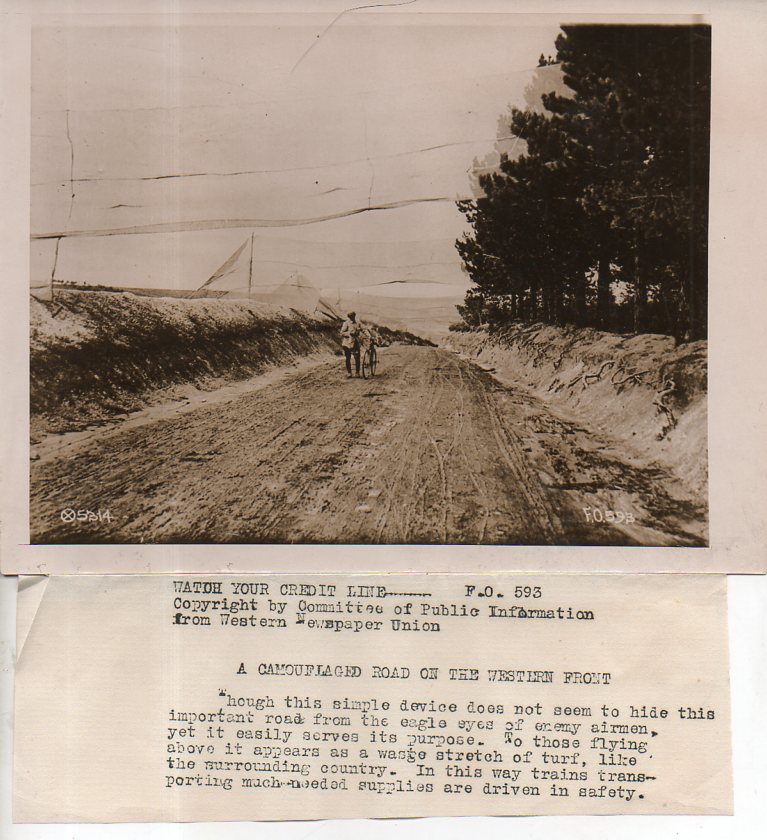
    But here we are, just the same.  And so the image above, with the man on a bicycle on a well-used road–he’s moving along under a long canopy of netting designed to obscure/hide the road from telescopic viewing or eyes-in-the-sky.   When this photo was made for the Western Newspaper Union, mid-1918, the war was nearly over.  But still there was the fighting, and the supply lines for the millions of troops, right to the bitter end at the 11th hour of the 11th day of the 11th month. 

    And the full version:

    Camouflage bike820

    The photograph itself is one from a collection of hundreds here from news photo service agencies, images made of the War from a pool of photographers who covered the action for American newspapers and magazines, and whose work was necessarily censored. The photographs would be selected/ordered by a news agency, and the caption of explanation would be provided by the news photo service (as seen above). 

    ·Posted by :

    ·in:

    —
  • History of Dots: Scrofula, Dalton’s Chemistry, Durer, and a Vienesse Classroom

    JF Ptak Science Books  
    Follow Me on Pinterest


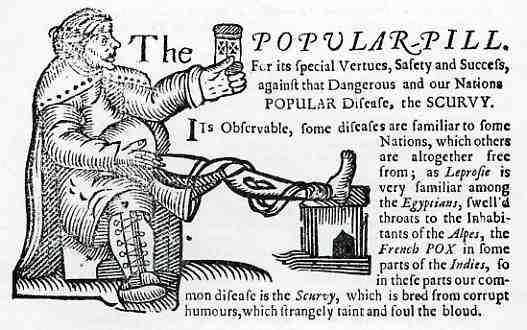
    0 abay feb 25 dots scrofula627In a continuing series on the History of Dots I’d like to add the following, disconnected though they are, so I don’t lose them in the coming mix.  It is also one of my few chances to actually need to use the word “scrofula”–a lonely, ugly word, a word as unpretty as “Susquehanna” is pretty, a word that should be as timid, but isn’t, a word that really exercises all parts of your mouth when you say it out loud.  (Try it–there’s like five or six movements involved in getting that past your lips.)

     To be truthful about it, it isn’t so much about scrofula as it is about the “curing ” of the disease with special little pills:  the Popular Pill!  This woodcut appears in a short sales treatise, published in London in 1675 or so, by Humphrey Nendick, (the delightfully titled)  A Compendium of the Operations Vertues and Use of Dr. Nendicks Applauded Pill, against all Chronick Diseases,m curing by the cleansing of the blood, That most successful medicine, which is so deservedly called, the Popular Pill.  For its Spcial vertues, safety and success, against the Dangerous and our Nations Popular Disease, the Scurvy.  I’m not so sure about what

    0 abay feb 25 dots durer628

    Dr. Nendick was up to with the pill, but I do know that is was obtainable from grocers, bakers, cutlers, gunsmiths and barbers all over England at three shillings for forty tiny dots of possible joy.  Its imaginary Galenical powers were supposed to bear against the tedium and insolence of all manners of scurvies and popular complaints–much like its contemporary dot/pill rivals like Pilulae Anti-Scurbuticae (sold at the Carv’d Posts in Stonecutter Street between Shoe Lane and Fleet Ditch (!)). 

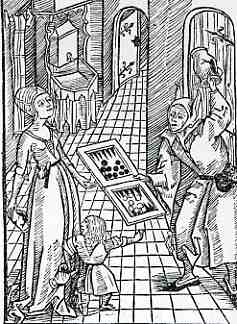
    Albrecht Durer doesn’t seem to have many dots at all in his works, though I did stumble upon this image from Sebastan Brant’s Navis Stultifera (Basle, 1497)–a fool interrupting a mother and daughter who were “discussing” their game of backgammon.

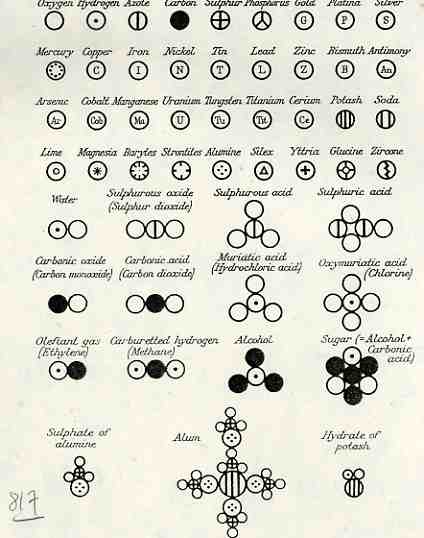
    On the other hand the history of the construction of the periodic table is necessarily filled with dots, as we see with the monarchical creation of John Dalton (1766-1844), in his New System of Chemical Philosophy (part II), and which was printed in 1810–these symbols were sued to visually represent the atomic structure of compounds, and were of vast importance and predictive powers, marking the true modernizing of chemistry.  It was in Part I of this work that Dalton first applied atomic theory to chemistry.


    0 abay feb 25 dots chem625

    0 abay feb 25 dots kids626

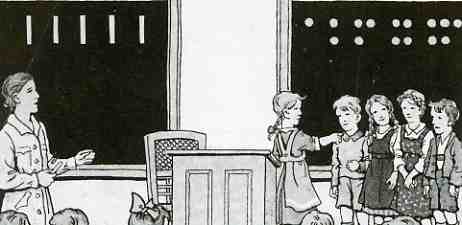
    This last element for this installment on dots simplifies things enormously, sort of, even though these dots represent the very building blocks of almost everything else.  They represent counting.  And they are beautifully present in this image from Franz Brauner’s Rechenbuch fuer osterreichische Volksschulen (published in 1953).  Funny that this “Rechenbuch” turns up again here in 1953–its been the major part of titles of books describing the laws of arithmetic for 450 years. 

    ·Posted by :

    ·in:

  • When You Leave out the Detail, Where Does it Go?

    JF Ptak Science Books   Post 2140   Part of the series on the History of Blank, Empty, and Missing Things.


    Follow Me on Pinterest

    When modern art was becoming modern, and artists were reveiling more of nature and life by using less of its components and using more of suggestion and motion and color–leaving out the “detail”–where indeed did that detail, well, go?

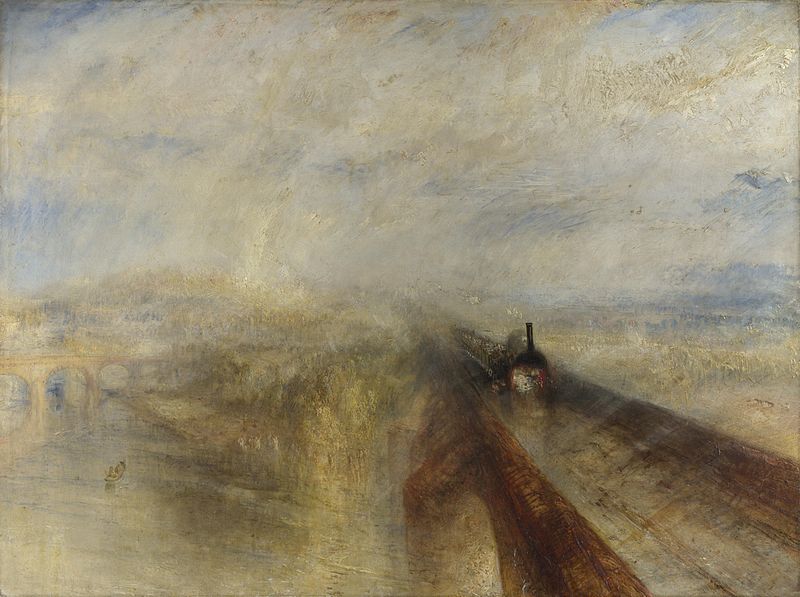
    Detail turnerIt is interesting to imagine a composite world to our’s, a place where that missing and removed detail goes.  For example, when JMW Turner painted a train passing over a river on a bridge, he was more suggestive of the scene than he was in reality-based descriptors.  [Rain, Steam and Speed – The Great Western Railway, 1844.]  The intricacies of realism and reproductional relativity is not there, the action and train and river implied, artistic impressions and whatever else was in the artist’s toolbox or mind’s eye. 

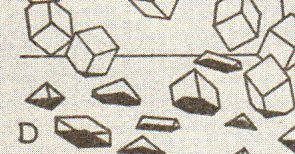
    Perhaps the seeping detail from one world to the next is more like the sphere entering the two-dimensional world of Flatland, or better yet the reverse of Charles Bragdon’s 1drawings of the footprints of 3-D objects passing through a 2-D plane…the detail of the Turner seeping through the canvas and into the opposing DetailWorld, falling like rain. Maybe it is a world of non-representational images and impressions awaiting the attention and arrival of detail to give it all a solid, easily distinguishable representation of the imagined world around the easel in that Other Place.

    Detail bragdon

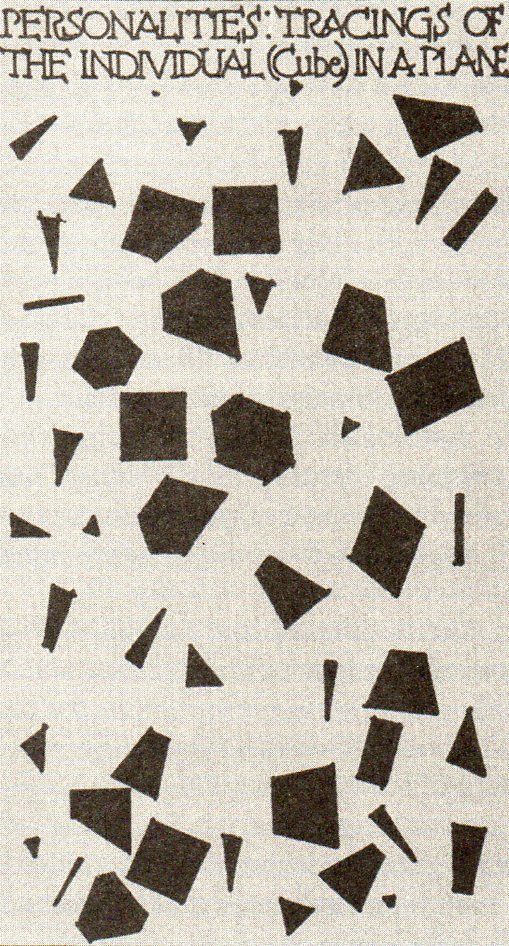
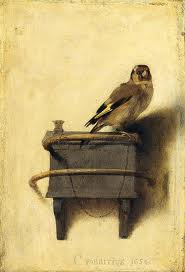
    Another beautiful image by Bragdon is from “Personalities: Tracings of the Individual (Cube) in a Plane” from  Man, the Square2 shows the “shadows” of the three-dimensional figures as they lived in their two-dimensional world.  It comes close to the impact of the cubes above, but really only depicts what two-dimensional creatures would see of the three-dimensional beings inhabiting their Bragdonesque world.  Blog--blagden 1 det349 All of this was put into my mind by seeing this image (The Goldfinch, 16540  by Carel Fabricius.  Clearly we can see a bird on a perch, chained to the upper rung, with another rung below, but as much as we can see  the detail  we don’t.  So much of this image is suggested and implied, hundreds of yers before Impressionism:  the face of the bird is barely there, the second rung dissolves into the wall, the shadows are muted and half-existent, and so on.  The details of the painting are as much missing as they are there.

    Detail fabricius

     And of course the world of detail would disappear more and more, until by 1911, it existed hardly at all, the representational world drifting off the canvas completely, for those who wanted that to be the case. 

    Again, as much as say Kasimir Malevich made all of the detail go away in his Suprematist paintings like a white square on a white square (White on White, 1917/18, which I can say is not served well at all with images online or in books, as the artwork is really pretty textured and detailed),

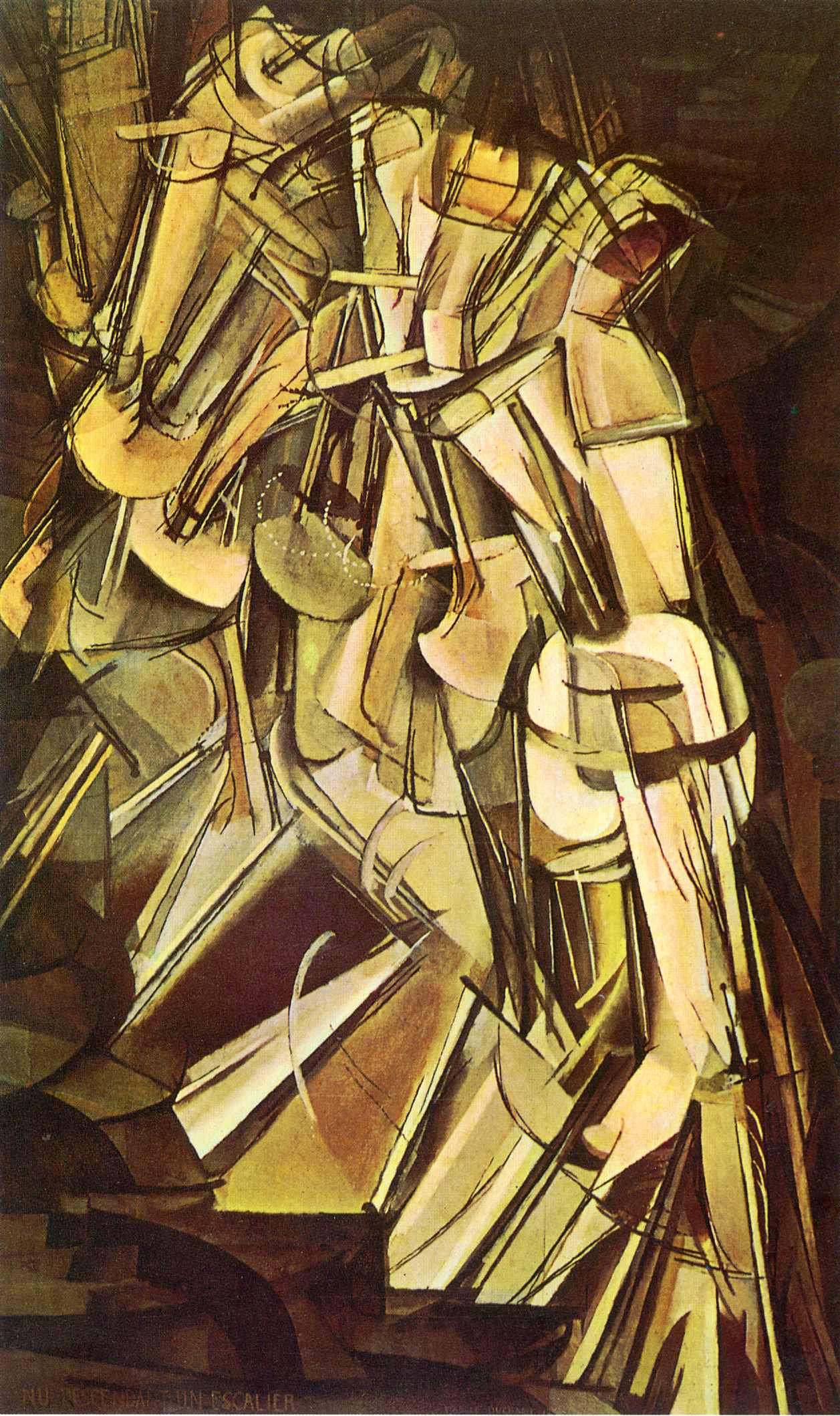
    Detail  white squareat about the same time ither artists like Marcel Duchamp were both taking away details of one sort while adding new details of another never-yet-done sort, as in his Nude Descending (1912), where we begin to see the representation of the fourth dimension in art:

    Detail duchamp

    Perhaps the rain of details into DetailWorld work in reverse for the unexpected details of stuff we can’t see in our world? 

    Well. We know that there is no DetailWorld, but I think it is certainly interesting enough to think of these revolutionary changes in art and trying to imagine the enormous amount of painterly stuff that the innovations/discoveries replaced, if they were to all go to one place.  In a way it is analogous to the changes in the mountain that I can see now from my living room window–mostly it is invisible when the patch of woods between our house and the mountain is all leafed out (seeing the forest for the trees), but with autumn and winter here at about the same time, it is easier to appreciate both the trees that I can see when I can’t, and the mountain that I can’t see sometimes when I can. 

    Notes:

    1.(Bragdon) A PRIMER OF HIGHER SPACE. (The Fourth Dimension). Rochester: Manas Press, 1913. 8vo, (12), 79pp, including 30 plates. 

    2. (Bragdon) MAN THE SQUARE. A Higher Space Parable. Rochester: Manas Press, 1912. 12mo, 34pp, 9 illustrations.  

  • An Uploading Alphabet for Sending Info to The Cloud(s), 1523

    JF Ptak Science Books  Post 2141  Part of the History of Memory series 
    Follow Me on Pinterest

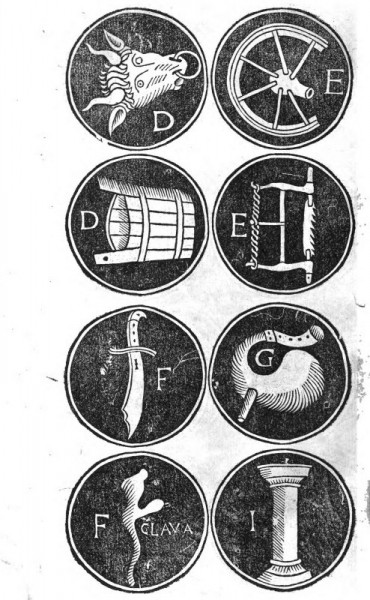
    These are some fine and early printed examples of uploading information, though it had nothing ot do of course with electromagnetic anything back in 1523.  The “Cloud” in question was the mind/brain, and the images helped to serve as placemarkers in how large amounts of memory were kept in the head, the methods available to just about anyone with a keen enough facility for organization and understanding, and the ability to develop learning mechanisms that would help to store and sort memory and info. 

    In another way, though, the process of memory was associated with the Cloud–this second attribution of the early Cloud, though–at least according to St Augustine–was God. Plato (Meno) thought along the lines of the soul learning nothing new, and that what learning was all about was recalling of the data that came to us before we were born.  Augustine–mostly in Book X of the Confessions–had  a different idea (and much more complex and elaborated than I could do justice here in a few sentences) about unconscious knowledge and memory, which was where, I think, he thought knowing God might be.  This memory (the “divine quality” in Cicero’s thought) was the storehouse of expressions in the belief that the knowledge of true things was unconscious, and that in understanding memory this knowledge becomes evident, and that at the base of it all is the knowledge of God. It is as I said much more complicated (and elegant) than this, but I think that the root of it is correct, at least so far as memory is concerned. 

    In any event, here are some of the visual clues for creating alpabetic memory palaces as found in the short (30 leaves)  1523 work by Gulielmus Leporeus, Ars Memorativa  (and available from the Bayerische Staatsbibliotek, here)


    Memoria alphabet D-I

    ·Posted by :

    ·in:

    —
  • A Parade of Zeros, 1583: Found-Dadaist Art

    JF Ptak Science Books  Quick Post

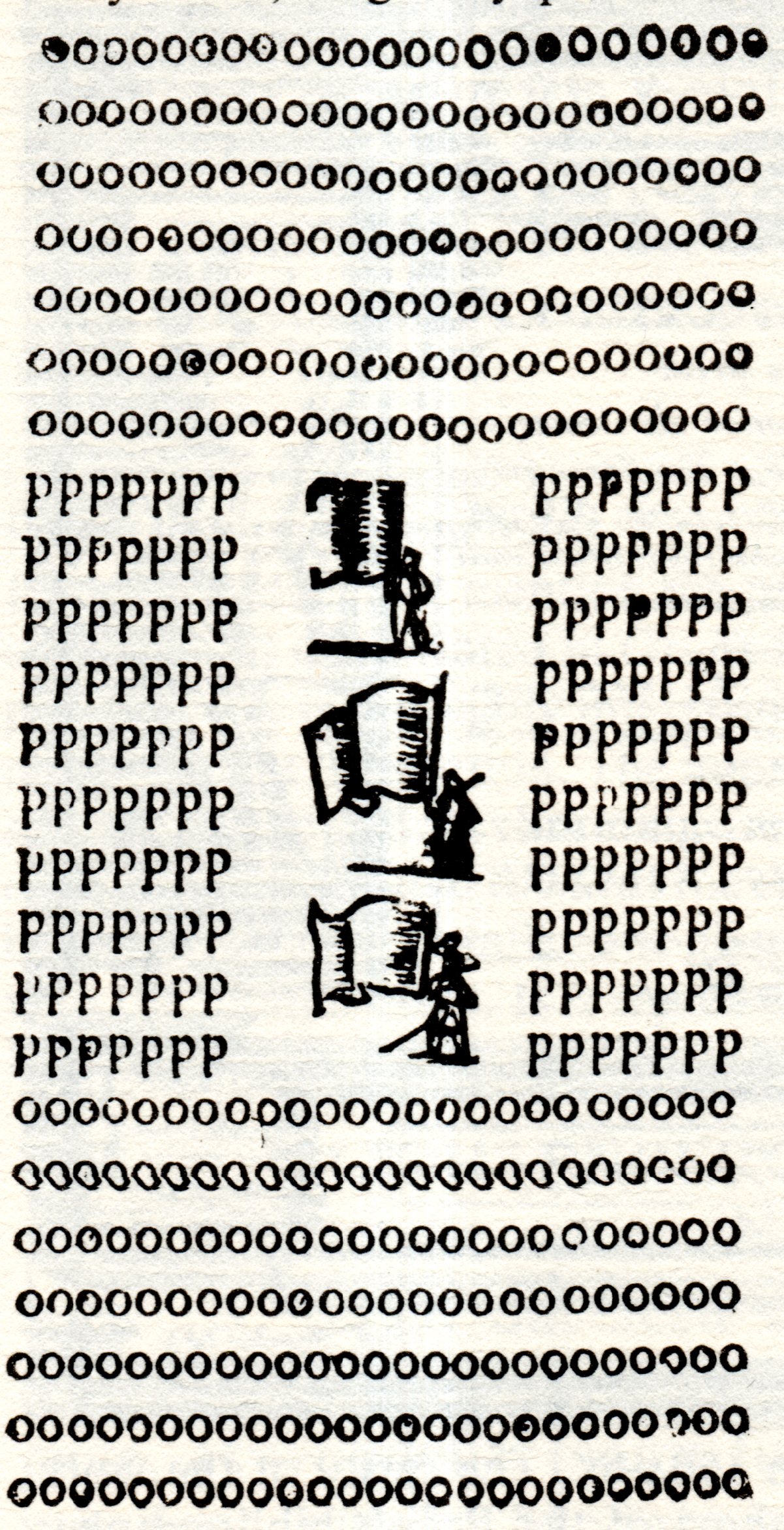
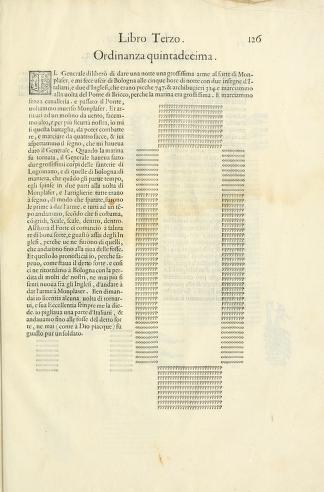
    Interesting bits of unintentional art–in some of these cases, unintentional, or found, Dadaist art–can be found in unexpected places.  Here, in this parade of zeros, we find such a case, and the place it is taken is from Girolamo Maggi’s book on fortification , printed in Venice in 1583. Aside from the crowded images like the Maturation of Zeros, I like the Embigenment of Empty Space approaches as much. 

    Troop detail823[Source]

    These are beautiful images, in spite of their deadly origin. 

    Troop movement7

  • A Wonderful Double-A, Triple-S Word: Maasssysteme

    JF Ptak Science Books  Quick Post 
    Follow Me on Pinterest

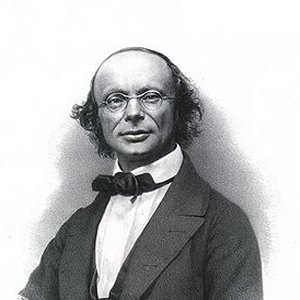
    Wilhelm_Eduard_Weber_III’ve been posting on some unusual words this month, first in the UN- words found in Joyce’s Ulysses, then another set of UN-s from Webster’s dictionary of 1828.  There were very many pleasant surprises in those lists, though most of what I was taking away as good clean entertainment really wasn’t the original intention, for the most part (especially so far as Mr. Webster is concerned).  Today’s entry in the Kingdom of Words is a lovely creation in German, something I found (for myself) today in a paper by the physicist Wilhelm Weber, printed in 1861. 

    The word is Maasssysteme, the only word I think I’ve ever come across with three S’s in a row, and those following two A’s in succession.  It seems as though there is a dim memory for examples of aass in Dutch, and maybe also in English, but I can’t pull them out of the memory right now.  For now, we’ll just enjoy Maasssysteme. 

    ·Posted by :

    ·in:

  • Bizarro-World and the Scourge of Extra-Earths

    JF Ptak Science Books   Post 2143


    Bizarroworld2

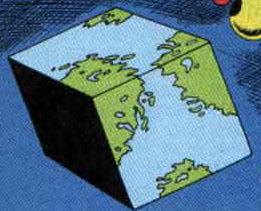
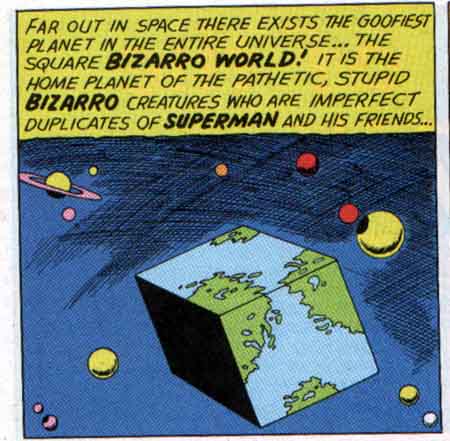
    Nothing quite says “bizarro” like the bizarre1–and there has been plenty of that on this blog.  There have been a number of places that I have identified as Bizarro Worlds, but so far it seems that the only self-proclaimed Bizarro World is this one, from the Superman2 comic book–a place that was the opposite of the Superman-y traits that made Superman Superman.  Somehow to equate bizarreness on this world everything appeared as geometrical shapes with basically no sphere or rounded edges.  (How Braque or Picasso and company would have reacted to this is unclear.) 

    Bizarroworld

    It is evident that Bizarro World inhabits a place in the universe that allows for bizarre things to happen, a sort of bizarrograviation, that also allows for shadow to be cast in space without regard to light source. 

    It is a lovely to addition–if only by this brief note, to a continuing series on Extra-Earths.  This is an Earth, and it is Extra, hence:  Extra Earth.   Some of the other Extra-Earth posts include:

    —Extra-Earth Humano-Alien Souls From Outer Space Repopulate Earth-Hell!!(??),

    —Mondo Bizarro, Science Afflictions and the Dubious Mind—Bad Science, Part 1. NYC in Space (?!)

    —The Battle of the Extra Earths: Mini-Extra-Earth Vs. Full-Sized-Standard-Earth (?)

    and some others, all quite findable on this blog via the Google search at left. 

    I’ve just noticed that these Extra-Earth posts share something else that few of the other 2500+ posts on this site do not:  extra exclamation points!

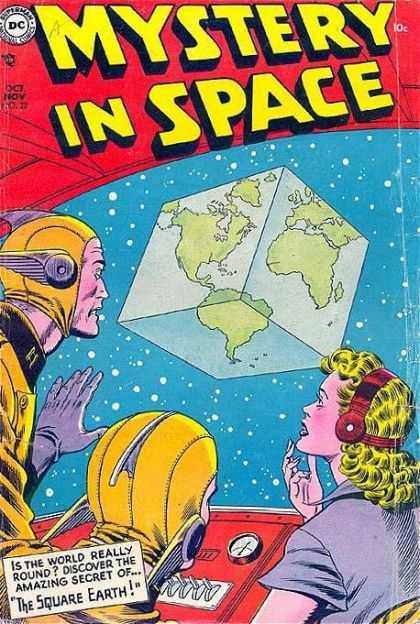
    And to end, I should point out that this is not the first time I’ve encountered a square Earth, bizarro or not:

    Earth strnage cubed earth


    Notes

    1.  “Bizarre”, via the OED: At variance with recognized ideas of taste, departing from ordinary style or usage; eccentric, extravagant, whimsical, strange, odd, fantastic

    • a1648   Ld. Herbert Life,   Her attire seemed as bizare as her person.
    • 1668   Dryden Secret-love Pref. sig. a1,   The ornament of Writing, which is greater, more various and bizarre in Poesie than in any other kind.

    Bizarre quality

    • 1741–70   Lett. Mrs. Carter (1808) 207   The bizarreries which arise from the mixture of good and bad which makes up the composition of most folks.
    • 1828   Scott Tapestr. Chamb.,   Rich in all the bizarrerie of the Elizabethan school.
    • 1844   Foreign Q. Rev. 33 60   Bizarreries.
    • 1858   W. Bagehot Lit. Stud. II. 194   The bizarrerie of Mr. Dickens’s genius.

    2.  “Superman” in the OED:

    A. “In Nietzschean thought (also with capital initial): an ideal superior man of the future who transcends conventional Christian morality to create and impose his own values; = Übermensch n.   More generally: a man of extraordinary power or ability; a superior being. Cf. superwoman n.In later use sometimes influenced by sense 2”

    • 1894   Forum May 302   The ‘cosmic, super-man’ of the future.
    • 1903   G. B. Shaw Man & Superman 196   We have been driven to Proletarian Democracy by the failure of all the alternative systems; for these depended on the existence of Supermen acting as despots or oligarchs.
    • 1909   T. Common tr. F. Nietzsche Thus spake Zarathustra ii. xxvi. 108   Never yet hath there been a Superman. Naked have I seen both of them, the greatest man and the smallest man… Verily, even the greatest found I—all-too-human!
    • 1925   H. V. Morton Heart of London 110   Above the kneeling priests is the Pharaoh, that ancient superman.
    • 1969   G. Jackson Let. 28 Dec. in Soledad Brother (1971) 179   How could there be a benevolent superman controlling a world like this.
    • 2008   K. Hawkins Talk of Town 241   Poor Nick. He’s determined to be a superman and resist emotional entanglements that could cloud his judgment.
    • 2010   M. G. Kendrick Heroic Ideal ix. 161   The Zarathustrian vision of a post-Christian faith rooted in the real world and dedicated to the creation of the superman, inspired a whole generation of radical Russian artists and Marxists.

    B. “With capital initial. (The name of) an almost invincible superhero having the power to fly and typically depicted wearing a tight blue suit with a red cape; a person likened to this superhero.The character first appeared in 1938 in a U.S. comic strip by writer Jerry Siegel (1914–96) and artist Joe Shuster (1914–92) and has since been the subject of radio and television series, as well as numerous films.”

    • 1938   Action Comics June 1   So was created..Superman! champion of the oppressed, the physical marvel who had sworn to devote his existence to helping those in need!
    • 1940   Time 26 Feb. 44/3   Last week Superman took to the air in earnest, as a three-a-week serial.
    • 1958   Times Lit. Suppl. 1 Apr. p. xx/4   The impression remains of a sense of values associated with ‘Superman’ and American comics.
    • 1968   S. Ellin Valentine Estate iii. iv. 142   ‘How the hell did he come to miss me?’.. ‘You’re Superman,’ the first man answered. ‘Bullets bounce off you.’
    • 1980   F. Weldon Puffball 77   ‘Now it’s our turn.’ ‘I don’t want it to be,’ she said, as if he, like Superman, could turn the world the other way.
    • 1995   FourFourTwo Oct. 135/1   Presenting Shearer as a goalscoring Superman seems a bit OTT.
     
  • Art in the “Annalen der Physik”

    JF Ptak Science Books   Post 2144 

    Follow Me on Pinterest

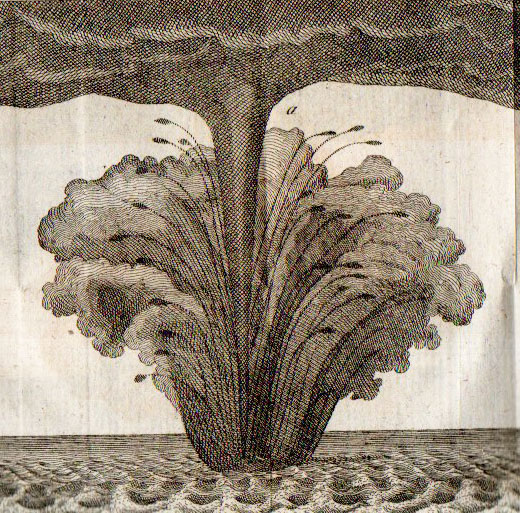
    Water spouts825det

    The Annalen der Physik, begun in 1799 and still going strong, is one of the foremost scientific periodicals ever published.  Over the years the debut of revolutionary and significant ideas have made their first appearances in the journal–Gauss, Clausius, von Helmholtz, Doppler, and many many others, perhaps most famously by the four spectacular papers in Einstein’s annus mirablis of 1905.  The Annalen also famously re-published significant contributions by foreign scientists, their work seen in German for the first time in these pages.  For many without French or English or Italian, it was the first time many German scientists read of Daguerre, Dalton, Cavendish, Volta, and so on–which was a big deal. [See this link for a collection of useful user’s guides to the Annalen that are published elsewhere on this site.]

    ·Posted by :

    ·in:

Recent Posts

Archives

Categories