A Daily History of Holes, Dots, Lines, Science, History, Math, Physics, Art, the Unintentional Absurd, Architecture, Maps, Data Visualization, Blank and Missing Things, and so on. |1.6 million words, 7500 images, 4.9 million hits| Press & appearances in The Times, Le Figaro, Mensa, The Economist, The Guardian, Discovery News, Slate, Le Monde, Sci American Blogs, Le Pont, and many other places… 5000+ total posts since 2008.

  • A Beautiful Idea: the Knight’s Magical Magic Square Tour (1888)

    JF Ptak Science Books  Post 2243  
    Follow Me on Pinterest

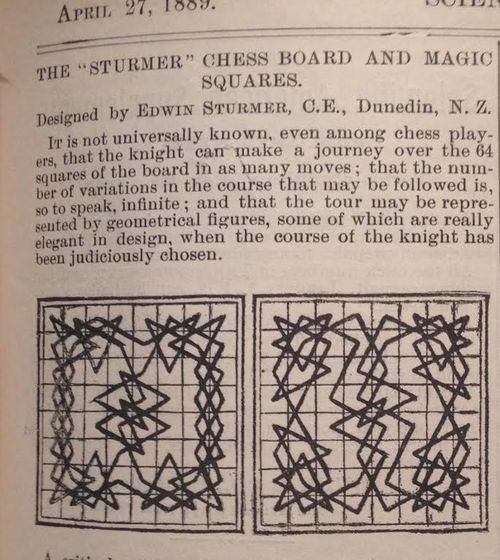
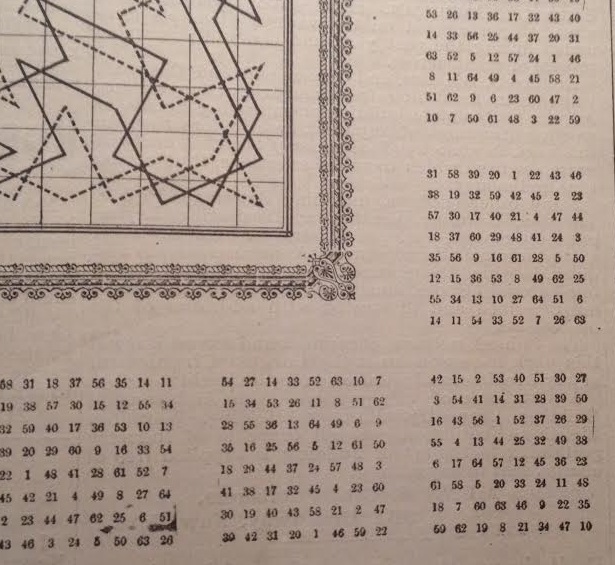
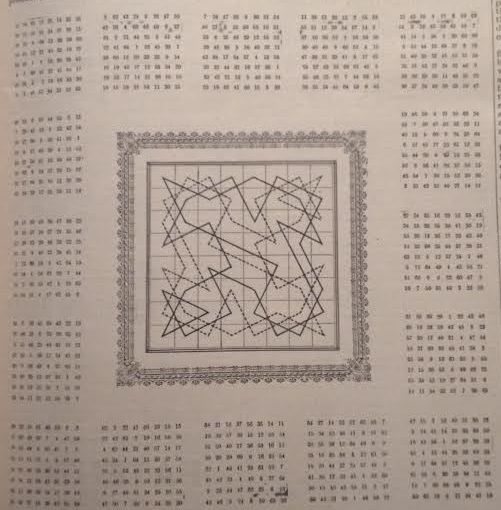
    The idea behind this extraordinary image below is the construction of an 8×8 magic square capable of describing BOTH the Knight’s tour (” a sequence of moves of a knight on a chessboard such that the knight visits every square only once…if the knight ends on a square that is one knight’s move from the beginning square) WITH the resulting moves forming a series of magic squares. It is the product of a Kiwi engineer named Sturmer, and appeared in the Scientific American Supplement for 1888.

    Sturmer2

    Eric Weinstein says in his article “There Are No Magic Knight’s Tours on the Chessboard” on Wolfram’s Mathworld site says, well, such a thing is not possible. “After 61.40 days of computation, a 150-year-old unsolved problem has finally been answered. The problem in question concerns the existence of a path that could be traversed by a knight on an empty numbered 8 x 8 chessboard.”

    Weinstein is concise: “Not surprisingly, a knight’s tour is called a magic tour if the resulting arrangement of numbers forms a magic square, and a semimagic tour if the resulting arrangement of numbers is a semimagic square. It has long been known that magic knight’s tours are not possible on n x n boards for n odd. It was also known that such tours are possible for all boards of size 4k x 4k for k > 2. However, while a number of semimagic knight’s tours were known on the usual 8 x 8 chessboard, including those illustrated above, it was not known if any fully magic tours existed on the 8 x 8 board.”

    Source:  http://mathworld.wolfram.com/news/2003-08-06/magictours/

    Sturmer


    Sturmer 3

    And this, from the British Chess Maagzine, 1888, page 278: 

  • An American Exodus

    JF Ptak Science Books  Post 2244

    LAnge migrant detail

    Everyone knows this image: the Madonna of the American 1930’s, the Migrant Mother, a photograph made by Dorothea Lange, a photographer for the Federally-funded Farm Security Administration. Lange was still very new to the FSA project when she made this photograph in the spring of 1936. On the tail end of a month-long road trip she was nearing the end of her day when she spotted a hand-lettered sign “Pea-Pickers Camp” by the side of the road. Lange briefly considered stopping but went ahead, questioning her judgment continuously for the next 20 miles, when she finally turned around to find the turn-off for the camp. She drove down the dirt road and found a ramshackle assembly of tents, one of which contained “an exhausted mother sitting forlornly with her children”. Lange spent only 10 minutes with the woman, making five exposures. She learned that “the crops had frozen, and the woman and children were living on vegetables scavenged from the fields, and the few birds that the children managed to catch. The mother could not leave; she had sold the tires from her car”.  It was published almost immediately and quickly became one of the great iconic images of the Depression, as well as for the American century.  

    Lange migrant mother

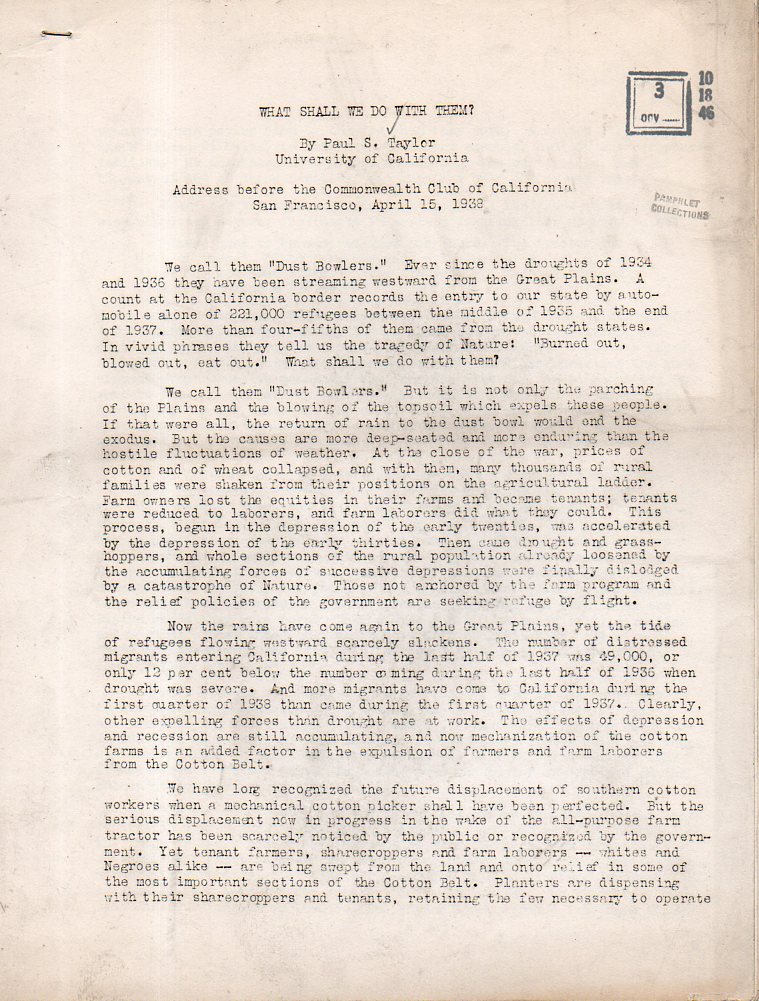
    I was thinking about this because of a typewritte, offset-printed pamphlet I bought written Paul S.Taylor, “What Shall We Do With Them” ( an address before the Commonwealth Club of California, San Francisco, April 15, 1938)–the “Them” being the dustbowler, the migrant workers, the disposed.  Paul Taylor was at this time three years into his marriage with Lange—he was a progressive thinker and a FSA operative who helped Lange land her job and was a part of an extraordinary team of very expansive ability that documented a pivotal period in American life. He was also co-creator with Lange of their great documentarian centerpiece of the 1930’s, An American Exodus, a Record of Human Erosion, which was published in 1939, the same year as the publication of The Grapes of Wrath and the release of the Wizard of Oz and Gone with the Wind. (Two years later–1941–James Agee (text) and Walker Evans (photographs saw their long-developing Let Us Now Praise Famous Men was published.)

    In this pamphlet Taylor gave testimony on migrant workers and nearly the height of the Depression—he was an expert, having traveled and lived among them and written academic papers on what he found. He outlined possible answers to the question, which had mainly to do with stability, which of course was the primary concern for the many of thousands of individuals and families who were once-stable but now very mobile, not having place to live or places to go. Taylor thought that opening dams and supplying irrigation and affordable government-owned houses would be the first of many steps to take to relieve the widespread suffering.  In all of the alphabet-soup programs uundertaken by the Roosevelt administration, none were nearly as “successful” in ending the national social erosion as the events that were to unfold less than a year later.

    Lange travel sleep

    Dorothea Lange “Three Families, 14 Children” US 99 San Joaquin Valley, California, November 1938. An American Exodus

    Taylor dustbowl092

    Notes:

    Lange describes her encounter with the Migrant Mother as follows:

    “I saw and approached the hungry and desperate mother, as if drawn by a magnet. I do not remember how I explained my presence or my camera to her, but I do remember she asked me no questions. I made five exposures, working closer and closer from the same direction. I did not ask her name or her history. She told me her age, that she was thirty-two. She said that they had been living on frozen vegetables from the surrounding fields, and birds that the children killed. She had just sold the tires from her car to buy food. There she sat in that lean- to tent with her children huddled around her, and seemed to know that my pictures might help her, and so she helped me. There was a sort of equality about it”. (From: Popular Photography, Feb. 1960).

  • Abbreviating Auschwitz: the Construction Contract for the Building of Auschwitz III

    JF Ptak Science Books 

                        1blogsept_23_astro_det641_2

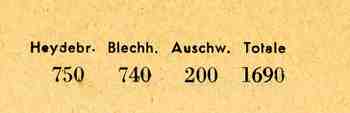
    This document of death, this pamphlet is the Auschwitz III Construction Contract between IG Farben and the Confederazione Fascista degli Industriali for Construction of the Buna Works at Auschwitz III, as well as construction at Heydebrek and Blechhammer, and was printed in 1942.  I’ve only been able to scan five pages as the document is fairly weak and I have a flat bed scanner–I just don’t think it would take much more abuse without falling out of its binding.  But I have scanned some of it, notably the participatory Italian companies and some of the allocation of workers to the different concentration camps.
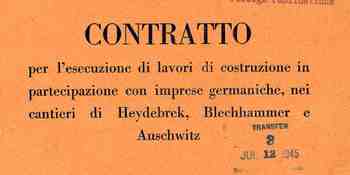
    1blogsept_23_astro_cvr_detail643

     
    The full title reads of the work reads:

    Contratto per l’escusione di lavori di construzione in partecipazione con imprese germaniche, nei cantieri di Heydebrek, Blechhammer e Auscwitz. It was printed by Tipografia del Gianicolo, in Rome, 1942, by the Confederzione Fascista degli Industriali, Federazione Nazionale Fascista Raggruppamento Germania.  The document measures a fragile 30.5 x 21 cm,  and is 29 pages long.  Like dozens of thousands of other things here at the store, this was formerly in the “Pamphlet Collection” of  the Library of Congress (which received the publication 12 July 1945) until we purchased the collection at the end of 1999.   
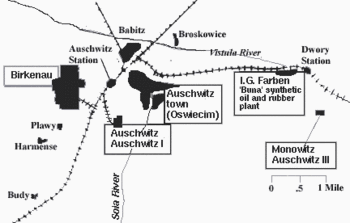
    Auschwitz_12map

    This is also probably the most awful thing I own.  Its like looking at those blueprints for the crematoria and the barracks–so precise, swimming in their blue pool, these concise, sure, white lines; designs for one of the worst things built in the 20th century–just drawings, lines on a long sheet of paper, for building something.  Completely removed from the breathing world, just cold logical constructions for someone else’s end.  That’s the feeling I get from handling this thing–the Italians and Germans figuring out where to put the thousands of workers, making sure that they get paid, providing for some sort of maintenance for the workers’ health, salaries, benefits, work schedules, breaks, vacations, incentives, mailing and the post, and so on.  All of the bits of the most mundane things that go into a large construction projects, like building a highrise, or a tunnel, or a highway, or a bridge to hell.  This contract could’ve been for just about anything at all.  But it isn’t.  Its for building a part of Auschwitz when anyone with any sense whatsoever knew what was already going on there.

    Of the many terible things in this document I was really bothered to see Heydebrek, Blechhammer and Auschwitz abbreviated at the top of some of these pages.    This is just so wrong. Wrong on every level, being an attribute of the nothingness, of the emptiness, of this document. 

    It is a simple, basic document on one of the least simple and basic things of the 20th century.  The contract detailed labor expectations, needs and regulations from both the German and laboring Italian sides for the construction of these three concentration and slave labor camps in 1942.   Subjects of interest in this document include salaries, housing, vacations, health care and insurance, as well as the application of German laws to the workers, qualifications, and classification of occupations.

    Perhaps the part of most interest is the short list—reprinted below—on pages 3 & 4 of the firms and engineers taking part in this agreement..

    ***

    The names that are attached to this document and signing off on the contract of this agreement (of 2 March 1942  which provided 8,636 Italian laborers for this construction) include:

    1)    for IG Farbenindustrie AG, Heydebreck, Heydebreck OS
    Adolf Mueller and (Hans) Deichmann

    Hans Deichmann served as (senior) legal representative for IG Farbenindustrie in Rome and Milan from 1942 to 1945 and in 1942 was responsible for recruiting Italian workers for construction in the above-named concentration camps.

    2)    for Oberschleische Hydrierwerke AG, Blechhammer, Kreis-Consei       
    Schlick

    3)    for IG Farbenindustrie AG Auschwitz, Auschwitz OS
    Adolf Mueller and (Hans) Deichmann

    The signatures representing Italian interests include:
    Aurelio Aureli
    Giacomo Milella

    Notes:
    –Blechhammer was a satellite camp of Auschwitz III (Monowitz)
    –Auschwitz III, also called Buna or Monowitz, was established in nearby Monowice to provide forced laborers for the Buna synthetic rubber works. The German conglomerate I.G. Farben established a factory in order to take advantage of cheap concentration camp labor and the nearby Silesian coalfields. It invested more than 700 million Reichsmarks (about 1.4 million U.S. dollars in 1942 terms) in Auschwitz III.

    On Italian labor being used at Nazi Concentration camps, as found in Vol  VIII, pg 749, 
    Nuremberg War Crime Tribunals:

    Q. Did you go to ter Meer* to get Italian workers — I am thinking of a prosecution exhibit, the one which was shown to ter Meer on cross examination.

    A. I was told at the time by an official source that Italian industry, after the collapse, would no longer produce because there was no coal, no current, or something. I was also told that since the Italian State obtained goods from Germany — buna, for example — the Italian State would be willing to enter into an agreement with Germany to make labor available, as was always the case from Italy. I said to him: “In case that is so” — neither ter Meer nor I knew whether that really would be the case — I said, “help the people at Auschwitz; help them to get workers if now” — I believe this was in 1944 — “the plants gradually go into operation.” For in these plants we wanted to have skilled workers — as I said yesterday, it is very important whether or not the man in charge has knowledge of the work he is doing.   –Vol  VIII, pg 749,  Nuremberg War Crime Tribunals. 

    *”Fritz ter Meer served on the IG Farben [Farben was Hitler and Hitler was Farben. (Senator Homer T. Bone to Senate Committee on Military Affairs, June 4, 1943.] board of directors from 1926 to 1945 and was the head officer directing the operations of the IG Farben factory at Auschwitz. The Nuremberg War Crimes Tribunal sentenced him to seven years in prison. He was released after serving only four years. Not long after, in 1956, Ter Meer was elevated to the chairman of the supervisory board at BAYER, a position he held for seven years. His grave in Krefeld has a meter-high wreath on it – donated by BAYER in recognition of his services.”

    ·Posted by :

    ·in:

  • On the Continued Rediscovery of the Horizontal Pendulum

    JF Ptak Science Books   Quick Post    

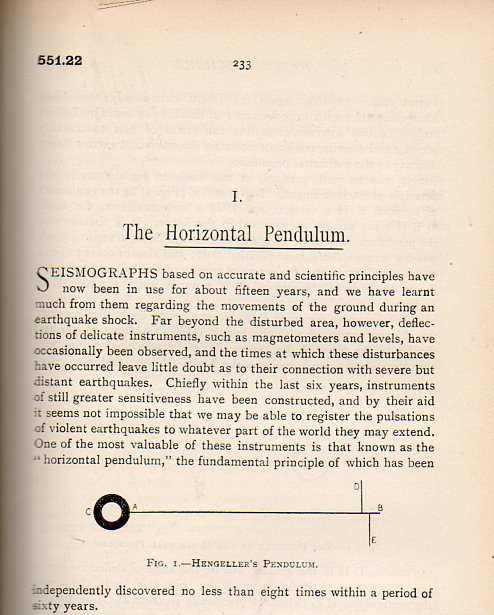
    I found this lovely little article in the not-terribly-common Natural Science for April 1896 while looking for an article on the nearly still brand-new discovery of X-rays. “Natural Science” was really more like natural philosophy than the biological stuff, as a quick breeze through any of its volumes shows, though there is plenty of high-Victorian interest in all aspects of living sciences found here. What was so interesting about the horizontal pendulum was how the author (C.Davison of “King Edward’s High School, Birmingham”) traced down its history of having been independently discovered (and forgotten) “no less than eight times within a period of sixty years”. As with other inventions that were “in the air” (like the telephone, and the electric telegraph, and the television, and so on, where a number of people were working independently at the same time) the horizontal pendulum was that too–except that the process of discovery continued for quite a long time.  

    Pendulum096

    I don’t mean to go into this at all–I just liked the wonderful research and presentation in this little five-page article.  And for anyone who cares, C. Daivson’s (not C. Davisson as in Daivsson and Germer) references are included below.

    ·Posted by :

    ·in:

  • 1950’s Atomic-Spawn Monsters “As Evil Atom-Age Scientists…”

    JF Ptak Science Books   Post 2245

    I’m unsure of how I came to post this–maybe it is all the result of the one still from The Werewolf from 1956 with its dynamite phrase:

    Evil as atom-age scientists

    I guess the “atom scientists” were evil because the monsters depicted in these movies were a result of atomic/radiation somethings gone-wrong. Thus: evil. Of course some of these scientists were Commies, and some just Brand-X Evil (a good band name).  All-in-all though there’s really nothing in any of these films that comes remotely close to the horror of The Bomb.

    Here’s a few more examples of quick/bad/cheap Atomic Movie Weirdnesses brought about by the bliss of evility inherent in some “atom-scientists”: 

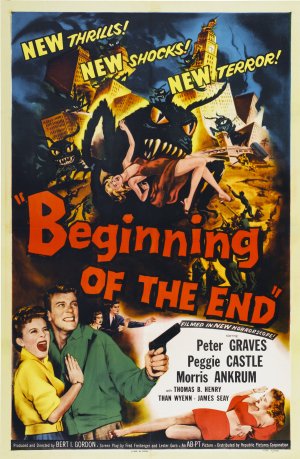
    The Beginning of the End (1957) Republic

    Evidently this film–“starring” Peter Graves–defines what might be the bottom of thehole-filled-hole filled with bad sci fi films. Poorly acted, badly written, with very little direction and astonishingly bad special effects, this film had nothing going for it. From what I’ve seen of it it moves beyond the so-bad-its-good category to so-bad-it-really-is-bad category.  Gigantism pops up again here, with scientists producing mega-foods via “radiation”–unfortunately the foods are eaten by grasshoppers, and then other stuff happens.  


    Atomic horror--Beginningoftheend


  • Beauty Pageant Panoramic Photos & Found Serendipities, 1920’s-’30’s

    JF Ptak Science Books  Post 2246                                                                 Follow Me on Pinterest

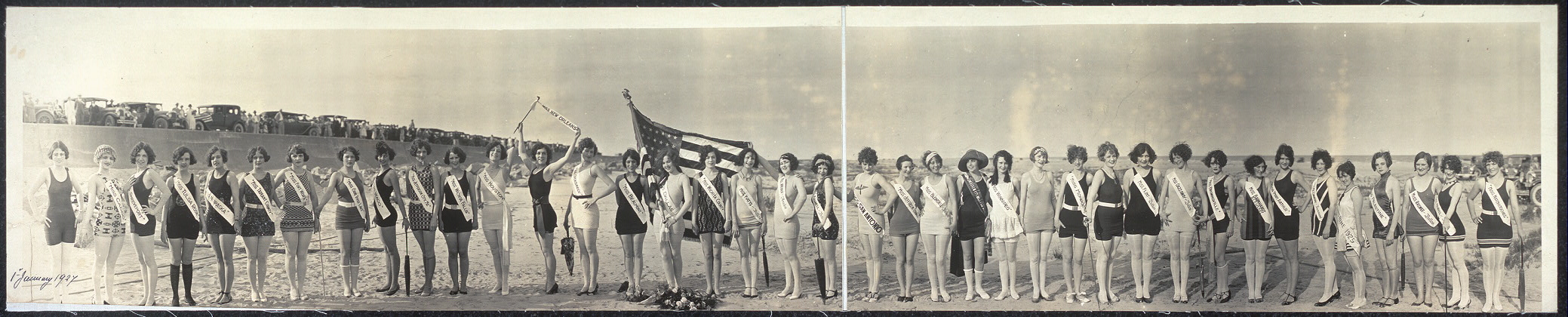
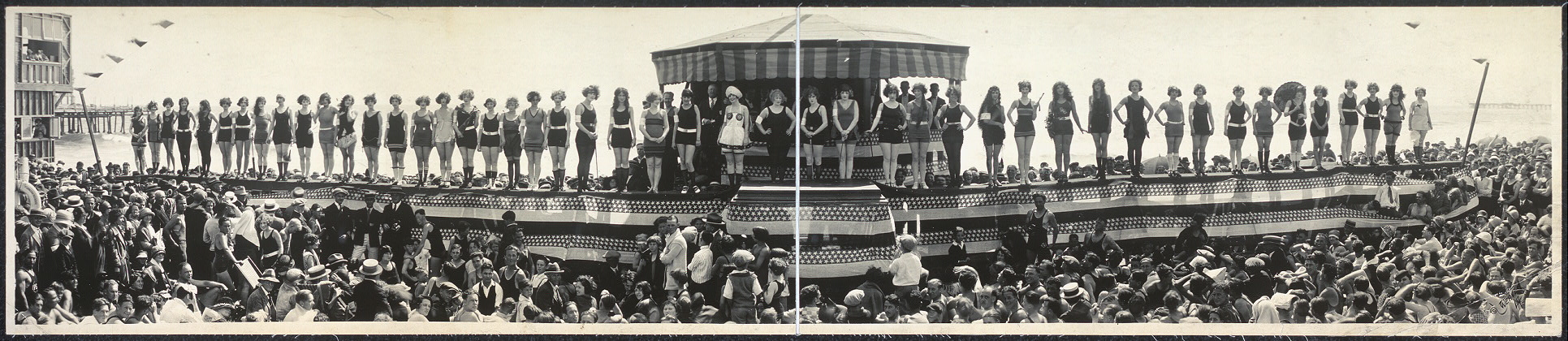
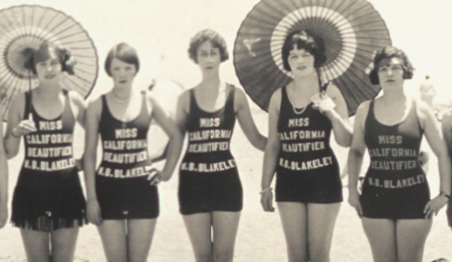
    These images come from the Library of Congress website–many of them wound up in my pinterest account.  The link for both for each image are found below.  Photographs like this–wide panoramas of big groups of people–are fascinating for the collection of moments that it captures, wall-to-wall serendipities.    [See the  Library of Congress panorama collection.]

    Beauty Galveston Detail

    Galveston Beauty Review, 1927 [detail]


    Beauty Galveston 1926


    Beauty--0crystal piuer detail


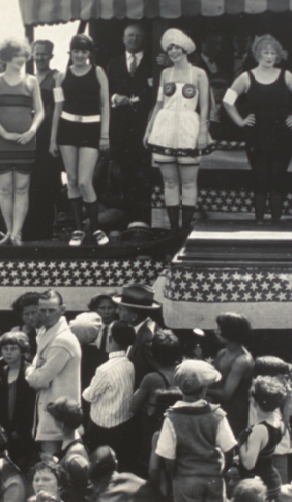
    Detail of below, featuring an unfortunate bath suit selection and a clump of men and boys.  Perhaps it is more “wad” than “clump”, like a murder of crows.   

    Beauty Crustal piuer

    Bathing Girl Parade, Crystal Pier, California 

    BEauty balboa beach detail

    Balboa Beach Bathing Beauty Parade, 1925 (detail from below) 

    Beauty balboa beach


    ·Posted by :

    ·in:

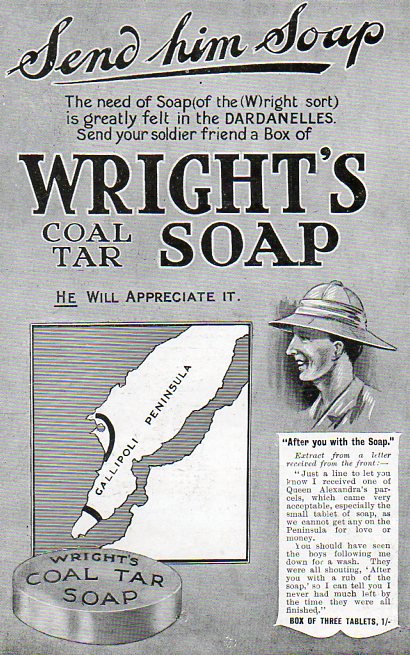
  • WWI Ads–Gallipoli Coal Tar Soap, 1915 (?)

    JF Ptak Science Books    Quick Post

    These ads are interesting and take a bite, both ways.  For example, the first–for Wright’s Coal Tar Soap–uses the background of the enormous struggle in Gallipoli to sell itself.  The ad appears in the 9 October 1915 issue of The Illustrated London News, and stresses the fact that the troops were badly in need of, well, soap, among other things, not the least of which was forward motion, or victory.  

    WWI--e---galipolli640 

    But the fact of the matter is that this relatively cheery image of the actions at Gallipoli looks entirely misplaced, especially at this point in the campaign when things were going badly.  The battle took place at Gallipoli peninsula in Turkey from 25 April 1915 to 9 January 1916, and the conditions were deplorable: massive heat, rotting corpses, poor sanitation, dysentery, flooding and then frostbite and bitter cold in the winter–that, plus the killing part, with 392,338 killed and wounded on both sides of this one campaign.  There’s much more to this campaign, of course–especially for my New Zealand and Australian friends–but this is not the place for it.   I was just taken by the spectacularly mundaneness of this ad for selling soap on the back of a terrible campaign, and an eventual disaster for the Allied forces. 

    ·Posted by :

    ·in:

  • Slow Lightning–a Pollockless Event from 1881

    JF Ptak Science Books   Quick Post

    When I saw this letter to the editor of Nature (in the May-October 1881, volume 23, page 284) I thought immediately of Jackson Pollock–but of course he wasn’t even close top being born yet. The boy from Cody, Wyoming was born in 1912, and he went from a Western no-longer-frontier-town to his greatest period of production in about 37 years.  Those three years, from 1948-1950, were like lightning, but slow…like seeing the progression of a lightning strike from the ground up, then replayed again backwards, and then faster.  And with many more than just a single strike.  That isn’t what W.M. Flinders Petrie of Bromley, Kent, was talking about of course–still 25 years and a world removed from non-representational painting–but that is what his title excited in me, here in his future.  In any event, the article is an interesting read, Pollockless and all.   (Another piece of long and interesting reading is found here, with Richard Taylor’s theory on Fractal Expressionism and the fractal dimension of Pollock’s painting.)

    "Having just seen the statement of Prof. Tait (Nature, 
    vol. xxii. p. 341) quoted, as a final authority, against the possi- 
    bility of distinguishing the source from the termination of a 
    lightning flash, I wish to record a storm that I saw. 

    ·Posted by :

    ·in:

  • Tables of Periodicals of Relativity Interest, 1896-1924.

    JF Ptak Science Books   Reference Tools  

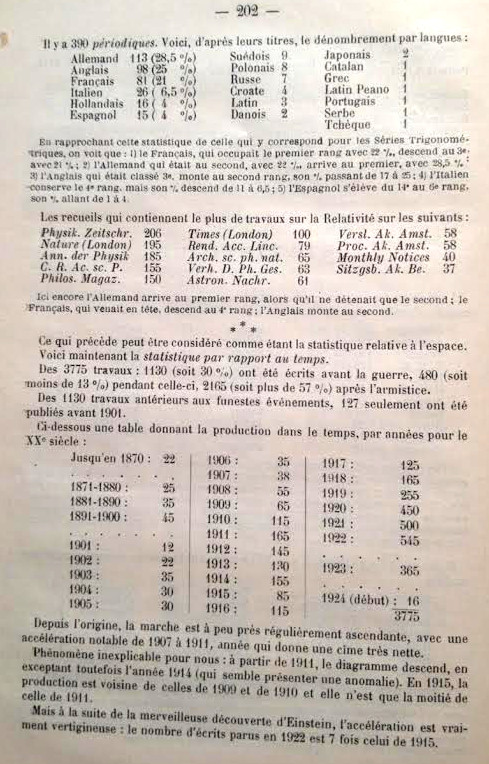
    Earlier in this blog I posted a great graph on the publications on relativity from 1896 to 1924 as published in Maurice Lecat’s Bibliographie de la Relativité, suivie d’un appendice sur les déterminants à deux dimensions, le calcul des variations, les séries trigonométriques, et l’azéotropisme (published in Bruxelles by Lamertin in 1924). Preceding that graph are a few tables of interesting bits on the history of relativity. though I can say that there aren’t too many surprises–the information is still very interesting.  The Physical Review does not make the top-14 list (in the middle table). [Also see here for a good summation of a 1921 bibliography of relativity.]

    Relativity Periodicals2

    The second set of tables shows the distribution by nationality of the contributor–it is interesting to note that the Americans made up 11% of the authors while the Physical Review came nowhere close to that percentage, meaning that the PR hadn’t yet come to its place of high regard as a premium publishing vehicle, though that would come soon enough, particularly by the early 1930’s.  

    ·Posted by :

    ·in:

    —
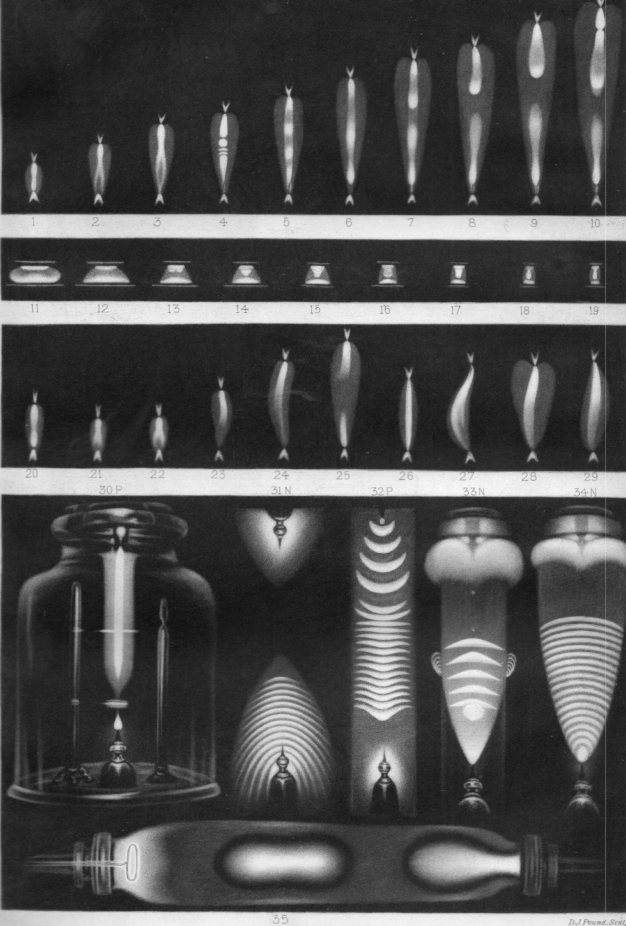
  • Found-Art in Electrical Discharge, 1880

    JF Ptak Science Books   Post 2212  History of Anticipation series   

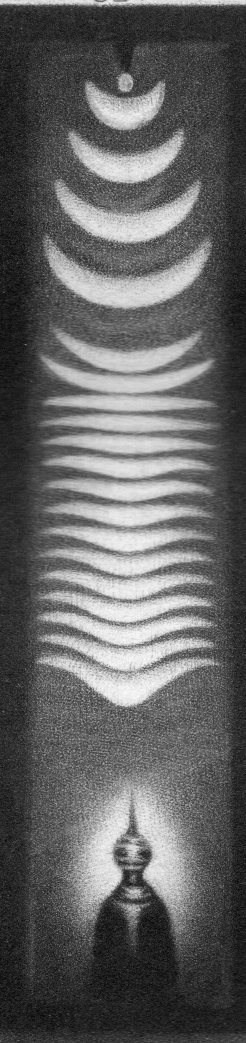
    It makes me wonder about how things were labeled “art” in the history of labeling things.  In a way it is not at all like naming where the American “West” is, or where the “South” begins, because those definitions seem to get very local and very detailed very quickly, and then the labels get bigger and wider and more open to interpretation.  That is to say that the labels make more accommodation for the idea, at least far more so than the labeling of “art” was concerned in the pre-Kandinsky/Cubist/Abstract era, or at the very least before the era of early impressionism.  
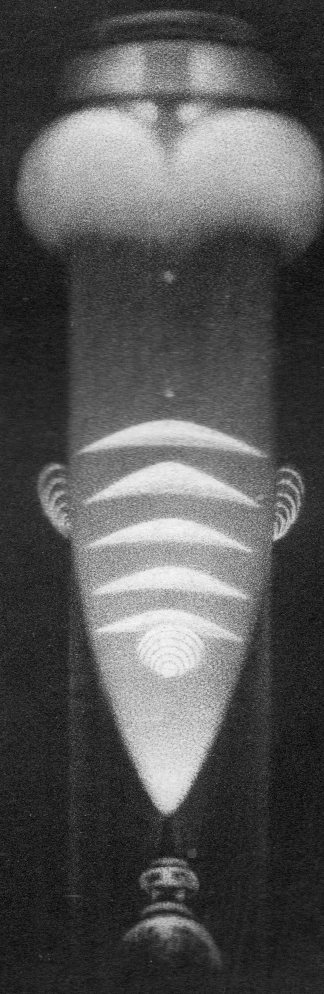
    Electrical discharge031

    This is a tiny detail from a full-plate plate from Nature, in an article by Warren de la Rue on electrical discharge (and printed 24 June 1880). (Actually, the big full-page images like this are fairly rare in Nature–more so when the image is mostly very dark, meaning they took a lot of ink to print.)  It is a beautiful thing, and was probably always considered beautiful in a scientific sense, though I think it would have been very highly unlikely for it to have been appreciated in an extra-scientific artistic sense by significant portion of the viewing population, let alone be called “art”.  Even if someone approached it as Impressionistic, it still did not resemble anything recognizable, and those days for non-representational art was still more than 30 years away.  

     Calling things “art” was far more regulated at this in the art history than what it would become in the decade of so after the popularization of discussion on the fourth dimension and the discovery of the X-rays and Thomson’s atom and then, just a little while later, the first appearance of the theory of relativity. The protocols were far more strict prior to the invention of Impressionism (I have no idea how J.M.W. Turner survived in his Outsider-y genre for all of those decades before progressive Impressionism) than those that existed in 1880, or at least for those that existed that could consider these electrical discharge images as “art”.  

    Of course Roualt and van Gogh and Rosseau and Braque and the rests had their own difficult experiences with acceptance, and some were even rejected by the groups that they helped to establish (like Duchamp with his readymades getting the heave-ho in NYC).  

    In general though there were very few people who had one foot in the Beaux Ecole school who could have another foot in the expansive world who could have considered scientific images like these as “art”.  

    The full image: 

    Electrical discharge030


    See also this post on Emily Van der Poel’s beautiful pre-abstract/cubist found art :  

    Art-vanderpoel186 


    Electrical discharge032


    ·Posted by :

    ·in:

    — —
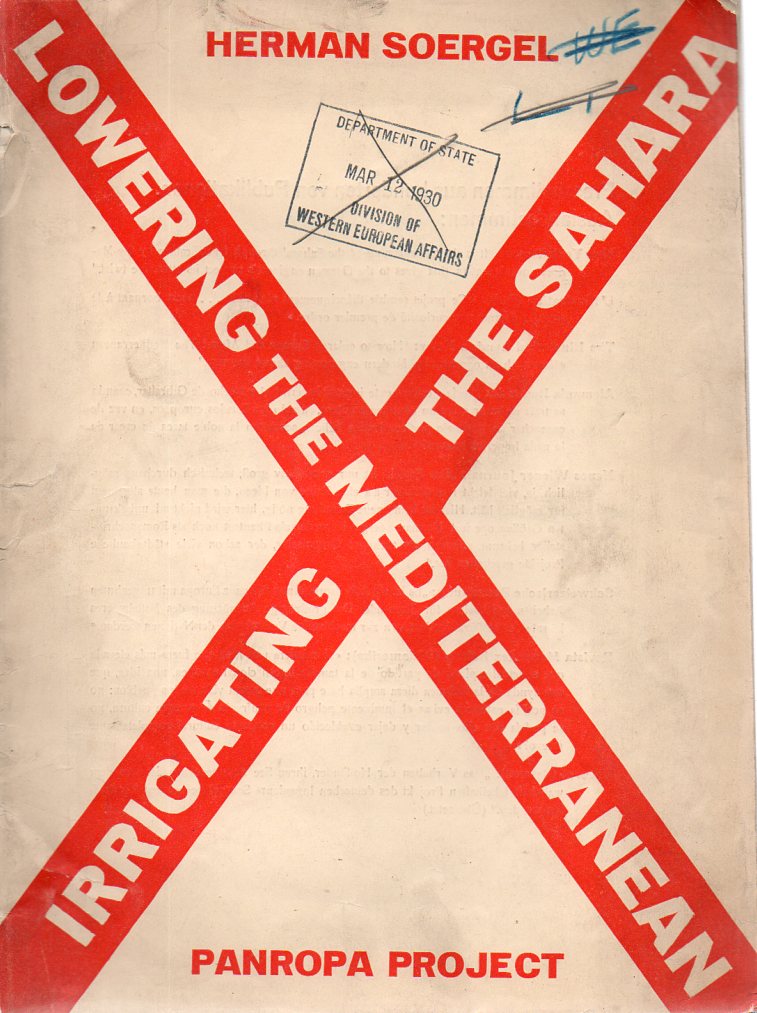
  • Lowering the Mediterranean, 1930 (!)

    JF Ptak Science Books (continuing an earlier post) 

    A Monumental and Potentially Fantastically Bad Idea: Draining the Mediterranean

      Soergel403 [Image source: private collection.]

    “Simply the thing I am shall make me live.”–from Jorge Luis Borges, “Shakespeare’s Memory”

       
    It would be a Purgatory, or worse, to suddenly wake up one morning with another person’s memory–worse yet than to have wished it, only to find that you didn’t want it at all.  This evidently works out with memories high and low, though it is tempting to want to wish to see what the inspiration looked like for one idea located in a particular memory.  Or maybe not.  But I am curious about when and here the author of the pamphlet above got his idea, and what it looked like to him–did he hear or see or smell something that prompted the inspiration for this reverse-monumental jolt?

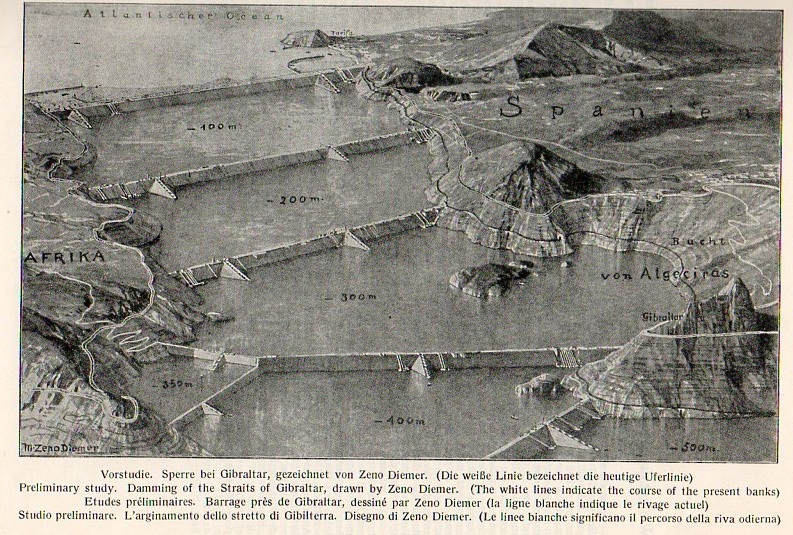
     It is interesting to pursue a loose thought like this to its not-necessarily logical end.  Such is the case with the self-styled Paneuropic ideas of Hermann Soergel (1885-1952), the author of the above. Soergel was a Bauhaus architect and author of a number of works on design and far more ethereal, floating-castle ideas. His most spectacular contribution—incubated in the mid-1920’s and still clinging by its fingertips as an idea among some current thinkers—was to put a dam across the straights of Gibraltar.  The dam would generate electricity of course, but most importantly to Soergel, it would also empty an enormous amount of water from the Mediterranean leaving vast new expanses of land to be developed and colonized over generations into the future.  The water of course would have to go somewhere, and that somewhere was the Sahara Desert, somehow in its wake creating farmable and productive lands. Soergel was creating a certain, very wide, fantastical future of uncertain monumental prospects.

    Soergel405
    A “brief outline” of the idea was published in this four-language pamphlet, Lowering the Mediterranean Irrigating the Sahara (Panropa Project), which was published by J.M. Gebhardt in Leipzig in the very bumpy year of 1929. (The Weimar years in Germany were already into deep bumpiness; the rest of the world would follow suit in October of that year.)  To be fair, Soergel didn’t plan on emptying the entire Mediterranean, just a bunch of it–at least enough to be able to rename it.

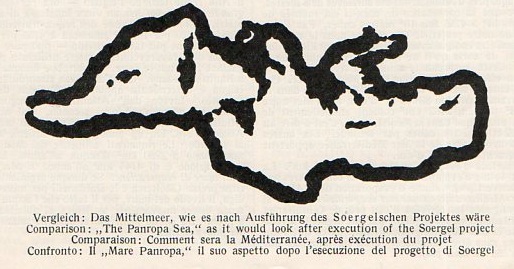
    [Here’s a map of the new Mediterranean, or the Mediterranean that would be made to go away.  As you can see at this point Sicily and Italy become enormous, and the Greek Islands are combined to form one large land mass–this last bit alone is enough to form total and complete reisstance to this idea. Also at this stage perhaps 150 or so miles of new lands have been reclaimed from the sea all along its former borders–more so in Turkey.  There is no mention as yet of any new islands that are formed in the sea water’s wake.]

    Soergel404

    The master plan at work was that the world would be divided into three economic spheres in the future, all beginning with the letter “A”:  American, Asia, and the new land to be created by Soergel, “Atlantropa”, which was the former Europe expanded into the new dry beds of the Mediterranean and North Africa.  And also of course Egypt, which would be covered with “thousands” of canals and become semi-submerged by the new borders of the meandering sea.  This would be the way for Europa to compete with the rest of the world in the future. 

    [I should point out that the image above comes from the Illustrierte Zeitung (Leipzig) for August 1931, and is a drawing by an artist named “AS. Christ” depicting a cross section of one of the bridge/dams of Soergel’s Panropa’s ideas.]

    Perhaps it is actually three steps to get from the idea of damming up the straits of Gibraltar to the osmosis of Shakespeare’s memories into someone else’s brain—a squinting acquiescence of the middle touch being the brilliant Jorge Luis Borges.  You see it was in the Argentine master’s last published story, “Shakespeare’s Memory”, that we meet Herr Soergel (as Hermann Sorgel) again.  But so far as I can remember Soergel exists only as a fictional character, with no reference to his real-life self.  In this wonderful story, Soergel inherits the memories of William Shakespeare—these bits come to him slowly but surely, until they start to conflict with his own memory, and things get difficult.  The man with Shakespeare’s memories winds up phoning strangers on the telephone, giving them away at random, until Soergel is left with his own mind again.  Superior as Bill’s memories were, they still weren’t Hermann’s, who wanted his own life back in the end. 

    And so from the titanic, pan-europic technodream of Bauhausian Hermann Soergel to the dead brains and living memories of William Shakespeare, all through the fingers of the beautiful Jorge Luis Borges.  

    ==Blog July 21==shakespeares memorie

    I’m sorry to report that at the end of it all, near the end of the pamphlet, Soergel releases his opinion on the political importance of his project.  And yes, his aim was to form an alliance between the new PanAmerica (of the “three Americas” with the new Pan-European African Union to thwart “the yellow peril” which “arises from the racial antipathy of India, China and Japan.  Soergel writes that “the fate of occidental civilization…will be settled on the Mediterranean”.  

    After it is all said and done, perhaps the best reiew of the work by Soergel is provided by the graphic designer who put the Big Red X on the cover of his work.  It fits. 

    Some of the works by Soergel include the following:

       Atlantropa. Fretz & Wasmuth, Zurich / Piloty & Löhle, Munich 1932

    Vorwort zu: Wayne W. Parrish : Technokratie – die neue Heilslehre , Piper, München 1933

    Die drei großen A, Amerika, Atlantropa, Asien , 1938. The three large A, , Atlantropa, Asia, 1938

    Atlantropa-ABC. Atlantropa ABC. Kraft, Raum, Brot. Kraft, Raum, Brot. Erläuterungen zum Atlantropa-Projekt , Arnd,Leipzig 1942 

    Some works about  Soergel: 

    Alexander Gall: The Atlantropa project. Die Geschichte einer gescheiterten Vision. The story of a failed vision. Herman Sörgel und die Absenkung des Mittelmeers .

    Herman Sörgel and the lowering of the MEditerranean . Campus, Frankfurt am Main 1998. 

    Wolfgang Voigt: Atlantropa. Wolfgang Voigt: Atlantropa. Weltbauen am Mittelmeer. Building the Mediterranean world.Ein Architektentraum der Moderne . An architects dream of modernity. Dölling und Galitz. Hamburg  1998.


Recent Posts

Archives

Categories