A Daily History of Holes, Dots, Lines, Science, History, Math, Physics, Art, the Unintentional Absurd, Architecture, Maps, Data Visualization, Blank and Missing Things, and so on. |1.6 million words, 7500 images, 4.9 million hits| Press & appearances in The Times, Le Figaro, Mensa, The Economist, The Guardian, Discovery News, Slate, Le Monde, Sci American Blogs, Le Pont, and many other places… 5000+ total posts since 2008.

  • The Long Fight for Capitalizing the Letter “N” in “Negro”

    JF Ptak Science Books   


    N


    “I believe that eight million Americans are entitled to a capital letter.” W.E.B. BuBois

    The history of the power of words is long and complex, and for the most part is on one side or the other of the political and social mirror, at least in the United States. Controlling the meaning of a word or phrase controls the idea which alters the way people approach it, defining the very heart of what may control the impulse for war or peace, which means that people may die as much for words as they will for ideas.

    Sometimes the idea of control is even simpler than the word—it may be a simple letter.

    Like the letter “N”.

    Since the American Civil War (now in its 150th year as of last month) when the use of the word “Negro” was used to describe African Americans, it appeared in print overwhelmingly with a small “n”. The idea was simple—to use a capital “N” would give a certain amount of respect and social diligence in referring to this race of people with a proper salutation; the small “n” minimized all of that, a symbol that these people were not worthy of having the initial letter of their race capitalized, and that because of their inferiority.

    This was also the case with the word “Colored”, which was used in the decades before the Civil War and then lightly after that, giving way to for a short time to “Freedman” and then Negro–”Colored” appeared in print as “colored” in the vast majority of times.

    The capital N was a rallying point, a common point of singularity for a large percentage of the Black population in the U.S.–and a very tiny percentage of the White population. We can deduce this because major papers such as the New York Times did not adopt a policy of using the capital “N” until 1930. And as a matter of fact the federal government documents printed “negro” small “n” beyond 1930, even though heavily lobbied to use the more enlightened and respectful “Negro”. The issue was evidently sidestepped throughout the Hoover administration.

    There was in the country a racism so entrenched and engrained that African Americans were seen as being wholly unworthy of being dignified with a capital “N”, and it was the natural way of things. As the editor of the Eatonton, Georgia, newspaper Messenger said when asked about the capitalization issue, that he would not be a party to it, because “it would lead to social equality.”

    And that’s just what everyone ws trying to avoid. And like the federal government, the control of the capital “N” extended into historical control as well. When W.E.B. DuBois wrote an article for the venerable American Historical Review, the editor, J. Franklin Jameson, refused to allow the use of DuBois’ capitalized “Negro”. As the editor of the Dictionary of American Biography, Jameson refused the capital “N” in the publication until it was terminally embarrassed into doing so, in 1937.

    And so it goes, 60 or 70 years of fighting for the minimum respect of capitalization.

    And this doesn’t even address the use of the reviled “n” word, which is a story unto itself. And in which there was also debate over the years as to whether or not that be capitalized.

    Notes:
    The major source of the information in this post comes the fantastic article by  Donald L Grant (12/01/1975). “Some Notes on the Capital \”N\””,  Phylon (0031-8906), 36 (4), p. 435, who did a splendid job of research.  There’s also a bit of memory pulled from H.L. Mencken’s The American Language (4th edition), which was clear and concise, even though Mr. M. had a small social problem here and there with minorities.  It must be said in his defense that the magazine he edited, The American Mercury, “always” used the capital N. 

    ·Posted by :

    ·in:

  • Freedmen and Abandoned Lands Department

    JF Ptak Science Books  Quick Post    On Naming Things series

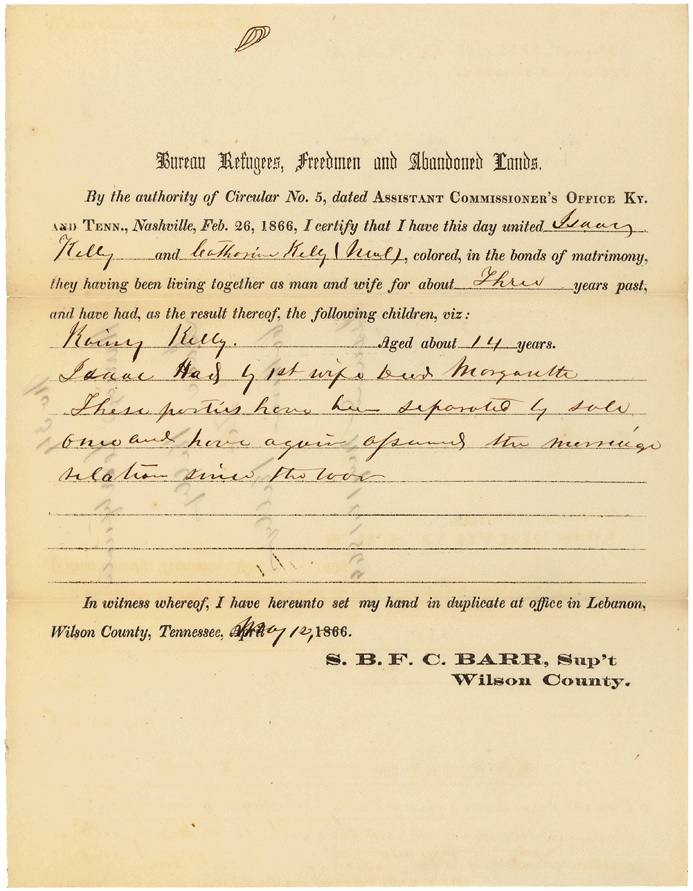
    Through the years I’ve known a little bit of something about the Freedman’s Bureau, but I think I’ve never known its full name:

    Freedman det

    This was an act of federal relief proposed by Abraham Lincoln in 18651 empowered to help the newly-freed slave transition to their new life.   The “Abandoned Lands” part was very unsettling, in a way equating refugees and newly-freed slaves with real estate.  But it was the language and practice of the time, and economy of presentation, and logic, I guess, that lead to this title.  The bureau here was the Military, which was run by General O.O. Howard.  The Bureau functioned from 1865 until it ran out of steam (along with other Reconstruction efforts and measures) in 1872.

    In a way it reminded me somewhat of the fight for the capitalization of the “N” in the word “Negro” (see here)–something that seems beyond the scope of thinking about nowadays, but it was a battlefield for decades after the Civil War, with that “N” not being decided positively until the 1920’s in common usage.  “Abandoned Lands” is not the same thinking-point as “N”, though it does make one think about what was in the common thinking that these three titles could be brought together as a single bureau, regardless of the hyper- and sub-text of the meaning associations via proximity

    Sec. 1. “…a bureau of refugees, freedmen, and abandoned lands, to which shall be committed, as hereinafter provided, the supervision and management of all abandoned lands, and the [92] control of all subjects relating to refugees and freedmen from rebel states, or from any district or county within the territory embraced in the operations of the army…”

    Sec. 2 “And be it further enacted, That the Secretary of War may direct such issues of provisions, clothing, and fuel, as he may deem needful for the immediate and temporary shelter and supply of destitute and suffering refugees and freedmen and their wives and children…”

     
    Freedman'

    [Source: with thanks to Rebecca Onion at Slate Magazine’s The Vault, who posted the original document earlier today and where the name of teh bureau struck me so heavily.]

    ·Posted by :

    ·in:

  • Flying But Not Flying in the Theatre, 1889

    JF Science Books    Quick Post    

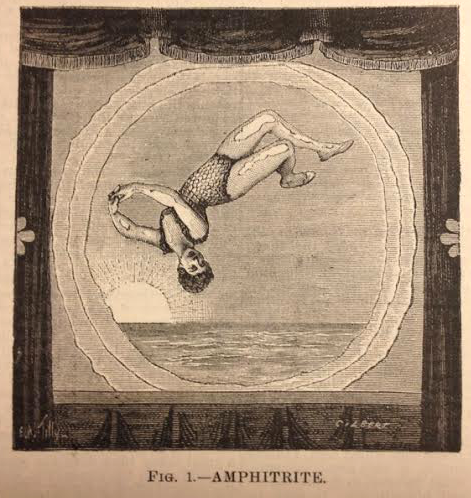
    Sci am flotaing theatre 2

    The Montgolfier Brothers had taken to the air more than 100 years before this image, for the first real experience of humans flying, though through the centuries there have been stories and reflections on all manner of human flight, from Daedalus’ waxed wings to de Bergerac’s bird-power ship balloons.  And of course the intonations of flight have been around for nearly just as long, though much of that was accomplish via acting and not so much by theatrical machinery.  

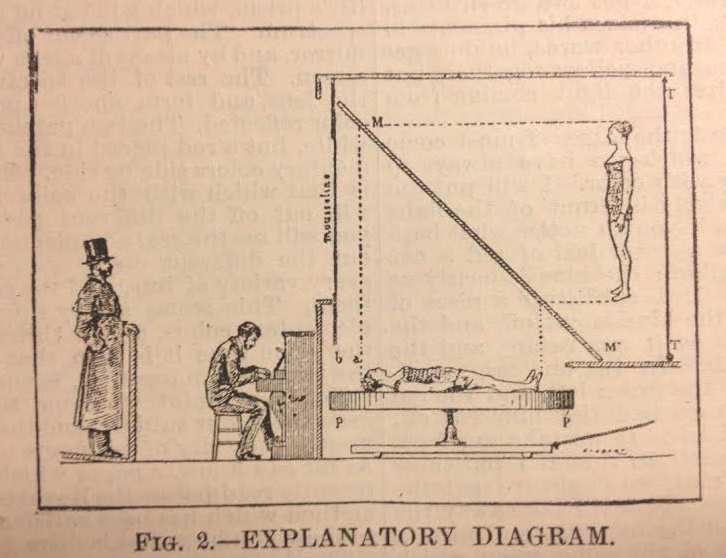
    A superior, and smallish, and elegant theatrical accomplishment in this area was tripped over by me in a browse through an 1889 volume of Scientific American Supplement while looking for an article about Tesla.  And there, in the issue of March 16, 1889 (on page 11008 (!)) was the Amphitrite.  Or at least the apparatus seems to be called by that name, I think, even though in Greek mythology it is the name of the sea-goddess and wife of Poseidon.   In any even it was an ingenious idea–the actor would be placed on a vertical rotating platform and by use of lighting and mirrors their form would be seen on a horizontal screen/background; so if the background was stationary and the actor was twirled on the platform, the effect would be a flying actor against whatever background was chosen. And so on.  That’s pretty good. 

    Sciam floating theatre

    ·Posted by :

    ·in:

  • Table Top Calculator that is the Table, and the Top

    JF Ptak Science Books   Quick Post

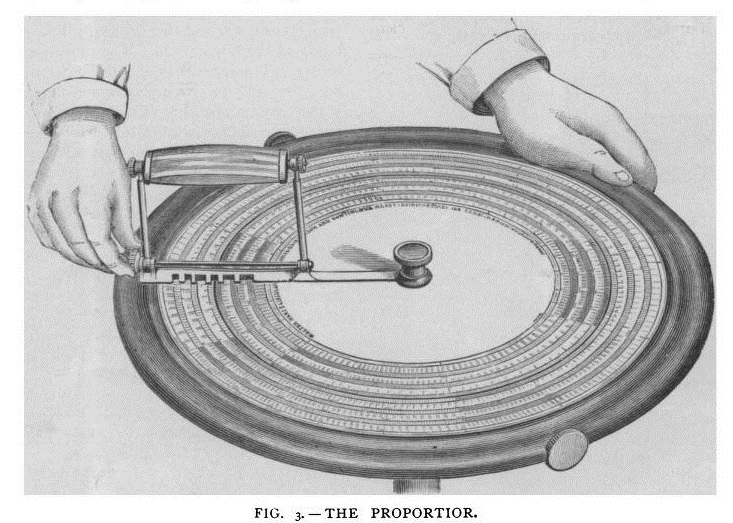
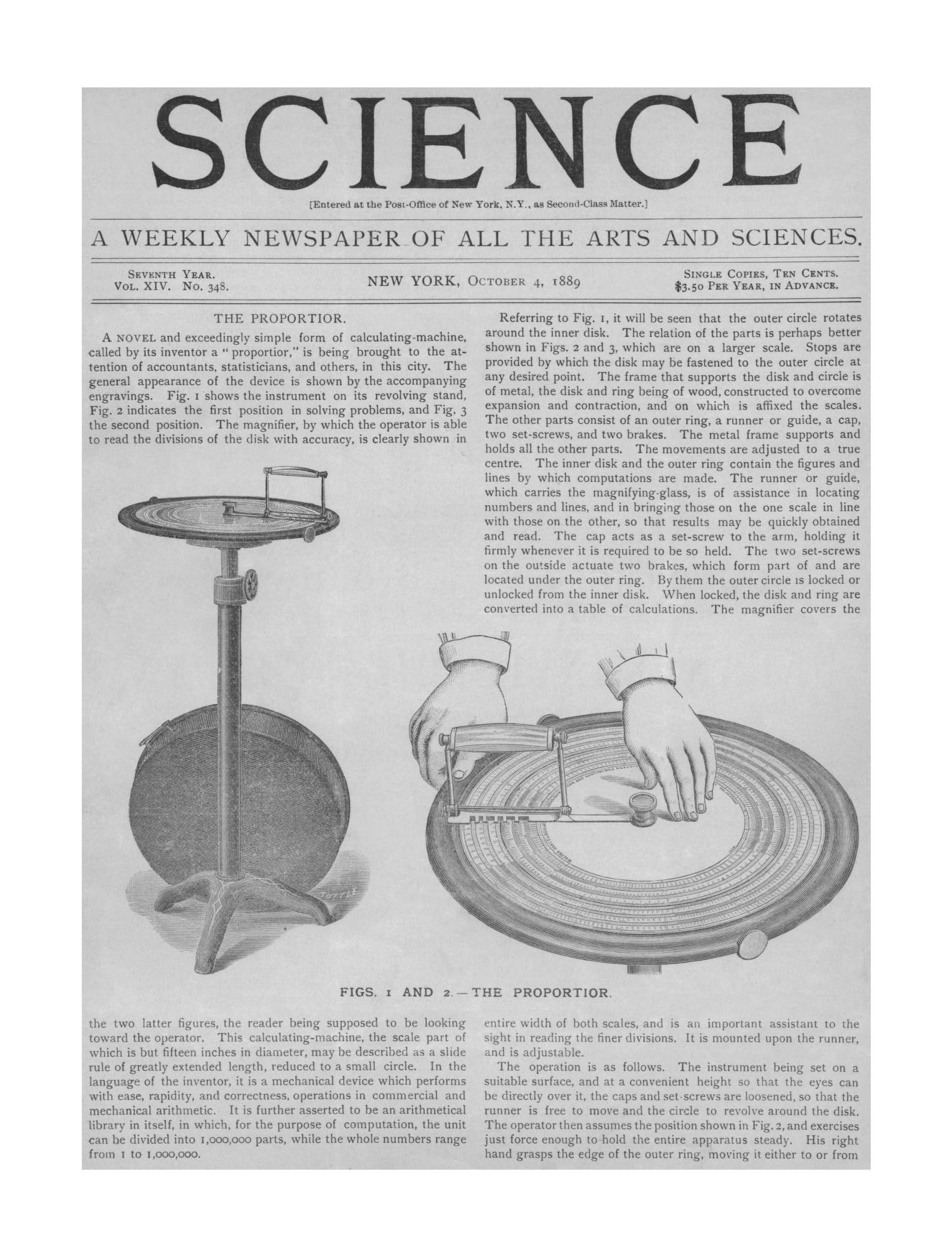
    The “Proportior” (sounding somewhat like an exclamation, like Excelsior!, and looking for all the world like it should be spelled some other more appropriate way) a fabulous desktop/tabletop calculator, as seen in the Science, October 4, 1889:

    Proportioner

    Proportioer2Thanks to Ray Girvan for the link to a successful download of images for this!


  • A Big Popular Statement on How Small Small Is (1883) (2)

    JF Ptak Science Books   Post 2255

    In three issues1 of Nature (London) magazine in 1883, William Thomson (Lord Kelvin)–polymath of a great and inquisitive mind–tried to create a good reference point for the size of atoms, mainly to establish that their size while being incredibly small were not unimaginably so, and that even objects of this minor magnitude could be approximated and studied.  And he did so with great ease and in a popular general-audience sort of way.

    All told, this was a very good piece of thinking, especially referencing the estimates of Niels Bohr 30 years later, publishing in the Philosophical Magazine (volume 26, pp 1-25, 1913) and calculating the size of an atom at .5 x -10 meters. And even though Thomson is talking about his estimates in terms opf science in a post-Dalton and post-Mendeleyeef world, he is also pre-Stoney, and Roentgen and Curie and Soddy and everyone else, especially pre-atomic-nucleus, and pre-proton (1919/20 with Rutherford and Moseley) and pre-neutron (Chadwick 1932), which are smaller still than the atom. Way smaller.  It is difficult to put into understandable terms on how “small” that small is:  the atomic nucleus is sort of 1/10,000th of the atom, and a proton or neutron smaller still, and then the quark smaller than that, until perhaps it becomes a Seussian exercise with future discoveries showing that after everything is said and done that it is turtles all the way down.  

    But Thomson managed to put an understandable assessment on a very difficult visualization, talking in terms of an atom being “1/10,000,000 or from 1/10,000,000 to 1/100,000,000 of a centimetre in diameter”, or 1×10⁻⁷meters, which is just about the size of a cell nucleus or DNA; that’s in the neighborhood, especially if you look at the smaller number which is 10-8 meters, which starts to close in on the size of the massive carbon atom (10-10), but sorta not so close to the electron (10-12) , or carbon atom nucleus (10-14) or proton (10-15).  Small, hazy stuff indeed, filled with nothing.  On the other hand, if you proceeded in a space vehicle 1014 meters from Earth our Solar System would appear as just another fuzzy splotch in the sky.  1016 meters is about a light year, and then it would taken 10,000 of those “just” to get slightly outside our galaxy.  And then there’s the rest.  

    In any event, Thomson did okay. And as it turns out (as I just now learned) there was an earlier Nature article in 1870 (the inaugural year of the journal) by its editor Norman Lockyer who estimated the size of atoms at just about the Thomson scale.  

    "FOUR lines of argument founded on observation have 
    led to the conclusion that atoms or molecules are 
    not inconceivably, not immeasurably small. I u;e the 
    words " inconceivably" and "immeasurably" advisedly. 
    That which is measurable is not inconceivable, and there- 
    fore the two words put together constitute a tautology. 
    We leave inconceivableness in fact to metaphysicians. 
    Nothing that we can measure is inconceivably large or 
    inconceivably small in physical science. It may be diffi- 
    cult to understand the numbers expressing the magnitude, 
    but whether it be very large or very small there is nothing 
    inconceivable in the nature of the thing because of its 
    greatness or smallness, or in our views and appreciation 
    and numerical expression of the magnitude. The general 
    result of the four lines of reasoning to which I have re- 
    ferred, founded respectively on the undulatory theory of 
    light, on the phenomena of contact electricity, on capil- 
    lary attraction, and on the kinetic theory of gases, agrees 
    in showing that the atoms or molecules of ordinary matter 
    must be something like the 1/10,000,000, or from the 
    1/10,000 000 to the 1/100000,000 of a centimetre in dia- 
    meter."--Thomson, below. 

    Notes:

    1. William Thomson,  The Size of Atoms, I pp 203-205, June 28, 1883; Size of Atoms II, pp 250-254, July 12, 1883; Size of Atoms III, pp 274-278, July 19, 1883, earlier presented before the Royal Institution, beginning February 2, 1883.


    ·Posted by :

    ·in:

  • On the Surprisingly Recent History of the Surgical Glove

    JF Ptak Science Books    Post 2256

    It is almost always the case that when you look at paintngs of surgeons at work—standing by or with or in their patients, surrounded by assistants and with a small crowd in attendance—and especially before say 1895 (the year of discovery of the X-Ray by Wilhelm Roentgen), that you will almost never see anyone wearing surgical gloves. And there’s good reason for that—surgical gloves really didn’t make a general appearance until right about that time.

    The idea of hyper-clean in the OR didn’t really exist until Joseph Lister began his practice of antispesis in the 1860’s—introducing washing surgical instruments in carbolic acid, and keeping the operating area clean and somewhat sterile. He used it in prep, and on the incision wound, and dressings, and instruments, and the effect was enormous. By what we take today as a “given” was a revolutionary advance when Lister started the practice in the 1860’s. People today think of his surname in connection with something different but somewhat related, and from exposure to television commercials for a certain mouthwash, but this would be like knowing the importance of Isaac Newton from those figgy cookies—and that just isn’t right.  Lister (1827-1912) figured out—through exposure to ideas by Ignaz Semmelweiss and Louis Pasteur, among others—that the infections in wounds that caused so many surgical deaths was not caused by the miasma in the air, but by something entirely different. 

    In his article in The Lancet of 21 September 1867 (and in his subsequent publication in book form later that year called Antiseptic Principle of the Practice of Surgery) he explained what he thought was the cause—microorganisms that traveled (at least) from the surgeon’s hands onto the wound, and not by something floating around in the air.  

    And thus the carbolic acid (phenol) and its application and miraculous results in operative and post-operative infection. This is one of the reasons why Lister is considered to be one of the founder of modern surgery.

    It is a little odd (at least from today’s viewpoint) that it would take several more decades for the next major step to be taken—the introduction of the rubber glove in the surgical arena. Rubber capable of being used for gloves hadn’t been around for all that lone a time, though there are some instances of surgeons using partial gloves made of sheep innards that reach back in the 1730’s. But it just didn’t happen–at least until nearly the turn of the next century.

    Well, there was some slight use in the 1830’s, but it wasn’t until 1893 that the wonderfully-named  Dr. J.C. Bloodgood insisted on glove use by his entire surgical team, though that was still fairly localized.  It was W.Steward Halstead’s adoption of the surgical glove at Johns Hopkins that really gave the idea national exposure, and so he is generally credited with the glove’s “discovery”, which is not true; it is true that he was responsible for the glove’s widespread use.  Halsdtead is a giant in the history of medicine, and although this is not among his great discoveries in medicine, it did probably save more lives than anything else he ever did.  

    Also consider:

    A good background on the rubber glove used in medicine is found at the Kiwi blog From the Nest, here. http://www.fromthenest.co.nz/2012/05/brief-history-of-the-surgical-glove.html

    J.C. Bloodgood http://www.ncbi.nlm.nih.gov/pmc/articles/PMC1390300/pdf/annsurg00536-0158.pdf

    ·Posted by :

    ·in:

  • On Historical Equalities of Garbage

    JF Ptak Science Books   Quick Post

    I wonder if we can speak of units of measurement for the stuff that we throw out in terms of some amount of industrial production of a country for a given period of time?  Like, do we here in the U.S. throw away enough stuff in one day/week/month to equal the total yearly production of some/all (?)  manufactured goods produced in fill-in-the-blank-country in 1850?  A figure such as this probably does not add to our understanding of, well,  anything at all–but maybe the discussion of what that number might be could be interesting. Or perhaps the very notion of even entertaining that such an equality is possible is enough for that unit of measurement to have done its job without even being established by simply bringing up the subject of vast waste.

    Our vast waste is vast.

    There are estimates that the average person (excluding businesses and corporations and such, strive as they may for personhood) in the U.S. throws away between 4 to 7 pounds of garbage a day.  (This according to Edward Humes in his new book, Garbarology–the author believes that the lower estimate by the EPA of about 4 pounds/daily is too low, and prefers the numbers of BioCycle magazine and Columbia University’s Earth Engineering Center, which give us the 7 pound figure.) Given, say, 300 million people in the U.S. that makes for about 7.6 trillion pounds a year, or about 2.1 billion pounds per day.  

    7.6 trillion pounds of garbage is more than double the world production of steel in 2011.(Source.)  

    This is also more than ten times the amount of all food produced in the U.S. per year. (Source.)

    But getting back to the historical aspect of the original question, in 1913 the total amount of pig iron produced by the chugging mills of the United States and Great Britain was about 84 billion pounds.  That’s 40 days of garbage today.  

    So, I’m not sure how many decades we need to go to get close to the Tonnage of All Manufactured Good in One Year = The Amount Americans Throw Out Each Day. My off-the-shelf approximation gets us close to the first industrial revolution period, which probably makes sense, but is difficult to imagine.

    It would be better for everyone involved if garbage was treated more as an energy source than it is, rather than shipping off huge tonnage of scrap iron and waste paper in enormous cargo ships to China, or burying it.  

    It seems incredible that in our enormous consumption of stuff that in the end the most popular thing to do with the shells of our wants is to make mountains of waste with it. 

    ·Posted by :

    ·in:

  • Crazy Cubes, Baseball Cannons, Logic, and the 4th Dimension, 1897

    JF Ptak Science Books   Post 2258

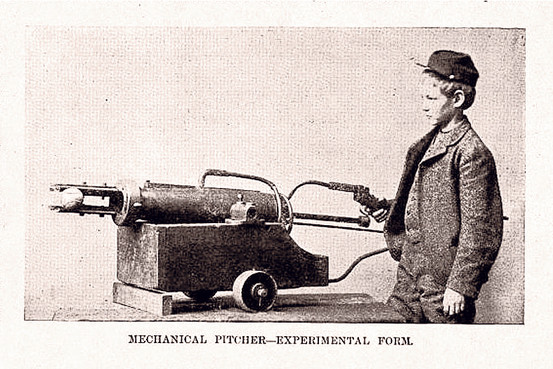
    Hinton cannon[Source:  Joshua Robinson, “A Machine Before its Time”, Wall Street Journal, June 21, 2010. See below.]

    Somewhat Zelig-like, Charles Howard Hinton (1853-1907) is a sort of shadowy Oxford-educated figure who turns up in the beautiful Jorge Luis Borges’ works, and who married George Boole’s daughter, and who was a great and very early visualizer of geometries of higher dimensions, and who was the coiner of tesseract, and the inventor of a baseball pitching machine, and a practical joker, and a sci-fi writer, and who deserved an obituary in the New York Sun by the masterful Gellett Burgess (May 5, 1907), and who seemed to keep one step ahead of everyone and himself.

    He was also the creator of crazy cubes.

    There are many standard-bearers in the history of modern art who probably owe something to Hinton, who published his ideas on the fourth dimension (illustrated!) just at the time when this idea was in it trial runs in the artwork of the modern age.

    And so do baseball players—or at least those at Princeton, where he introduced his machine which evidently was used there for several seasons. The pitching gun really was a cannon, the baseball loaded into the thing with an appropriate cartridge to shoot the ball at pitcherly speeds, which he described it in Harper’s Weekly for March 20, 1897. (How Hinton got to Princeton is interesting and a mystery, both; he was an instructor of math in England until he was charged and convicted of bigamy in 1886, whereupon he took his first wife and four (?) sons to Japan to teach in Yokohama for a while, then yadda yadda yadda he starts teaching at Princeton in 1893.)

    Hinton was into a lot of things, with a very inquisitive mind, and very smart. And so he bounced here and there in his careers, from position to position. David Toome, in his fine The New Time Travelers: A Journey to the Frontiers of Physics (2010) gently and wonderfully describes Hinton (in his relations to the exterior world of work) as “buoyant” (page 29).

    In any event, Hinton seems not to have patented the thing,so far as I can determine in 10 minutes of patent searches.

    The cannon seems to have excited a bit of baseball scifi in itself, adding to Hinton’s other pleasures.

    In a longer and better article than mine, Joshua Robinson writes in the Wall Street Journal about  Hinton’s machine and the near-roboticized future of baseball:

    “…(I)n 1896, the Los Angeles Times called it a “Frankenstein.” One Washington Post columnist worried it would ring in an age of robots ruining the national pastime—this was a long time before anyone was worried about steroids.

    “There would be the base-burning, high-pressure, anti-friction catcher,” he wrote, “and the shortstop made of aluminium and rivets and filled with cogs, cams, valves, shafts, and belting.”

    Hinton’s pitcher was an interesting idea, but ultimately it proved to be too cumbersome and slow to be of any sustained use. Plus, as Robinson points out, after the cartridge was fired there was a puff of smoke, which caused occasional consternatiuon and confusion for those standing in front of the canon. And ducking.

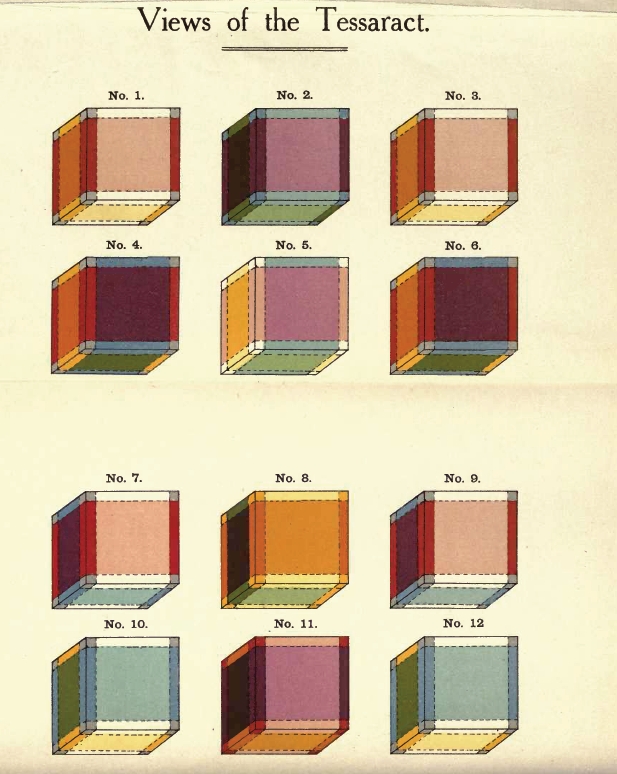
    And the so-called “crazy cubes”?  That moniker is my own creation. These were simply (really not so) creations by Hinton that he said would help people visualize his four dimensional world, as Rudy Rucker (see below) describes as “points moving around in three dimensions might be imagined as successive cross-sections of a static four-dimensional arrangement of lines passing through a three-dimensional plane…”  Evidently the cubes helped many people experience a more internalized world of fantastic difference, some stating that the cubes drove some people insane. Of course they were just colored cubes, pretty in themselves–though the problem of visualization was fairly knotty.  

    Hinton tesseract[Source: The Fairyland of Geometry, a Cultural History of Higher Space, 1869-1909, here.]


    Notes:

  • A Big Popular Statement on How Small Small Is (1883)

    JF Ptak Science Books   Post 2259

    In three issues1 of Nature (London) magazine in 1883, William Thomson (Lord Kelvin)–polymath of a great and inquisitive mind–tried to establish a good reference point for the size of atoms, mainly to establish that their size while being incredibly small were not unimaginably so, and that even objects of this minor magnitude could be approximated and studied.  And he did so with great ease and in a popular general-audience sort of way.

    All told, this was a very good piece of thinking, especially referencing the estimates of Niels Bohr 30 years later, publishing in the Philosophical Magazine (volume 26, pp 1-25, 1913) and calculating the size of an atom at .5 x -10 meters. And even though Thomson is talking about his estimates in terms opf science in a post-Dalton and post-Mendeleyeev world, he is also pre-Stoney, and Roentgen and Curie and Soddy and everyone else, especially pre-atomic-nucleus, and pre-proton (1919/20 with Rutherford and Moseley) and pre-neutron (Chadwick 1932), which are smaller still than the atom. Way smaller.  It is difficult to put into understandable terms on how “small” that small is:  the atomic nucleus is sort of 1/10,000th of the atom, and a proton or neutron smaller still, and then the quark smaller than that, until perhaps it becomes a Seussian exercise with future discoveries showing that after everything is said and done that it is turtles all the way down.  

    But Thomson managed to put an understandable assessment on a very difficult visualization, talking in terms of an atom being “1/10,000,000 or from 1/10,000,000 to 1/100,000,000 of a centimetre in diameter”, or 1×10⁻⁷meters, which is just about the size of a cell nucleus or DNA; that’s in the neighborhood, especially if you look at the smaller number which is 10-8 meters, which starts to close in on the size of the massive carbon atom (10-10), but sorta not so close to the electron (10-12) , or carbon atom nucleus (10-14) or proton (10-15).  Small, hazy stuff indeed, filled with nothing.  On the other hand, if you proceeded in a space vehicle 1014 meters from Earth our Solar System would appear as just another fuzzy splotch in the sky.  1016 meters is about a light year, and then it would taken 10,000 of those “just” to get slightly outside our galaxy.  And then there’s the rest.  

    In any event, Thomson did okay. And as it turns out (as I just now learned) there was an earlier Nature article in 1870 (the inaugural year of the journal) by its editor Norman Lockyer who estimated the size of atoms at just about the Thomson scale.  

    "FOUR lines of argument founded on observation have 
    led to the conclusion that atoms or molecules are 
    not inconceivably, not immeasurably small. I u;e the 
    words " inconceivably" and "immeasurably" advisedly. 
    That which is measurable is not inconceivable, and there- 
    fore the two words put together constitute a tautology. 
    We leave inconceivableness in fact to metaphysicians. 
    Nothing that we can measure is inconceivably large or 
    inconceivably small in physical science. It may be diffi- 
    cult to understand the numbers expressing the magnitude, 
    but whether it be very large or very small there is nothing 
    inconceivable in the nature of the thing because of its 
    greatness or smallness, or in our views and appreciation 
    and numerical expression of the magnitude. The general 
    result of the four lines of reasoning to which I have re- 
    ferred, founded respectively on the undulatory theory of 
    light, on the phenomena of contact electricity, on capil- 
    lary attraction, and on the kinetic theory of gases, agrees 
    in showing that the atoms or molecules of ordinary matter 
    must be something like the 1/10,000,000, or from the 
    1/10,000 000 to the 1/100000,000 of a centimetre in dia- 
    meter."--Thomson, below. 

    Notes:

    1. William Thomson,  The Size of Atoms, I pp 203-205, June 28, 1883; Size of Atoms II, pp 250-254, July 12, 1883; Size of Atoms III, pp 274-278, July 19, 1883, earlier presented before the Royal Institution, beginning February 2, 1883.

     
  • FootPunk–Heavy Metal Skates, 1880

    JF Ptak Science Books                                                  Futre Punk series  &   Daily Dose from Dr. Odd series

    SciAm July 24 d

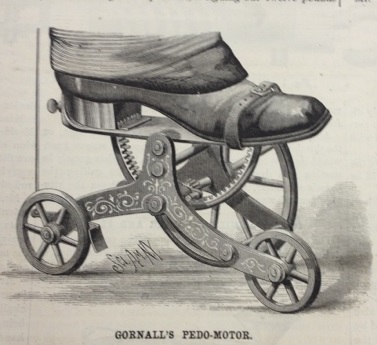
    Somewhere between walking and bicycles Mr. Richard Gornall found a mechanical need to fill what may or may not be an imaginary gap.  He invented or suggested the Gornall Pedo Motor, which appeared in the pages of The Scientific American  on February 14, 1880 (page 107), along with a great wood engraving.  Gornall said that his invention, which “accelerates the motion of walking”, would “occupy the immediate position between the roller skate and the veliocepede”.  The walking heel-toe motion was supposed to transfer power via a rotary drive to the rear wheel, thus creating in a way a mechanically powered roller skate.  The invention sounds not-so-great, but the image is certainly pretty.  

    ·Posted by :

    ·in:

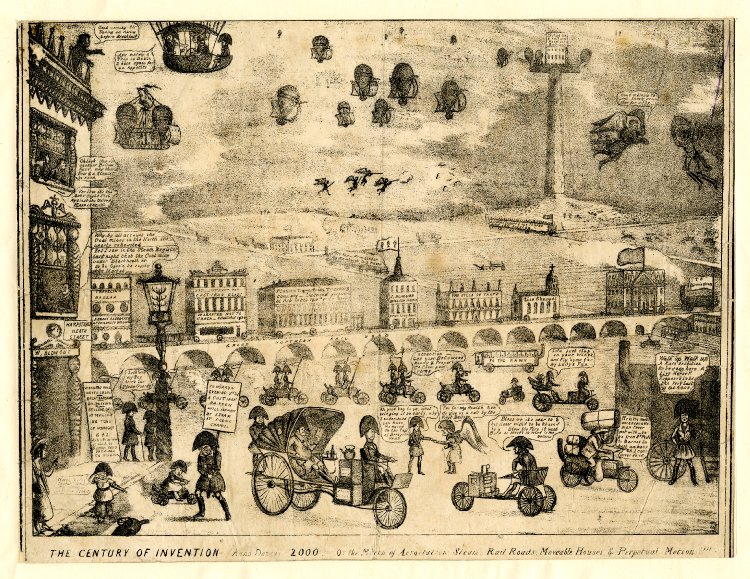
  • Robotic Preachers of the Year 2000, as Seen from 1834.

    JF Ptak Science Books    Post 2260                                          History of the Future series

    “The century of invention Anno Domini 2000 or the march of aerostation, steam, rail roads, movable houses & perpetual motion” is a terrific lithograph, made ca. 1834, the handiwork and imagination of Charles Jameson Grant, a satirist and observer of high order.  He tried looking into the future 165 years hence, and in some practicable ways he got a lot of it right–the imagery wasn’t there, but the ideas were.  

    Grant year 2000

    [And as long as were slightly on the subject, the idea of “anno domini”, or “the year of our savior”, was an idea controlling the past and future aspects of time that came into being about 500 years after the birth of the event upon which the savior years are based.  The idea of anno domini was really in widespread use until the Middle ages were well underway, around the year 800.]

    It is difficult to make out from this print (found at the British Museum site, here) but the small visual clues and textual bits are very interesting.  First of all the print displays things like small and large individual steam-powered four-wheeled vehicles, as well as plenty of balloons (in the spirit of aviation, at this point in its fourth decade and entering a great heyday) passing each other in every which way, off on adventures, or work, or in a race (as with the “out of Sight Club”).   There are also numerous people flapping around in the sky (“winging it so early”)  with their (something)-powered wings, some of whom are hunting birds. 

    The main sensation here is speed, though I would not say it was democratic–the means to be able to got to Dublin in your balloon “for an appetite” and return later in the day would have been fantastic to the 1834 reader trying to image doing such a thing on such a whim, with a newspaper in your lap–but certainly it would be available to the leisurely class.  

    There was also an idea for balloonic (first time I’ve ever typed that!) communication, as one man in a balloon shouts to another to “give me a call by the first balloon”, meaning perhaps it is a communication device, or a balloon-delivered letter.  

    The dialog certainly portrays an attitude of unremarkable observation, conveying how commonplace flight and mobile towns and steam cars would be in the year 2000.  That’s where one of the great insights comes into play–at lower left there is a person remarking about a race, and the exclamation upon a great rarity being shown: a live horse.  That Grant would make this an issue is interesting, as it would certainly rub the 1830’s consciousness the opposite way of what the brain expected to see in the street, and that was horses.  Horses powered much of transportation at this time, and to imagine a world in which the horse would be gone would’ve been, well, unimaginable.

    Ditto too the great and extensive coal mines fueling the Industrial Revolution (and it isn’t as though factory workers in 1834 woke up int eh morning cheerfully exclaiming that, “Hey, We’re in the Industrial Revolution!”) going dry, the coal consumed.  

    Also at bottom there is a very unusual placard concerning robotics: “a cast iron Parson will preach by steam at Fudge Church”. Now this is doubly intriguing because it not only invokes a steam-powered person, but a (perhaps) thinking one.  It is also putting the word of god into the care and trust and tending–and right into the mouth–of a machine.In short–a robot preaching to a human choir.  This is still far removed from the singularity (and the assumption that Our Robot Overlords would have any interest in humans or their religious beliefs), and seems a bit on the primitive side in its display, but the intellectual imagery is pretty powerful stuff.  I assume that the power of this would’ve been less so at the time of publication, guessing that Grant was making more of a not-so-subtle satire on the steam-driven puffery of some preachers with the creativity of kettles, and that in the future this would be magnified to the point of steam and smoke. But still the idea of placing the deeply emotional stuff of belief systems in the control of a machine is extraordinary for the time, I think.

    So I think that if you hard enough at this print and don’t get distracted by the images Grant uses to try and visualize his ideas of eh future and concentrate on what these things represent, then I think that Grant got a lot of his vision right.  

Recent Posts

Archives

Categories