A Daily History of Holes, Dots, Lines, Science, History, Math, Physics, Art, the Unintentional Absurd, Architecture, Maps, Data Visualization, Blank and Missing Things, and so on. |1.6 million words, 7500 images, 4.9 million hits| Press & appearances in The Times, Le Figaro, Mensa, The Economist, The Guardian, Discovery News, Slate, Le Monde, Sci American Blogs, Le Pont, and many other places… 5000+ total posts since 2008.

  • Cell vs. Cell: Photoelectric Cell and Shooting a Prisoner for Escaping their Cell (1930)

    JF Ptak Science Books  Quick Post

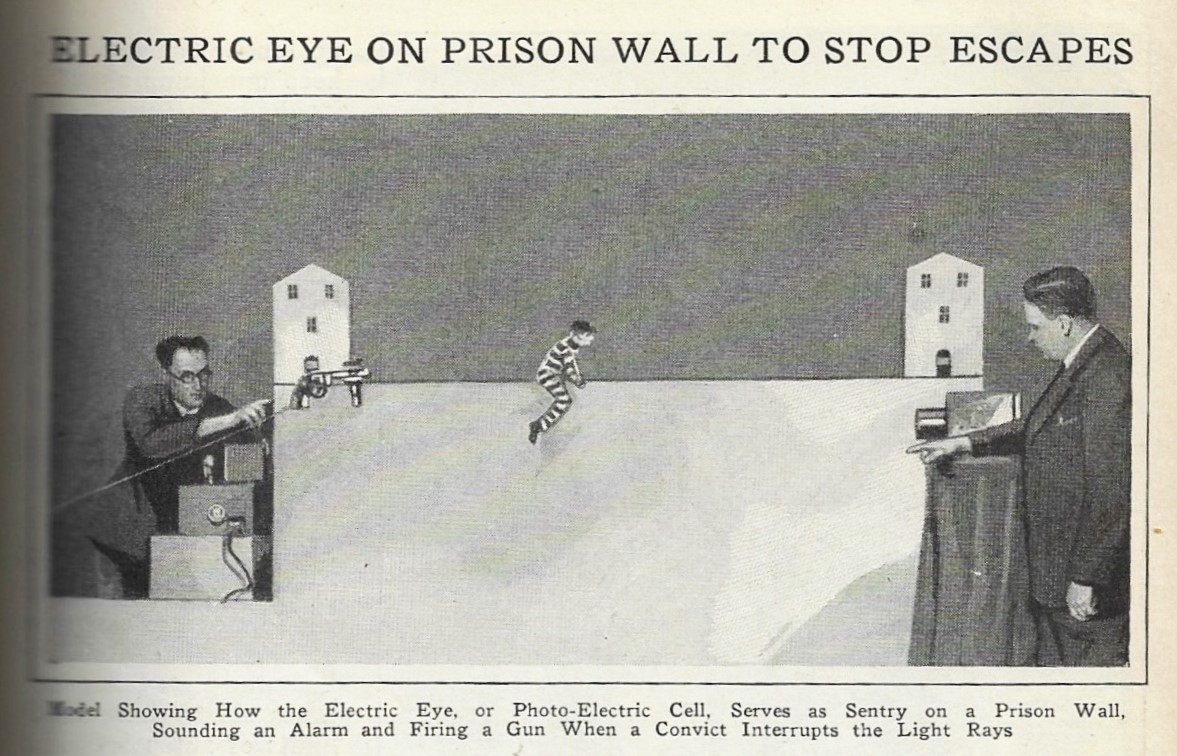
    The photoelectric cell was a mature invention (appearing in 1883) when it became armed and lethal in 1930.  Popular Mechanics published this photo (explained with only a caption and a paragraph) in its July 1930 issue. We see that should a prisoner make a dash up and over the prison wall, they interrupt the “electric eye” sentry which we read (1) fires a pistol positioned along the wall and (2) sounds an alarm, simultaneously.  It seems as though the alarm system could be reconstituted at the base of the wall, sounding an alarm before the prisoner got to the wall (let alone up and over it), rather than shooting as the alarm sounds.  The consequences of this idea–which I suspect was never implemented–were, well, rather extreme.

    Pop Mech 1930 Convict Killer

    ·Posted by :

    ·in:

    —
  • From Children’s Games to the Lake of Fire: Fun and Hell by Mr. Bruegel (Alpha & Omega, Part I)

    JF Ptak Science Books  Post 2834a

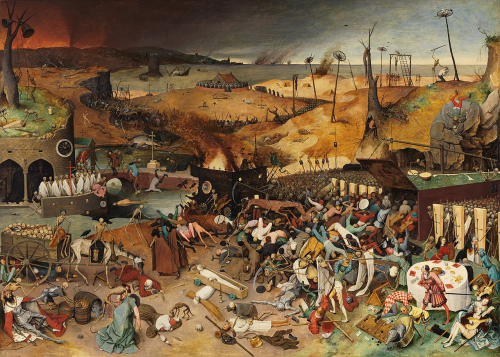
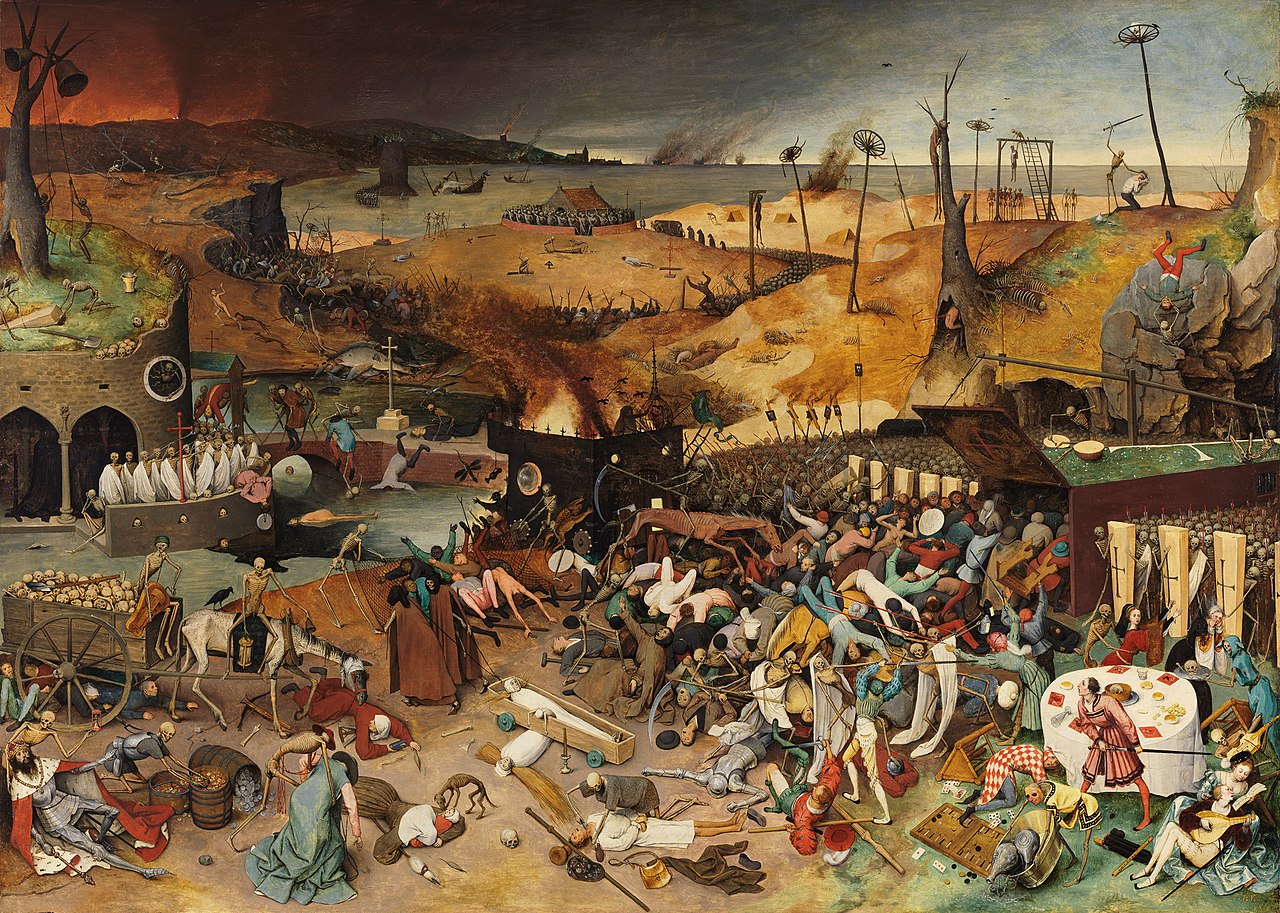
    Somehow I was drawn to take a close look at Pieter Bruegel (the elder’s) massively complex painting, The Triumph of Death (painted ca 1562), in which people were skeletonized by skeletons, killed in fantastic grotesqueries. No doubt I found my way there thinking about COVID-19, and the 1918 Influenza Pandemic, and naturally to the time of the London plague and then the Black Death, winding up on Bruegel’s bitterblack doorstep. In the painting’s many nooks and crannies and its deep minutiae, there is no regard for hope to be found, no possibility of god’s grace to comfort and possibly save the doomed, nothing by the delivery of myster-horrories leading to the lake of fire.
    Bruegel triumph of death

    There is just so much going on in this painting, so many scenes that you’d expect to see an overall narrative, except that there is none, just hundreds of people being taken by Death and its skeleton minions, led off to the gate of Hell. There are dozens of individual passions being crushed and morals observances being made, but they all seem to stand apart and clear.

    I did a quick survey to see if there was an overall census of this apocalypse, but I didn’t find one, surprisingly, which probably means I didn’t look hard enough. That said I thought it would be quicker to make my own scan of what is going on in the painting, starting in the near-center, where we see the spiked opening of the cave of Hell, surrounded by the armies of the dead. In the foreground is a very bad litany of very bad things, people being hanged and burned and drowned and stabbed and knifed and strangled broken on the wheel, those looking out to a deeper field of burning houses and a burning armada, everything burning or set to burn—everything was on fire, leading to the place where the fire was on fire.

    Continuing the survey in the image’s far left-bottom, we see a king in his finery being shown an empty hour glass; to his left a skeleton in armor poking around in bags of gold and silver coins, while just nearby is a cardinal being led to eternity by a skeleton wearing a cardinal’s hat. Further on we see a very strong denial of the absence of mercy, in this case a starving dog nibbling on the face of a dead baby still in its dead mother’s arms, and this right next to someone being overpowered and having his throat slit.

    Behind the king there is a skeleton crew operating a wagon full of the dead—one of the skeletons plays a hurdy gurdy while the other sits daintily astride the starving horse pulling the dead crate. Nearby people are being gathered in a net—like, well, people being led of to hell in a net—which seems a better end than what is going on around them, a diatribe of death by hackings and assorted other nastiness.

    On the opposite side of the painting from the king, on the far right corner, is a pair of, what, friends or something singing and playing, completely oblivious to the larger scene and even to the lute-playing skeleton leering and hovering over them. To their left is particularly disturbing figure—a skeleton wearing a human face with no eyes is tipping over a brazer filled with flasks, this taking place next to an upset backgammon board and a fallen deck of cards.

    Rounding it all out, in the center of the painting, we finally see Death itself, riding a red horse, horse of war, the symbol of fire, of blood, and one of the four horses of the apocalypse. Death charges on, and in this horrible commotion leads his hundreds of skeletons into what was probably a generic scene of generic people doing generic things appropriate to their generic-icity, the great an overwhelming triumph over mortals seeming abandoned by their god.

    So, there it is—I just ran out of steam in thinking of a census of what was happening in the painting, settling for a summary. Its just a little too nasty for right now.

    The cure for this painting is to have a look at Bruegel’s superb painting of children’s games, which comes up next.
    ·Posted by :

    ·in:

    — —
  • From Children’s Games to the Lake of Fire: Fun and Hell by Mr. Bruegel (Alpha & Omega, Part II)

    JF Ptak Science Books  Post 2834b

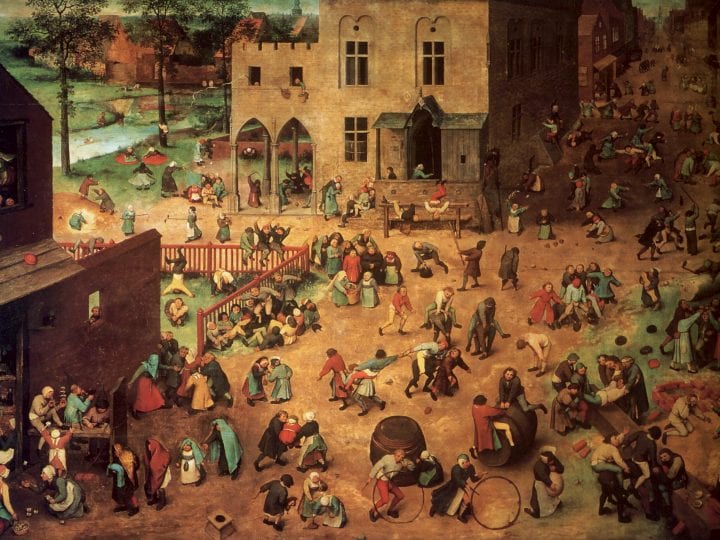
    Being quite filled up with Bruegel’s orderly disaster of death’s chaos control, I went to the other end of his work, to the Alpha of his death Omega: Children’s Games (1560). It is the opposite of The Triumph of Death painting (the preceding post), showing some 200 kids at play, involved in at least 80 different games—it is a visual dictionary of fun and hope. The viewer goes from one game or kid cluster to the next, experiencing a fun slow climb to the mountaintop—and in the other, with death being death and all that, it leads the other way along a road of broken glass.

    Bruegel children

    for a good and expandable view of the painting, see: https://artsandculture.google.com/asset/children%E2%80%99s-games-pieter-bruegel-the-elder/CQEeZWQPOI2Yjg?hl=en

    I’m sure these kids at play were thinking “ars longa, vita brevis” as they lost themselves in the easy complexity of whatever it was they were doing—well, no, they didn’t think that because they didn’t need to, as they were alive in it.

    The game clusters seem to be distributed evenly, and in spite of all of the divergent action, everything seems to be orderly in spite of the sweaty irregularities of the kids. The composition reminds me of the ultra careful construction of engraved illustrations in 18th and 19th century encyclopedias—like those of Abraham Rees Cyclopedia… and J.G. Heck’s Iconographic Encyclopedia—where the pages are filled to the edges with related and unrelated objects though by their arrangement there seems to be plenty of unused space.

    I can only recognize a game here and there—there are a number of experts who have gone through the painting and identified every aspect of every game, as the painting really is a social geology as much as it is anything else.

    For interesting reading see:

    In closing this short share I’d like to mention another fantastic Renaissance work featuring children’s games: the games played by Gargantua in Rabelais’ 1534 work Gargantua and Pantagruel, as there are at least 145 of them (217 in the revised edition), and they appear in a list! Again, there’s only a few here that I recognize straightaway, though they all can be found and explained.

    From the text (being nearly all of chapter 22):

    “Then blockishly mumbling with a set on countenance a piece of scurvy grace, he washed his hands in fresh wine, picked his teeth with the foot of a hog,
    and talked jovially with his attendants. Then the carpet being spread, they brought plenty of cards, many dice, with great store and abundance of
    chequers and chessboards…”

    “There he played.
    At flush.

    At love.
    At primero.

    At the chess.
    At the beast.

    At Reynard the fox.
    At the rifle.

    ·Posted by :

    ·in:

    —
  • A Chinese Kingdom in North America (1753)

    JF Ptak Science Books  Quick Post

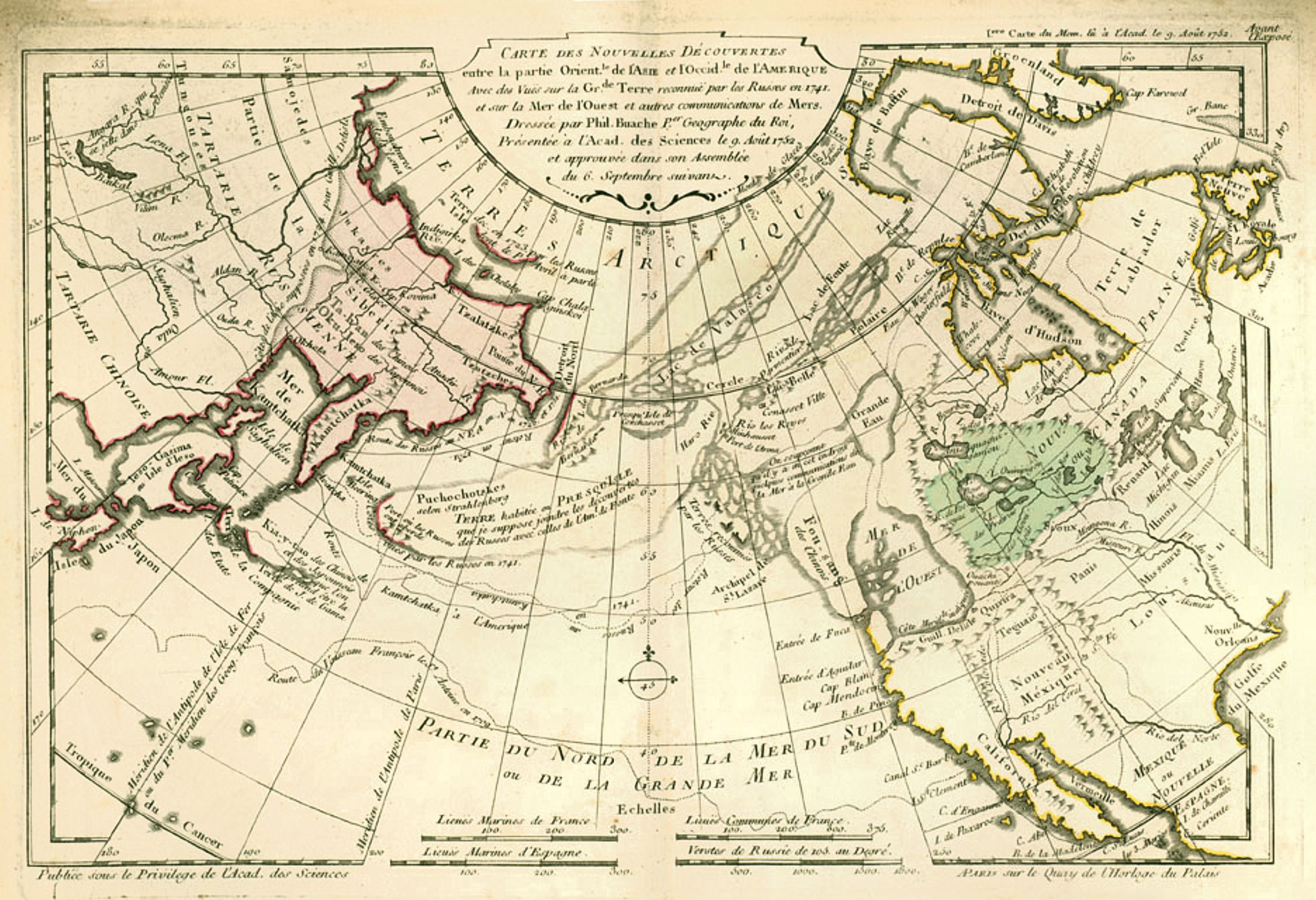
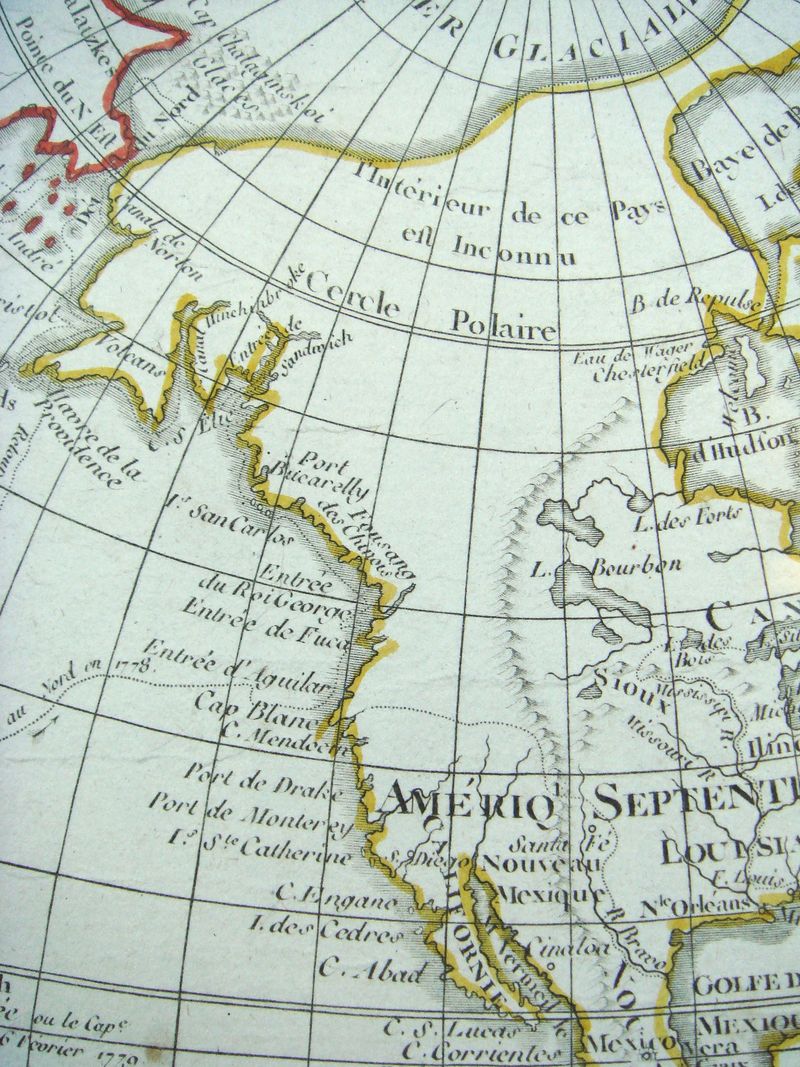
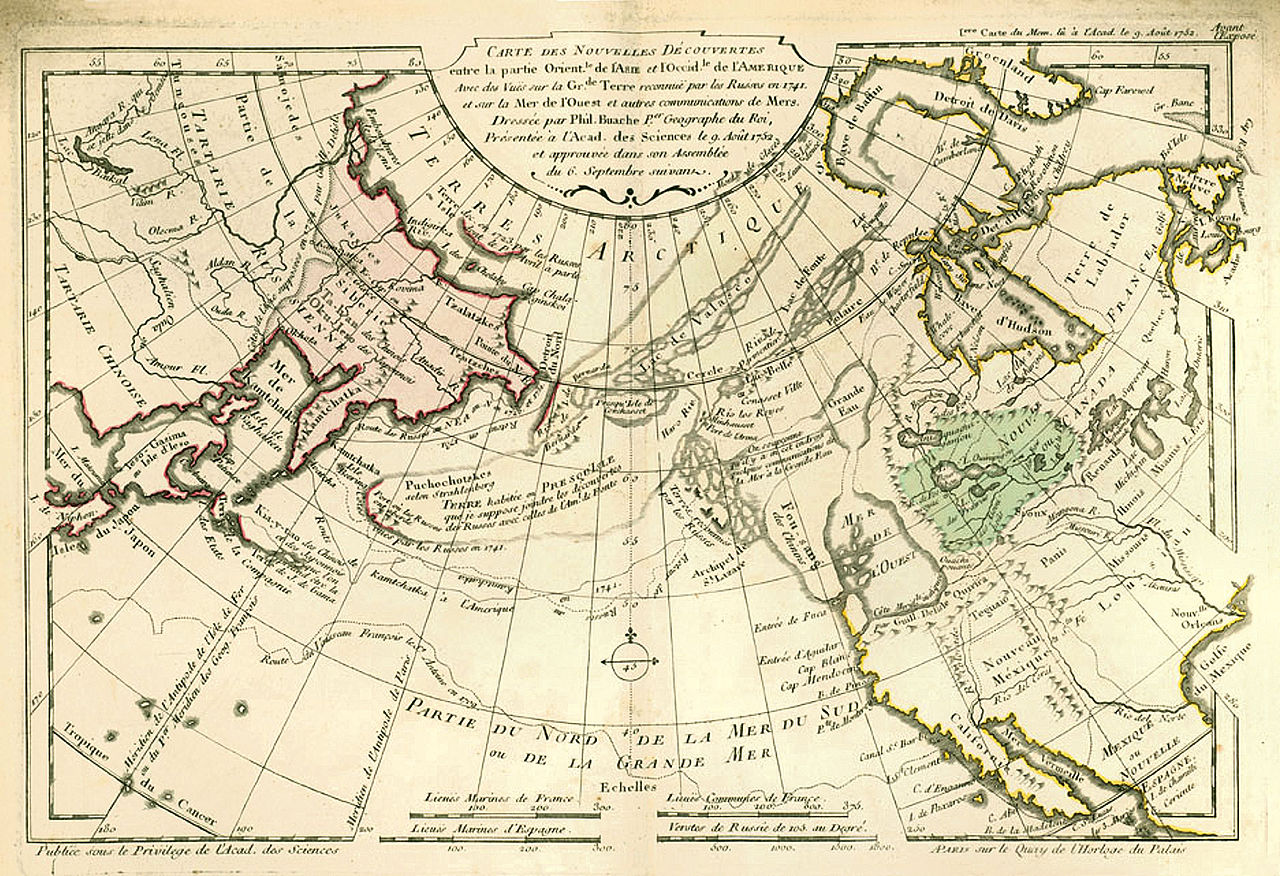
    Here’s a good example of the mapping of a non-existent entity: the Kingdom of Fusang, or the Chinese/Fusang people, located in British Columbia/Washington state, appearing in the considerable Philippe Buache’s map, Carte des Nouvelles Decouvertes…(1753).  It is a wonderful map that also has a lot of suggested possibilities of realities in the not-much explored Pacific Northwest of North America.  What we see appearing above the huge landmass of “Californie” (mostly the entire west coast of the present-day U.S.) is the island-like “Fou-sang des Chinois”.  This area stretches from about the 47th to the 59th parallels, and is contiguous to another hypothesized entity, the “Mer de l’Ouest”, which is an enormous body of water about the size of Hudson Bay. This is also connected to another very large body of water, the “Grande Eau”, which in turn has connections leading to the Atlantic ocean, thus forming the much-hoped-for and dreamed-of Northwest Passage.

    Fusang three

    • Click to clarify and enlarge

    Source  https://en.wikipedia.org/wiki/Fusang#/media/File:Buache1753Map.jpg

    I’m not faulting M. Buache whatsoever in telling this little tale of prospective Geography–he produced (for his time) an excellent map of not very well understood and distant places. 


  • Early References to the Holocaust and Auschwitz (1943)

    JF Ptak Science Books  Post 2835

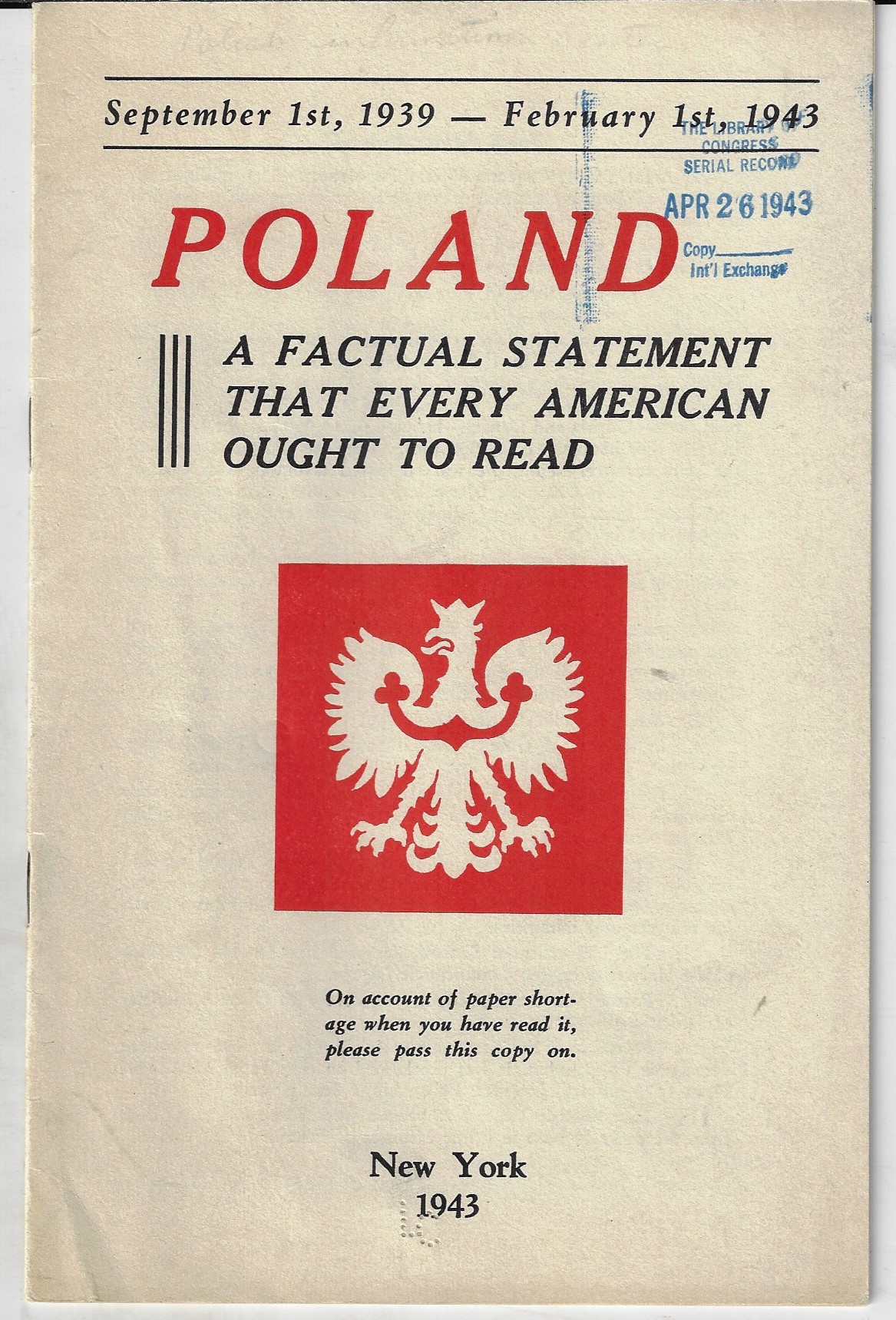
    Poland  factual statementPoland, a Factual Statement that Every American Ought to Read (published by the Polish Information Center, 151 East 67th Street, NYC) sounds like a semi-dry academic pamphlet, waiting to be ignored. But it was printed in 1943, and the audience then would no doubt have been interest in what the hell was going on there.  It turns out that there is some extraordinary reading to be done in its quick sixteen pages, not the least of which is a notice of the murder of a million Jews and a description of camp life in Auschwitz (Oswiecim). As there are only five copies of the work located in libraries worldwide (according to WorldCat/OCLC) I thought I’d reproduce its most significant section , the “German Reign of Terror” (pp 12-15). This leads with these numbers of crimes committed by the Germans: To forced labor in Germany (1,000,000 Poles); to the Government General (700,000 Poles); shot and murdered (1,200,000 Poles), starved to death (about 500,000 Poles). “It staggers the imagination to think that every tenth human being in German occupied Poland had already been shot or hanged tortured to death, starved…or deported to Germany.”

    There are other stories of mass executions, as well as a short description of Auschwitz: “More than 60,000 Poles have been murdered in the concentration camps of the Government General and the Reich. Oswiecim is the most gruesome on Polish territory. It was set up in July 1940 and consists of ten barracks, each of which is supposed to contain 400 prisoners, but actually houses 1,000 men. Prisoners wear thin cotton uniforms in winter as in summer. They were only given shoes on October 15 and had no caps before December. On arrival they had to fill out answers to 32 questions about their life, family, health, wealth and political activities. Two weeks suffice to break men above 45 years. Younger men lose their vigor and youth within half a year…”

    And this: “The Jewish population is closed up in ghettos and suffers no less than the Poles. Particularly in the last six months the Jewish population has suffered an unheard of persecution amounting to a process of willful extermination. Losses in Jewish population up to 1943 exceed one million persons killed.”

    • Note: I don’t know enough to speak about the obvious demarcation in this report between “Poles” and “Jews” except to say that it exists in the text and that I’m aware of it.  

    And so, here is the scan of the “German Reign of Terror” section:

    German Reign of Terror

    In his message to Poland broadcast on May 3rd, 1941, Prime Minister Churchill said: “Every day Hitler’s firing parties are busy in a dozen lands. Monday he shoots Dutchmen, Tuesday Norwegians, Wednesday French and Belgians stand against the wall, Thursday it is the Czechs who must suffer, and now there are the Serbs and the Greeks to fill his repulsive bill of execution. But always, all of the days, there are the Poles.”

    Let us be frank: for many reasons the world still is not fully aware of the enormity of Polish suffering nor does it realize the importance of Poland’s contribution to the Allied fight for common victory.


    ·Posted by :

    ·in:

    —
  • On the Early Imagery and Definition of the “Cowboy”

    JF Ptak Science Books   Post 3836

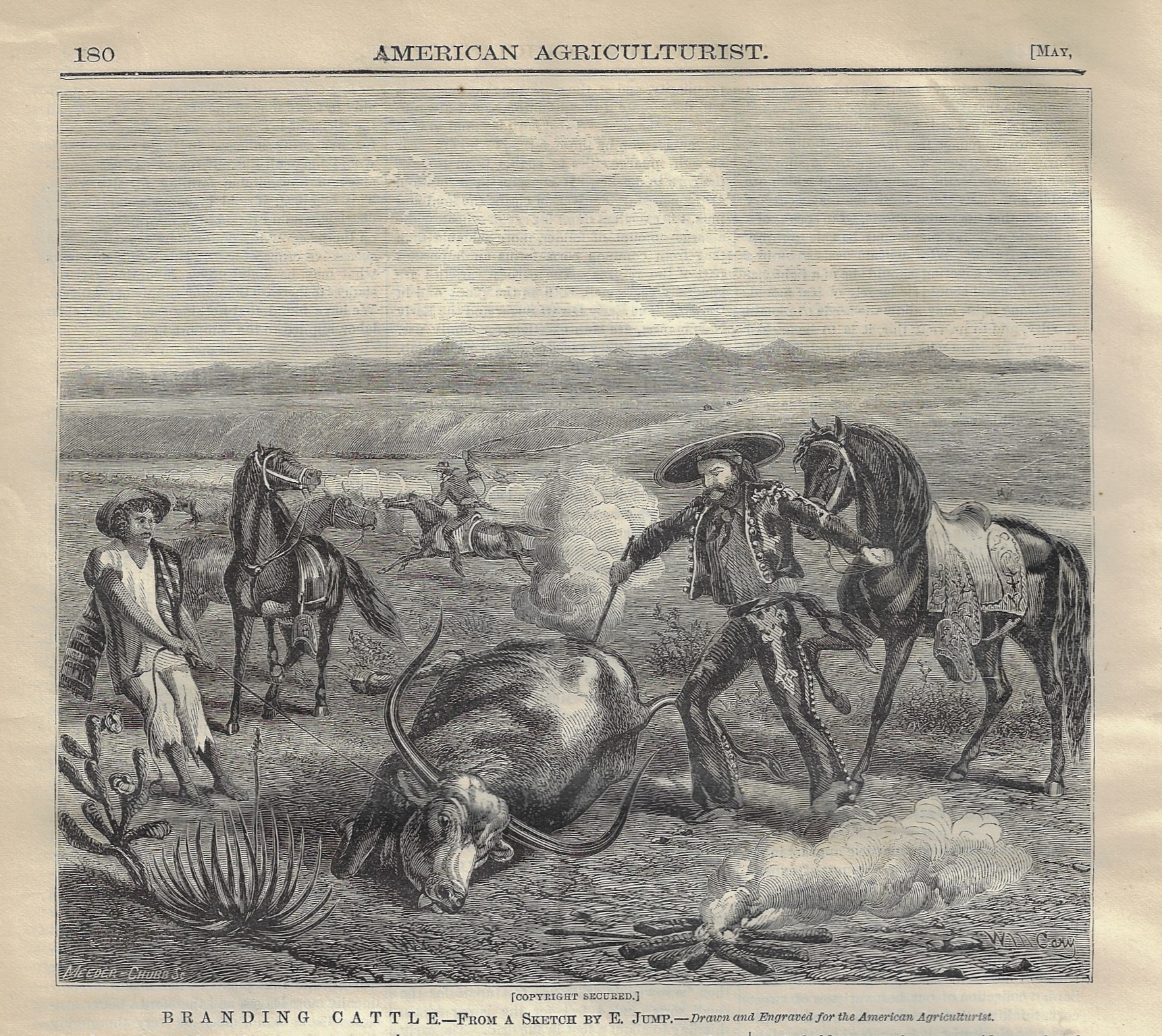
    I just came upon a very early image of a cowboy, finding it in an unusual publication, American Agriculturalist. It is vacquero in a branding scene, and even though the word “cow boy”/”cowboy” has a longish history and easily researched, finding the earliest image of the cowboy is a more complicated matter.  Images of cowboys begin to appear commonly by the late 1880’s, but once you get before 1880, the cowboy in art/representation gets more and more difficult to locate. It seems as though the among the earliest images is “El lazo”, showing a gaucho chasing a cow, which was illustrated by “J.D.” and printed in 1841. An image of cowboys branding cattle in Texas appears 26 June 1867 in Frank Leslie’s Illustrated Newspaper, and then I’m not coming up with much else in the pre-1870 era. Which takes us to the work illustrated below by the Frenchman Edward Jump (1832-1883) and his vacquero. (I’m sharing this hoping that someone will have some references for a timeline of the depiction of the cowboy…if that is you, please let me know).

    Cowboy 1870

    In the meantime, I’ve done the easier task in looking at the history of the word “cowboy”, as follows. 

    The word “cowboy” (“cow-boy”, “cow boy”) was little seen in the U.S. in the decades before the great surge in cattle drives—prior to the 1870s. The word most commonly associated with America’s greatest folk heroes actually got its beginning in Ireland, and was commonly used in Britain from 1820-1850 where its meaning was quite literal, applying to the young boys tending the cows owned by a family or community. An earlier use by Jonathan Swift in 1725 also refers to nothing more than a boy tending cows. 

    The word “cowboy” is first seen in the U.S. in the New Orleans Picayune, not referring to a man, but to a race horse instead. The word—referring to humans—breaks into printed use in the U.S. at about the same time the great drives were ending. Perhaps the first mention in print of the human cowboy comes hyphenated in Wilkes’ Spirit of the Times magazine in 1866. By 1877, only 11 years later, the great national character, Texas Jack (a scout brought along by Buffalo Bill Cody to his Wild West shows whose real name was John Burwell Omohundro, Jr.), laments the passing of the long drive and the cowboy in the same journal:

    “The cow-boy…how often spoken of, how falsely imagined, how greatly despised, how little understood!”

    ·Posted by :

    ·in:

    —
  • An Early, Instantaneous, 3-D Modeling Device (1836)

    JF Ptak Science Books  
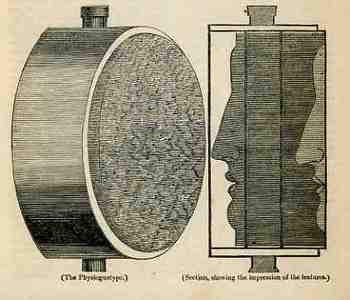
    Blogphysiog320 In the “Spirit of Discovery” section of the British weekly magazine The Mirrour of Literature, Amusement, and Instruction for 22 October 1836 is a short notice on the “physiognotype”, “a machine for taking casts, lately invented by a gentleman in Paris” [The patent application for this device seems to be the work of Richard Rettford, UK patent # 6732, 1834.] We’re accustomed to these devices now as they’ve been for sale in toy shops for decades—but in 1836 it was a real breakthrough for making instantaneous three-dimensional models of small things.  In 1836 there really wasn’t any simple way of producing a direct, proportional model like this in 3-D except for encasing it in plaster and then casting from that mold.  Two-dimensional modeling was easier, and there were numerous devices constructed for this purpose as people pursued the still-hot rage of physiognomic forecasting, with simpler means (like shadow portraits) being hundreds of years earlier.  (Photography remember is still three years away from being announced and another few years from being sort of accessible to middle-class folks.) 

    This device was simple and cool, and it worked.  It was basically a board with a mesh of tiny holes drilled into it through which were placed knitting needles (it looks as though it was 12” around or so and four inches deep), bound in wood, with the enclosure encased by a bladder of warm water (“to ensure that the needles moved with the greatest facility”)—this last bit was really a good idea.  You were left with a “brush of needles”, very densely packed, and very easily disturbed.  The author writes that the process took about two seconds, didn’t hurt at all, and caused “a sensation that cannot well be described”.  (Though he did state that if the instrument wasn’t warmed by the water the process would’ve felt like putting your face in the snow…does that mean it felt like putting your face in warm snow?) 

    I’ve tried, briefly, to see where this invention went, but it seems not to have advanced far beyond the reach of quack medical practioners and magicians.  It seems as though something like this could’ve been useful in the machine shop for modeling (replacement) parts without having to take the machine itself apart to do it.  I guess that it could’ve been used by haberdashers, cobblers, and all sorts of other craftspeople and small manufacturers, but it seems as though it actually wasn’t.  It looks like a dandy piece of thinking, to me. 

    ·Posted by :

    ·in:

  • A 10,000-Ton Aircraft from the Future of 1934

    JF Ptak Science Books  Quick Post

    Science and Mechanics 1934 ocean liner big file

    Science and Mechanics 1934 ocean liner big file

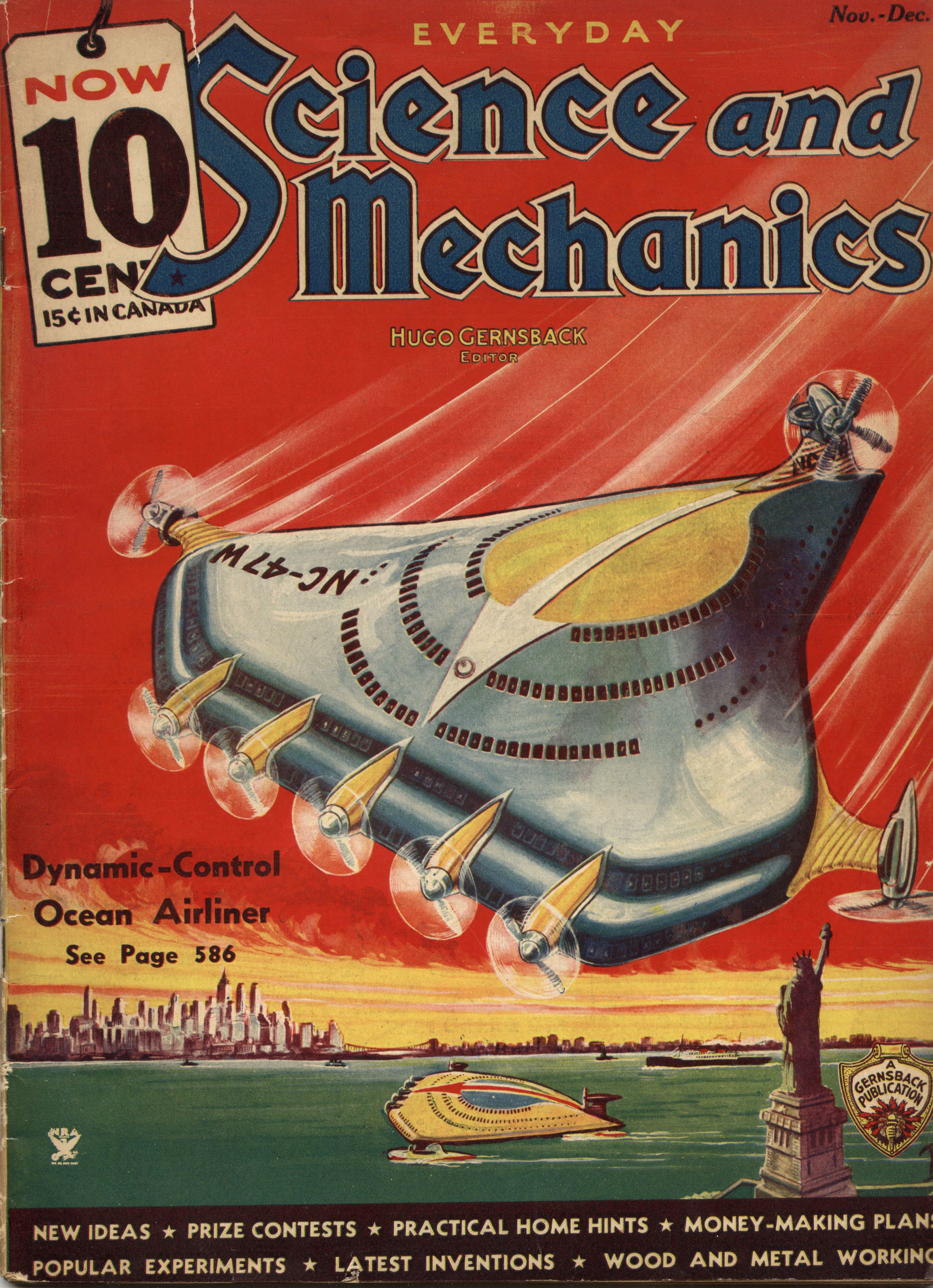
    Hugo Gernsback–(1884-1967)  the very busily creative pioneer in science fiction, author, and editor of some of the finest sci fi, pre-sci fi, and pop science journals from the ‘teens into the 1940’s—though big and very heavy in this consideration of a future flier. The aircraft seems to be enormous, though about the only spec given here is that it would weight 10,000 tons, and that it would probably appear by 1952, if not sooner.

    That’s a lot of tons to be thinking about being airborne, back there in 1934. To put things in perspective the Boeing 747 weighs in at 370 tons (give or take), which nattily works out that it would take 370 747s to equal the weight of the monster Gernsback was thinking about.

    This bit of speculation is found in the page of Everyday Science and Mechanics (Nov/Dec issue for 1934), with Gernsback reasoning for such a spectacular aircraft being based on a logical progression of heavier-than-air aircraft sizes:

    “The tendency at the present time in airplane building is toward constantly increasing size. It is probably realized by all who have concerned themselves with aircraft that the larger machines are not very far in the future. From the earliest Wright airplane, which weighed approximately 1/2 ton, to the present record holder, the DOX, which weighed fifty tons, took a period of some 26 years. The 10,000 ton airplane, projected on a like time-scale, would, therefore, make its appearance not later than the year 1952. However, with the nature of the present-day technique, it is quite possible, at this moment, that the 10,000 ton plane will be here much sooner.”

    Or not.

    That brings us to the other bit of specification mentioned in the article—the tail propeller on this aircraft was 75′, so, using that as a measuring device the plane was about 600’x 600′ and about 150′ tall. The aircraft’s mission was basically like that of an ocean liner, though flying. I guess stripped down it would have made an excellent troop transport, being capable of flying in, what, a vast amount of materiel as well as probably 2-3,000 troops.

    This aircraft still classifies as a mega-behemoth, and there hasn’t been anything in the air (as a heavier-than-air aircraft) that comes anywhere close to this.


  • A Canonical Conical Hill (1856)

    JF Ptak Science Books  Quick Post

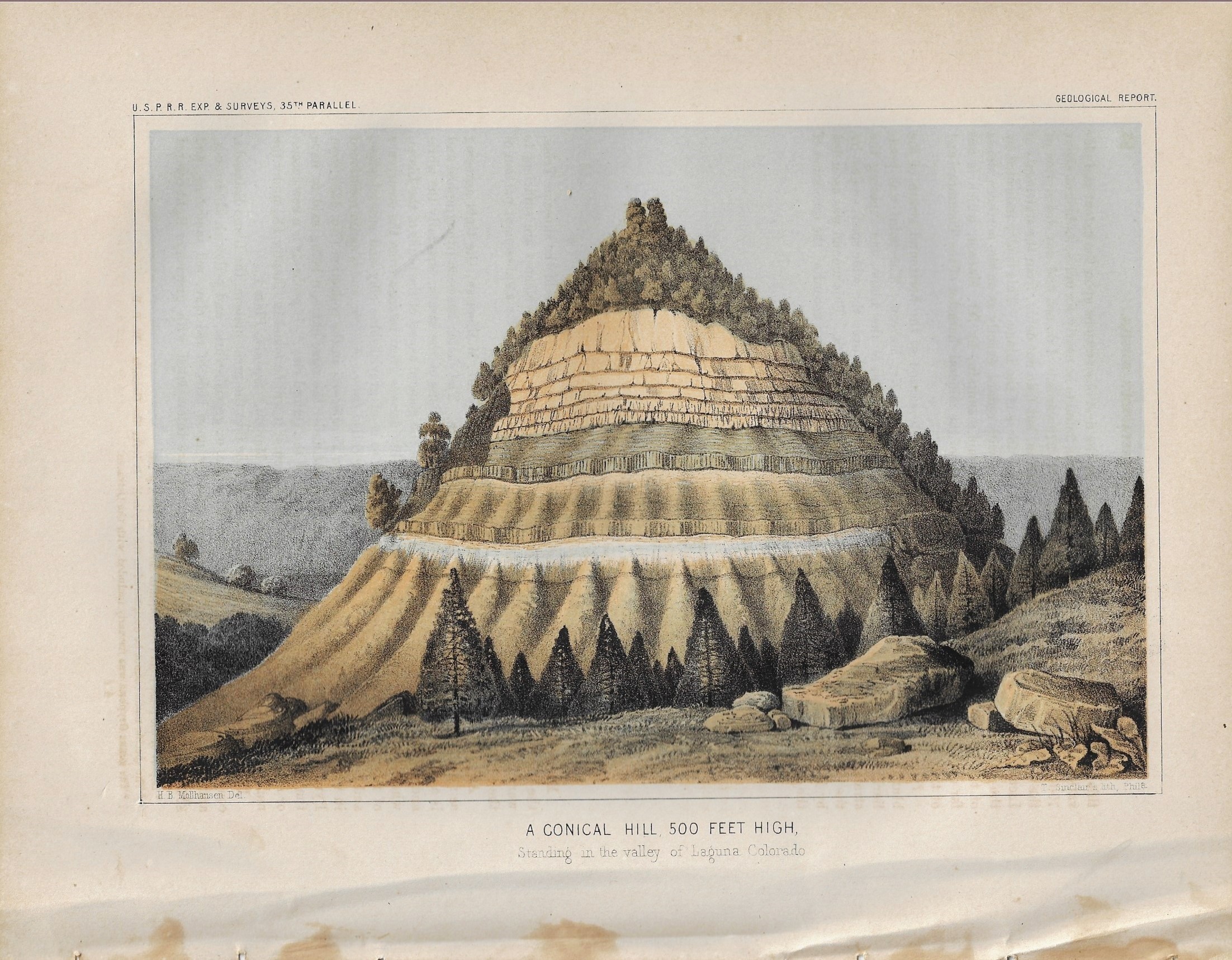
    Well, this isn’t technically “canonical”, but it was close to the word “conical” that is in the title to this image, so I went with it. In any event what we are seeing here is  classic exemplar of a large hill with exposed strata. The image appears in the Reports of Explorations and Surveys…to ascertain…the Route for a Railroad from the Mississippi River to the Pacific Ocean, a massive 13-volume work that is more commonly referred to as the USPRR. The chromolithograph appears in volume III of the work, and was published in 1856.  The accompanying text explains the image.

    USPRR Conical Hill

  • A Great Road Locomotive (1873)

    JF Ptak Science Books  Quick Post

    JFI 1873 road locomotive _1_

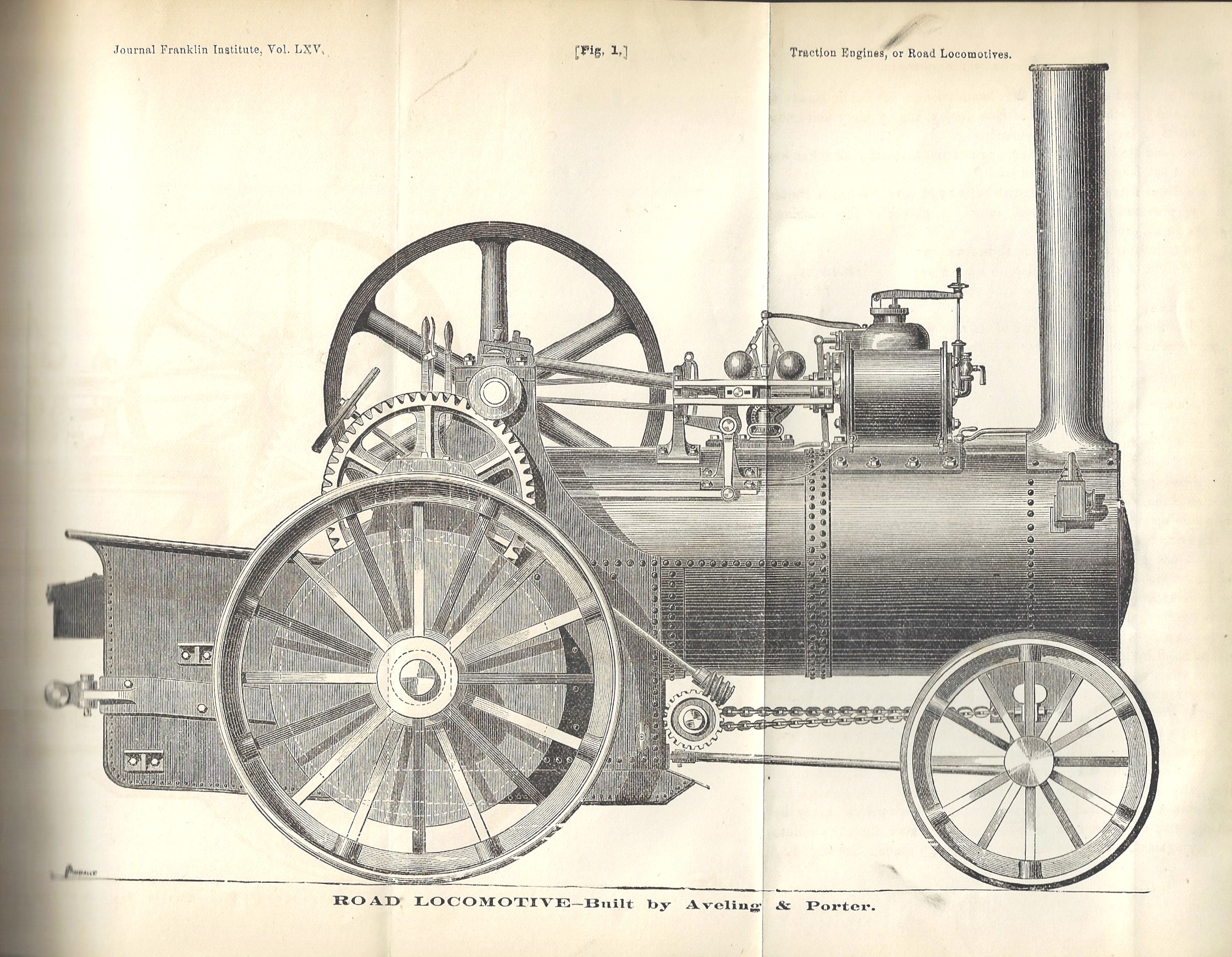
    I found this fine illustration in an 1873 volume of the Journal of the Franklin Institute, a “road locomotive”, the first one produced by the firm Aveling & Porter, who, we are told, “had previously done no real work”. This certainly looks like real work to me.  The specifications found in the article paint an even larger picture than the picture of the machine does it credit. The boiler, for example, is 8′ long, meaning that the machine overall is about 11′ long; the boiler’s diameter is 30″, which makes the vehicle about 10′ tall. The big wheel is big: 60″ in diameter (supporting a 10′ height) and very heavy, weighing 450 pounds.  The overall weight on this beast is 11,648 lbs.

    Source: Thurston, R.H. “Traction Engines or Road Locomotives. The Past, the Present and the Future of Steam on the Common Road”.  Journal of the Franklin Institute, volume 95, 1873, pp 17-43.  

    ·Posted by :

    ·in:

  • Louis Turner’s Classic History and Bibliography on Nuclear Fission, 1940

    JF Ptak Science Books

    I’ve found this article by physicist Louis A. Turner to be very helpful over the years.  He was an I-was-there guy (and actually an I-am-here guy) who wrote a stuccato article on the history of nuclear fission which was top heavy in references, and did so in 1940, just before the clamp came down on publication on the topic.  Certainly there are other more modern efforts in this area that are far more detailed, but few have managed to do so good a job in as limited space as Turner. 

    Louis Turner. “Nuclear Fission.”  Lancaster:  American Physical Society,  1940. An article in the  Reviews of Modern Physics, vol 12/1, January 1940, pp 1-30  of an issue of 85pp   Original orange wrappers.  Fine condition.  (The issue also contains articles by Seaborg and Zwicky.)His references list is quite useful:

    • E. Fermi, Nature 133, 898 1934.
    • E. Amaldi, O. D’Agostino, F. Rassetti and E. Segrè, Proc. Roy. Soc. A146, 483 1934.
    • I. Noddack, Zeits. f. angew. Chimie. 37, 653 1934.
    • O. D’Agostino and E. Segrè, Gaz. Chim. Ital. 65, 1088 1935.
    • I. Curie, H. von Halban and P. Preiswerk, J. de phys. [7] 6, 361 1935; C.R. 200, 1841 1935; 200, 2079 1935.
    • A. von Grosse and M. S. Agruss, J. Am. Chem. Soc. 57, 438 1935.
    • O. Hahn and L. Meitner, Naturwiss. 23, 320 1935 [CAS].
    • O. Hahn and L. Meitner, Naturwiss. 23, 37, and 230 1935.

    ·Posted by :

    ·in:

Recent Posts

Archives

Categories