JF Ptak Science Books Quick Post
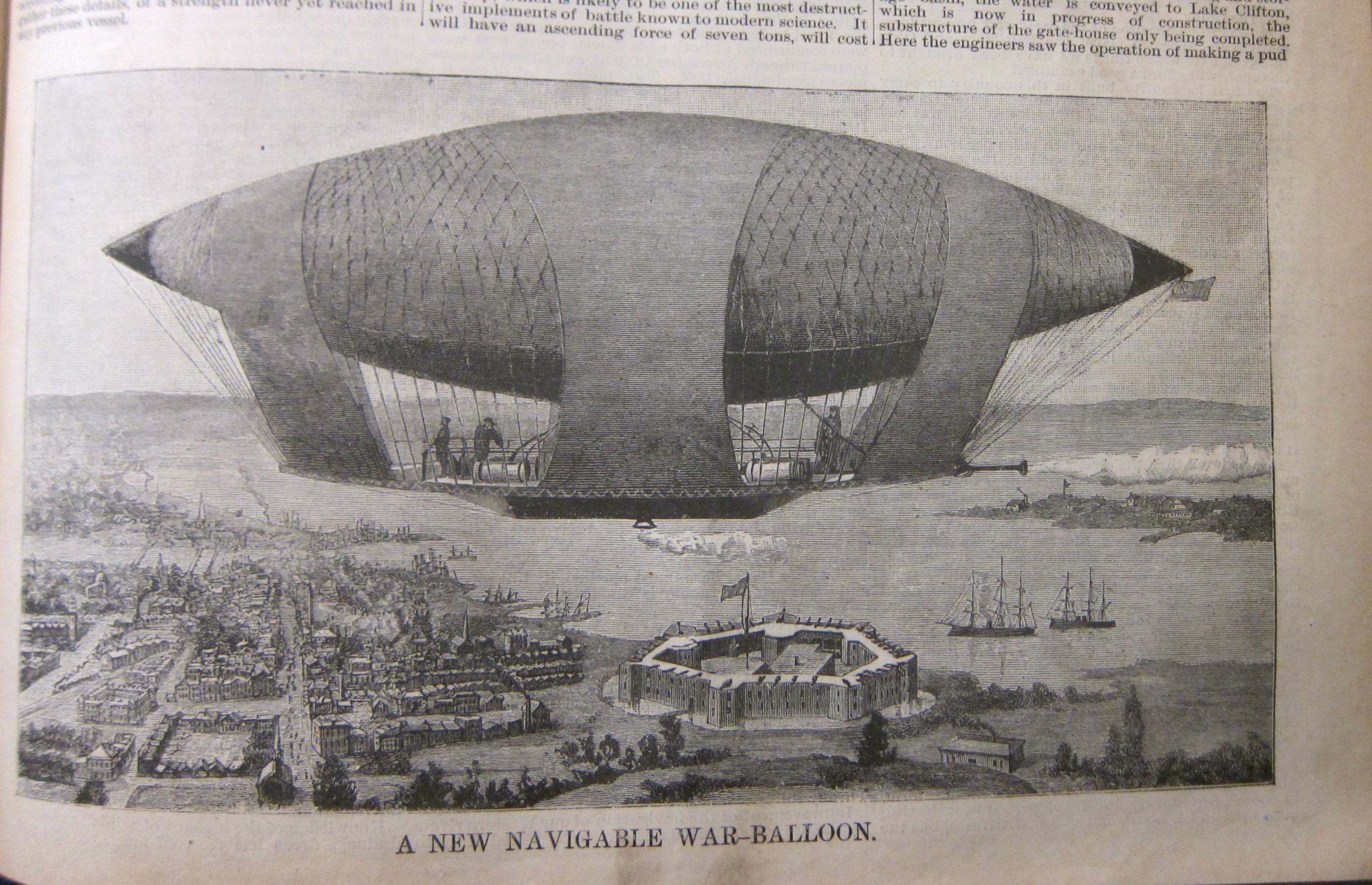
Here’s a rather Jules Verne-y concept for a military balloon, presented to by General Russell Thayer, and published in the Scientific American Supplement in 1885. In this iteration the aircraft is labeled a “war-balloon” but looks benign and observational; in the second image, see a month later in Harper’s Weekly, the balloon is definitely a war machine, having just bombed something with what looks like an enormous explosive. The scene here illustrates an airship in flight over a very industrialized section of a city, perhaps to drive home a propaganda point that bombing was accurate enough to be strategic and also that targets were industries and not general populations.
(The first aerial bombing seems to have been during the first Italian War of Independence and used by the Austrians from a balloon against Venice in 1849; while this 1916 bombing occurred a few years after the first bomb was dropped from a heavier-than-air aircraft during the Italo-Turkish War on 1 November 1911, the Italians this time delivering the blow in Tripoli.)
The idea of aerial bombardment was an enormous threat, imagining death coming from above, huge airships dropping untold numbers of bombs upon a city–I imagine that the idea came as much a blow to someone at the end of the 19th c as the threat of nuclear devastation came to those in the mid-20th c. As a matter of fact S.L. Koter and J.E. Gessler quote an unnamed “distinguished officer in the U.S. Navy” implying much the same thinking as would be later heard as nuclear-weapons-inspired Mutually Assured Destruction (MAD): “War will become impossible because it will signify not merely great loss of life and property, but annihilation”. (Ballooning, a History; 1782-1900, p. 268.)
It is particularly interesting to note here that Thayer, proposes to use a propulsion system that is not dependent on a propeller but rather “compressed air”. “In the independent balloon the motor is a high pressure air compressor coupled directly to a newly devised carbonic acid gas engine and a reservoir for storing the air until sufficient pressure is obtained. The construction of the dependent balloon is similar to that of the independent ship except as regards the motive power which is here electricity…”