JF Ptak Science Books Post 620 Blog Bookstore
According to negative theology, ‘there is not found in God anything other
than infinity.’ (Cusa, De Docta Ignorantia, vol. I, § 26)
“With respect to the intellectus, reason (ratio) is at the horizon…but with respect to the
sense, reason is at the zenith, things that are within time and things that are beyond timecoincide in reason.”(Cusa, De DoctaIgnorantia, vol. III, ch. 6, § 216
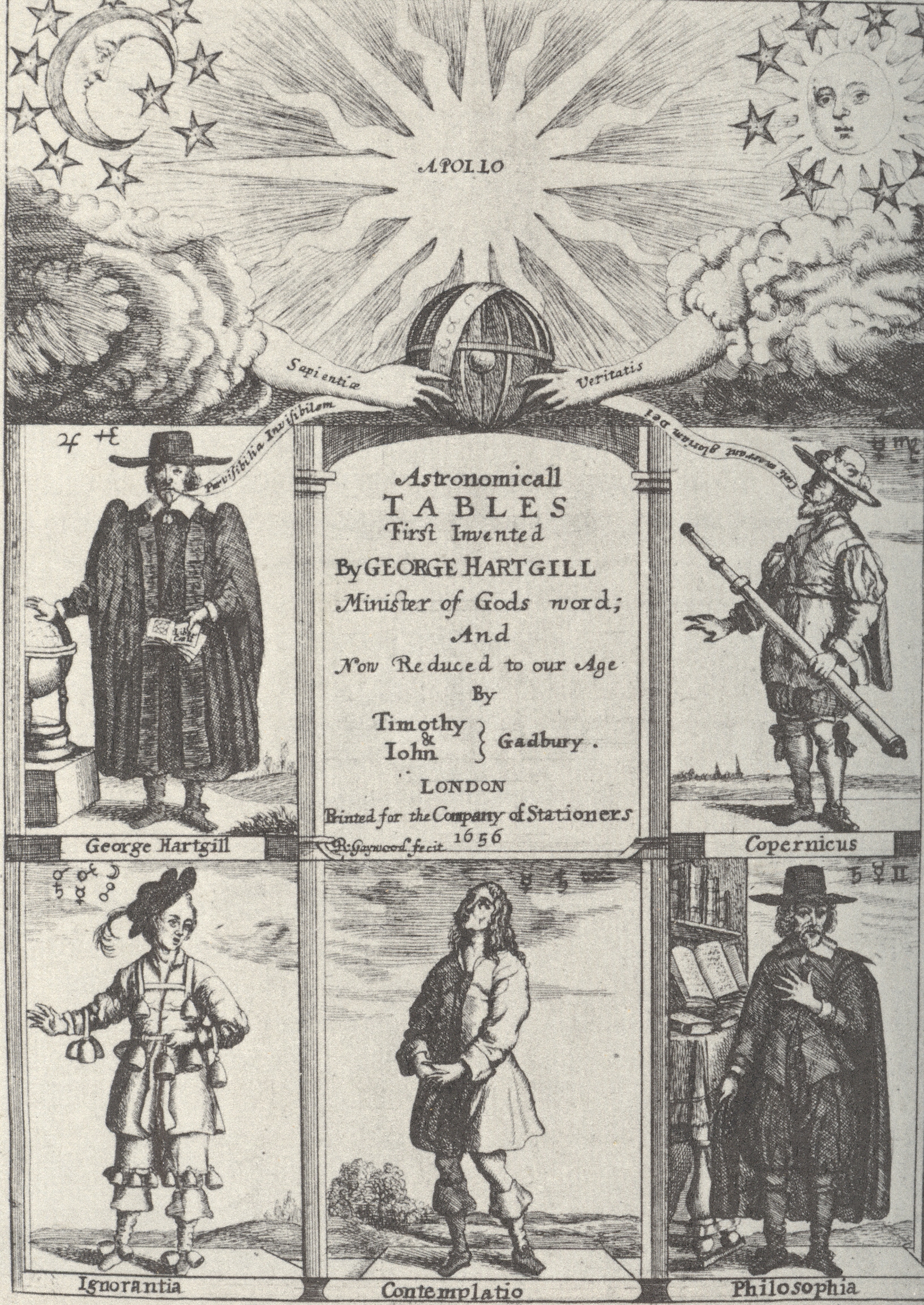 In my imaginary Encyclopedia of Interesting Title Pages, the Astronomical Tables shewing the Declinations….* by George Hartgill** is very much middle fare, very interesting but not overly so (I say sniffily), but very much worthy of attention. The initial bit that caught my attention was small and sort of trifling: it seemed that the writer possessed the temerity to place his own portrait on the title page across from that of Copernicus. As it turns out, the selection was obvious and logical, though I wouldn’t know that until I pieced together the symbolisms of the page. Aside from that, there was a fair amount of action on the title page, and for all of that it retained a certain spareness, a lightness in spite of itself.
The title page is an elegant call to synthesis of science, philosophy and religion in the understanding of astronomy. To start: at the top-center is the burning sun, “Apollo”, the great and perhaps most important of all the Olympians, the god of sun and light (among other things). The arms of the heavens (signified by the arms reaching out from the Moon and Sun) embracing a globe of the earth within an armillary sphere. The arms carry the legends of “spientiae” (“wisdom”) and “veritatis (“truth’). Surrounding the title proper are five figures, the upper two being Hartgill and Copernicus. The word balloon coming from Hartgill’s mouth says “per vidibilia invisibilem” or “ the visible and the inivisible”, and touches the hand of wisdom; Copernicus’ balloon I can only partially read, but it seems to end “gloria dei” (to the glory of god), and ends under the arm of truth. In turn these two figures rest on three others: Ignorantia, Contemplatio and Philosophia.
Ignorantia here is depicted by an entertainer decked out in bells. He isn’t necessarily “ignorant” per se: the “ignorance” comes in multiple forms: one is of the intelligent and educated person knowing the things that weren’t yet known; another in terms of a belligerent ignorance, insisting on the known and the comfortable in the face of compelling new evidence stating otherwise; and also of simple ignorance of not knowing and not caring. Contemplatio and Philosophia pretty much speak for themselves. The three of them seems to support the advanced “ignorance” of Hartgill and the mathematical/philosophical Copernicus, all of which are illuminated by the wisdom and truth of the source of all light. Its simply a wonderful, well-designed title page.
*Astronomical tables shewing the declinations, right ascentions, and aspects of three hundred sixty five of the most principall fixed stars and the number of them in their constellations after Aratus : as also the true oblique ascentions and descentions of all the said stars upon the cusps of every of the twelve houses of heaven according to their latitude….1656.
**Granger’s Biographical History of England (1824), says of Hartgill: (he was)…”chaplain to the Marquis of Winchester, was a painful preacher, a reverend divine, and a most excellent mathematician, as appears by his ” Astronomical Tables;” which, according to the judgment of the best astronomers, could not have cost him Jess than seven years’ labour, considering the perfection of the work.”