JF Ptak Science Books LLC Post 627 Blog Bookstore
While finishing yesterday’s post on the occasional
nothingnesses of details in Renaissance painting and using one of the painting
by Vittore Carpaccio to make my point, I stumbled upon another image by this
Renaissance master that was almost all detail,
and of great somethingness. 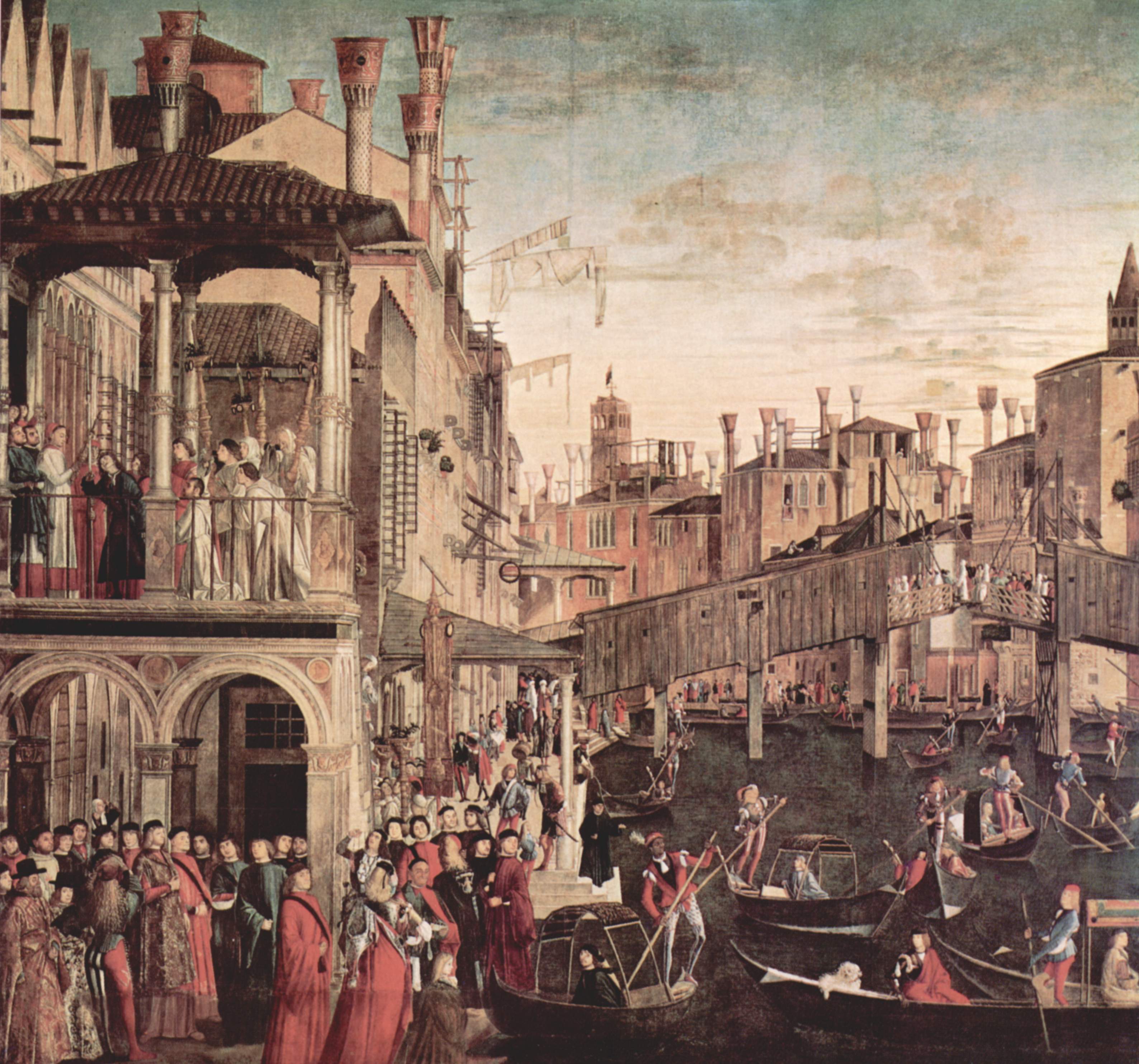 The painting
is Il miracolo della reliquia
della Santa Croce (“The Healing of a Madman”, painted in 1494), which is a
large, extraordinary and detail-filled canvas of a street scene in
Qerini, the Patriarch of Grado (which was the old name for the Patriarch of
Venice, one of the four Sees, with patriarchs reaching back to the 6th
century), who was healing a mad/possessed man of whatever aliments finding
safety in him, and evidently accomplishing the task with a tiny piece of the original
cross of Jesus, given to Qerini ‘s patriarchy in the 14th
century.
The miracle itself takes up only a very small portion of the painting—you
can find it in the upper left, in a spacious loggia, the “madman” (I think)
crooking his head to look up at the outstretched crucifix; a quiet, almost
secondary acquiescence to all of that other energy in the painting. Even though not the intentional subject of
the painting, it is the wooden Rialto Bridge
stage, though I guess one could say that the key area of interest was the city
of Venice
itself. Or the throngs of its citizens
enjoying the airy passage through the city.
The focal point does seem to be the bridge, which had the capacity to
open for taller ships, and was a focal point of transfer for the
community.
There is some reason for this outside of the artistic sense—the paining was
one of nine commissioned by the Confraternity of the Scuola Grande di San
Giovanni Evangelista, which was a major concern in Venice.
was meant to be as much a part of the appeal of the painting as was the miracle
that called for the attention in the first place.
This was a very crowded scene, the foreground and background material and
subjects as important as the subject itself; it was a greatly democratized work
calling as much attention to the city of Venice as the miracle being worked
within it—and it still remains a calm and quiet vision Perhaps it is the steadfast of the objects
above the street, like the pot-like chimneys (at least 26 showing) and the
clothes-drying poles with their flag-like fare that contribute to the quietness
above the bustling city street. Experts
say that this is a superb rendering of the cityscape, with accurate coloring, a
beautiful documentary of life in Venice
just at the end of the 16th century.
In addition to the cityscape we see all manner of small life in the many
people in the painting: passengers in
the gondola are carrying pets (at least one dog and a bird), the stores at the
foot of the bridge, an open air market (with sellers lined up with small
tables), plus all manner of styles in dress.
It is a wonderful example of the opposite of yesterday’s post: something where all of its comparative “nothings”
were the most important part of the unit.