JF Ptak Science Books Post 1090
The esteemed Michael Bernhard Valentini (1657 – 1729), professor of medicine and of physics at Giessen, Germany and natural history collector, produced one of the century’s most important works on the state of museums and natural history collections. Actually, his Museum Museorum1 was much more than that, its three volumes presenting more descriptions and illustrations of all manner of scientific things than just about anything else of the pre-encyclopedist 17th century. There are many “firsts” to be found in this work, including numerous first-time description of fossils, tropical plants, American botanical specimens, techno items, shells, and on and on, not to mention sections on monsters, dragons and mythical creatures.
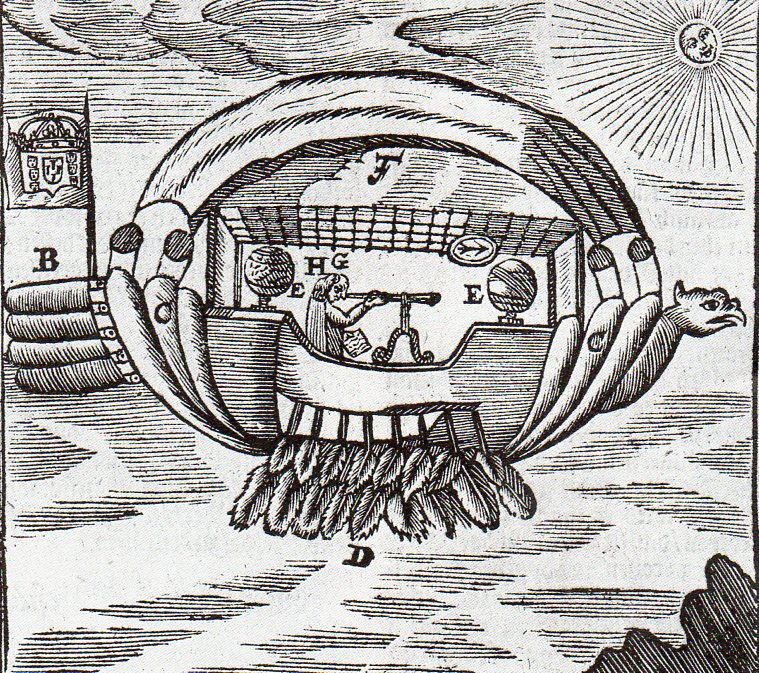
One image that caught my attention appears in volume two, and seems to me to be a flying machine, though I can’t recover how it is being kept aloft, or what is providing its power. The pilot is keeping a sharp eye on things with a telescope, and is reckoning position with a compass2 and two globes. The canopy of the aircraft seems to be just that, some sort of cloth held in place by pulleys and ropes, though I don;’t know what is providing lift, if anything. Perhaps the whole thing finds its lift and propulsion with the many feathers on the craft’s keel. I’m not sure. But I can say that I don’t recall any other earlier image of a pilot using a telescope and compass.
Valentini also assembled an enormous natural history collection of his own, and in addition to his spectacular collection of the state of scientific and technical knowledge at the begininng of the 18th century, he also included in his book a list of 100+ museums/collections of natural history objects–an extraordinary document for the time and unfortunately one that can’t be reproduced here.