JF Ptak Science Books Post 1107
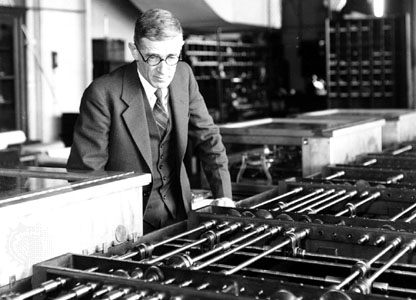 I’ve written a number of times about Vannevar Bush in this blog. He was a brilliant, practical, deep-sighted Yankee of an old school, capable of selecting the correct course of action and getting to it, his quiet resolve apparent to everyone. He also had a large part in the winning of WWII, being in charge of scientific and technical development for military and war-related affairs, deciding how to spend time and effort and money for the best possible result to win the war (That would be the OSRD, the Office of Scientific Research and Development, which he headed, and created–actually he outlined the whole thing on one sheet of paper and had the mammoth idea approved by President Roosevelt in a quick 10-minute session in 1942.)
He had a brilliance to him in choosing the important stuff that was necessary and the important stuff that could wait. For example, he told Norbert Wiener that the war needed to be won before investing in the challenge to develop the digital computer–it just wouldn’t be developed quickly enough, he felt, to do the jobs necessary to substantiate its time and effort before war was won.
He also could say “no” to Einstein, a man who he admired and respected, but also a man who he thought he could not trust with the development and construction of the atomic bomb. As much as he wanted to share the project with Einstein, he couldn’t, and wouldn’t, and didn’t. And he had a point.
He stood on tall ground in regards to Oppenheimer when the witches went to gather Oppenheimer’s soul. At a time when major forces decided that Oppenheimer must go, that he should be excluded from Q clearance and from being involved with the development of the thermonuclear bomb–and that he must go because he was seen as a security risk because of a series of minor incidents (like light associations with the Communist Party in the 1930’s), Bush would have none of it. Mostly, Oppenheimer represented a threat to political desires for the development of new weapons, not so much, really, as a possible Soviet agent. Bush supported Oppenheimer, and questioned the entire legitimacy of the hearings themselves.
“Here is a man who is being pilloried because he had strong opinions, and had the temerity to express them”, Bush said, ending his testimony with this forceful statement:
“I think this board or no board should ever sit on a question in this country of whether a man should serve his country or not because he expressed strong opinions. If you want to try that case, try me…”
Many of course stood by Oppenheimer; Bush’s support seems to me to be among the strongest. Perhaps even more pissed than Bush was I.I. Rabi, who in disgust of the proceedings said: “”He is a consultant, and if you don’t want to consult the guy, you don’t consult him period…We have an A-bomb…and what more do you want, mermaids?”
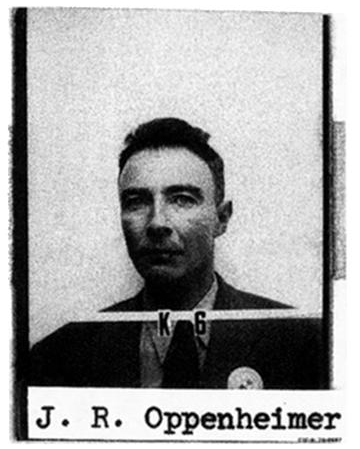
There was also John Lonsdale, chief of security for the Manhattan Project and who investigated Oppenheimer thoroughly, as he said during the hearings: “We kept him under surveillance whenever he left the project. We opened his mail. We did all sorts of nasty things”. Lonsdale firmly believed in Oppenheimer, thought him innocent in this ‘non-trial”, and defended the man throughout the rest of his long life (dying at age 95 in 2003).
Others of high importance questioned Oppenheimer’s integrity, patriotism and trustworthiness: