JF Ptak Science Books Post 1736 [History of Holes series.]
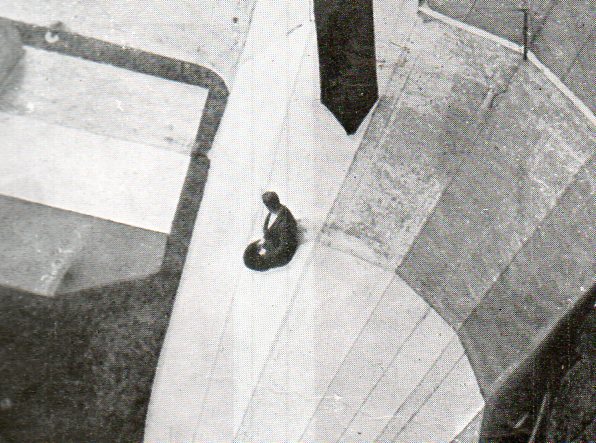
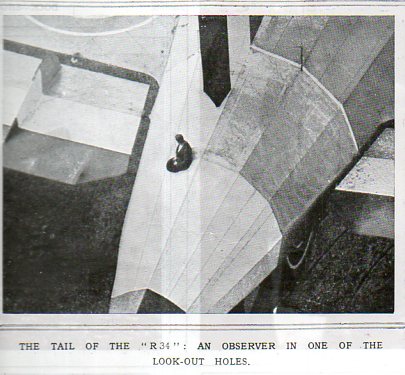
Holes are of course everywhere–it just depends on how hard you look. This image, though, struck me very quickly as an unexpected hole (though of course once you allow yourself a moment to think about ti the whole thing makes sense). It is a very plain “observer’s perch” in the tail of the great British airship, the “R 34”, and appeared in the Illustrated London News in April, 1919, just before its first flight. The aircraft was massive–643 feet long1–and on one superficial level its hard to imagine holes in its structure of any sort, let alone an unprotected observation post. But there it is.
And this
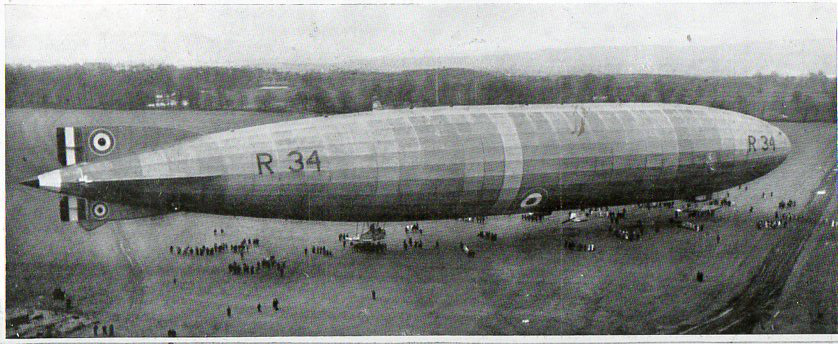
Here’s a full view of the “R34”, successor to the “R33”:
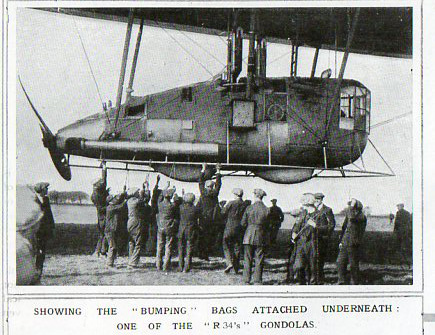
This is an image of the (forward?) gondola of the airship, looking like it has come in for a landing, or touchdown, or whatever–there is something so very primal about this relatively small group of men reaching up for the railing on the gondola…a railing placed there specifically for that reason. Its hard to imagine that such a seemingly small effort would be enough to control any part of the airship’s motion, though perhaps it was.
 And the detail, showing the man in the middle clearly off the ground–clearly he must be weighing his options:
 At least he seems to be wearing one glove, anyway
Then there’s the image of the “bad” hole, the iconic image (photographic and motion picture) of the conflagration and crash of the Hindenburg, a result of a very quickly-spreading “hole” in the skin of the aircraft as it was coming in for a landing/mooring in Lakehurst, New Jersey, 1937.
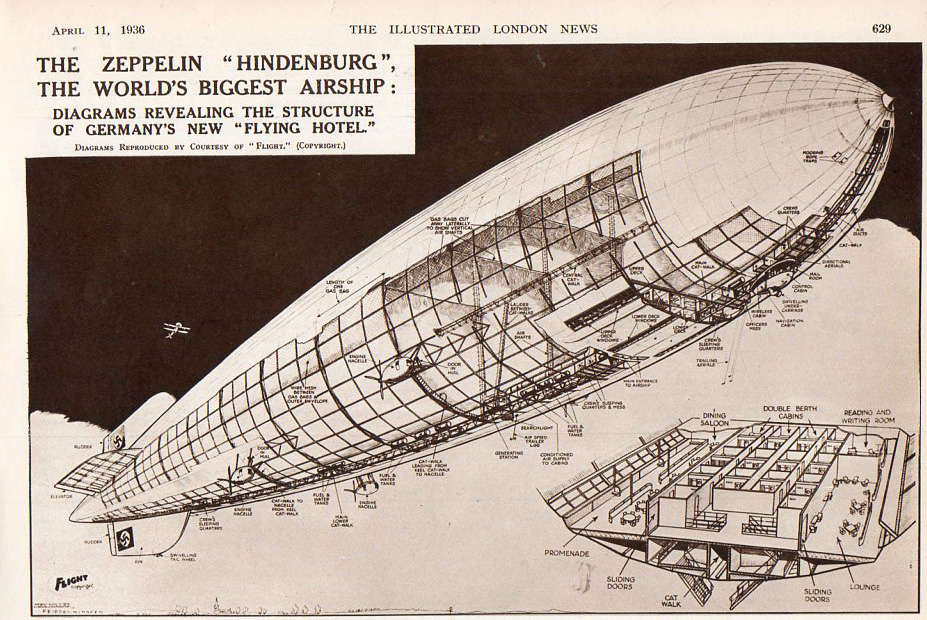
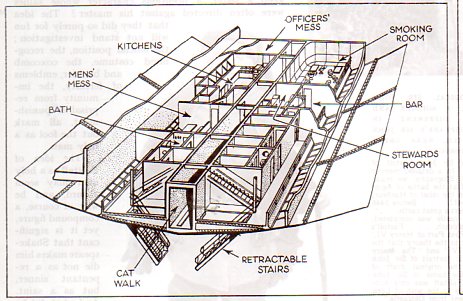
Here’s a cross-section of the Hindenburg as it appeared in the Illustrated London News in 1936:
Notes:
Specs on the “R34”:
- Length: 643 ft 0 in (196 m)
- Diameter: 79 ft 0 in (24 m)
- Volume: 1,950,000 ft3 (55,000 m3)
- Useful lift: 58,240 lb (26,470 kg)
- Powerplant: 5 × Sunbeam Maori, 275 hp (205 kW) each
The Hindenburg was quite a bit larger than the R34–in fact, it was the largest thing ever to fly, at 803 feet long and 135 feet in diameter…and 200,000 m3, almost 200% larger than the mammoth R34.