JF Ptak Science Books Post 2002 
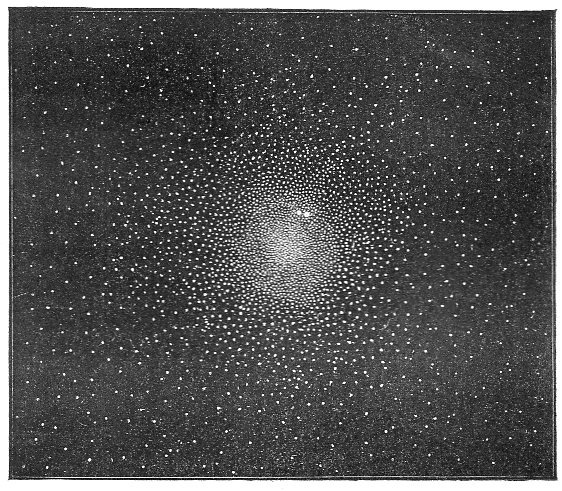
This beautiful engraving appeared in Amedee Guillemin’s Le Ciel: notions d’astronomie a l’usage des
gens du monde et de la jeunesse, which was published
by Librairie de L. Hachette and Company, and printed in 1865 (the
images from which are available here). There are many striking images in this book, and I’ve chosen this one because it has a certain deep depth to it, and relays a complexity and distinctness to something that is generally imaged as being less so, being a massive star cluster and all. The “Amas du Toucan”, known now more familiarly as 47 Toucanae or 47 Tuc (NGC 104), is a bright element in the southern sky, a huge clsuter 120 light years wide and 16,700 light years from Earth, visible to the naked eye in the constellation Toucan (created by Petrus Plancius in 1598 or so). And here it is, in a little 9×8 cm engraving with hundreds of white points as stars, made after an engraving of Sir William Herschel (1738-1822, a German-born Engloish astronomer who–with his sister Caroline and brother John–spent decades observing and recroding stars, double stars, clusters and nebulae).
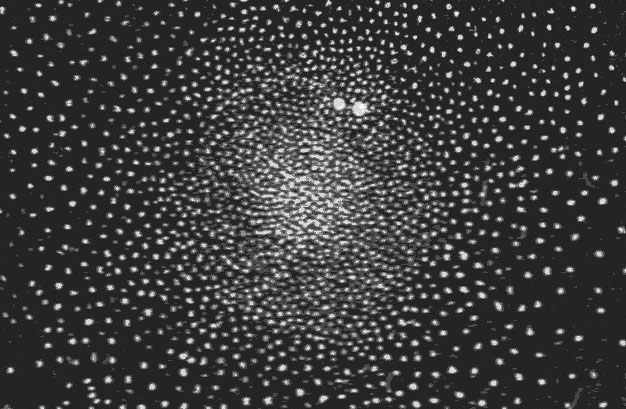
47 Tuc was first catalogued as not-a-star by Abbe Nicolas Louis de Lacaille (1713-1762), a French astronomer who found it too be too fuzzy to be a single star, and who produced a 10,000 (Southern) star catalog, Coelum Australe Stelliferum, which was published in 1762, and which also introduced 14 new constellations. 47 Tuc made another quck appearance in the great Catalogue des Nébuleuses et des Amas d’Étoiles (“Catalogue of Nebulae and Star Clusters”), a superb and meticulous work by Charles Messier, and published in 1771.
The Guillemin work is simply a lovely and elegant thing–one of many accomplishments in a beautiful and relatively simple book.