JF Ptak Science Books (This is a null post, carried over from the bookstore section of this blog–I’m sharing it in the bookseller format to simply share the info on this fascinating machine.)
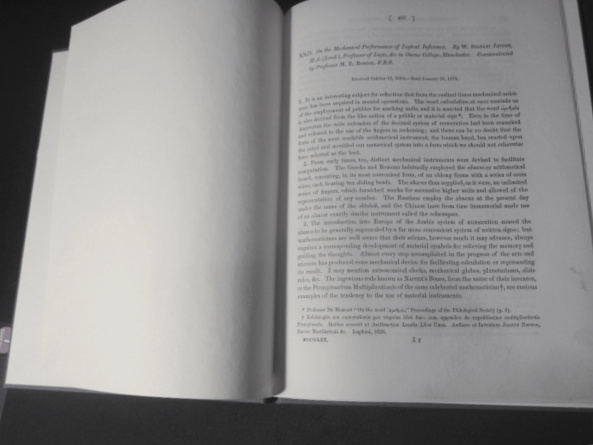 W. Stanley Jevons, On the Mechanical Performance of Logical Inference, in Philosophical Transactions of the Royal Society, 1870, pp 497–518. This is an extract from the volume, containing the entire article, plus its three engraved plates showing the works and interior of the machine. This is very tastefully bound in paper covered boards with a paper spine label. This is the first description of the one the preeminent.
Jevons was a polymath and one of my favorite thinkers of the 19th century. He worked across many fields but seems to be remembered today mostly and unfortunately for his theory of the relationship between sunspots and economics cycles. He is not so well known as the inventor of one of the earliest pre-modern computers and particularly for it being the fastest machine of its kind ever invented.
“In 1870 a British scholar, W.S. Jevons, built the first computer designed to solve logical problems. Inspired by Boole and Babbage, Jevons built a mechanical device implementing automated deduction…”–Paul Amblard, “A Finite State Description of the Earliest Logical Computer: The Jevons’ Machine”, in the Springer International Series in Engineering and Computer Science book series (SECS, volume 434)
“The creation of analog computing devices is both relevant and significant to the development of modern computers, but was there no early pure mechanical digital apparatus, given the advent of Boolean logic and Venn diagrams in the 19th century? One individual in particular began a small, but significant movement that transformed digital theory into mechanical devices that, while lacking the sophistication and power of later electronic digital computers, did, nevertheless, function in a digital mode. The person responsible was the Englishman W. Stanley Jevons (1836–1882).”–George Buck and Stephen Hunka, “W. Stanley Jevons, Allan Marquand, and the Origins of Digital Computing” in IEEE Annals of the History of Computing, Vol. 21, No. 4, 1999.