A Daily History of Holes, Dots, Lines, Science, History, Math, Physics, Art, the Unintentional Absurd, Architecture, Maps, Data Visualization, Blank and Missing Things, and so on. |1.6 million words, 7500 images, 4.9 million hits| Press & appearances in The Times, Le Figaro, Mensa, The Economist, The Guardian, Discovery News, Slate, Le Monde, Sci American Blogs, Le Pont, and many other places… 5000+ total posts since 2008.

  • Heavy (Underground) Metal, 1910

    JF Ptak Science Books  Quick Post

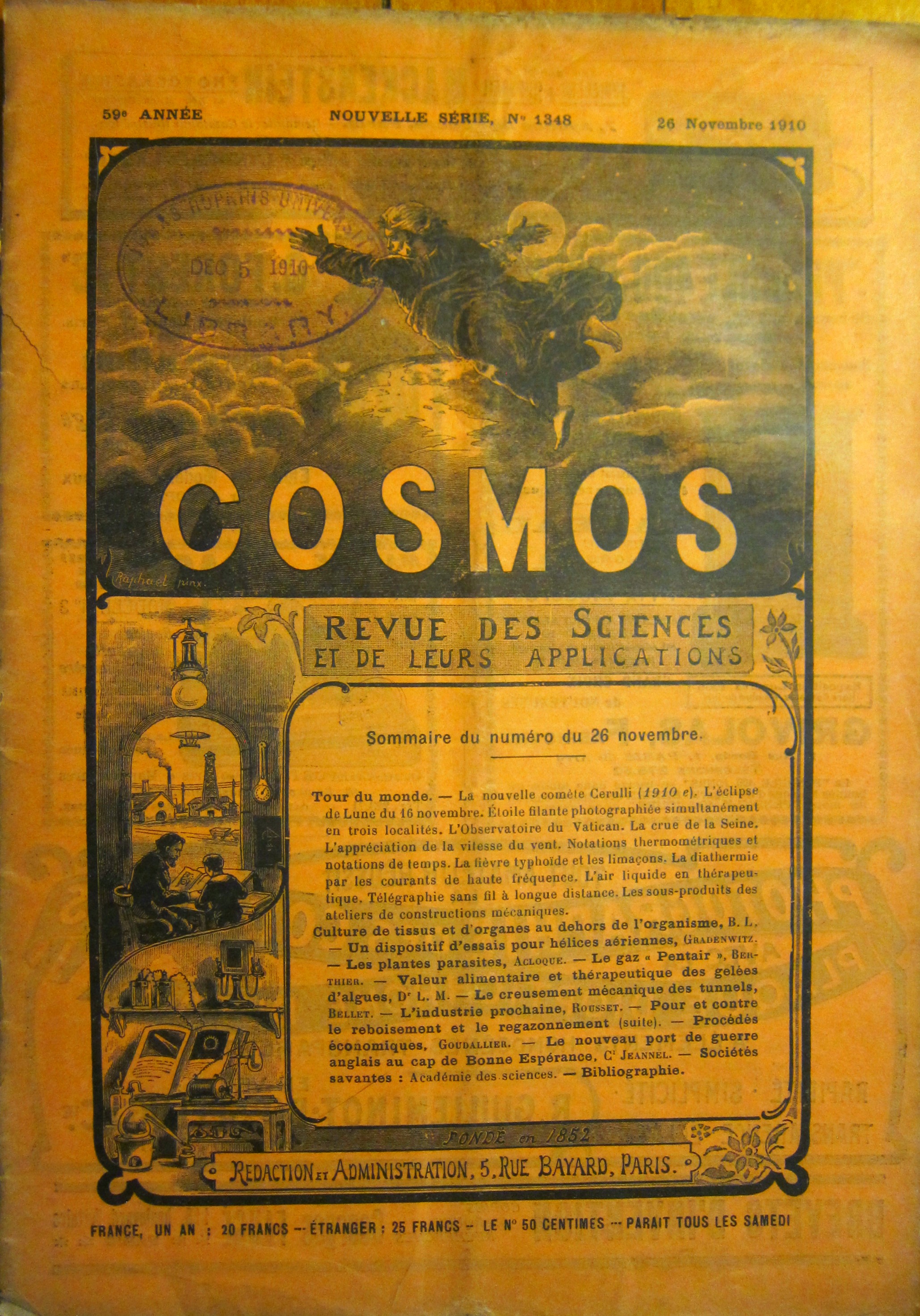
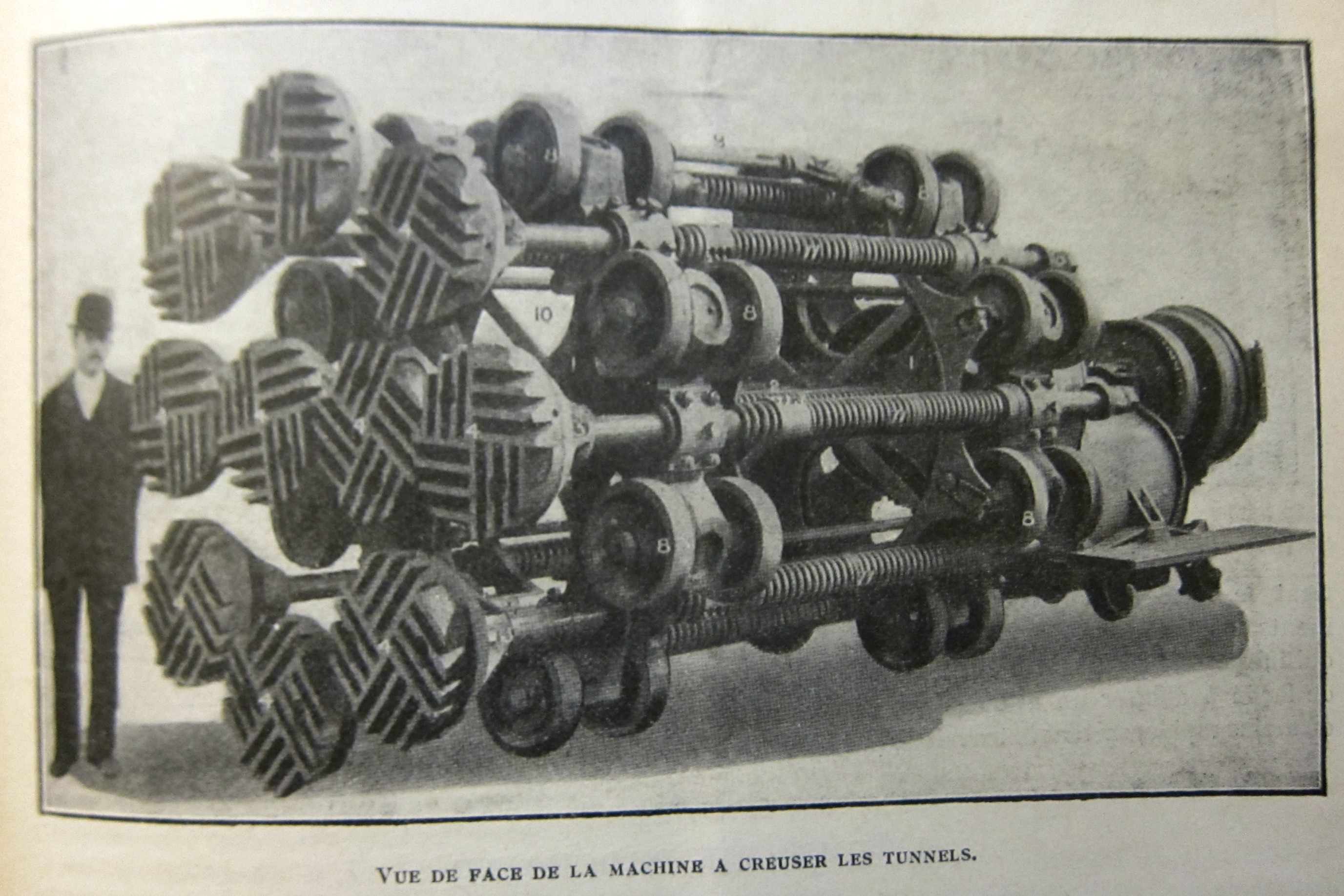
    This is a beast, and the beast was a tunnel digger. This image is from the article “Le Creusement Mechanique des Tunnels” and is captioned “Vue de face de la machine creuser les tunnels”, with “creuser” meaning to dig, and the entire thing meaning, simply, “front of the tunnel digger”, though it sounds much better in French. It appears in Cosmos, Revue des Science et de Leurs Applications, which was published in the weekly issue for 26 November 1910.  This is the only science journal/magazine with a cover illustration featuring the Creator of the Universe.  

    What a wonderful thing this machine was, though right after I think of how many backs of laborers it saved, I am moved immediately to what an engineer would do if the machine got stuck.

    Cosmos November 1910 _2_

    Cosmos November 1910

    ·Posted by :

    ·in:

  • Another Ship in the Skyline (1904)

    JF Ptak Science Books  Quick Post

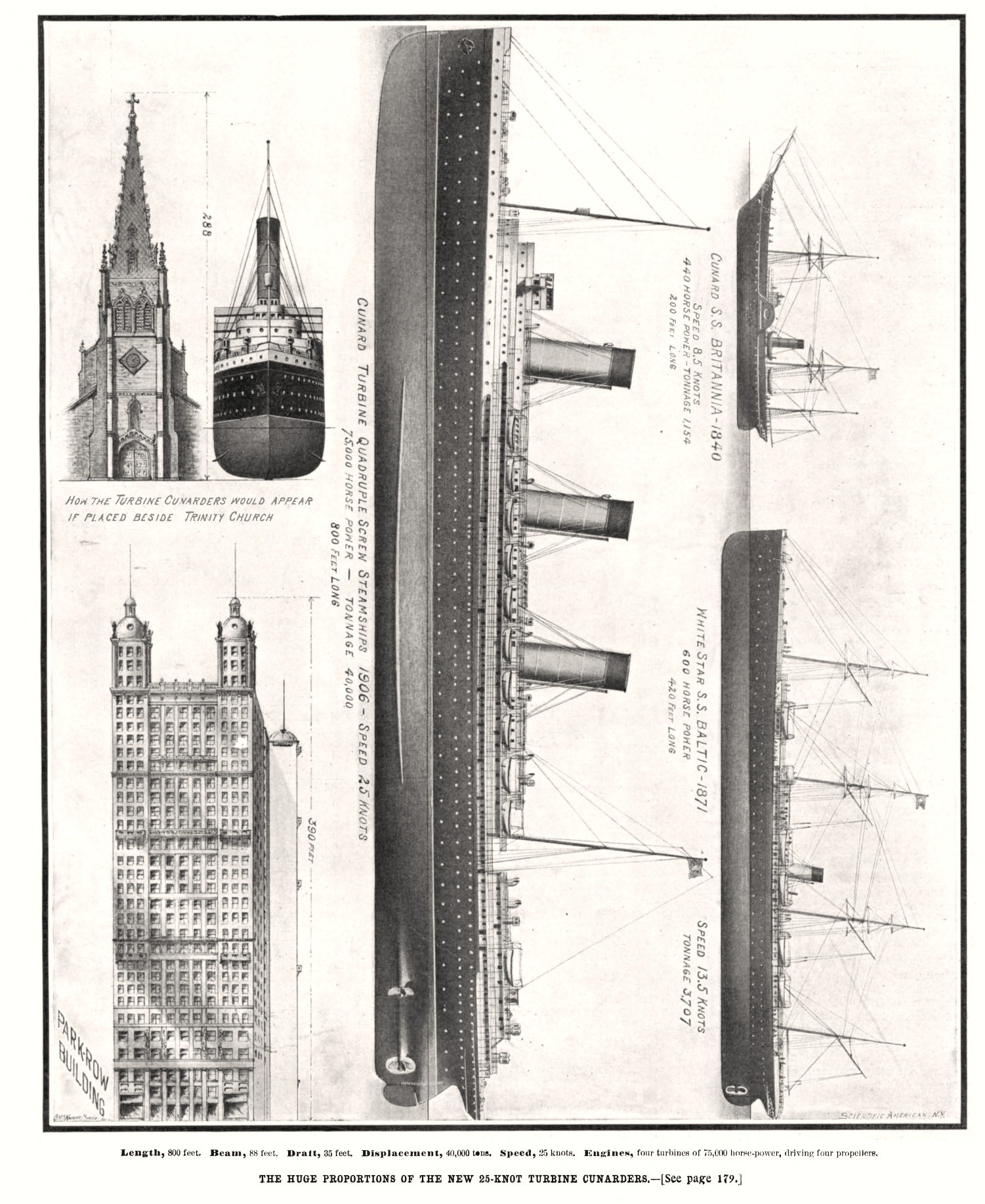
    And here we have another in the short but interesting series, “Ships in the Skyline”, a data visualization and creative display of information of high order and somewhat cross-species order. (Others in this series can be found by searching the title in the Google search box at right.)  This example appears in Scientific American on September 19, 1904, and shows the newest (yet to be named) Cunard Steamship Company fleet addition, a monster 800′ long and with 75,000 horsepower. It is placed side-by-side to Trinity Church, which was the tallest structure in Manhattan for decades, and nearly rises to that height; in the center panel the new ship (is this to be the Lusitania?) is place on end next to and dwarfing the Park Row Building, which was the world’s largest office building in 1904.  The images do press and get their point across very well, I think, in trying have the general reader understand the enormous size of the new “Cunarder” in terms of something that is known, making the stand-alone mass of the new ship more understandable in terms measurement of some other well known thing.

    Sci Am 1904 Ship skyline

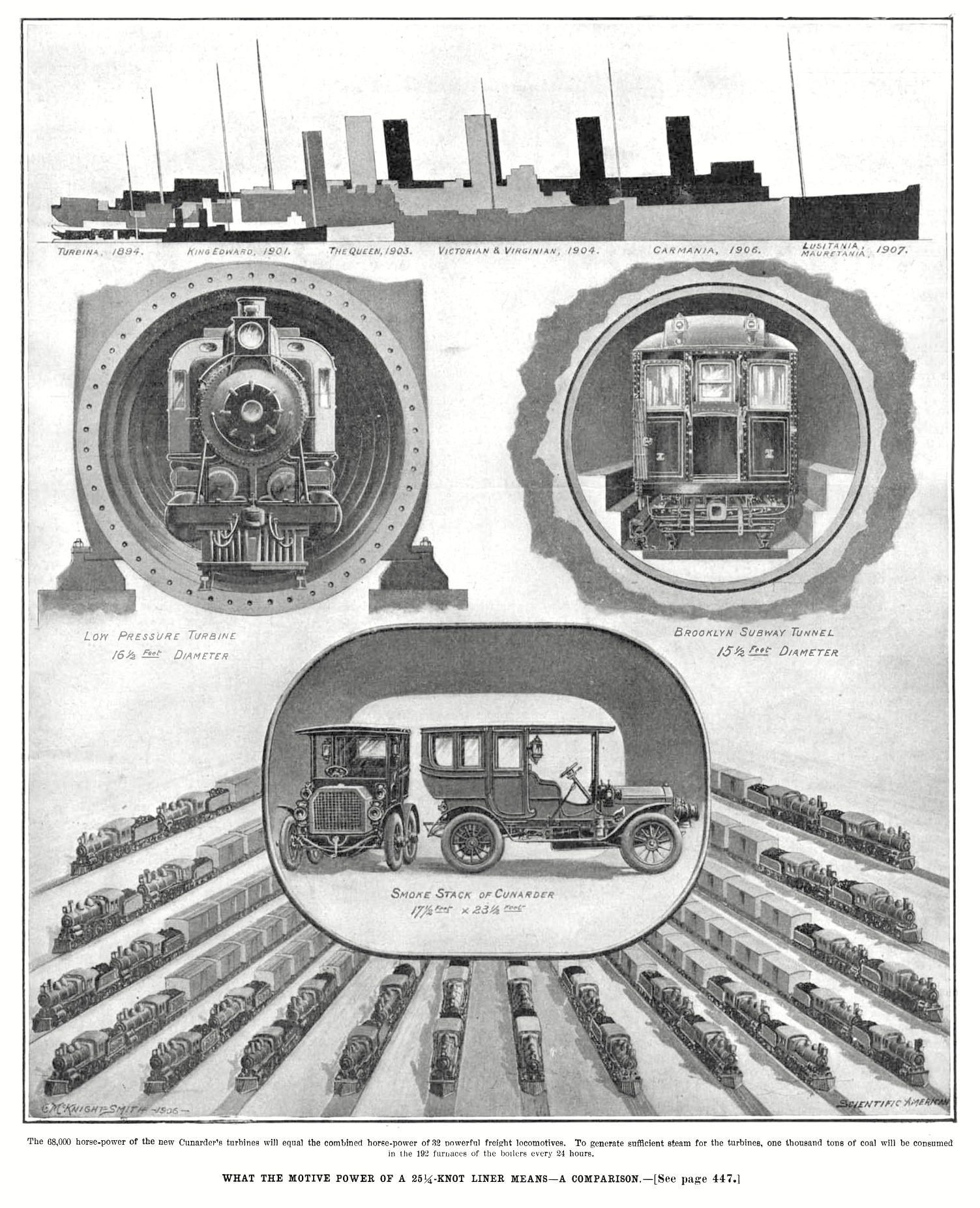
    And other issue celebrating the massive power of the new Cunard ships, this from December 15, 1906 Scientific American front cover, about two years later:

    Sci Am 1906 ships comparative


  • A Few Circular Ships (Some Submerged and Semi-Sugmerged) 1868-1880

    JF Ptak Science Books     (Expanding an earlier post)

    I’ve noticed a few interesting articles on the circular ship from mid-late 19th century; I don’t really have much to say about them except that I appreciate their structure and, well, beauty, and so I’m just sharing them here. 

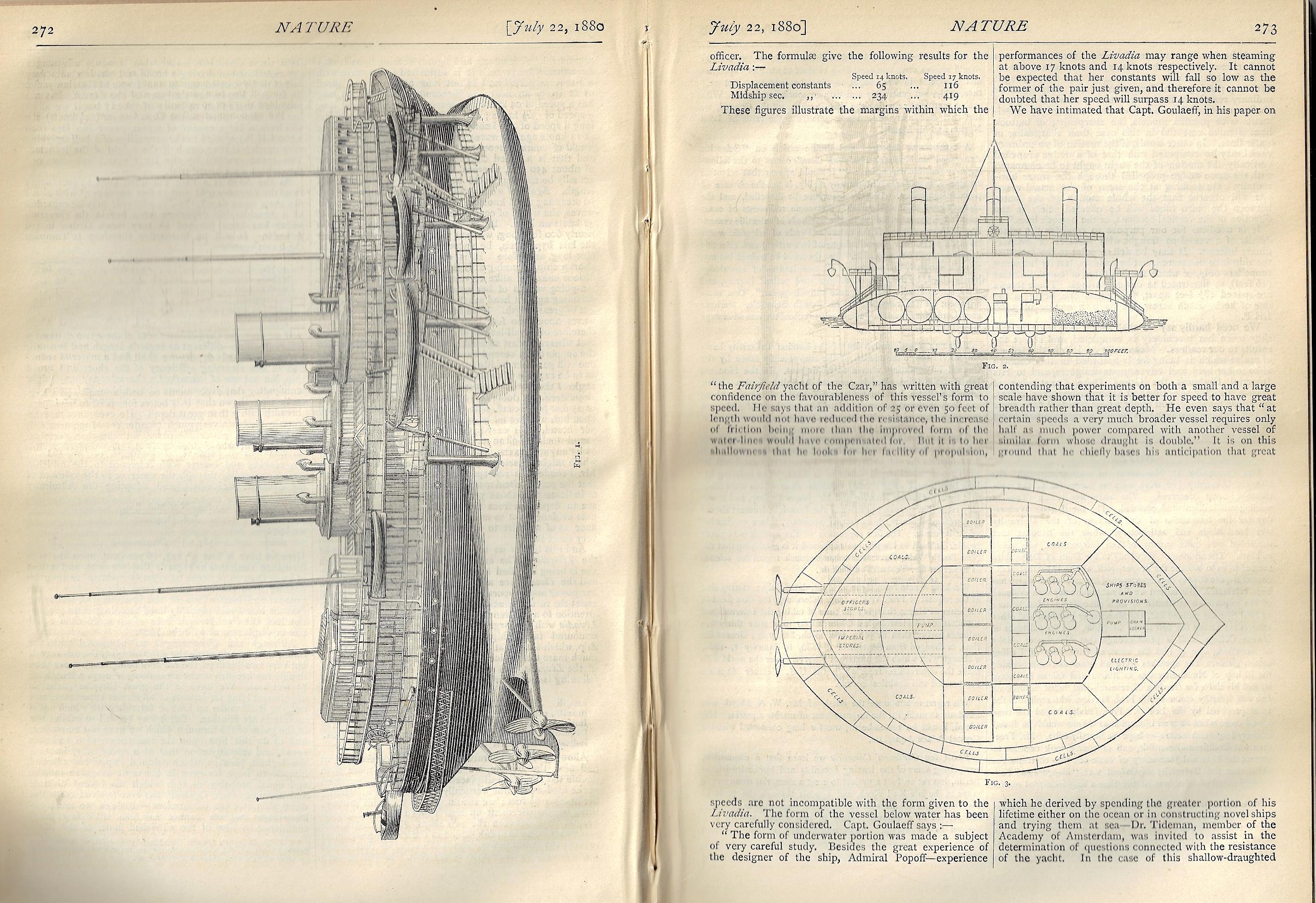
    First is “The Russian Imperial Yacht, ‘Livadia’”, which is an article in Nature, July 22, 1880, appearing on pp 270-274, with several large illustrations, including an elevation and a plan of the ship.  

    Nature 1880 Lividia

    “The Livadia was an imperial yacht of the House of Romanov built in 1879–1880…intended for service on the Black Sea…a radically novel ship conceived by Vice Admiral Andrey Popov, designed by naval architect Erast Gulyaev and built by John Elder & Co. of Govan on Clyde. The Livadia continued Popov’s line of circular shipsalthough this time Popov sacrificed geometrical perfection for seagoing capabilities. She had a beam of 153 ft (47 m) against overall length of only 259 ft (79 m). An extreme example of tumblehome architecture, she sported a conventionally shaped superstructure mounted on a wide, flat-bottomed, turbot-shaped submerged hull or pontoon. The Livadia turned out a surprisingly maneuverable and stable ship with a respectable maximum speed of 15.7 knots and her efficiency was comparable to conventional ships. Her performance at sea trials surprised most naval architects and was attributed to the favorable placement of the propellers.”–Wikipedia

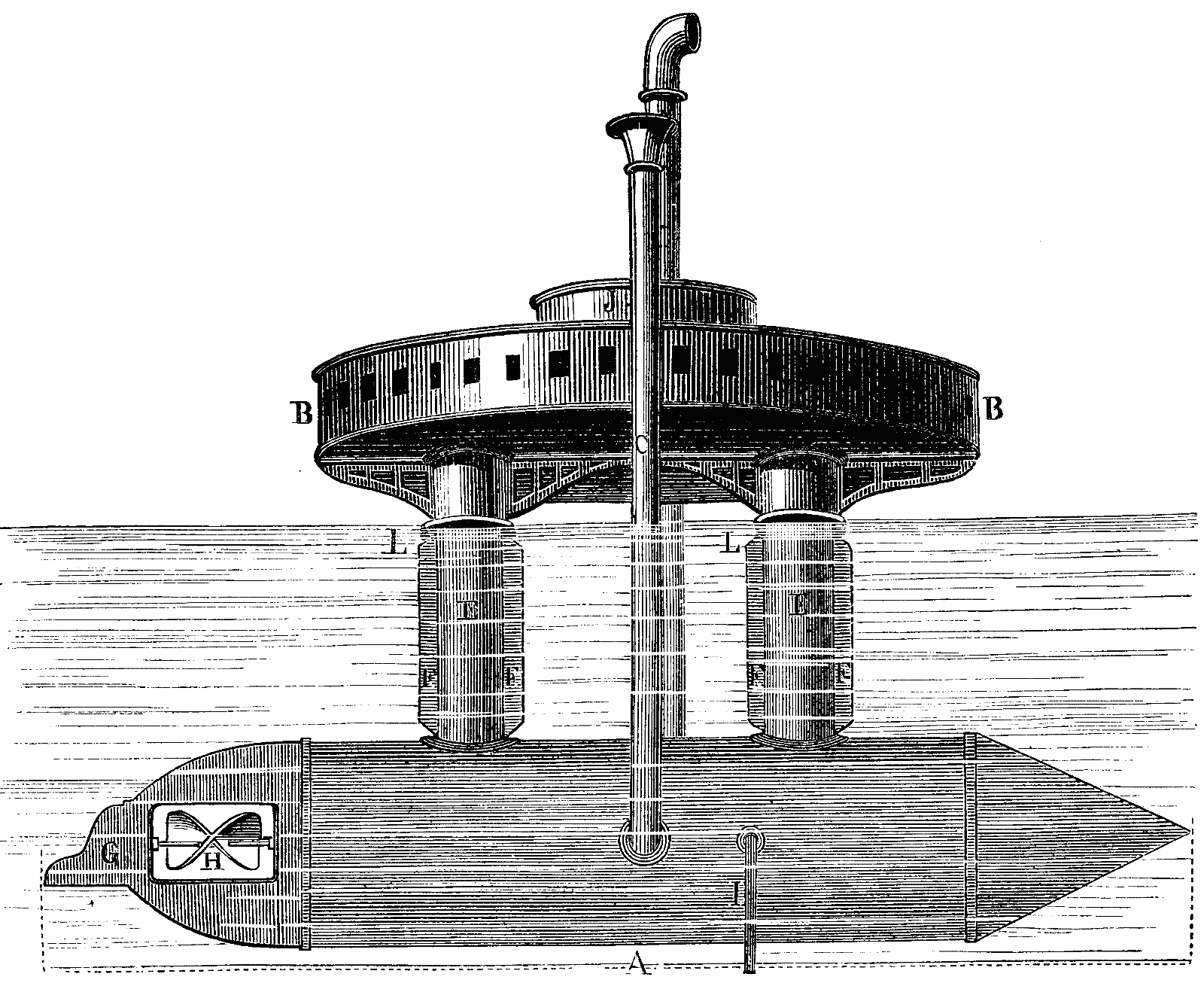
    Next is this fantastic set of drawings for a proposed circular semi-submerged ship, the work of Donato Topmmasi of Paris, and which appeared February 24, 1877, in the Scientific American, page 115.

    Submerged ships tommasi a


    ·Posted by :

    ·in:

  • H.L. Mencken’s Copy of a Stone Catalog for the Big Sleep

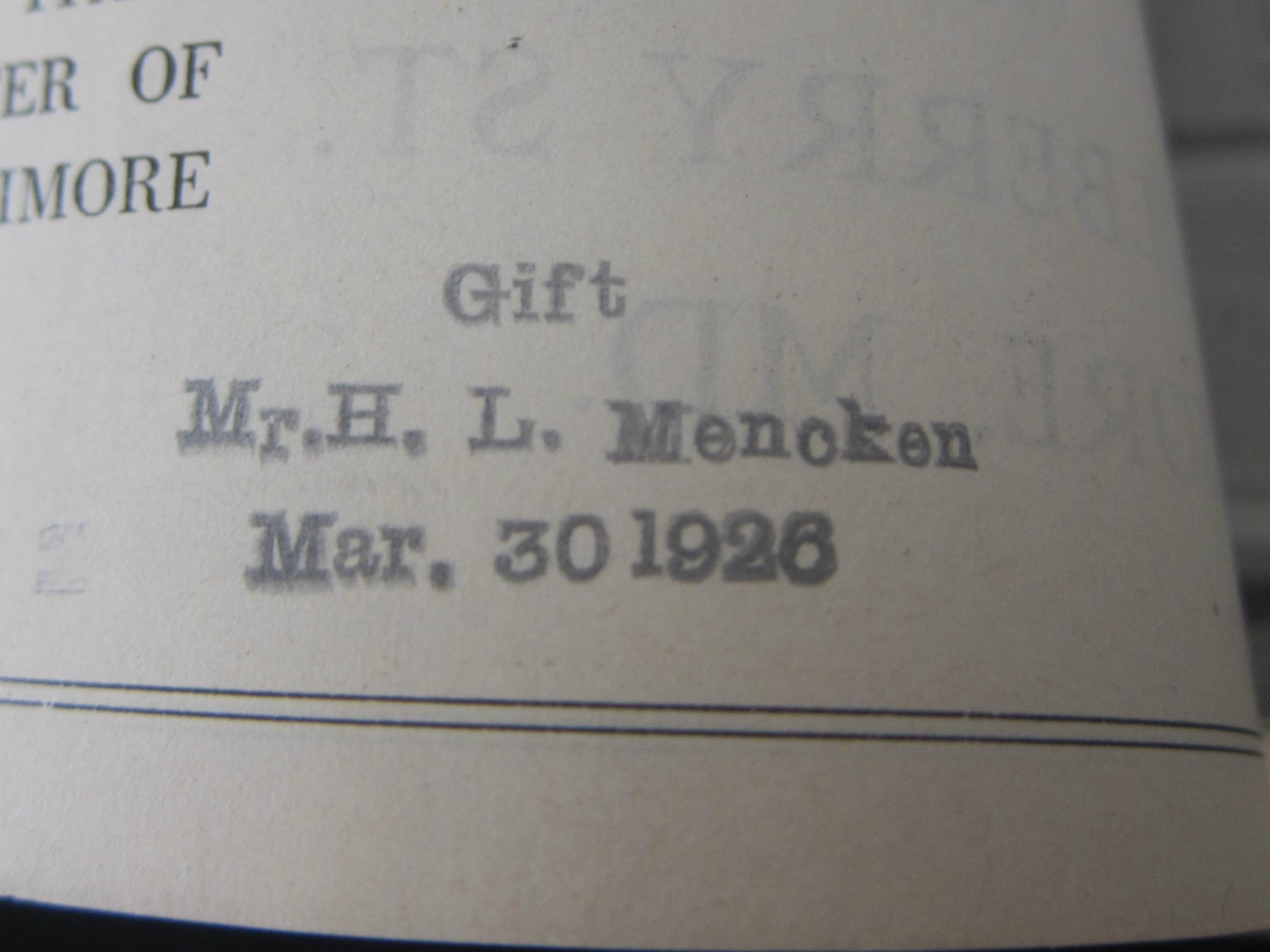
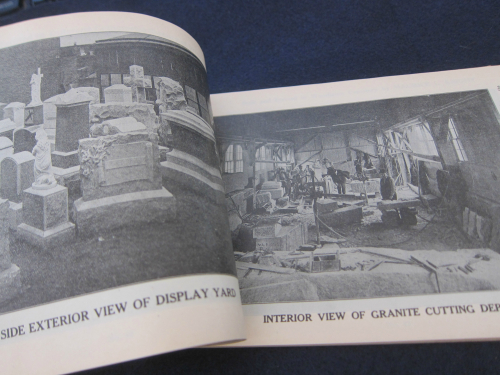
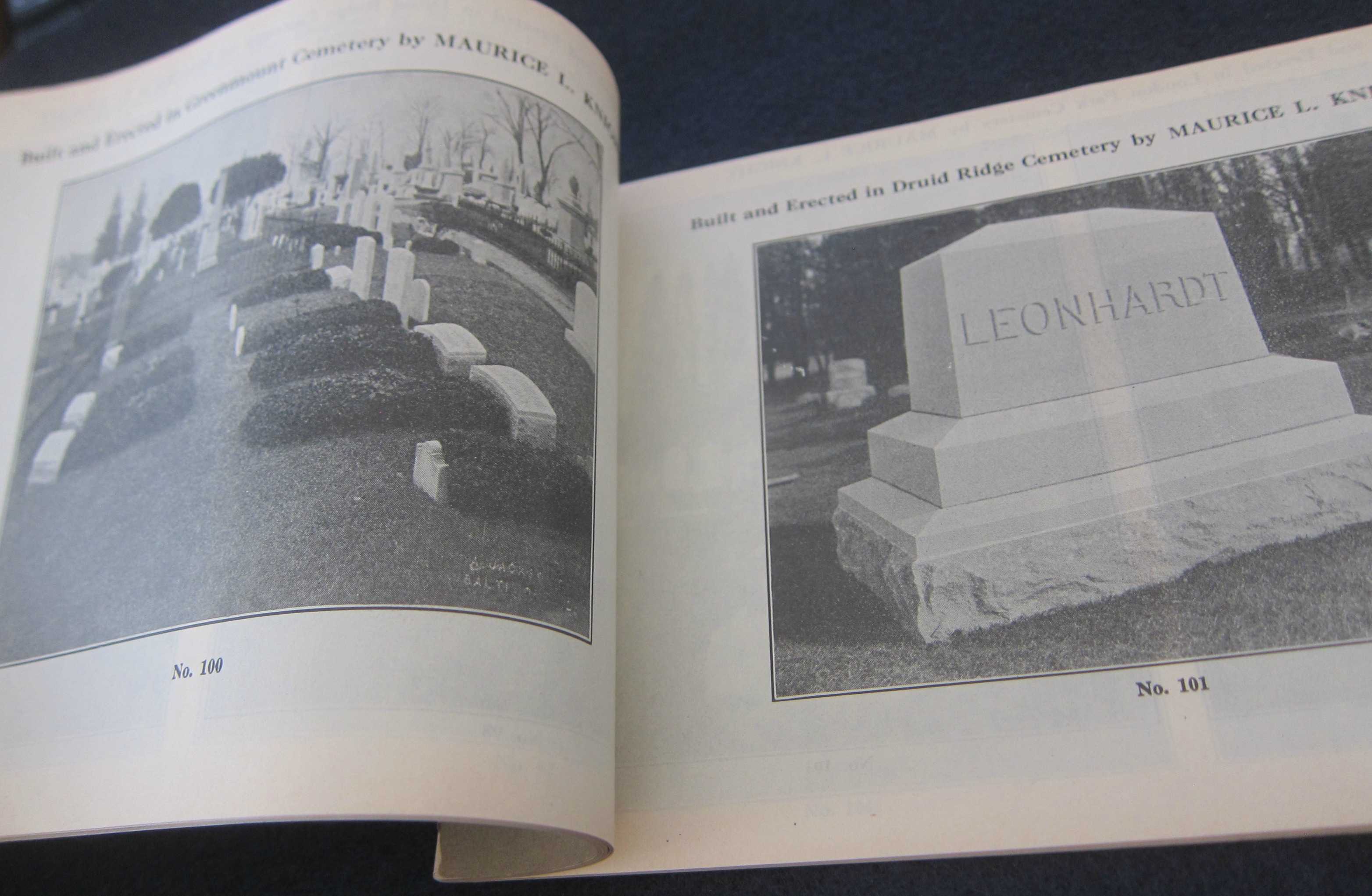
    Mencken tomb _5_ I came upon this curious pamphlet1 by Maurice Knight, curious in itself, being a manufacturer’s catalog for gravestones/markers/monuments, which was something I knew must have existed in dozens of different incantations through the years, though I had never actually seen one. Opening the catalog I saw at the bottom the small and distinctive rubber stamp stating that this was once the property of H.L. Mencken, who shed it to the Library of Congress in 1926, and which later was sold to me in the library’s Exchange Program for surplus and duplicate material. 

    Knight was a Baltimore man and firm, and as it turns out there are numerous examples of  Knight’s work pictured (“in use”) in a number of Baltimore cemeteries, but most interestingly in Loudon Park Cemetery, where the Mencken family plot is located. I cannot tell if the Mencken stones have any connection to Knight, or if Mencken was planning something else. (There are no annotations by Mencken in the text nor I guess should there be–I just state this because if I don’t I imagine that someone will ask.). Mencken’s family plot was already well-established, so I’m really not sure why he would have this prospectus.  

    Anyway, here it is. The title of the catalog tells the reader to “Consult the Master”–with Mencken, I wonder who that master might have been? 

    Ironically the location of the stone works (1025 West Mulberry St, Balto) is now a simple empty lot, its nothingness secured by a chain-link fence. Not a very romantic end to a business who purpose was remeberance. 

    Notes:

    1. Consult the Master, Maurice L. Knight, for your Monument-Tomb-Vault. Office and Works, 1025 West Mulberry St., Baltimore, MD. 9×6″, ca. 75pp, with 150+ illustrations of the work of the stone master. Title printed vertically though the book opens horizontally. Original wrappers. The wrappers are scuffed and bumped a bit around the edges, though the text is bright and clean.  Provenance: stamped on the reverse of the title page “Gift/Mr. H.L. Mencken/March 30, 1926”, being a gift to the Library of Congress, with their surplus stamp on the rear cover. 

    Mencken tomb _2

    Mencken tomb _2

    ·Posted by :

    ·in:

  • The Long Range Guns at Calais Take Aim at England (1929)

    JF Ptak Science Books   Post 2734

    I have posted numerous times on German propaganda pamphlets illustrated with maps showing Germany besieged (1925-1935): hordes of planes, hundreds of thousands of troops, legions of tanks, mountains of artillery pieces, and so on, all graphically displayed quite well enough to strike some fear into the heart of a reader even with just  a casual glance seeing their red-hot rolling menace to the Fatherland. (To see some of those posts, just search “German propaganda” in the google box at right.) 

    It seems to me that I have seen dozens of such illustrations of maps showing Germany surrounded, graphs of military capacity, data visualizations of naval strength, men under arms, and so forth, showing the imminent demise of the spent, Versailled, and used-up but potentially recovering Germany.

    During that time I’m hard pressed to recall one example of these displays for Great Britain, though I think there was a map in the mid-1930’s in the Illustrated London News that showed the history and possible future invasion routes the island.  Perhaps I’ve just missed these displays, as I don’t actually pursue this as an interest though because of my work I have a lot of exposure to such stuff and am well situated to take advantage of a chance find–and this is what happened today, with the following map happily appeared in my hands as if by magic:

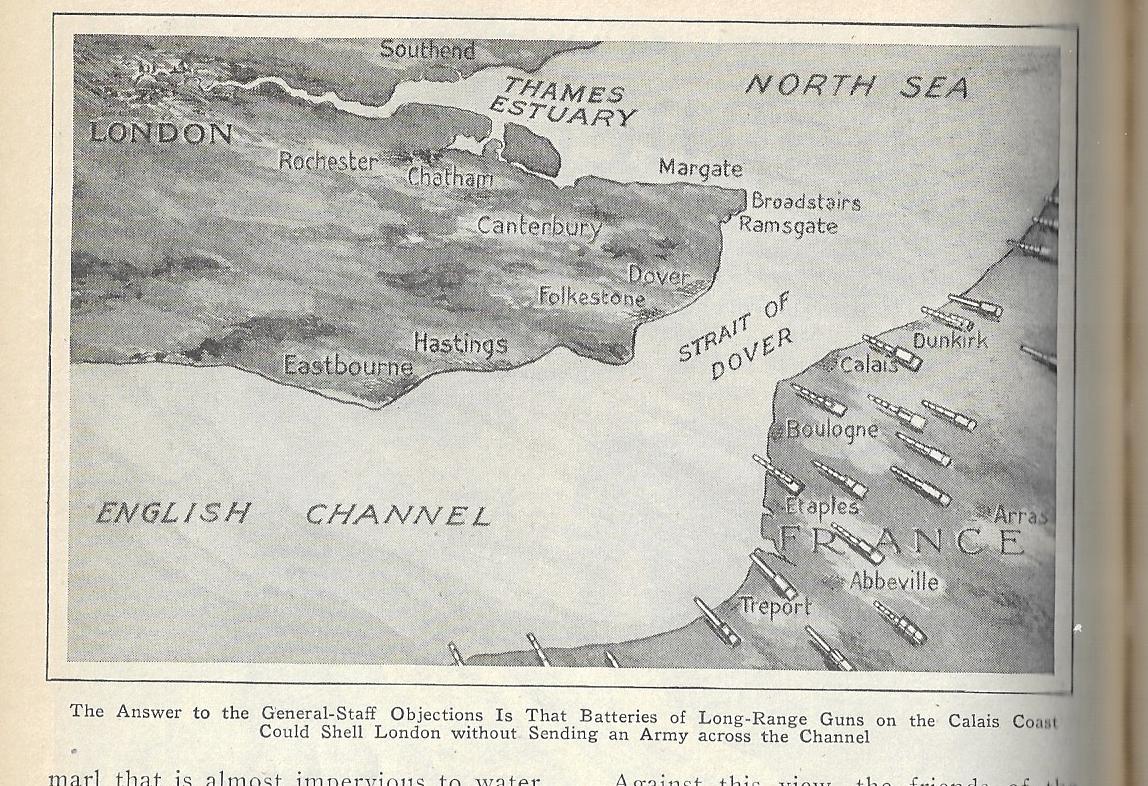
    Pop Mech 1929 England attacked

    The map appears in the May 1929 issue of Popular Mechanics, tailing out an article on the possibilities and the complaints of constructing a channel tunnel. For some reason this bird’s-eye view is included with the article though appears to be utterly unrelated except that it does involve the English Channel. (The article points out another sort of invasion, the tunnel having the potential to admit any number of “more or less undesirable people, who would introduce foreign customs,. deface the countryside and otherwise corrupt English habits of living”.)

    And so, behold! The potential enemies of Great Britain, 1929. It might be conceivable that it is France and France alone setting up those “long-range guns”, what with the long history between the two countries and all, though it seems as recent allies this would not be the case. The enemy could be the feared invasion of visitors from the Continent coming through a tunnel that was far from being an actual project.  Or it could he someone else advancing through France to the coast to threaten the Brits, Calais being the closest point bewtween he two countries across the channel, and the spot where much of the German high command (excluding Rommel) thought that the D-Day invasion would come, even after the invasion had begun. Unfortunately we don’t know what the purpose of this drawing was…except that it would come close to being true in another 11 years.  

  • Money: How Much did a Sergeant’s Chevrons Cost in 1870?

    JF Ptak Science Books  Post 2735

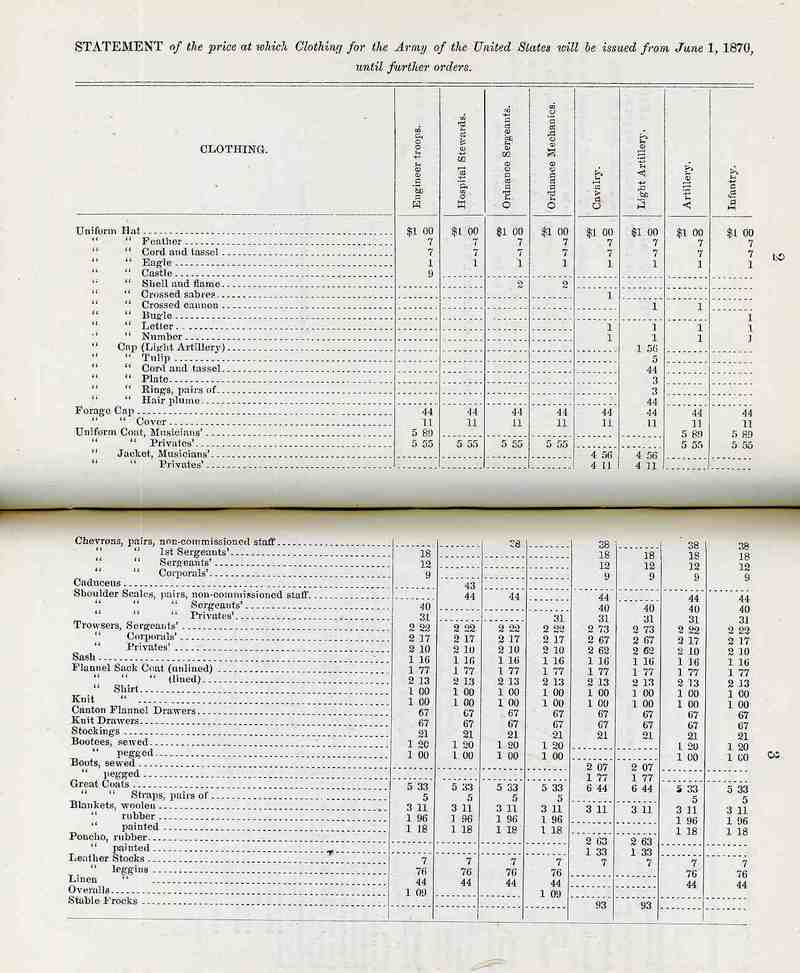
    Here’s an interesting list of prices, outfitting U.S. Army personnel stem to stern so to speak. The major thing here that I do not know is who it was paying these prices–was this the cost to the government in supplying these goods to soldiers? Or are these the prices that soldiers paid for replacement goods? Or did new recruits pay for their uniforms with the costs deducted from future pay?  My suspicion is that these are the costs to the government in outfitting the army, plus arms and munitions and food and all of the rest.  Interesting numbers, if you can use them.  

    There were a number of things here that cost only a penny, like the eagle emblem for a private’s uniform hat, while the most expensive items listed here for soldier accoutrement were the cavalryman’s greatcoat ($6.49) and the musician’s uniform (at $5.89). 

    Some other interesting bits:

    • Underwear, 67 cents
    • Mess can, 22 cents
    • Standard tent, $17.11
    • Sash, $1.21
    • Shovel, 59 cents
    • Sergeant’s trousers, $2.32 (for the corporal, $2.17, and the private, $2.10)
    • Stockings, 21 cents
    • Hospital tent, complete (though without medical equipment) $106
    • Garrison flag, $48

    What does it mean for the average person to spend 5 bucks in 1870?  How does that translate to current currency?  There’s a ton of difficulty in doing that, but one simple way that gives at least some clue to understand the value of those dollars is to put it into the context of how much of a weekly salary something might absorb for a worker at that time. For example, here are some weekly salaries for a few professions:

    • rag cutters at a paper mill, $7.45 (male) and $4.00 (female)
    • blacksmith at iron works, %15
    • “forger of nuts” in carriage works, $20
    • forgers of lightning rods, $10
    • coopers in lime works, $12
    • sail makers $10
    • laborer in a varnish works, $11
    • shoemaker, $14

    These are average weeklies, and would varying according to location (with high and sometimes substantially so being paid in the West and unusual destination points). So in general, a $2 expense is about a day’s labor for a 6-day/10-12 hour week, which means it is not like buying a cup of coffee. This is simplistic, but useful.

    [Source for the data above: the very interesting and exhaustively-titled Special report on immigration : accompanying information for immigrants relative to the prices and rentals of land, the staple products, facilities of access to market, cost of farm stock, kind of labor in demand in the western and southern states, etc., etc., to which are appended tables showing the average weekly wages paid in the several states and sections for factory, mechanical, and farm labor, the cost of provisions, groceries, dry goods, and house rent in the various manufacturing districts of the country, in the year 1869-’70, by Edward Young, chief of the Bureau of Statistics. https://babel.hathitrust.org/cgi/pt?id=hvd.32044024335481;view=1up;seq=248

    And the army?  Here are some figures I found for Union pay during the Civil War, per month:

    • Private and Corporal, $13
    • 1st sergeant, $20
    • 1st Lieutenant, $105.50
    • Captain, $115.50
    • Major $169
    • Lt Colonel, $181.
    • Colonel $212, Brigadier General, $315

    [Source: Civil War Trust https://www.civilwar.org/learn/articles/military-pay]


    (Click for a larger, readable image.)

    Sergeant shirt


    ·Posted by :

    ·in:

    —
  • Background to this blog

    Welcome!  This blog started in January 2008 as a history of science blog that related to my bookstore, but within the first two months the content spilled over into all sorts of unexpected areas, and I’ve happily not tried to steer a clear course since then.  The categories bar makes sense of the mass of the posts, I think.  At this point there are some 2730 posts (plus another 1200 Quick Posts) that run about 2 million words and illustrated by 7000 images.  This blog has been referenced or has been re-posted in The New York Times, The Times, Scientific American,  Le Point, Slate France, Le Monde, Le Figarro, The Economist, The Wall Street Journal, Boing-Boing, Jezebel, Wired, Bloomberg,  Discovery News, The Guardian, the Huffington Post and many other places, and has been viewed more than 4 million times. 

    ·Posted by :

    ·in:

  • Not Sci Fi (1929)

    JF Ptak Science Books   Quick Post

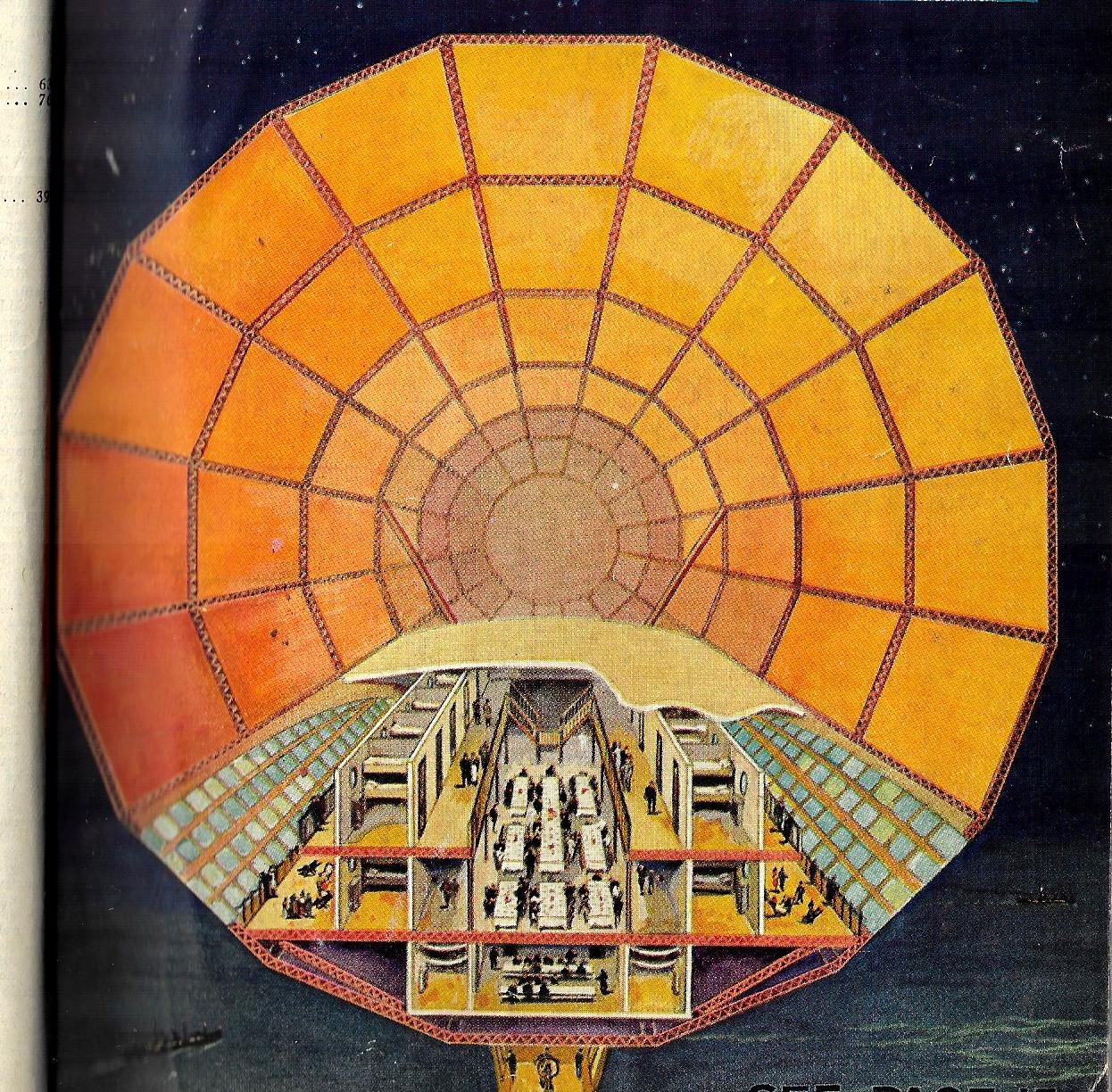
    Pop Mech 1929 cross section airship

    [Cross section for what would be His Majesty’s airship R100 (I think), from Popular Mechanics, January 1929.]

    At first this image looked like the cover of one of Hugo Gernsbach’s science fiction magazines given the number of dining tables and sleeping quarters, but no–it is the front cover of the January 1929 issue of Popular Mechanics showing what I believe would be a cross section of the airship R100. It would be easy to assume that this was an artist’s creative attempt to show  the interior of a rigid airship sometime in the future, given the size and scope of the accommodations for the passengers. But as it turns out, it is a drawing of the interior of what I’m pretty sure would become the British airship R100. The article appeared just months after the first commercial transatlantic rigid airship flight, a 111-hour accomplishment by the Graf Zeppelin (LZ-127). Seven months later, in August, the LZ-127 would make the first around the world flight in 21 days.  The R100’s first flight would occur four months later on 18 December 1929, all 719′ feet of her (with a massive 133′ diameter), with her crew of 37. 

    [I’m not an historian of rigid airships or of flight in general, but it looks to me that the cross section is in accordance with others showing the interior of the R100. Correctly identified or not, the image of the concept is lovely]


  • Early Aerial Bombing, 1916

    JF Ptak Science Books  Quick Post

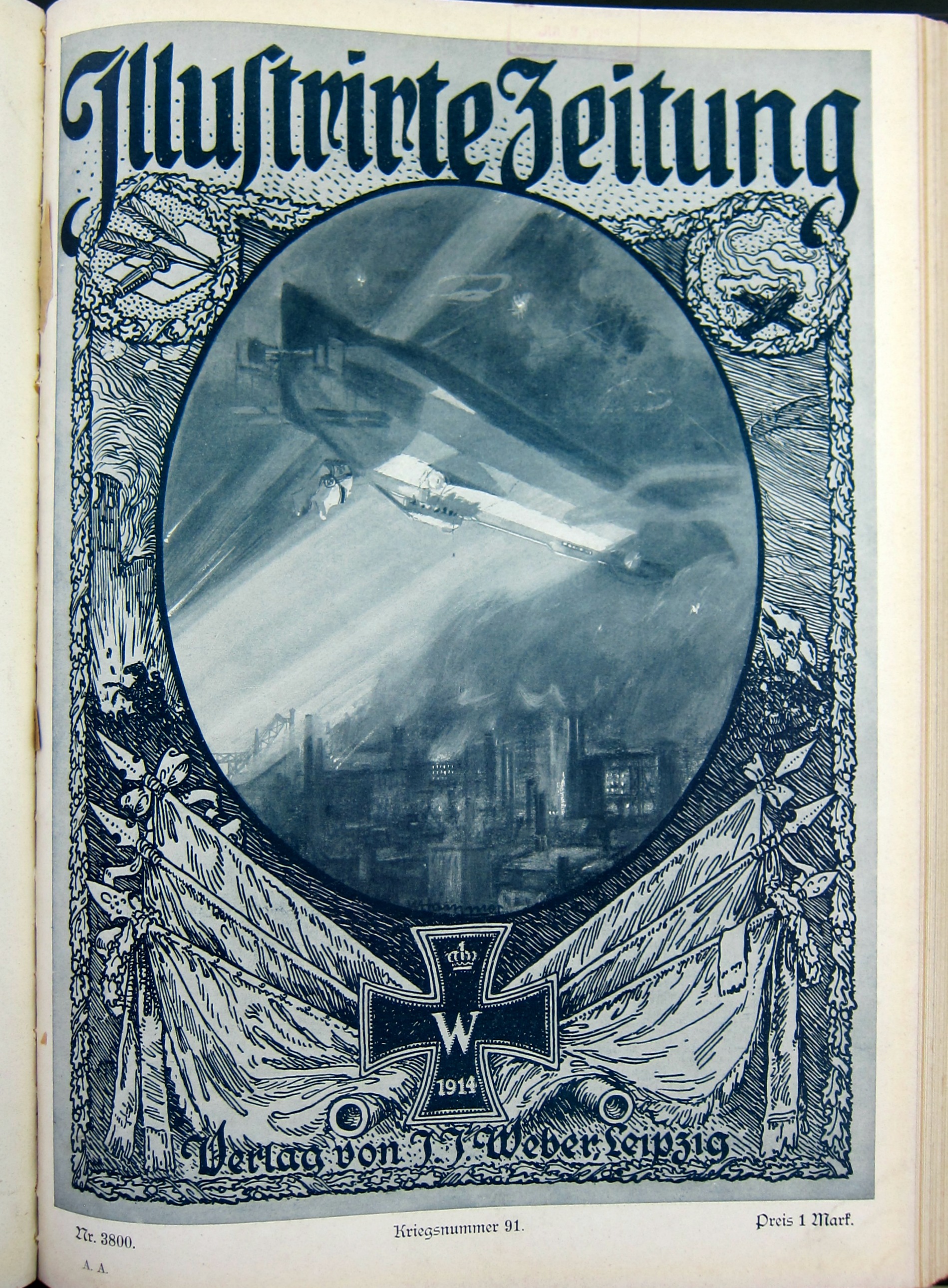
    This issue of Illustrirte Zeitung (Leipzig) was published 27 April 1916 (volume 146, number 3800) and features an early-ish image of an airship bombing a city. The first time this occurred in WWI was in the autumn of 1914, at Liege, with a bombing campaign initiated against London in January 1915.  (The first aerial bombing seems to have been during the first Italian War of Independence and used by the Austrians from a  balloon against Venice in 1849; while this 1916 bombing occurred a few years after the first bomb was dropped from a heavier-than-air aircraft during the Italo-Turkish War on 1 November 1911, the Italians this time delivering the blow in Tripoli.) The scene here illustrates an airship in flight over a very industrialized section of a city, perhaps to drive home a propaganda point that bombing was accurate enough to be strategic and also that targets were industries and not general populations. 

    • “Airships made about 51 bombing raids on England during the war. These killed 557 and injured another 1,358 people. More than 5,000 bombs were dropped on towns across Britain, causing £1.5 million in damage. 84 airships took part, of which 30 were either shot down or lost in accidents. Aeroplanes carried out 27 raids, dropping 246,774 lb (111,935 kg) of bombs for the loss of 62 aircraft, resulting in ground casualties of 835 dead, 1,972 injured and £1,418,272 of material damage.”–Wikipedia

    Bombing 1914


    ·Posted by :

    ·in:

    —
  • The Warsaw Uprising, 1944. (And 1943.)

    JF Ptak Science Books 

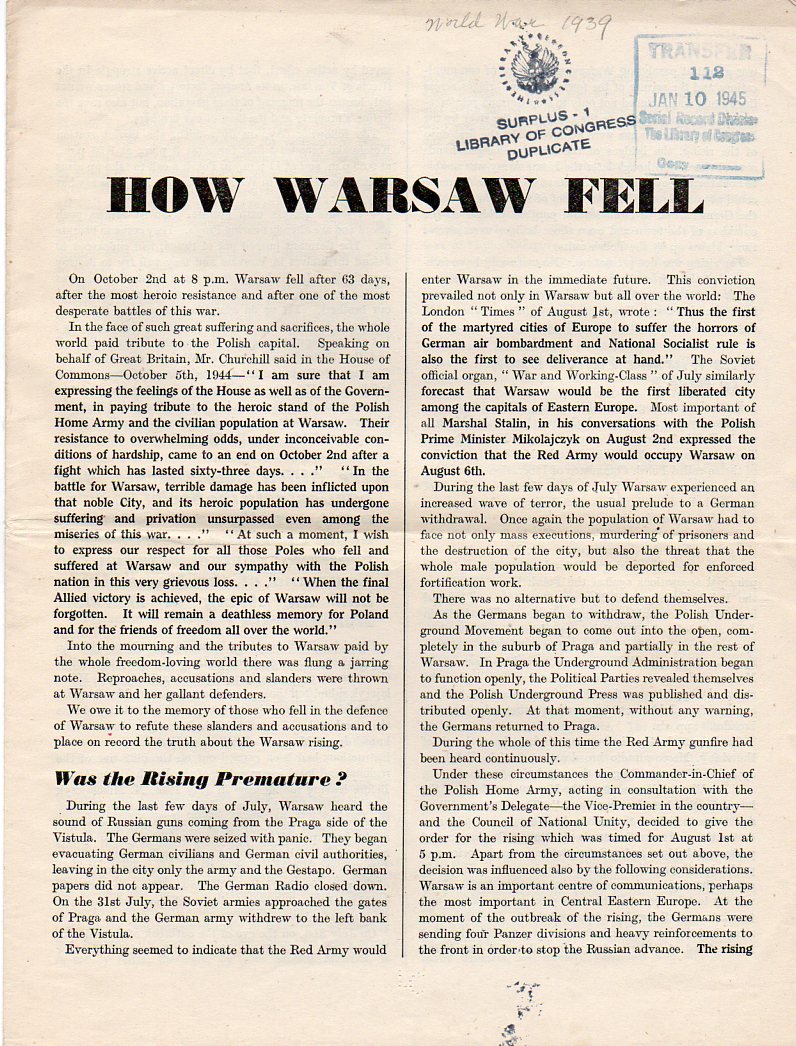
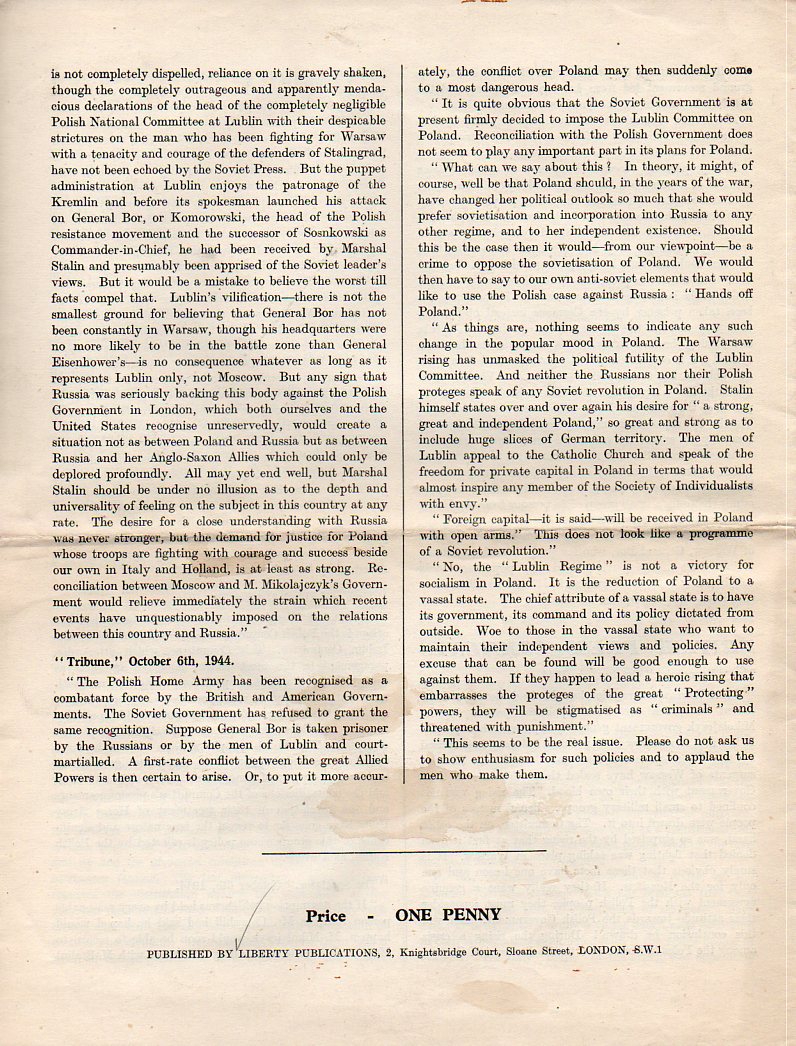
    The bottom line of the 63-day-long Second Warsaw Uprising (August/September 1944) is that the Soviet Union allowed the Polish Home Army to fail, watching from its position across the Vistula as the Nazis and Poles slugged it out, both exhausting themselves, the Nazis ultimately defeating the Poles, eliminating most of the Soviet concern for the Polish military and government, allowing the Soviet Union to take the country over more completely when the time came a few months earlier.  It was the Soviets’ choice to see two enemies annihilate themselves to have more control over Poland and immediately turn it into a vassal state when it rolled into Warsaw in January, with 85% of the city destroyed (“at the moment of its fall practically the whole city was rased [sic] to the ground”) and 600,000 of the city’s population  dead, along with 80% of the Home Army. 

    • Full text (though not my copy) here, at Instytut Józefa Piłsudskiego w Londynie :http://pilsudski.org.uk/archiwa/dokument.php?nonav=&salatka=1&nrar=709&nrzesp=108&sygn=88&handle=709.238/632

      Warsaw774

    With this in mind,  where was the Polish Home Army or the Americans or the Brits-or anyone–when the first Warsaw Uprising occurred? Absent.1 This battle–generally known as the Warsaw Ghetto Uprising–took place about three years after the Nazis established it as a means of control for the city’s 400,000 or so Jews. In the intermediary years hundreds of thousands of Jews had been “deported” (that is, sent to the concentration camps to be exterminated or worked to death), so that by the time of the Uprising only 60,000 people remained in the Ghetto.  And by this time there was no doubt in anyone’s mind who lived there (and perhaps too in Warsaw as a whole) what the euphemism of “deportation” actually meant.  The battle started off well for the home defence (the ZOB2) but, ultimately, with little access to resource and with nowhere to actually retreat or regroup in the few acres that remained of the original Ghetto, whoever was left in the Ghetto were either killed or captured by 16 May.  The German commander, SS Brigadefuhrer Jurgen Stroop reported on that day that “the former Jewish quarter in Warsaw is no longer in existence”:

       “Progress of large-scale operation on 16 May 1943, start 1000 hours.
       “180 Jews, bandits, and subhumans were destroyed. The former Jewish quarter of Warsaw is no longer in existence. The large-scale action was terminated at 2015 hours by blowing up the Warsaw Synagogue.
        Total number of Jews dealt with 56,065, including both Jews caught and Jews whose extermination can be proved. “

    Stroop was arrested and hanged in Poland, in Warsaw, in 1952.

    Warsaw775

    So, this 6-page pamphlet, published by Liberty Publications in London at the end of 1944 (and received by the Library of Congress on 10 January 1945), detailed the misery of the non-recongition of the second Warsaw Uprising and the reason(s) for it. It details the travesty, the disinterest, and the political accomplishment of the Soviet Union gained by its criminal inaction. There is of course no mention whatsoever of the first Warsaw Uprising.  Selfish inaction breds itself, consumes others and then–like yeast–consumes itself.

    Notes

    1. “WHEN THE revolt in the ghetto broke out in April 1943, all of Warsaw was aware of the fighting. The news of the revolt was transmitted to the Allied capitals by the Polish underground, but no help came for the Jewish fighters – not from the US or England, nor from the Soviet Union; not even a sign of recognition or an acknowledgement by the Allies of the battle raging in the ghetto. The Jewish fighters in the Warsaw Ghetto were unknown soldiers, isolated from the world. Only two years later, after the end of the war, did their valiant battle receive universal recognition.”–“Who Defended The Warsaw Ghetto?”, by Moshe Arens, in the Jerusalem Post, 29 April, 2003.

    2.  The ZOB  was the Zydowska Organizacja Bojowa, led by Mordechai Anielewicz, and ZZW (Zidowski Zwiazek Woskowy) led by Pawel Frenkel.

    ·Posted by :

    ·in:

  • A Tiny Notice Foreshadowing a Great Announcement–Experimental Proof of the General Theory of Relativity, 1919

    JF Ptak Science Books   Post 2736

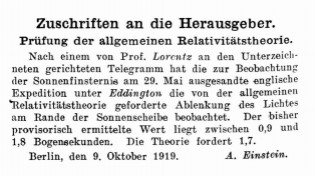
    According to Abraham Pais, an “excited” Albert Einstein contributed a very short note (“Zuschriften an die Herausgeber, Prufung der allgemeinen relativitatstheorie”/”A Test of the General Theory of Relativity”) to the editors of the journal Die Naturwissenschaften1 reporting on the telegram he had received from H.A. Lorentz on September 22 on the impending confirmation of the theory of relativity as it was tested in the May 29, 1919 eclipse experiments organized by Sir Frank Dyson. Chandrasekhar explains the situation so: 

    • “It was some months before the two expeditions returned to England and the participants were able to measure their plates and collate their results. But rumours of the successful confirmation of Einstein’s prediction reached Einstein in early September I919. And on 22 September I919, the Dutch physicist Hendrik Antoon Lorentz sent Einstein a telegram confirming the rumours to which Einstein replied (also by telegram).. Einstein’s own satisfaction with the outcome of the British expeditions is shown by the postcard (dated September 27, 1919) to his ailing mother in Switzerland. It said: Dear Mother: Good news today. H. A. Lorentz has wired me that the British expeditions have actually proved the light deflection near the Sun….”

    “The telegram that had announced the news to Einstein…was an informal communication. Nothing was definitive. Yet Einstein sent almost at once a very brief note to Naturwissenschaften for the sole purpose of reporting the telegram he had received. He was excited.” (Pais, Subtle is the Lord, p 303).

    Einstein’s note in Naturwissenschaften was concise and to the point: “…the English expedition, under Eddington…has observed the deflection of light at the limb of the sun demanded by the General Theory of Relativity3…”

    The results of the experiment were read on November 6, 1919 (the presentation begun by Dyson, followed by A. C. Crommelin, the leader of the Sobral expedition)  to a joint meeting of the Royal Society and the Royal Astronomical Society, and famously published in the Philosophical transactions of the Royal Society in 1920 as “A Determination of the Deflection of Light by the Sun’s Gravitational Field, from Observations Made at the Total Eclipse of May 29, 1919”4.  J.J. Thomson (as president of the Royal Society)  closed the meeting and “pronounced the canonization [of Einstein]”: ‘This is the most important result obtained in connection with the theory of gravitation since Newton’s day, and it is fitting that it should be announced at a meeting of the society so closely connected with him. . . . The result [is] one of the highest achievements of human thought.’ (Pais, Subtle…, in the chapter “The Suddenly Famous Doctor Einstein”, p 305) R.H. Folwer, president of the Royal Astronomical, also spoke and announced ‘“The conclusion is so important that no effort should be spared in seeking confirmation in other ways.”

    The Einstein note is dated October 9 in the text and was published a week later on October 17. It is one of the first appearances on the confirmation of the theory, with the exception, evidently, of a few notices in Berlin newspapers5 just days earlier. (Again, this according to Pais.) It would be on November 6 that “Lorentz sent another telegram to Einstein, confirming the news. On November 7, 1919, the Einstein legend began.” I assume that Pais is talking about the general article that appeared in the London Times on that day (and which would be written for the New York Times on the 9th, and then it was off to the races with the news, with Einstein himself contributing an article three weeks later to The Times). Well, except in Germany, where the reporting beyond this notice in Naturwissenschaften was more reserved, as noted by an article on the 1919 eclipse on the Max Planck Gesellschaft website: “In contrast to the enthusiastic reception shown by the foreign press, the media in Germany were more reticent on the subject. Not until 14 December 1919 did the Berliner Illustrierte Zeitung publish a photo of Einstein and an article entitled: “A new luminary for the history of the world: Albert Einstein, whose research means a total revolution in the way we see the world and whose findings are equal to those of a Copernicus, Kepler and Newton”. 

    Here’s the entire announcement from Naturwissenschaften:
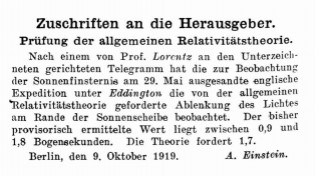
    EInstein 1919

    Writing about the eclipse on his website, Simon Singh says that J.P. McEvoy, author of Eclipse: The Science and History of Nature’s Most Spectacular Phenomenon (Fourth Estate Ltd., 1999), “encapsulated the significance of the announcement” writing of the ironies of the event:  “A new theory of the universe, the brain-child of a German Jew working in Berlin, had been confirmed by an English Quaker on a small African island.” A further bit to add here is that the expeditions were undertaken by British scientists to prove the work of a German scientist, beginning their work before the end of WWI.

    S. Chandrasekar reports that in 1933 Rutherford expounded on the eclipse and Einstein’s fame, rather more broadly and more deeply:

    “The war had just ended: and the complacency of the Victorian and the
    Edwardian times had been shattered. The people felt that all their values and
    all their ideals had lost their bearings. Now, suddenly, they learnt that an
    astronomical prediction by a German scientist had been confirmed by
    expeditions to Brazil and West Africa and, indeed, prepared for already
    during the war, by British astronomers. Astronomy had always appealed to
    public imagination; and an astronomical discovery, transcending worldly
    strife, struck a responsive cord. The meeting of the Royal Society, at which
    the results of the British expeditions were reported, was headlined in all the
    British papers; and the typhoon of publicity crossed the Atlantic. From that
    point on, the American press played Einstein to the maximum…”6

    I guess this is where the ultra-fame of Einstein begins.

    Notes:

    1.  Die Naturwissenschaften, volume 7, heft 42, October 17, 1919. p 776

    2. S. Chandrasekhar, “Verifying the Theory of Relativity”, in Notes and Records of the Royal Society of London Vol. 30, No. 2 (Jan., 1976), pp. 249-260.

    3.  The Collected Papers of Albert Einstein, Volume 7 (English).

    4. W. Dyson, A. S. Eddington, C. R. Davidson, “A Determination of the Deflection of Light by the Sun’s Gravitational Field, from Observations Made at the Solar eclipse of May 29, 1919”, Philosophical Transactions of the Royal Society,  A 220 (571-581): 291–333 (1920). Eddington had written previously on the expedition, “The total eclipse of 1919 May 29 and the influence of gravitation on light”, in The Observatory, Vol. 42, p. 119-122 (1919)

    5. “An article by Alexander Moszkopwski entitled ‘Die Sonne bracht es an den Tag’ in the Berliner Tageblatt of October 8, 1919, must presumably have been based in information from Einstein himself”. (Pais, Subtle…, footnote p 306.) Also, Andrew Claude de la Cherois Crommelin contributed  “The Eclipse Expedition to Sobral”  in The Observatory 42, 368-371, and though it published in October there is no mention of definitive results yet.  Crommelin also publishes an article in Nature on 13 November (volume 104, p. 280-1), appearing about a week after the Royal Society meeting, in which he publishes the results, all on the equivalent of a single page.  

    6.  Chandrasekhar, ibid., pg 251.

     [Interesting to note here that in Maurice Lecat’s Bibliographie de la Relativite (1924) this contribution receives only a scant placement within the Einstein section, in part 13 (c).]

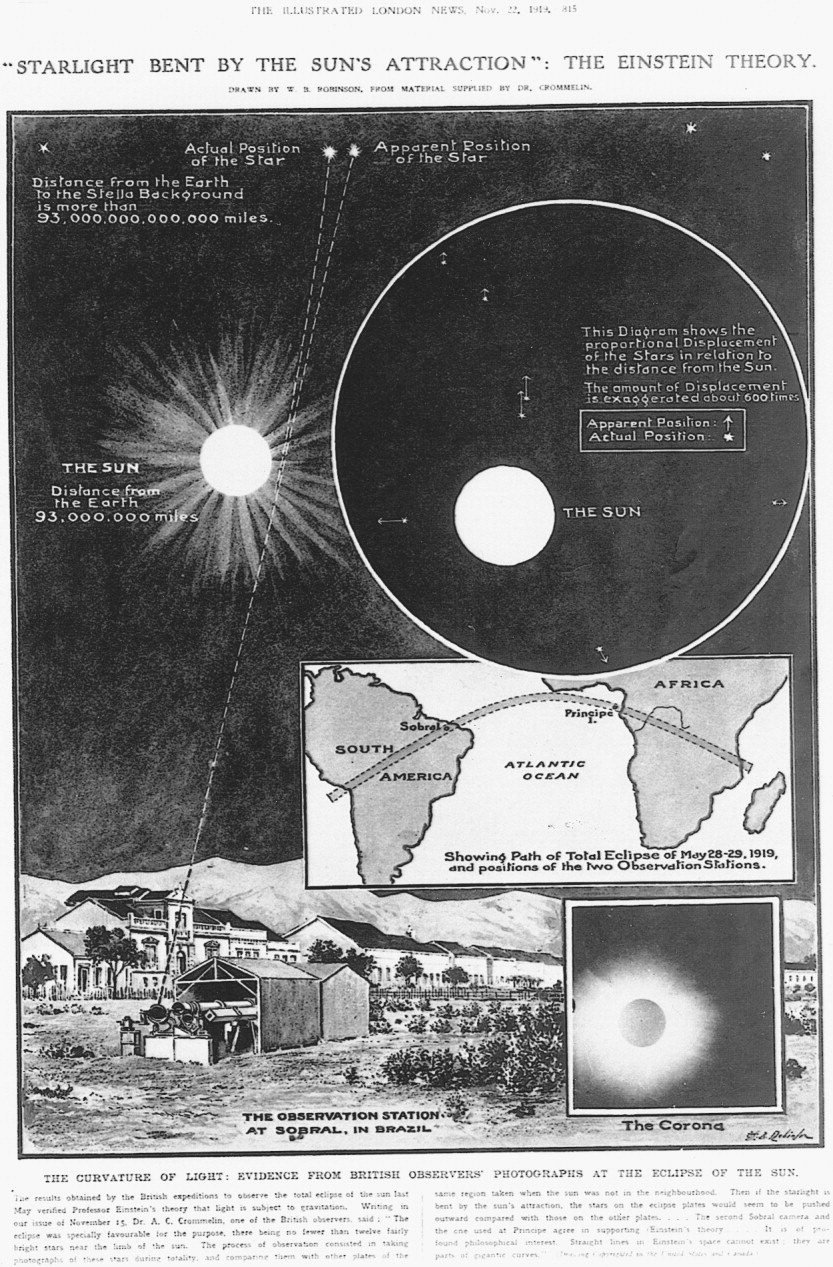
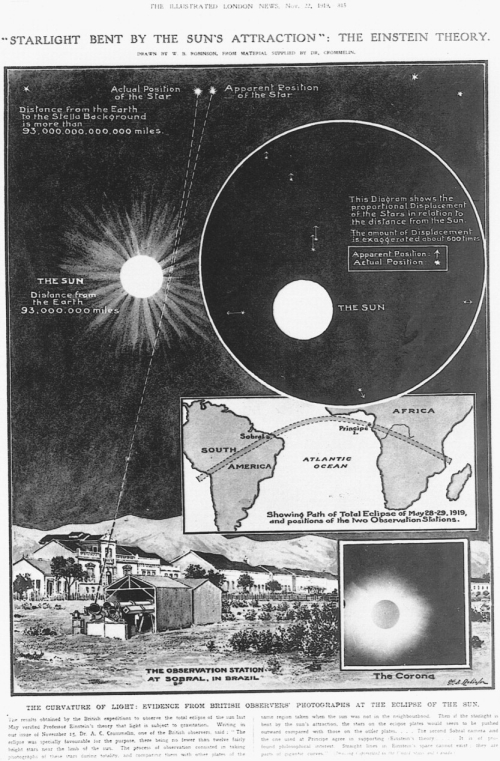
    And just for fun, here’s a good graphic drawn by the old hand W.Robinson for the Illustrated London News, for general consumption, based on information provided the magazine by Crommelin, and published November 22, 1919, page 820:
    1919 illus london news

     [Image source: University of Chicago, http://www.journals.uchicago.edu.prox.lib.ncsu.edu/doi/full/10.1086/376099, and this via the excellent article by Matthew Stanley, “An Expedition to Heal the Wounds of War” The 1919 Eclipse and Eddington as Quaker Adventurer”, In Isis, 94/1, March 2003. 
    ·Posted by :

    ·in:

Recent Posts

Archives

Categories