A Daily History of Holes, Dots, Lines, Science, History, Math, Physics, Art, the Unintentional Absurd, Architecture, Maps, Data Visualization, Blank and Missing Things, and so on. |1.6 million words, 7500 images, 4.9 million hits| Press & appearances in The Times, Le Figaro, Mensa, The Economist, The Guardian, Discovery News, Slate, Le Monde, Sci American Blogs, Le Pont, and many other places… 5000+ total posts since 2008.

  • Found-Art in Scientific Journals–an Acoustic Kraken (1881)

    JF Ptak Science Books   Quick Post

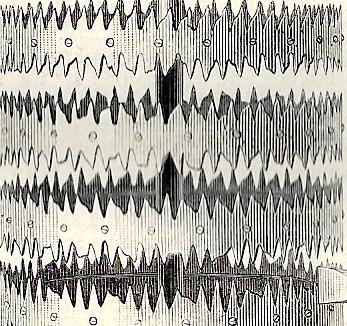
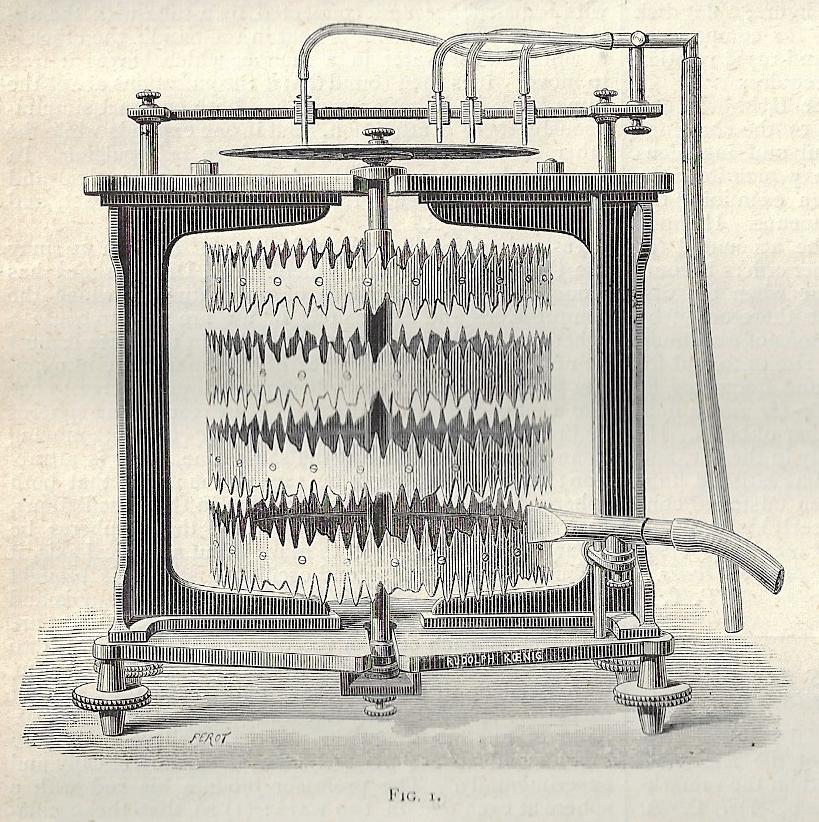
    This does for a moment look like a piece of Found Scientific Art–and I guess it is–reminding me of a multiply-layered steely jaw of some creature, which you can see if you look hard enough. In reality, it was the tonal guts of a wonderful scientific apparatus constructed by Rudolph Koenig, reported in the July 14, 1881 issue of Nature:

    Nature 1881 Konig wave siren detail

    And the full version of the original 3×3″ image

    Nature 1881 Konig Wave Siren

    “Prior to the advent of oscilloscopes and other electronic sound-analysis tools, even seemingly rudimentary tasks of acoustic analysis – determining the frequency of a musical tone, for instance, or making waveforms observable – were not simple jobs  with obvious solutions. It fell to researchers of the time to come up with mechanical devices, often quite clever and sometimes rather complex, to make these investigations possible.” “Though oriented differently [the wave siren]… is similar to the other wave siren shown in this collection, but with more complex wave forms in the undulating rims…”–Bart Hopkin, Instrument Maker, “Engravings of early Acoustical Apparatus”, from his website

    Rudolph Konig (1832-1901) “far and away the most accomplished among makers of [acoustical devices]” (Hopkin, above) was a very highly accomplished and discriminating instrumentalist, scientific instrument maker, and experimentalist. “Koenig will also be remembered as the inventor and constructor of many other beautiful pieces of apparatus for the investigation of acoustical problems, among which may be mentioned his wave-sirens, the first of which was shown at Philadelphia in 1876. His original work dealt, among other things, with Wheatstone’s sound-figures, the characteristic notes of the different vowels, a manometric flame apparatus, a vibration microscope, among others; but perhaps the most important of his researches are those devoted to the phenomena produced by the interference of two tones, in which he disputed the views of Helmholtz as to the existence of summation and difference tones.”–Wikipedia

    “Prior to the advent of oscilloscopes and other electronic sound-analysis tools, even seemingly rudimentary tasks of acoustic analysis – determining the frequency of a musical tone, for instance, or making waveforms observable – were not simple jobs  with obvious solutions. It fell to researchers of the time to come up with mechanical devices, often quite clever and sometimes rather complex, to make these investigations possible.” “Though oriented differently [the wave siren]… is similar to the other wave siren shown in this collection, but with more complex wave forms in the undulating rims…”–Bart Hopkin, Instrument Maker, “Engravings of early Acoustical Apparatus”, from his website


    ·Posted by :

    ·in:

    —
  • Clouds, Paddle W-Patterns, Hot Ice, and other Attractions: “Nature” magazine, 1881

    JF Ptak Science Books  Quick Post

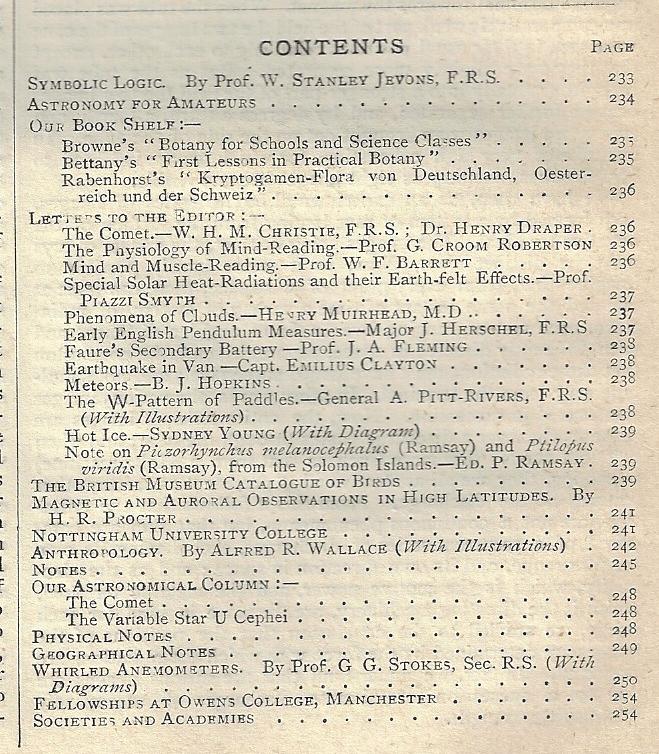
    I just finished a short post about the wide-ranging W. Stanley Jevons  review of John Venn’s classic book, Symbolic Logic, when I had another look at the contents of the slim issue of Nature in which the article appeared. This Nature is our present-day mega-Nature, but here in 1871 it was only in its 12th year. And even though the issue was only 17 pages long, it was filled with an astonishing range of succinct papers, and heavily seasoned with bits for the generally curious of the high Victorian era. After you read the gentleman’s gentleman high-end astronomer Henry Draper’s paper, you could read “the Physiology of Mind reading” and follow that up with “Mind and Muscle-Reading”. Piazzi Smith followed that with “Special Solar Heat-Radiations and their Earth-felt effects”, with “Phenomena of Clouds”, “early English Pendulum Measures”, and J.A. Fleming’s “Faure’s Secondary Battery”. Papers on earthquakes and meteors, and then the wonderfully enticing “The W-Pattern in Paddles” and of course “Hot Ice”. It all ends up with an extended article by G.G. Stokes’  (a remarkable physicist and mathematician who spent his entire career at Cambridge, the vast majority of that as Lucasian Professor of Mathematics from 1849 until he died in 1903) “Whirled Anemometers”, which occupies about a third of the issue. 

    Nature 1881 Contents_0002

  • From the Department of Vast Understatement (1958): a Half-Visible Wernher von Braun

    JF Ptak Science Books   Post 2742

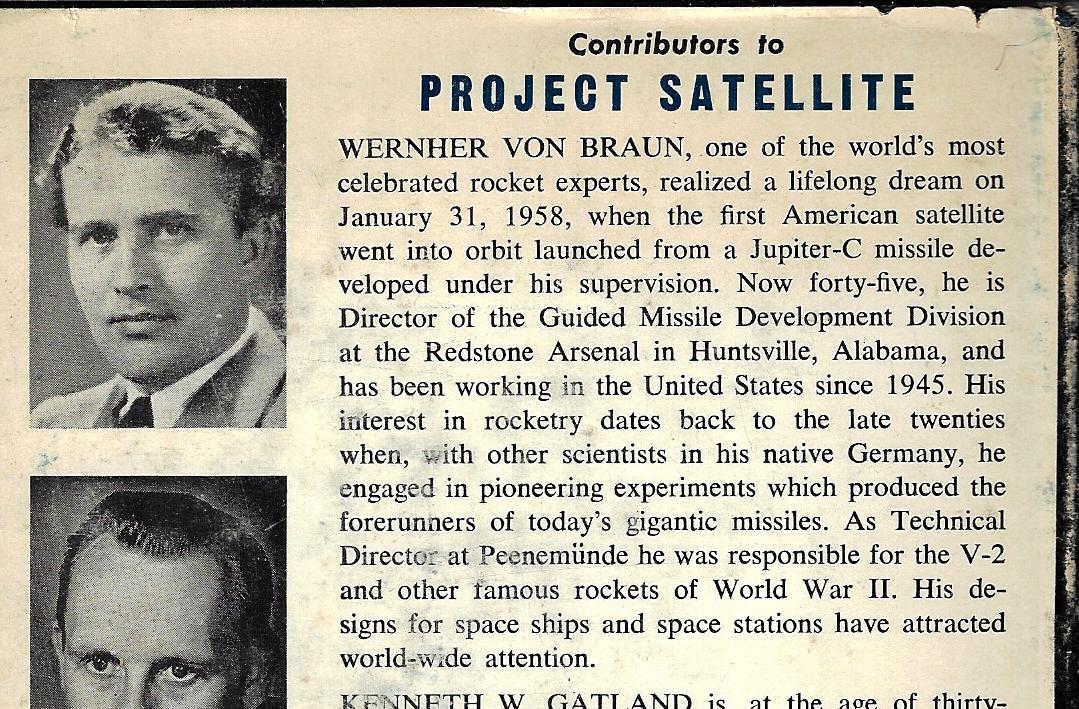
    Von Braun_2_What does one do about Wernher von Braun? For a long time it was difficult to find his name at the National Air and Space Museum, though I don’t know what that status is, nowadays. In 1958 I know what was up with him, at least according to the dust jacket of this book he co-authored, one of the first books on satellite communication, Project Satellite.  (I can almost here the echo of the title repeating, a la 1958…)

    It is there that we are told that Dr. von Braun “has been working in the United States since 1945”. Indeed he was, thanks to having been swept up by U.S. forces at the end of the war just 40 days or so after the last V-2 was launched. There were many others taken by the U.S. in this way, though von Braun was hardly alone as a Nazi working as a rocketeer for Adolf Hitler, but he may have been one of the few members of the Nazi Party who were collected and worked  at the Army Ballistic Missile Agency in Huntsville, Alabama, there in 1958.

    “…(H)e engaged in pioneering experiments which produced the forerunners of today’s gigantic missiles”. So true–and just when I thought that the blurb writer would skip mentioning the V-2, they do:

    “As Technical Director at Peenemude he was responsible for the V-2 and other famous rockets of World War II.”

    And there it is. 

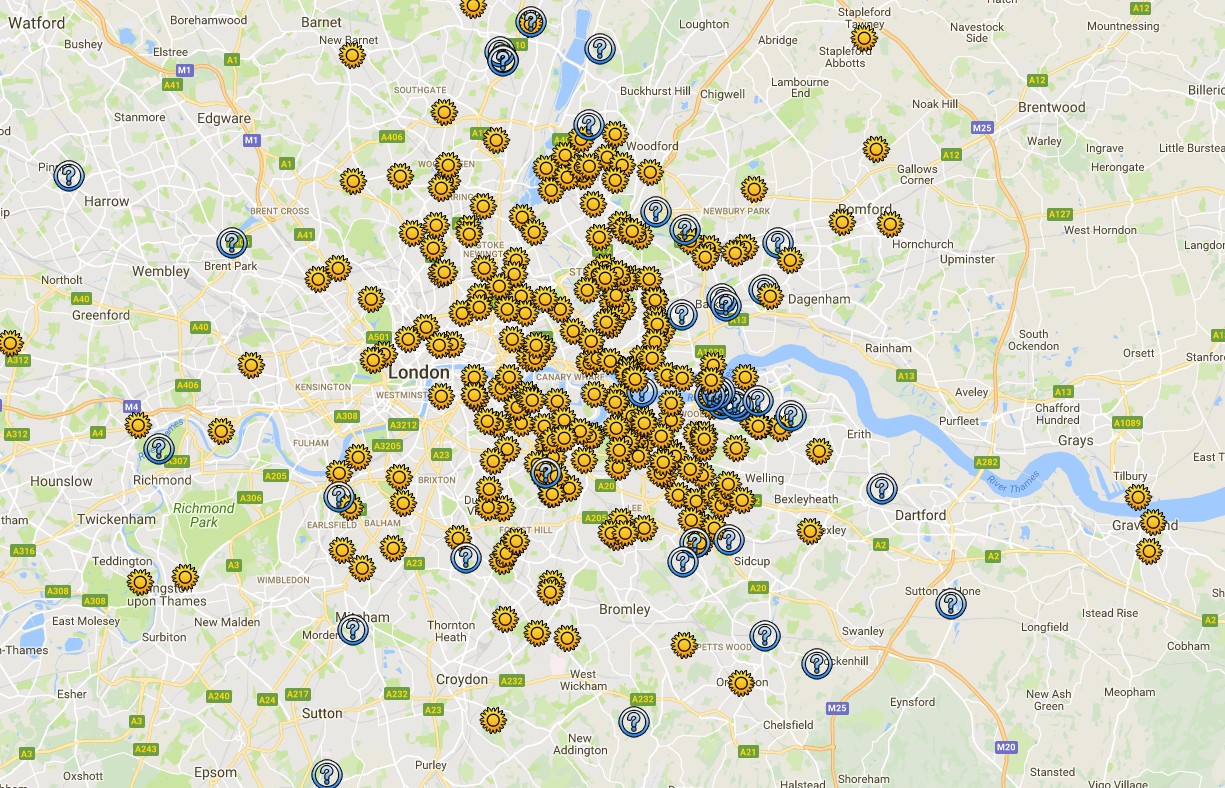
    Let’s remember that von Braun was a Nazi, worked hard for Hitler’s ear to keep his projects rolling, and used slave labor (12,000+ of whom were worked to death at Peenemunde and related sites) to build his “famous rocket”, the great forerunner of “today’s gigantic missiles”. The V-2 began its life ending lives soon after D-Day, with more than 5,000 of them launched primarily against British and Belgian targets, killing 2,754 and wounding 6,523 in London, alone, and terrifying everyone. His pioneering spirit can be seen in the following extraordinary map, which begins to show the V-2 action on London:

    V-2 map

    map via The Londonist https://londonist.com/2013/06/v2

    The map makes quite an impression, no? 

    And he helped create the U.S. space program. 

    Back to the book jacket–what else could they say, I wonder, back in the thick and near-disastrous days of the Cold War?

  • Found-Art in Scientific Journals–“Mechanical Engineers” and Endless Chain Haulage, 1870

    JF Ptak Science Books   Quick Post

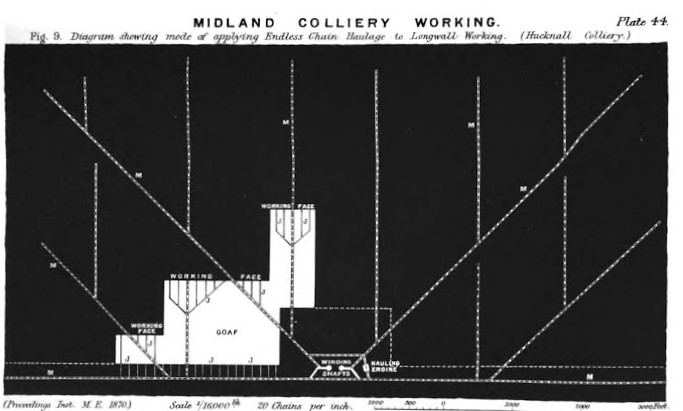
    I do believe that the engineering journals–particularly those from the 19th century–hold great promise for “Found-Art”:  these are images out-of-context whose whole or components are attractive from an artistic sense that was generally not regarded as “artful” until the creation of non-representational art in 1911. After all, art is the West spent a millennium or two trying to represent nature as closely as possible to what the eye perceived. (If you use 2000 years as a starting point for this discussion, it is remarkable, in a way, that perspective was (re-?) discovered in the West for fully two thirds of that time.) In any event I’m not going to get into a big discussion of all of that in this post, as the Found-Art business appears numerous times on this blog and I’ve chatted on about it there–so if you want to read that discussion just search “found-art” in the google box at right and have at it. For now, all I want to do is share the latest find, which comes from the Proceedings of the Institution of Mechanical Engineers, 1870, and published in Birmingham, in the article on hauling coal from Hucknall Colliery, Notinghamshire.  The seems like it might be a cross-section but I’m fairly well certain that it is a plan of some of the mine’s workings, the straight lines being the constructed and the future rail lines for the coal buckets that hauled out the chiseled-away coal. It is extraordinary, really, to think about all of this happening 600′ down, powered by steam, in the dangerous choking/exploding dark.

    [Note: this image becomes much sharper when you click and expand it.] 

    Mechanical Eingeers Proc 1870 Coal mine

  • Proving that Heavier-than-Air Powered Flight was Possible–Samuel Langley, 1896

    JF Ptak Science Books   Post 2743 

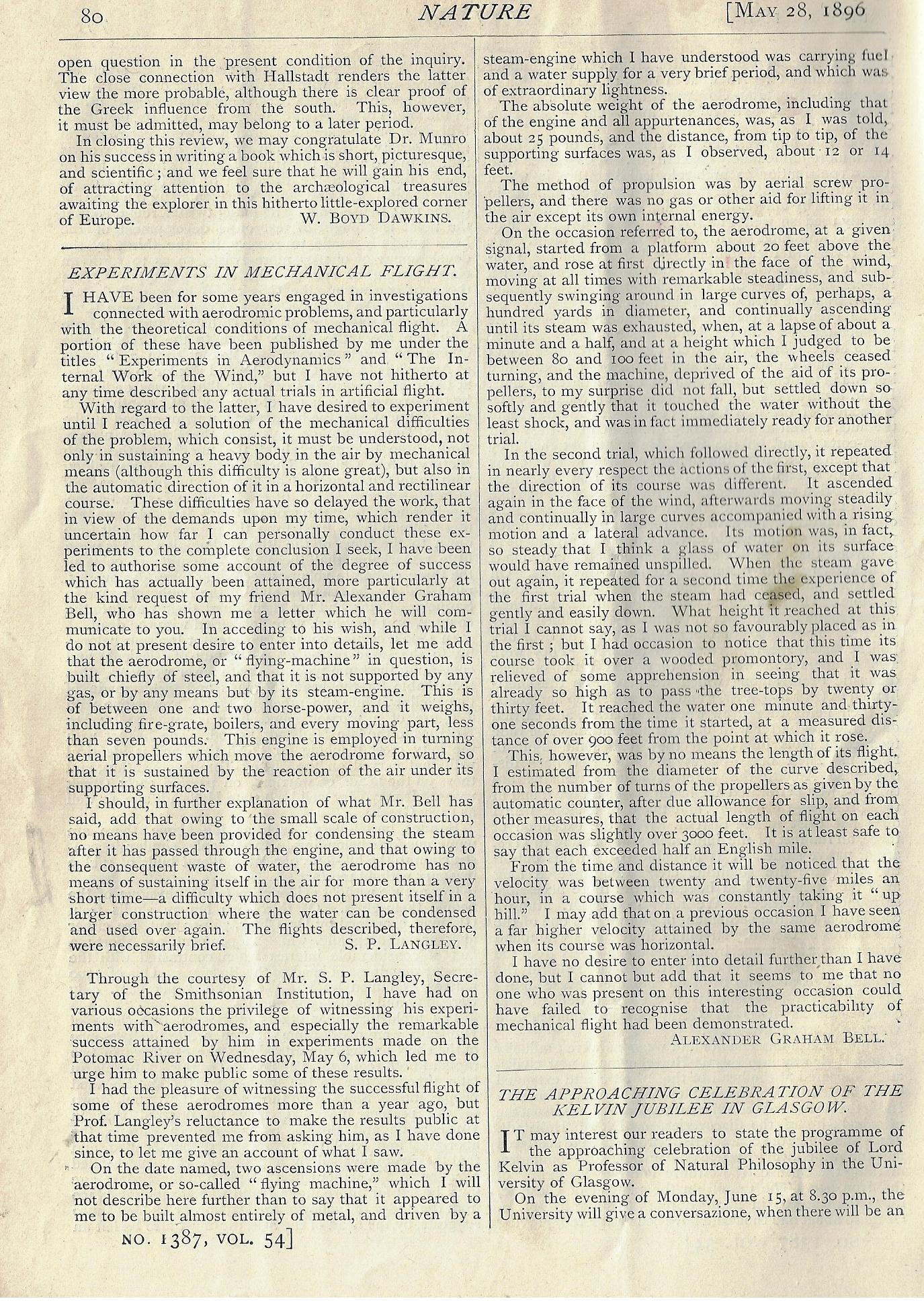
    I came upon this article last night in the pages of Nature–it doesn’t look like much, but it turns out to contain a first-person account of an historic moment in the history of aviation. The article, “Experiments in Mechanical Flight”, is by Samuel Pierpont Langley (1834-1906) and Alexander Graham Bell (1847-1922). and appears in volume 54, May 28, 1896, page 80 in the issue of pp 73-96. It contains the first account printed in England of heavier-than-air non-piloted sustained powered flight–and proof that mechanical heavier-than-air flight with existing technology was real. (This article appeared on 28 May; a somewhat shortened account appeared in Comptes Rendus… two days earlier, on the 26th. The first printed announcement of the event  seems to have been in Science, May 22, 1896, according to Brockett’s Bibliography of Aeronautics, #7160.)

    I think most people remember Langley as the (Third) Secretary of the Smithsonian Institution and for his work in astrophysics and observational astronomy, but he was a significant figure in the history of aviation, publishing his first extended work in the field in Experiments in Aerodynamics in 1891, and became one of the first if not the first aerodynamics experimenter in the U.S. He was also the first government-sponsored in-house researcher in this field.
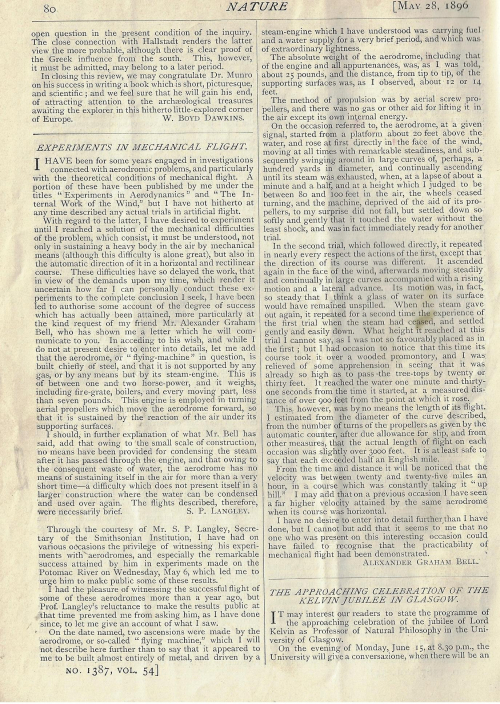
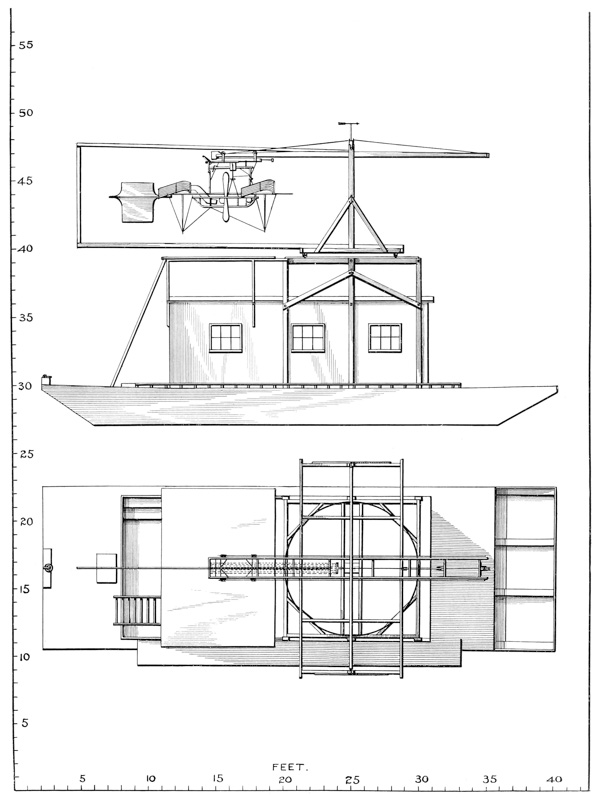
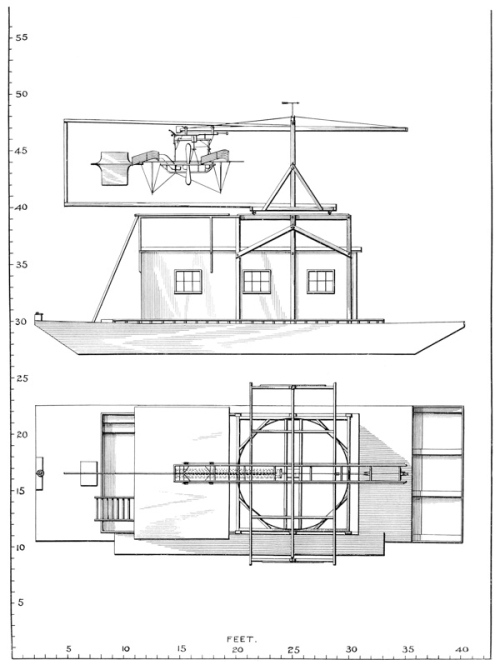
    Langley textThis article (or notice, really) covers Langley’s  historic experiments of 6 May 1896 with his 13′-wide Aerodrome 5–the fifth iteration of his mechanical flying machine–which was launched from a makeshift “houseboat” (“…nothing more than a scow about 30 feet long by 12 feet wide, upon which a small house was erected, to be used for the occasional storing of the aerodromes…”)1 moored in the Potomac River a few miles south of D.C. near Quanitco, Virginia. There was one witness to this affair, Langley being very concerned for privacy, particularly not wanting news of failures to reach a general audience. His guest observer was his old friend, Alexander Graham Bell, who had already witnessed some of Langley’s earlier attempts with models and made monetary contributions to help fund the larger enterprises. Langley had no interest in making the report—though he did invite Bell to do so. And it is the second part of this short, two-part paper in which Bell’s observations appear.

    Langley’s own description of the aircraft appeared in his Mechanical Flight2 : “The aerodrome was built chiefly of steel, though lighter material entered into the construction, so that its density as a whole was a little below unity. No gas whatever entered into the construction of the machine, and the absolute weight, independent of fuel and water, was about 11 kilos (24 pounds). The width of the supporting surfaces was about 4 metres (13 feet), and the power was furnished by an extremely light engine of approximately one horse-power. There was no one to direct it on board, and the means for keeping it automatically in horizontal flight were not complete. It is important to remark that the small dimensions of the machine did not allow it to include any apparatus for condensing the steam, so that it could only carry water enough for a very brief course—a drawback which would not be encountered in one of a larger construction.”

    Bell’s description of the aircraft: “On the date named two ascensions were made by the aerodrome, or so-called “flying machine,” which I will not describe here further than to say that it appeared to me to be built almost entirely of metal, and driven by a steam engine which I have understood was carrying fuel and a water supply for a very brief period, and which was of an extraordinary lightness.” And “The method of propulsion was by aerial screw propellers, and there was no gas or other aid for lifting it in the air except its own internal energy…The absolute weight of the aerodrome, including that of the engine and all appurtenances, was, as I was told, about twenty-five pounds, and the distance from tip to tip of the supporting surfaces was, as I observed, about twelve or fourteen feet3.”

    The flying experiment began, and much to the delight of Langley, Bell, and the men who fished previous flying efforts from the Potomac, the two Aerodrome 5 flights for the day were successful. The first flight brought the steam-driven, one-quarter-scale model made a half mile at altitudes of up to 100 feet, marking it the world’s first flight of its type. The second flew longer, and faster (3300′ and 9 seconds aloft), and Bell was much impressed by the serenity of the plane’s descent once the engine exhausted its fuel, turning the plane into a glider that touched lightly down onto the Potomac.

    Bell was thrilled with the display, and recorded what he felt:

    • The flying machine “resembled an enormous bird, swooping steadily upward in a spiral path until it reached a height of about 100 feet in the air.”

    And then, Bell famously observed:

    • “It seems to me that no one who was present on this interesting occasion could have failed to recognize that the practicability of mechanical flight had been demonstrated.”

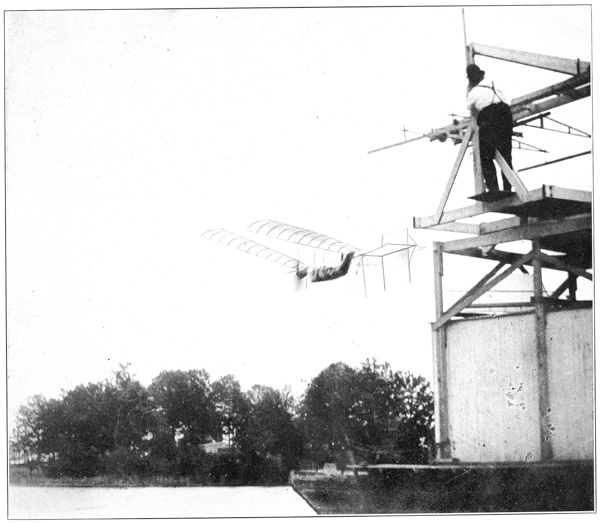
    The once-reticent Langley himself writes an account of the event in “The Flying Machine” in the June 1897 issue of McClure’s (vol IX/2)–this was a very public article in a very popular magazine that also featured a drawing of the aerodrome right on the front cover.  The article also includes the Bell observations as well as the first printing of the photograph that Bell made of the second flight, the first of its kind, though it is really a drawing after the photograph, the photo itself used as proof of the event and the drawing done to enhance that. The coverage of the event and the Bell statement also appears in the Smithsonian Reports for 1896 (published in 1897). Later, Scientific American Supplement #1404 , Nov 29, 1902, reprints the Bell observations and other historical statements in “The Langley Aerodrome”.  
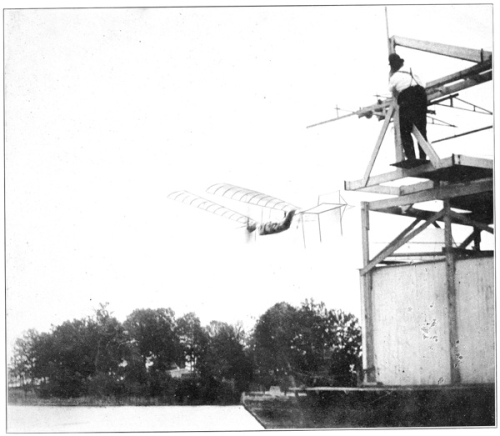
    Langley flightThe Aerodrome 5 in flight. Image via Langley’s 1911 Experiments…(see below; the image is not in the Nature article)

    Even in the face of support of U.S. presidents and stipends from the military, and with a history of mounting successes, the public failure in two attempted flights of his expanded, full-size Aerodrome A (a refitted and larger #5 and #6, this time designed for a pilot, and powered by a state-of-the-art 52hp engine designed by Charles Manly) on October 7, 1903 proved to be too much for Langley and his supporters, resulting in a withdrawal of funding, and the relatively quick retirement of Langley from this field. Just weeks later (December 17) the Wrights made their historic flight at Kitty Hawk–they were successful in many of the ways that Langley was not and made the first manned, powered, controlled, and sustained flight. Early aviation expert Tom Crouch of the National Air and Space Museum remarked that “The problem was the machine itself and Langley’s approach…he did just about everything wrong that the Wright brothers did right. “4

    That said, John D. Anderson Jr in the AIAA Journal states that it must not be overlooked that “[Langley] made extensive use of aerodynamic coeffcients and legitimately shares with Lilienthal the credit for introducing the concept of lift, drag, and resultant force coeffcients to the applied aerodynamics community. His data are the first substantive proof of the aerodynamic superiority of high-aspect-ratio wings over those with low aspect ratio; it is curious that Langley is not widely recognized for this important contribution.”  And significantly, “the work did serve a very useful purpose. The fact that a man of Langley’s stature believed in the possibility of the flying machine was enough to convince most laymen that aeronautics was no longer the pastime of fools.”5

    NOTES

    1. Samuel P. Langley and Charles Manly (editor), Langley Memoir in Mechanical Flight, Smithsonian Contributions to Knowledge, Washington, D.C., 1911. Part I (Langley), 1887-1896; Part II (Manly), 1897-1903. 
    2. _____. Langley, p. 123.
    3. From the Nature article, quoted above.
    4. Lee Wolff, “First in Flight (Almost)”, http://www.chopawamsic.com/First%20Flight.htm
    5. John D. Anderson Jr., “ Langley’s Aeronautical Research: A Modern Critique and Reassessment”, AIAA JOURNAL Vol. 35, No. 3, March 1997 Historical Review Paper.

    The extended  quote by Bell in the last three paragraphs from the Comptes Rendus:

    “La durée du vol, dans le second essai, fut d’une minute et trente-une secondes et la vitesse moyenne entre vingt et vingt-cinq milles à l’heure (soit dix mètres par seconde) sur un trajet qui fut constamment en pente ascendante.”

     “Je fus extrêmement frappé du vol aisé et régulier de la machine dans les deux essais, et du fait que lorsque l’appareil, privé de la force motrice de la vapeur au plus haut point de sa course, fut abandonné à lui-même, il descendit chaque fois avec une égalité d’allure qui rendrait tout choc ou tout danger impossibles.”

    “Il me semble que personne n’aurait pu assister à cet intéressant spectacle sans être convaincu que la possibilité de voler dans l’air à l’aide de moyens mécaniques venait d’être démontrée. “ 

    The “hosueboat”, with launching apparatus and with the aerodrome in place (from Langley, 1911):   Langley hosueboat
  • Outsider’s Guide to 57 Things that Weaken America (1923)

    JF Ptak Science Books  Quick Post   From the series on Questionable Quidity

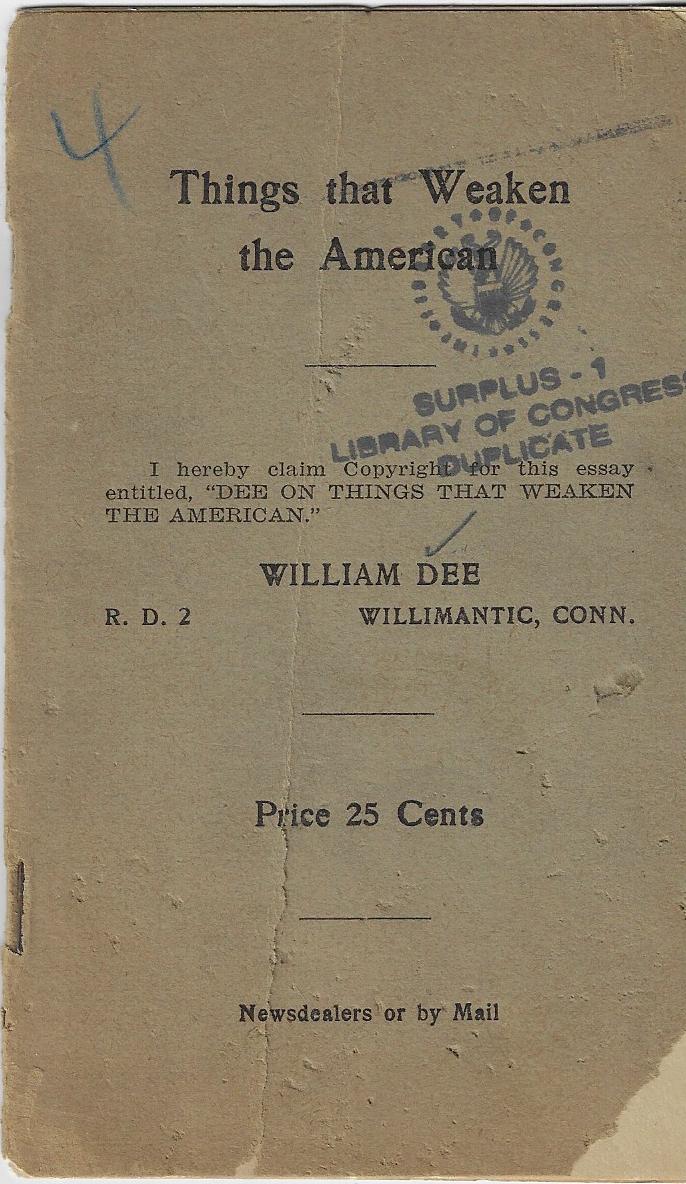
    Books covers things that weaken americaWilliam Dee, of Willimantic, Connecticut, set out in 11 pages his 57 complaints of Things That Weaken America. Some of them are actually more or less relatively maybe sometimes semi-correct with qualifications, others not so, and still many others being most definitely anti-correct. Some bits are straightforward and make no argument or explanation, as with the entries for artificial teeth (“remove them after eating”), tragedies (“avoid them”),  and city living (“is unnatural”). Others are more expansive and inscrutable, as with the entry that rails against a vegetarian diet, ending with the need to sleep alone so that your bedmate does not draw off your vitality with their magnetism.  The short and skimpy pamphlet has a sort of Devil’s Dictionary feel to it, though without the barbed wit and insight and artfulness. Why Mr. Dee stopped at 57, and why he didn’t really address anything that really threatened the United States, I do not know. 

    The writer strikes me more a 19th century person than a 20th c–perhaps he was born in 1863, which means instruction from his parents were probably taken from their 18th c parents, and the sentiments of the newness of the 1880s and 1890s just never gave way to the modern age. And maybe not.

    Here are other examples (spelling, grammar, and etc. as found in the original):

    • City Living: “Is unnatural.”
    • Artificial teeth: the only advice was to “remove them after eating”.
    • Exercise: “Hurtful to those whop are already over-exercised, by 100 times, from modern efficiency.” (?)
    • Night-time work: “Good for night-hawks, but bad for honest workmen. It is another short cut to the poor house.”
    • Steadily Working: “This gives no chance for the workman to rest and become his original self again” In lieu of frequent vacations, “take two hours’ rest at mid day.”
    • Doctors: “Some doctors have been known to keep their patients ill for income.”
    • Choir singing: “People who are not making a living at it should avoid it.”
    • Unfortunate marriages: “Have a reliable physician examine both for perfect health and avoid hell on earth…”
    • Sentimental music: “It weakens the body.”
    • Graduation exercises: “A strain on the strongest and a set-back to others. Unnecessary. Abolish.”
    • Too Ambitious: “Causes too much draft on the vitality.”
    • Public Opinion: “Bad if against you.”
    • Too Much Work: “Four hours in 24 is enough for Ford efficiency. Have frequent vacations.”
    • Vegetarian Diet: “Avoid it.” Also, without explanation: “Sleep alone to be sure that the larger oneis not drawing on your vitality by a more powerful magnetism”. 
    • Weakening Dreams: “Very bad.”
    • Love: “Very weakening. Marry the girl.”
    • Houses: “They should be small to be easy to burn in case they become infected by germs.”
    • Polluted Water Veins: [Too long and odd to transcribe.]
    • Psychological Illness: “Keep away from sick people if you are troubled.”
    • Strains: “Avoid them.”
    • Hard Study: “Avoid as much as possible.”
    • Tragedies: “Avoid them.”
    • Home Talent Shows: “Utterly ruinous to those who work for a living.”
    • Piano and Organ Playing: “Mental and nerve burden. Avoid. Health is better than music.”
    • Love Letter Writing: “Very bad. Marry the girl.”


  • A Note on Speculative Scientific Writing on “Infinitely Probable” Extraterrestrial Life, 1897

    JF Ptak Science Books   Quick Post

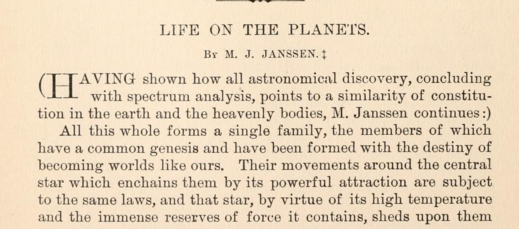
    Deep into a stellar, pioneering, and very productive 350-paper career  (Pierre Jules Cesar Jules Janssen, 1824-1907) wrote this interesting paper that appeared in Appleton’s Popular Science Monthly (volume 50) in 1897 (translated from his address to the French Academy of Sciences on 24 October 1896), speculating on the possibility of teeming life elsewhere and on the unity of the laws of science and nature. He was a great traveler in the name of astronomy, an independent researcher with a house in Montmarte and a maker of his own telescopes and spectroscopes (that in the first decade of the science), who via a mistaken identification of finding oxygen in the spectrum of Mars1 (1867-1869, in the middle year of that discovering helium), came to a realization that life existed on Mars. And from there Janssen went on to create the possibility of worlds throughout the universe, all brought about by the creation of the science of astrophysics in which he made such important contributions.  There’s a lot in these few short pages, including this interesting speculation:

    • “I say further that what we know of the unity of the chemical composition of the matter of the sun, the stars,
      and the nebulae permits us to make new inductions respecting the part performed by the bodies which are
      on the earth the most important factors of the phenomena of life. It is thus infinitely probable that hydrogen,
      oxygen, nitrogen, carbon, and especially water, which on the earth are the indispensable constituents of
      vegetable and animal life, fill a like office not only in the planets of our system, but throughout the universe.”

    Janssen is one of many who speculated on life in the universe, even among spectroscopists of Janssen’s time (including William Huggins, Angelo Seechi, Heinrich Schellen), part of a continuum of thinkers reaching back to Bruno (1584), Kepler (Somnium, 1634), Wilkins (Discovery of a World in the Moone..., Borel (1657), Fontenelle (the great Pluralitie des mondes, 1686), Huygens (1698), Derham (1714)…the list begins to get pretty crowded in the 18th century.


    Janssen life other worlds _a_

    • [Images sources all via Internet Archive, here: https://archive.org/stream/popularsciencemo50newy#page/812/mode/2up]

    ·Posted by :

    ·in:

    —
  • First Appearance in Print of the Terms “Relativity Theory” and “Theory of Relativity” 1906

    JF Ptak Science Books  Quick Post    Part of the series on “Naming Things”

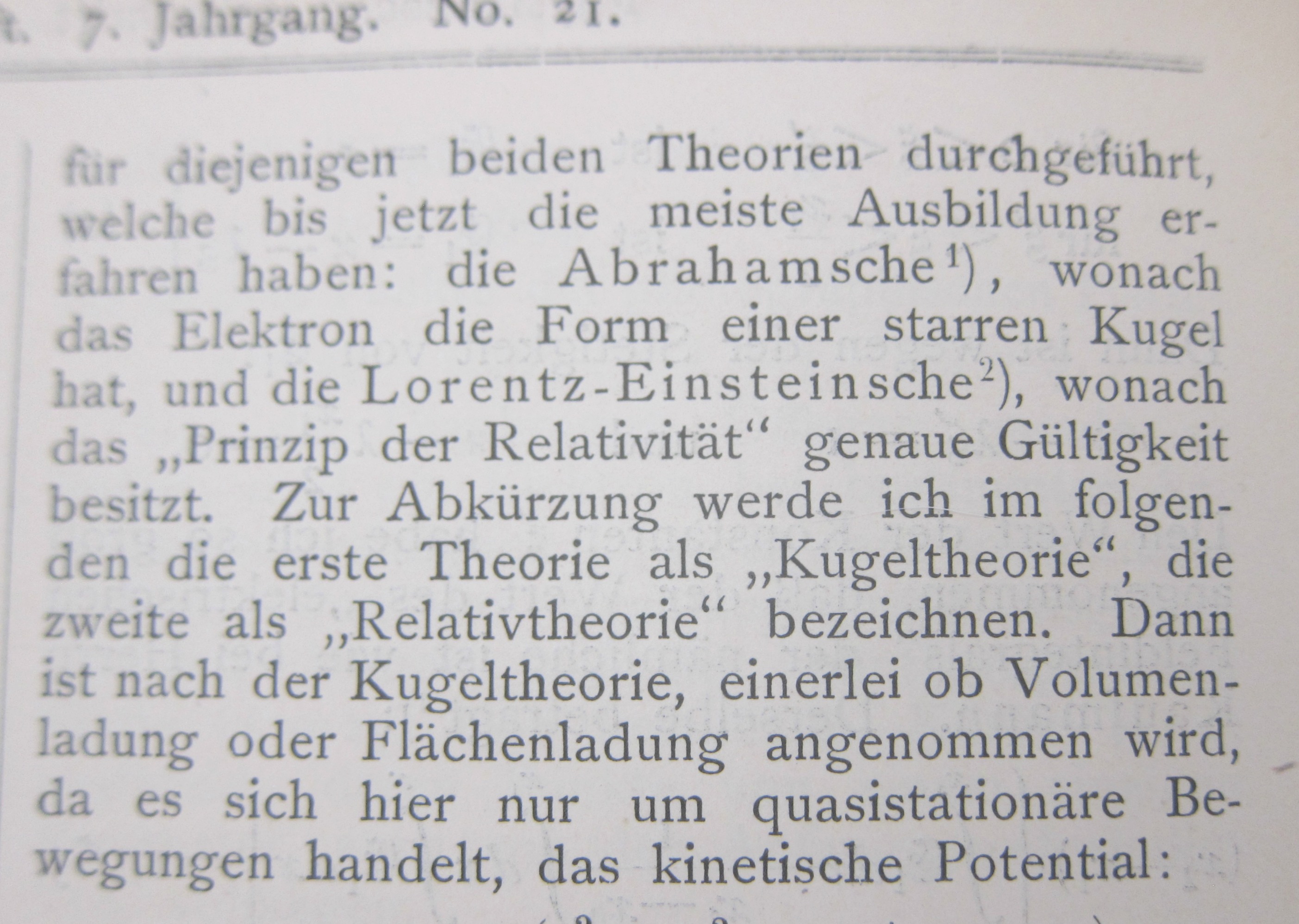
    It was very surprising, finding this, the first time that something so familiar as “relativity theory” appeared in its most familiar form. It appears very soon after the publication of the Einstein 1905 paper, a work by Max Planck1 that appeared in the Physikalische Zeitschrift in 1906:

    Einstein relativtheorie

    Prior to using the words “postulate” and “principle” associated with relativity (as in “Prinzip der Relativitat”, appearing in the second paragraph of Einstein’s June 1905 “Zur Elektrodynamik bewegter Körper” in Annalen der Physik)  it is first referred to as “relativity theory” (“Relativtheorie”) by Max Planck on p. 756 (col 2 line 9 and also on pp 758+759) of this volume. Then in the “discussion” part of the Planck paper the“theory of relativity” (“Einsteinische Relativitatstheorie”) appears for the first time in print just a few pages later (p. 760 col 2 line 15) by Alfred Bucherer.

    And there it is.

    Notes:

    1. Max Planck, “Die Kaufmannschen Messungen der Ablenkbarkeit der β-Strahlen in ihrer Bedeutung für die Dynamik der Elektronen” [The Measurements of Kaufmann on the Deflectability of β-Rays in their Importance for the Dynamics of the Electrons],Physikalische Zeitschrift in 1906, volume VII, the paper occupying pp 753-761 (printed in double columns), printed in Leipzig by S. Hirzel. There are other papers of relativity in VII including Wacker (p 300), Farkas (p 654), Stark (p 353), and Wilkens (p. 846).

    • “The term “theory of relativity” was based on the expression “relative theory” (German: Relativtheorie) used in 1906 by Planck, who emphasized how the theory uses the principle of relativity. In the discussion section of the same paper, Alfred Bucherer used for the first time the expression “theory of relativity” (German: Relativitätstheorie).”–Wikipedia

    ·Posted by :

    ·in:

    —
  • Excellent Crowd Scene–Soldiers Viewing a Boxing Match, 1918

    JF Ptak Science Books    Quick Post

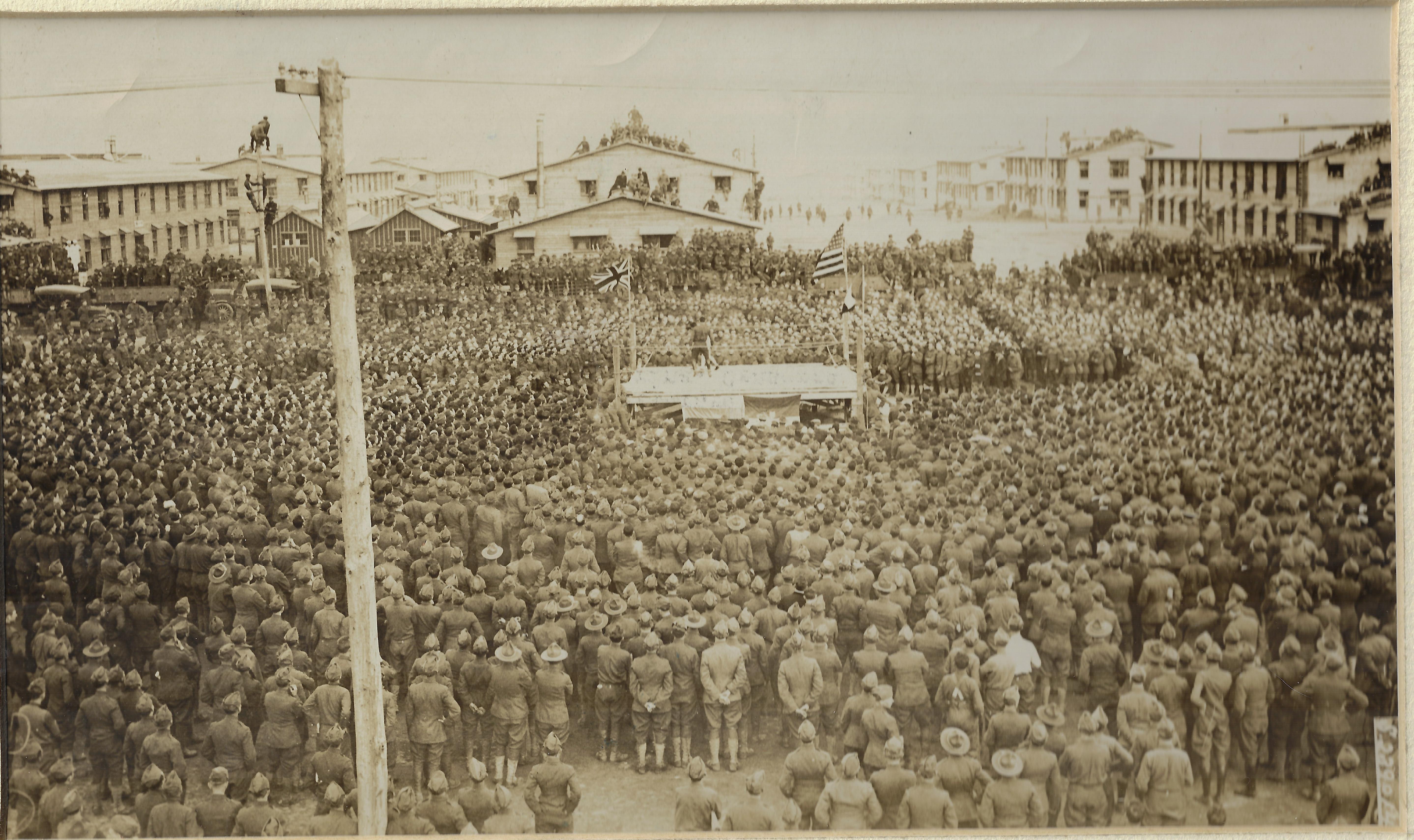
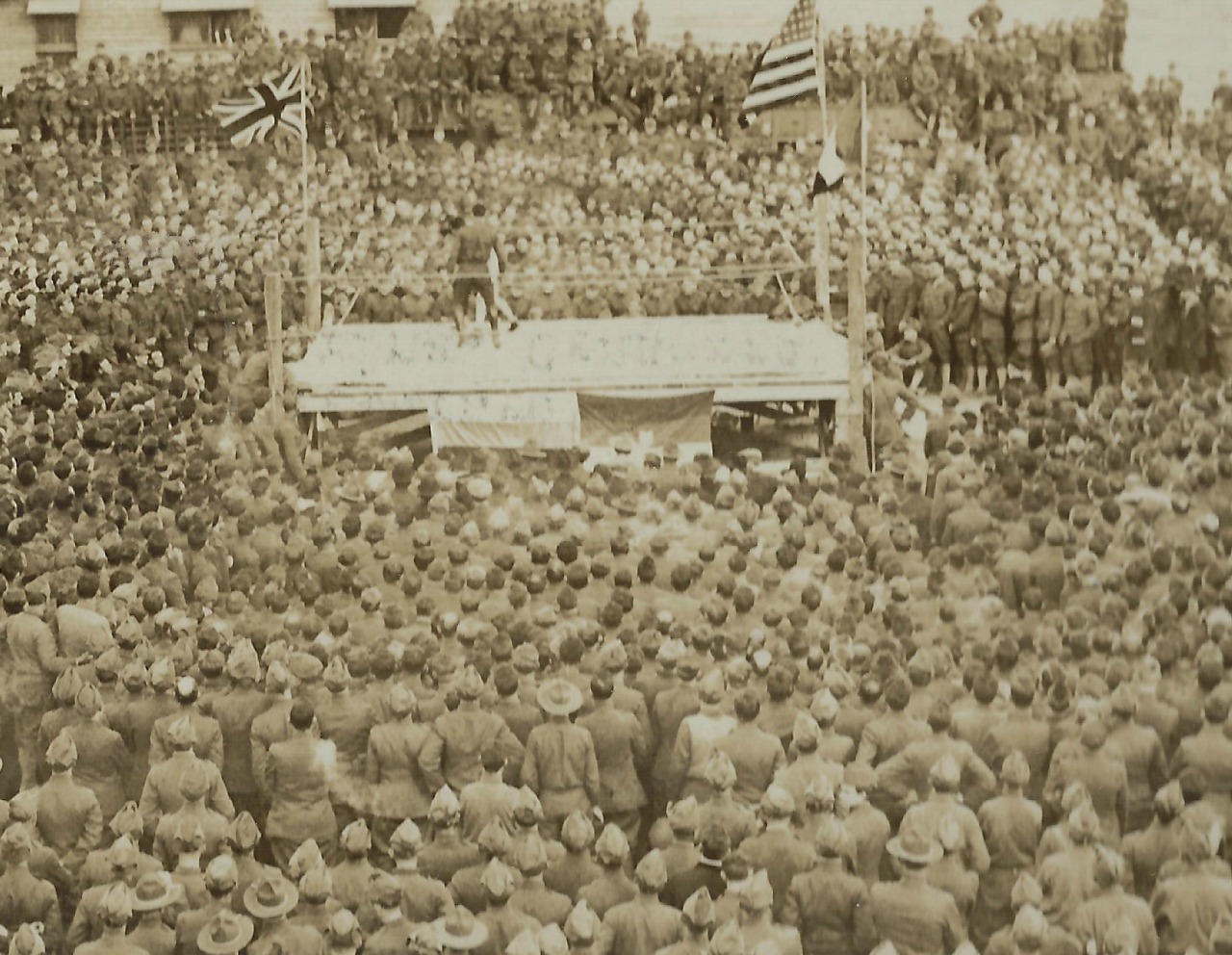
    I’ve posted probably 100+ images from a stash of WWI News Photo Service photographs that I have here (you can find some of them by clicking on the WWI Photos link at the top of each page, located just under the blog’s banner, and read about the photo services) and the one I’m hosting today is one of the few sport-centric images in the 550 item collection. This is a “championship” bout being held at Camp Upton (Long Island, NY) in ca. late 1917/early 1918. The photos usually came with a typed description of the event that was used for a caption by the newspaper or magazine that published it, and this one (reproduced below) describes the scene. I’ve tried to enlarge some of the areas of interest in the image, but the original isn’t sharp enough to allow for more than about 250% increase. But that is good enough to give the viewer a sense of the density of the crowd, and the makeshift atmosphere surrounding the event.  

    WWI Photo Boxing Photo

    And the detail:

    WWI Photo Boxing Photo detail

    ·Posted by :

    ·in:

  • Tech Quiz: an Elevation of an Elevation (1880)

    JF Ptak Science Books   Quick Post

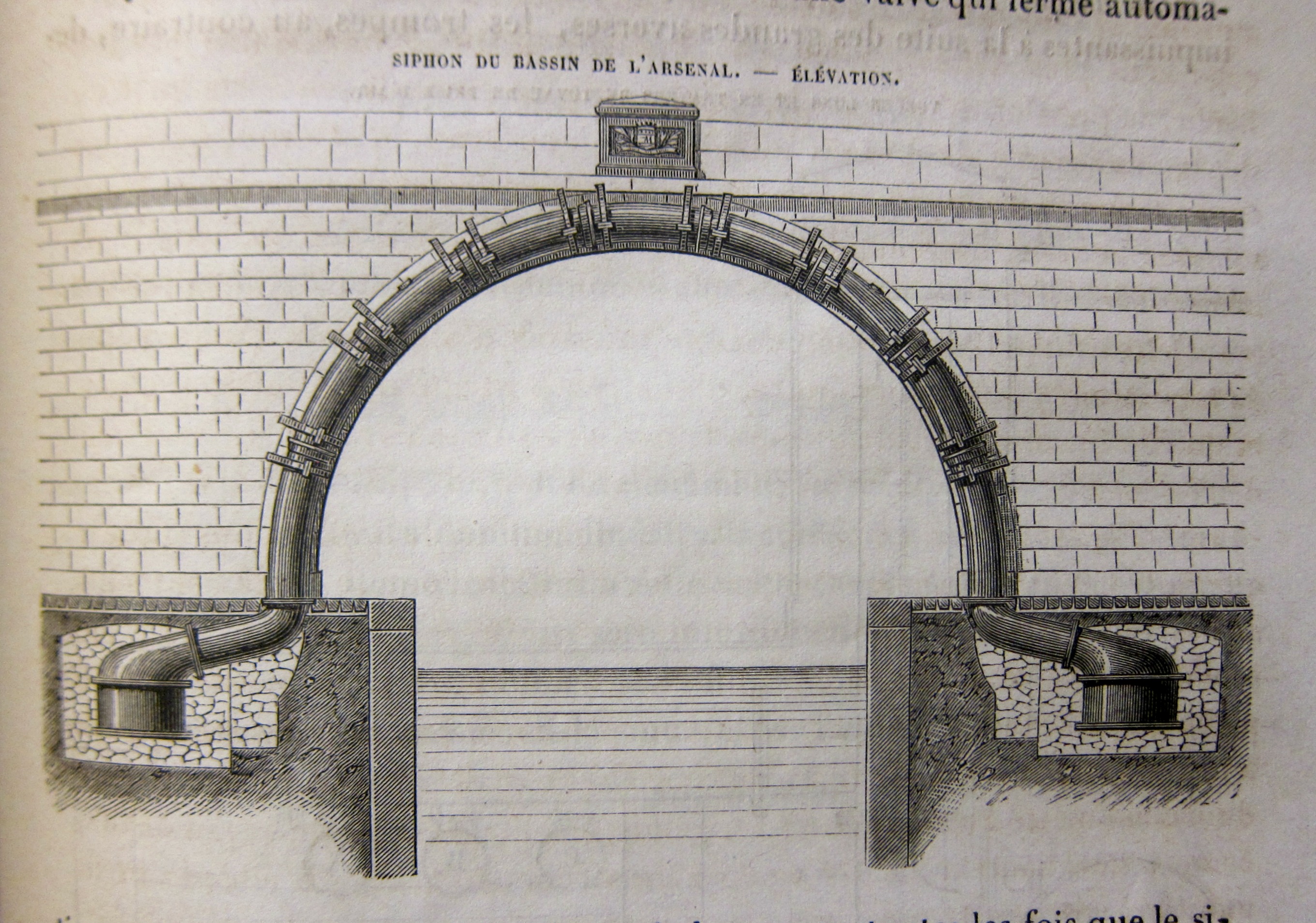
    This is just a lovely little mechanical drawing that I found in the pages of the 5 May 1880 issue of the Comptes Rendus de l’Academie des Sciences and I decided to share it. The Comptes Rendus is a very old workaday maintstay in my job, and I have become very familiar with it over the years, and in its great heyday in the 19th c it published all manner of scientific events over many disciplines, and at the highest level for each field. I’ve never really paid too much attention though to the illustrations in the journal as general “art” as I have done with other journals (like the Annalen der Physik)…why, I don’t know. In any event I was working on a two-part Pasteur paper in this volume and noticed this elevation of a “siphon” for Napoleon’s canal Saint-Martin, which is just about at the center of old Paris. 

    SciArt CR 1880 Siphon

    The structure does look a little like a headphone, and as pretty as this is, it subject matter wasn’t. This is a sewer line that would allow the sewage and etc. to flow over the canal along the arch of a bridge…which makes this an interesting problem. I mean, it is a necessary and important thing, dealing with waste, and that is exactly what this pipe was all about. 

  • A Quick and Logical Dispatch of ET-Built Martian Canals (1895)

    JF Ptak Science Books   Post 2744

    A friend of mine forwarded an article to me that in one clear paragraph would seem to demolish the widely hypothesized belief in Martians (of some sort) building the relatively-recently discovered “canals” of Mars. As succinct and logical as it was, it seems not to have made much of a dent in the popular belief system of Martian structures having been built by intelligent life forms. The note was written by a Miss M.A. Orr and was published in the Journal of the British Astronomical Association (vol 5, 1895, p 209) and which also appeared in Publications of the Astronomical Society of the Pacific in their volume 7, April 1895, though this time the author was evidently mis-identified as “Mr. J. Orr”. The extraterrestrial debate for life on Mars is an old and long affair that I don’t want to set in motion in this short 20-minute post, so we’ll leave that for another time. For now, I’d just like to reproduce the body of the argument, which looks very sharp and compelling and has a nice hallmark of insight to it, and which I think could have been delivered as a debate coup de grace from which the opponent just could not recover without direct ET interference.

    Mars  Flammarion 1892 Schiaparelli

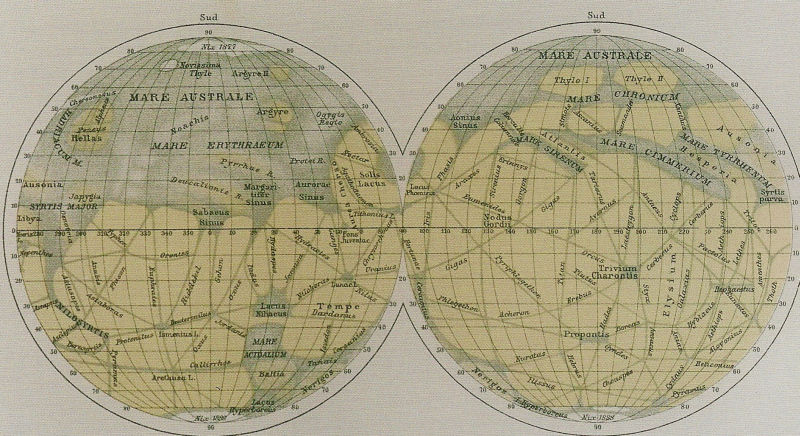
    Schiaparelli’s canali as shown in a  map from Flammarion’s book on the planet Mars, 1892.

    The short version of the short note is that the canals as identified in 1895 were iterated by Ms. Orr to have an average width of 33 miles,  an average depth of 70 feet, and an average length of 2000 miles, which is basically digging a ditch as wide as the English Channel but 2000 miles long (or from Dover to Moscow plus another few hundred miles)…for just one canal.

    Ms. Orr reckons that this would be the equivalent of constructing “1,634,000 Suez Canals”, and which would occupy a workforce of 200 million (Earthlings) for 1000 years.

    It is quite a mental image, no?

    No doubt there were many who dismissed the reasoning (as Edward S. Morse did with peppery ridicule and vinegar in his book Mars and its Mystery in 1907) because the life-on-Mars bit continued on for some time, exemplified by the astronomer Percy Lowell in his highly popular works on  pro-life views of Mars,  Mars and its Canals in 1906 and Mar as an Abode of Life in 1908.

    Why this argument didn’t pose a major roadblock to the thinking crowd of ET folks, I do not know, but from my brief survey, Ms. Orr seems to have had little impact on the debate with what looks like sound and simple reasoning.

    Here’s the text by Ms. Orr:

    “The Canals of Mars”, by Mr. J. Orr. Publications of the Astronomical Society of the Pacific, Vol. 7, No. 41 (April 1, 1895). 

    Mr. Pétrie read a paper by Mr. J. Orr, a member of the West of Scotland Branch, on ‘The Nature of the “Canals” on Mars.’ The paper, which had been read at Glasgow at the meeting of the Branch, was to show the almost absolute impossibility of the belief, which at one time somehow obtained popular currency, that the so-called canals were of an artificial character- the work of a supposed Martian race.

    By ruling grooves on a globe illuminated by a strong light, Mr. Orr calculated that the minimum breadth for visibility of the Martian canals must be about 33 miles. The length of an average canal, as measured on Schiaparelli’s map, is about 2000 miles; and since on our terrestrial canals a minimum depth is required, to insure a constant supply of water at the center (diminished by leakage, evaporation, etc.), a depth of at least 70 feet would be required in the case of such a Martian canal as Tartarus. Even granted that the diminished force of gravity on Mars would render the work of excavating a ditch 70 feet deep equal to a terrestrial one of 26 feet, it was calculated that the canals would contain about 1,634,000 of our Suez Canals, and would require an army of 200,000,000 of men, working for 1000 of our years, for their construction. Assuming that the population varies with the surface, since the area of the earth is about 3^ times greater than that of Mars, we should get a Martian population of about 409,000,000. All the adult males, and a large number of the women, must, herefore, have engaged in the great work.

    * The writer supposed the ‘ canals ‘ to be great fissures caused by the cracking of the surface in contraction due to cooling, the planet having reached a considerably more advanced stage in its life than the Earth.

    * Ά slide having been shown, representing the general canal system as given by Schiaparelli, the President (Mr. E. W. Maunder, of the Greenwich Observatory,) said he hoped that Mr. Orr’s statistical, but, nevertheless, amusing and instructive, paper might prove one more nail in the coffin of a very absurd idea, which had certainly got most undue currency – namely, that the canals on Mars could possibly be the work of human agents. The mere fact that the whole of the resources of one of the greatest nations in Europe had failed to dig a little ditch some 26 miles long, and, comparatively speaking, only a few feet wide, might, he thought, convince us that the people on Mars, supposing there were any, could scarcely excavate 80,000 or 100,000 miles of canals, 40 miles wide.

    ·Posted by :

    ·in:

Recent Posts

Archives

Categories