A Daily History of Holes, Dots, Lines, Science, History, Math, Physics, Art, the Unintentional Absurd, Architecture, Maps, Data Visualization, Blank and Missing Things, and so on. |1.6 million words, 7500 images, 4.9 million hits| Press & appearances in The Times, Le Figaro, Mensa, The Economist, The Guardian, Discovery News, Slate, Le Monde, Sci American Blogs, Le Pont, and many other places… 5000+ total posts since 2008.

  • Horses in the Sciences: Proving Nothing and Something

    JF Ptak Science Books   Post 1419   [Dedicated to our primum mobile family horse person, Emma Digh Ptak.]
    Horsepower281

    The history of horses in the sciences is not a very wide subject area, though I’d like to look at a few instances in which they help to prove both something and nothing–particularly in the third case below, when the “nothing” was a very big “something”. 

    First, in the history of horsepower (and such an odd history it is, having somewhat and famously to do with billing issues for steam powered engines) there is a certain restricted high-percentage element that are just no-go, unworkable ideas.  Some of them served as the basis for further and deeper thinking,and some of them were simply far ahead of the technical abilities of their times. 

    In 1825 Edmond Genet1 published an interesting book (Memorial on the upwards forces of fluids and their applicability to several arts, sciences and public improvements) which in and of itself is a milestone in a number of different technical aspects–one part of it though sensationally and beautifully elevates itself to the Not-Quite-a-Good-Idea-at-Almost-Any-Time Department.
    Horsepower282
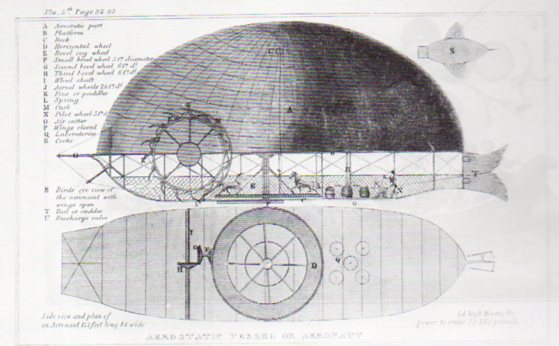
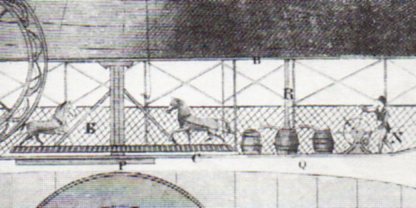
    “The actual plans of Genet’s airship called for a balloon shaped to resemble the rounded back of a large fish and containing about 1,023,000 cubic feet of hydrogen gas, with a platform or deck fastened beneath. Two horses, moving on a revolving wheel on this platform, were to provide the power for operation of a pair of large, silk-covered aerial wheels, while the rudder in imitation of a fish tail was intended “not only to steer the machine, but also to supply it with an additional force of propulsion”. –Genet in his Memorial…

    One thing that makes Genet’s work so impressive is that as a result of it he applies for and is granted the first patent made in the U.S. for a flying machine.  The flying machine he presented in his work though is a little problematic:  the canopy and the machine itself are not at all drawn to scale, and their size and breadth are lost a little in that under-representation.   I’d say that the figures in the drawing should be half of what they are, given that the flying machine was 132′ long and 46 feet wide (and 54 feet high), and the canopy was to be filled with a million cubic feet of helium.  The thing was a beast, and was supposed to be blessed with the capacity for lifting 72,000 pounds2.   The horses were along for the forward propulsion, moving two large paddle wheel-type wheels on either side of the airship.  It just doesn’t look right.

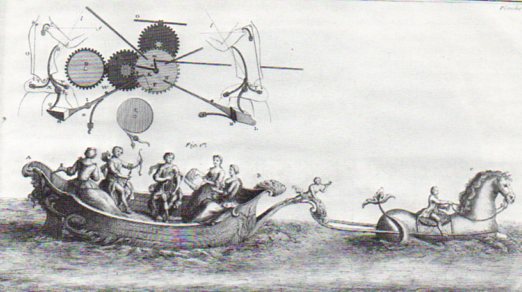
    Next is a tempting mechanism, an inset living inside a larger engraving depicting a mode of transport not-so-tempting.  It comes from Colonel Jean-Gaffin Gallon’s (1706-1775) Machines et inventgions approuvees par l’Academie Royale des Sciences....published between 1735 and 1777, and poetically covers its subject over a 111-year span from 1666 to 1777.   The massive work was illustrated with nearly 500 engravings covering all manner,shapes and description of technological invention and advancement, not the least of which was the first illustrated description of Pascal’s logic machine.  Amid all of this vast wealth of potentially revolutionary achievement,. I pluck out this equine example of possible nothingness: 
    Horsepower280

     which I am just not sure about, not having the text.  I can only hope that the horse was some sort of imaginary mechanical something, given its task and its size.  From the looks of its neck and the rider and the length of the horse, if it was a living thing it would have been gargantuan. 

    Here’s an appearance in the Gallon work (from 1735) of another, mechanical, horse that was used for stage productions, and which seemed fairly articulated:

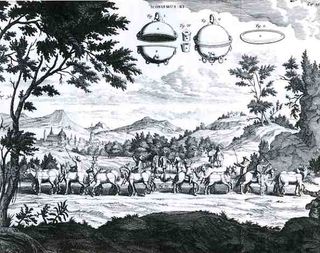
    And thirdly, there is this, perhaps the most famous image of horses in the history of scientific illustration:
    Mantegna vacuum von guer

    This beautiful illustration is from one of the greatest experimental physics books of the 17th century, coming as it does from Otto von Guericke’s  Experiemnta nova (ut vocantur) Magdeburgica de vacuo spatio (Amsterdam, 1672).  (In another minute department, this one is also I guess the greatest book ever written by a Mayor of anywhere (as von Guericke (1602-1886) was mayor of Magedeburg for 33 years).)  The image shows the greatest of von Guericke’s efforts, and one of the greatest (or most important) experiments in experimental science–the dramatic demonstration of the vacuum, showing here that teams of horses could not pull apart two halves of an evacuated sphere, and of course the efficacy of air pressure operating against it (um, the vacuum). The “floating” bits in the sky were an exploded view of the sphere that was the subject of the experiment. 
                   
    What was more important though, and what the general reader today might easily miss, was that von Guericke created something that many scientists and philosophers said didn’t, and couldn’t, exist:  the vacuum.  In modern times, Copernicus depicted the universe as a vast void; Descartes came in the back door (following the ancient and interesting though incorrect theory of Aristotle), not liking the idea very much, and claiming that such empty space couldn’t exist.  Von Guericke provided the proof that the vacuum, that nothing, did exist.

    As a matter of fact the issue of nothingness was very contentious, with the concept of its possibility and the display of a vacuum not achieved until this effort by von Guericke, with his team of horses tugging away at the essence of nothing.

    NOTES

    1.  Genet is best remembered in American history as “Citizen Genet”, at least far more so than that being remembered for gentleman farming or his work in aerostatics and invention.  “Edmond Charles Genet had tried to recruit American volunteers to serve in the armies of Revolutionary France and to outfit American privateers to fight against the British. Despite President Washington’s orders for him to desist from his high-handed appeals to the American public, he continued the same practices until he was forced from office. Washington permitted him to remain in this country as a private citizen, saving him saving him from the possibility of being guillotined for his failure.” So writes the great historian of Science I Bernard Cohen.  It wasn’t altogether true though that it was Washington who saved Genet; his being allowed to remain in the U.S. was strongly pursued and lobbied by Alexander Hamilton, Genet’s greatest detractor/enemy/nemesis in Washington’s cabinet.

    2. By contrast, the Wright I Flyer (the famous first-flight airplane of 1903) had a wingspan of 40 feet, weighed 625 pounds and sported a 12 horsepower, 170 pound  engine (and which by the way was all produced for about a thousand dollars–not nothing, but not a lot).
  • Little Pieces and Superb Design: Rockets, Canons, and other Boom Boom

    JF Ptak Science Books  Post 1420

    Artillery285

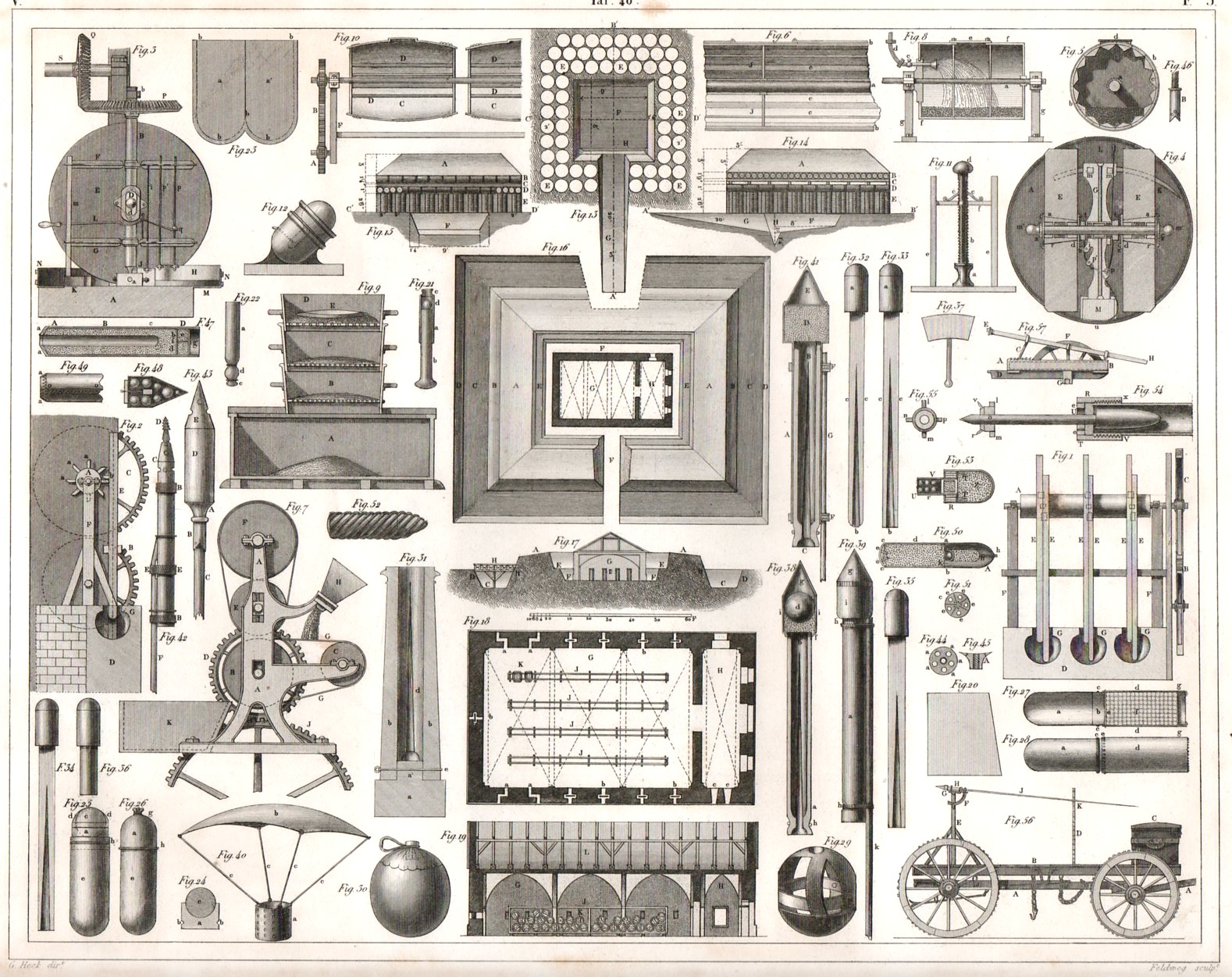
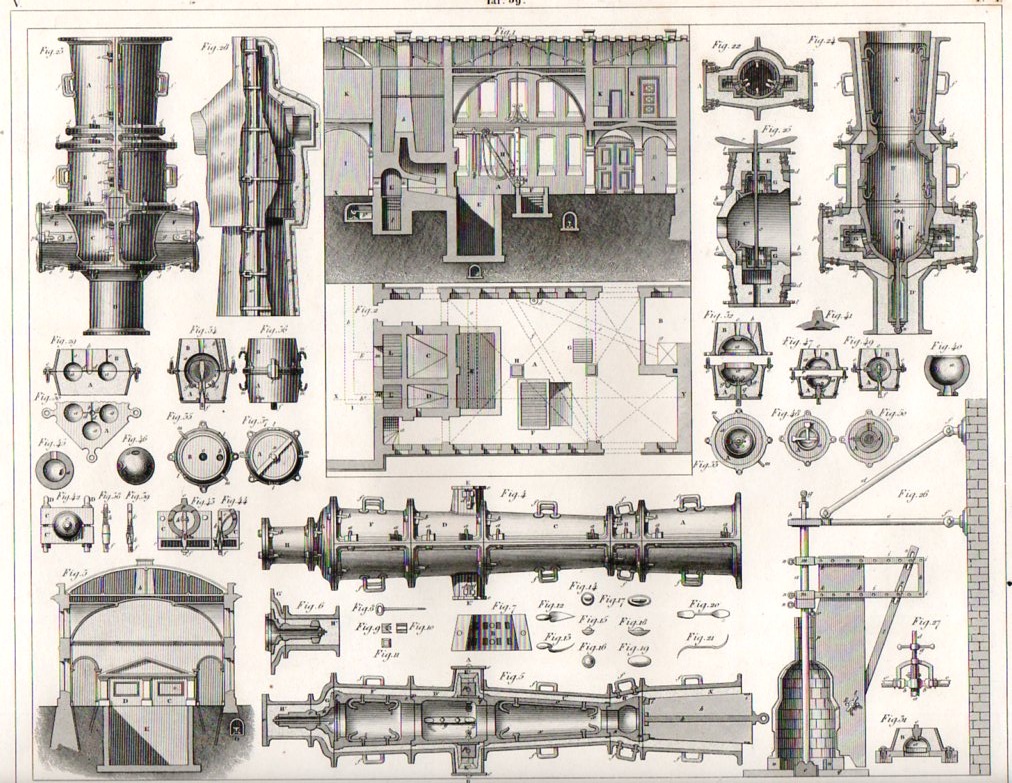
    The Iconographic Encyclopedia of Johan Georg Heck (printed 1851)  turns out to be perhaps one of the best designed books of its type in the nineteenth century.  Seemingly no  matter how much diverse information is hosted per page, whether the items number in the dozens or over a hundred,  the artist managed to distribute them with such grace and apparent ease that it is an absolute pleasure to see it all arranged before you. 

    Take for example the following two engravings of artillery fabrication of the early/mid 19th century.  There are 49 complex images on this first  piece of 11×8-inch paper (above), and yet there seems to be also a lot of white space.  It is a full but not crowded display of superb craftsmanship–it is also all very interesting. (Both are available for purchase from our blog bookstore.)

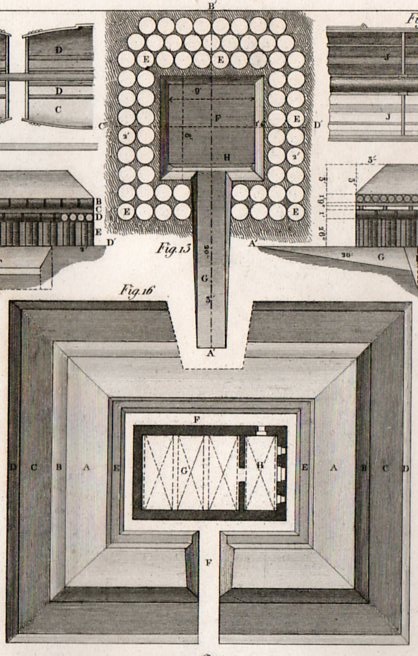
    To start, the main figures at top-center shop the plan and elevation of a workshop for casting canons, and we can clearly see the main furnace (“A”) for the big guns, surrounded by smaller auxiliary furnaces for smaller pieces.  Off to the side we see “K”, which is the drawing room and also the place where the director of the plant would live. Underneath it all in section we see various pipes and drains used to take away water and ash.  The structure on the lower right is for forming the business end and the purpose of the canon or mortar–namely, the ammo, and in particular, the pattern mold of a 50-lb mortar.  The long vertical pole at left used to place he liquid metal under pressure in the hearth, the ball being at the very bottom center.

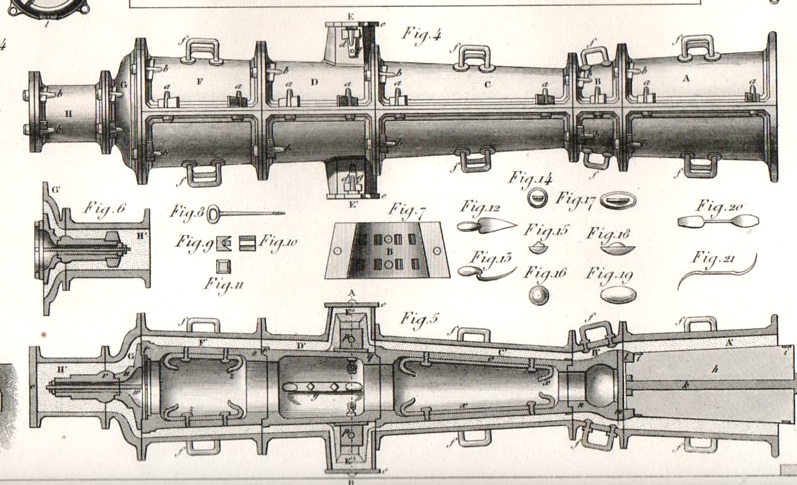
    I’ve enlarged figures 4 and 5 to show the particulars of a canon (dry sand) mold, #4 being the exterior of the mold and #5 showing a cutaway so that one could see the six-ponder canon that was being formed inside.

    Artillery286

    There is just so much in this image that a more knowledgeable person could easily go on for pages describing each and every bit. 

    The second image displays cartridges and (in general) fireworks–military pyrotechny.  What strikes me right away in this image are the five architecturals in the running vertically down the middle of the sheet.  They show what to do with gunpowder once it has been manufactured, which is an important consideration on handling and safety prior to it being used in battle–the first plan shows a field magazine, while the other four show the disposition of the construction of a permanent magazine, which show plenty of ventilation as well as massive walls which are in turn sunk into the earth and surrounded by ramparts.  It also seems that the roofing is huge, built no doubt to accommodate an earth filler.  Each of the barrels carried a hundred pounds of powder, so there was considerable interest not to allow the magazine to blow up, and if it did, to have the blast go mainly skyward. 

    Artillery287

    Some other items of interest in the second engraving include the incendiary devices (at bottom, #s 29+30),  signal rockets (#s 32,33,34,35), and the Congreve rocket, (#40 and #52,  which is much bigger and meant to be fired on the enemy, it being an incendiary); #53 is another Congreve, but this one scatters grenades as it is in flight. 

    Artillery288

    There’s a lot that can be described here but it goes a little beyond what I wanted to do with this post–it is also a lot beyond what I know about the subject.

  • Bad Ideas Department: Restructuring the City and the “Terminal Box”, Neopolis, 1938

    JF Ptak Science Books   Post 1421

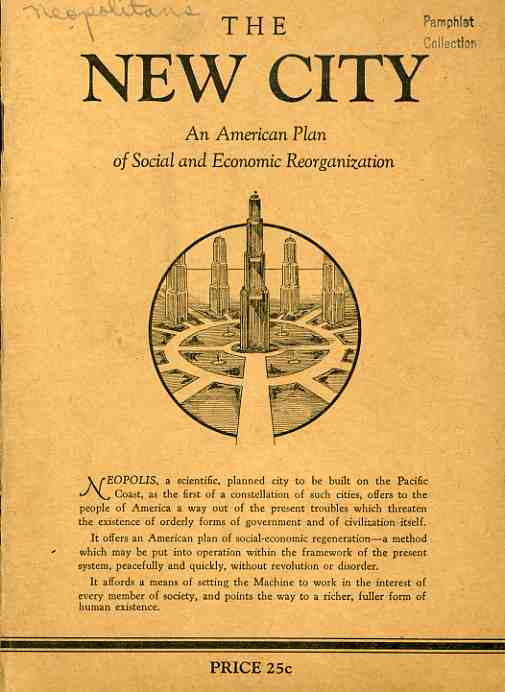
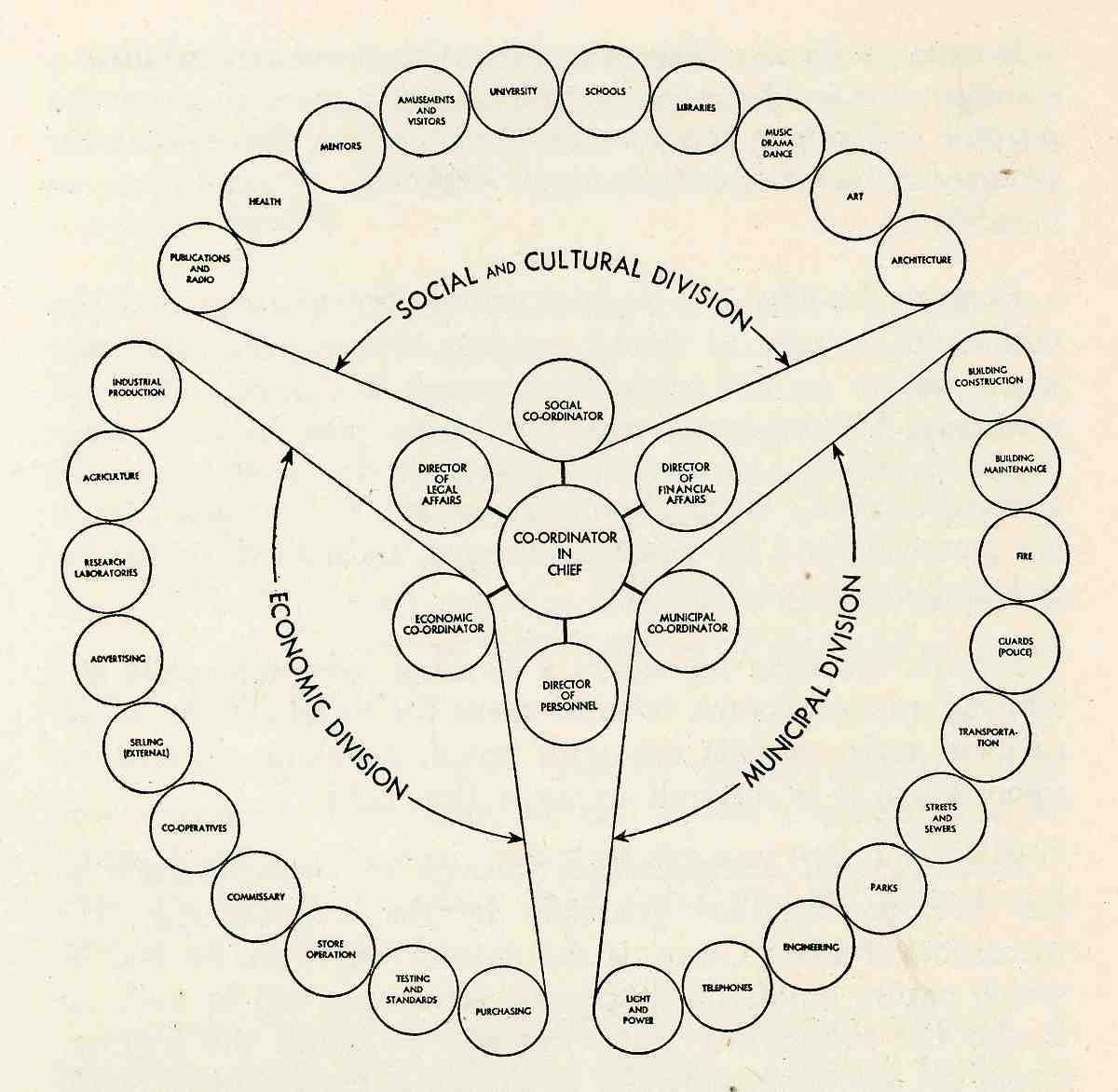
    0-blog---Nov 14 new city075 The unnamed author of The New City, an American Plan of Social and Economic Reorganization (1938), makes a hard-edged plea for the formation of a new American society—and by “new” the author really means it, advocating a different economics, social structure and even the physical development of new cities and abandonment of the old physical and philosophical structures. (The rare original of this deterministic futuristic publication is located at our blog bookstore.)

    Sprinkled among the Swiftian notions of rightness, quixotic lancings of social ills and a general bombardment of the structure of society are some interesting and isolated points: 
    “America is the supreme user of the machine…ravishing the irreplaceable wealth of one of the earth’s richest continents, tearing down forests, looting the treasures of coal and draining the reservoirs of oil and natural gas, by methods scandalously wasteful.” 

    This leads the author to the Depression, “a decade of demonstration of the profit system’s inability to deliver to the people the needs of life, a painful heartbreaking demonstration”.  0-blog---Nov 14 new city076

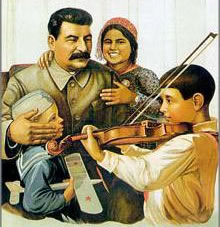
    It is the profit-deliverers, not the machines or people, who are to blame.  One way of addressing the distribution system, was, unfortunately, Russia—“a form if society set up to overcome this impasse of the capitalistic system of production and distribution”.  Of course the Russians–the Soviets–were just in the middle of their enforced starvation/gulag/brutalization period under Josef Stalin, the gigantic negative parts of which were still in general not known to the great unwashed. 

    The unnamed author dips lightly into Socialism, and then into Fascism and Nazism, though the only thing he/she really has to say about the later two is that “their answer [to economic woe] was in the seizure or control of the means of production by the state”, their own brutal means skipping off unnoticed into a pinkish glow, though the loss of personal freedom is “disdained”. 

    The New City is actually a new world order, a new governmental form to take advantage of technological advancements leading to “nationalized urbanization” The first city in this new order is Neopolis, and this pamphlet was a call to those who would stand as its citizens.  (There’s actually a sort of application form, though all it really is a bill-of-sale for ordering more copies of the New City pamphlet.)

    Even though the pamphlet is easily obtained, membership, the possibility of being a Neopolitan, is something entirely different.  The difference is actually exceptional, perhaps the most extraordinary thing about this whole misguided idea.  “Membership is to be carefully controlled at all times” we read. . “It is not desired to build up a huge and unwieldy membership of poorly-assimilated elements….interesting educational instruction…with tests to determine the fitness of the member for loyal, cooperative activity, leading, necessarily, to the elimination of those who may be found undesirable”. 
    That’s some pretty muscular, steroidal stuff, particularly after such a glancing blow against the Soviets and Nazis. 
    0-blog---Nov 14 new city077
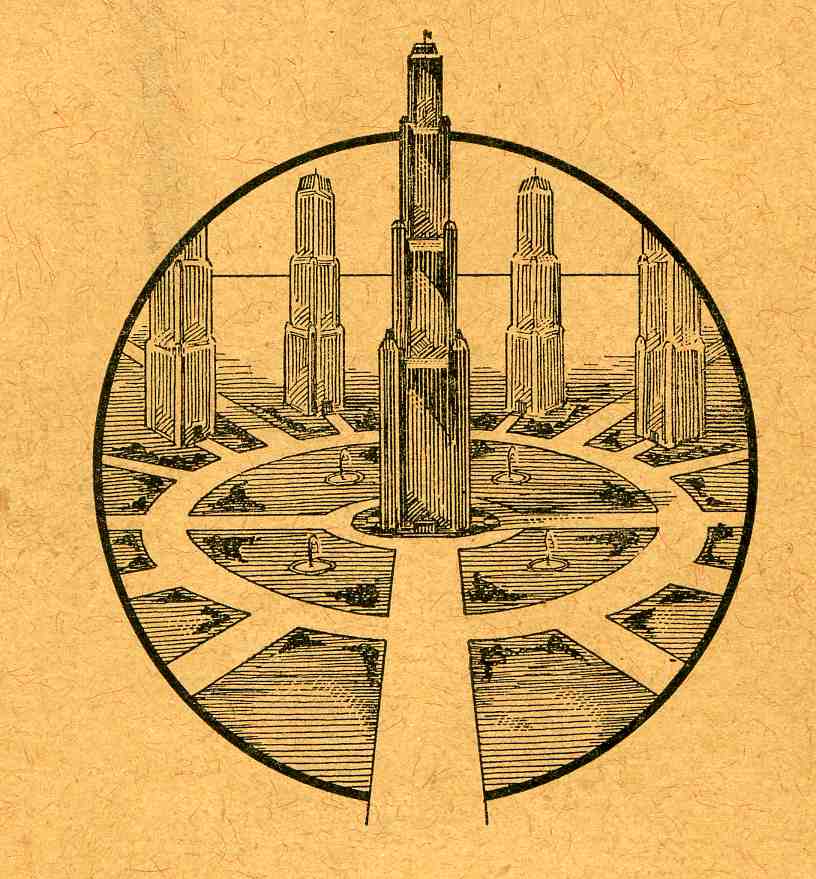
    Since this is just an “abridgment” of a soon-to-be-written 250-page explanation of the concept, the complex and concentric organization of society is left mainly to the drawing of its plan, the physical layout of the city based upon this ideal. 

    The Seattle-based author never did quite make it past page 29, never did name themselves, and never provided a concrete place where all of this heady stuff was being think out.  It is a sort of pretty design in a creepy/queasy way, there on the front cover, but that’s about as far as it goes.  If anyone actually did send any money to this quack thinker, it wound up in a nicely metaphorical place:  at “Terminal Box 3463”. 

    This may be the very best idea to come out of touching this pamphlet—a place where people can send correspondence regarding Bad and/or Dead or Dying Ideas: “Terminal Box ______”.  I guess that box number would be pretty high by now. 

    Stalin20 (Uncle Joe, before he killed the children, and dozens of millions of others.)

  • An Uncomfortable Caricature: Darwin, the Descent, and the ASPCA (1871)

    JF Ptak Science Books  Post 1422

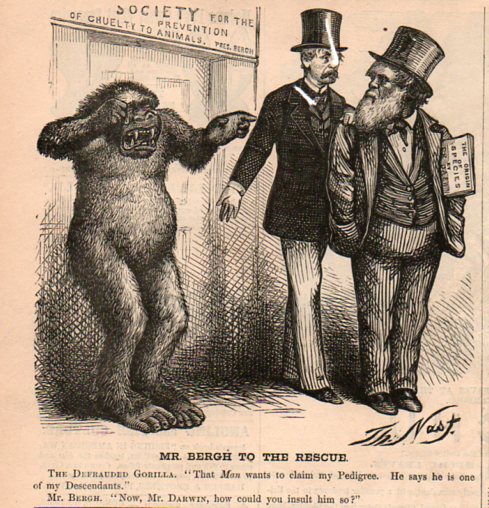
    Darwin cartoon  bergh294

    Poor Mr. Bergh.

    I wonder what his reaction was to appearing in this 1871 Harper’s Weekly cartoon by the great and indomitable Thomas Nast, linking him in a terrible and probably inscrutable way with the man of the century? 

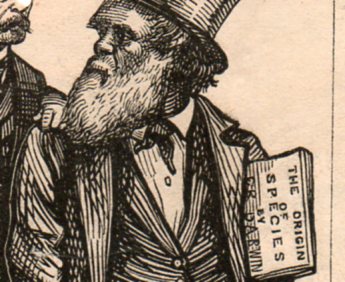
    Henry Bergh was the founder of the American Society for the Prevention of Cruelty to Animals (mainly I think in response to the treatment of work horses and the campaign for anti-sweating rules), and he is grabbing Darwin’s shoulder to remind the old man that in the shadow of the publication (earlier that same year) of The Descent of Man, and Selection in Relation to Sex (twelve years after the first edition of the Origin, and two years after the appearance of the Origin in its fifth edition) that a great harm was being done to the weeping gorilla.  Weeping because he was upset at being coupled with Darwin, weeping with the insult that someone such as Charles Darwin could be associated with him, with Mr. Bergh gently but firmly pointing out to Darwin that by connecting himself with the gorilla that he was doing a grave injustice to the gorilla.  (The original is available on our blog bookstore.)

    Darwin cartoon  bergh295
    Of course Darwin didn’t use a gorilla in the Descent, but no matter–it was a quick work by Nast and it contained enough of the stuff of some truth to reach publication.  Nast after all usually produced two of these small sketches plus a full-page work every week, and would do so for decades.  He got his point across–and it was a point shared by many, not the least of which/whom was The Times.

    The Times of London gave such an awful review of the book that a review of this review was published in the April edition of the British journal Nature1.   It was Thomas Stebbing who wrote the response to The Times‘ inciteful, hateful attack upon the Descent of Man. The Times saw Darwin’s work as an attack upon society,  accusing him of undermining authority and principles of morality, opening the way to “the most murderous revolutions”.  A “man incurs a grave responsibility when, with the authority of a well-earned reputation, he advances at such a time the disintegrating speculations of this book.” Stebbing’s review of the review is drippingly sarcastic, pointing out obvious errors in specific and the tone of the article in general in the defense of the book. Darwin’s “facile method of observing superficial resemblances” (says The Times) incites Stebbing to issue the following: “they may fancy that truth is worth discovering , even when it seems to involve some contradictions to our pride and some loss of comfort to our finer feelings…” (What a great line!)

    And so Thomas Nast piled on, though I’m not sure if he had a personal opinion on the matter–I prefer to think of Nast as rather forward thinking, at least in terms of more-correct thought on Indians/women/Blacks/the KKK/public education/government corruption, though he did have his failures in regards to the Irish, Catholics in general, the Pope, and some other areas2.  Nast may have just been reporting on public sentiment, or maybe not.  He at least doesn’t depict Darwin in a physically abusive manner like so many others, though Darwin does appear a little on the stubby side. 

    But getting back to Bergh–I have my doubts that he would’ve been entertained by being depicted so.  As I said, he founded the ASPCA, and also founded the American Society for the Prevention of Cruelty to Children.  He inherited a fine family fortune, and put it to good use.  He died at home, 429 5th Avenue (around 38th St and 5th, just a couple of blocks from where the NYPL would be) in 1888.  I hope he didn’t care; I doubt Charles did. 

    NOTES

    1. Nature,  1871, volume 3, 20 April 1871.

    2. He hated Gen. George McClellan so far as I can tell, which gives him an “A” rating in my book.
     

    ·Posted by :

    ·in:

    —
  • The Old is New Department: Refuting Darwin with Commas, Adjectives, and the Creator (1873)

    JF Ptak Science Books    Post 1423

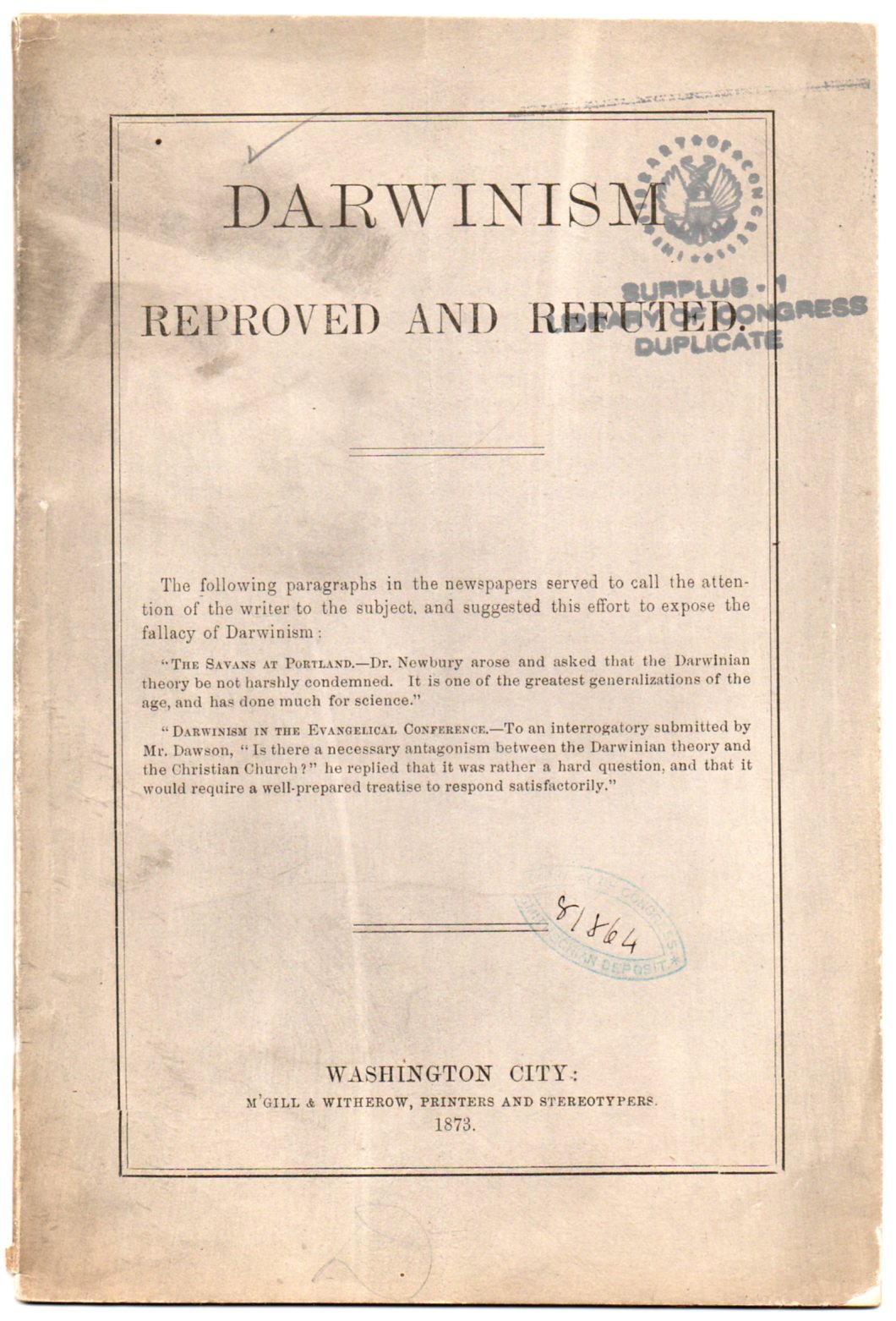
    Darwin refuted296 I wasn’t going to write anything at all about this pamphlet, but the vocabulary was so strong and vehement, and reminded me so much of what we can read in today’s daily press, that I thought to at least pick out some of the choice morsels. 

    Darwinism Reproved and Refuted, published in Washington D.C. in 1873, is left without any attribution to the author, the writer not caring to sign his/her name, not even to use as the wood into which some shingle with a weak social sciences/psych/religious Ph.D. could be nailed.  It is just left to the imagination or indignation that the writer didn’t or couldn’t feel confident enough to actually sign their work.  It is also one of hundreds if not thousnads of anti-Darwin vehemence–there is a chance I guess that there were more of these things written than there are visible-to-the-naked-eye stars in the night sky.  (The original pamphlet is available at our blog bookstore.)

    The author has little room for Mr. Darwin’s work1, clearly on a super-rant over The Descent… and on the theory of evolution, using such colorful words in runny purple prose like “\repugnant, revolting, unsophisticated, outrage, deadening influence, peculiar, fallacious, cunning”–and this coming from the first two paragraphs.  Needless to say, even though  the writer was too weak to sign their name, they did have some strong opinions. 

    “Utterly false, radically and fundamentally wrong, futile in the extreme, unreliable, ungrounded, false, short-sighted (in relation to god), ridiculous…” continues the author. The endowments of the Creator stuff doesn’t work its way in until the third page, when the adjectival and adverbial assault was already on it way, all without the assistance of any scientific counterexamples–but then the rest of the work is dedicated to proving the godless nature of Darwin’s work and its escape from scientific reality.

    We find this:  “Evolution is founded on materialism, which is another term for atheism”….”let this doctrine be compared with the Mosaic account of creation, and then the student of nature determine if he will choose for his progenitors Darwin’s pair of ring-tailled [sic] monkeys, or ‘Adam…’ “

    And so that’s what we get to in the refutation:  the Creator.  Old version of a contemporary complaint to get Darwin tossed out of classrooms to protect the youth of America, replacing it with divination.  The author writes:  “In the investigation of nature which is the proper province of the scientist, the most effectual method of studying it, in order to render this subject clearly intelligible to the human mind, is to regard the economy of nature as a form of government, having God for its founder, its Supreme Ruler, and Law-giver.”

    There’s not too much one can do with that, and even though it sounds antique, isn’t necessarily so, because the philosophy exists today, only with fewer commas. 

    Notes:

    1.  By 1873 Darwin already had produced an epochal body of work, including but not limited to On the Origin of Species by Means of Natural Selection, or the Preservation of Favoured Races in the Struggle for Life (1859),  On the various contrivances by which British and foreign orchids are fertilised by insects (1862), On the Movements and Habits of Climbing Plants  (1865), The Variation of Animals and Plants under Domestication (1868), The Descent of Man, and Selection in Relation to Sex (1871), and  The Expression of Emotions in Man and Animals (1873)

  • A Million Miles of Barbed Wire? (1918)

    JF Ptak Science Books   Quick Post

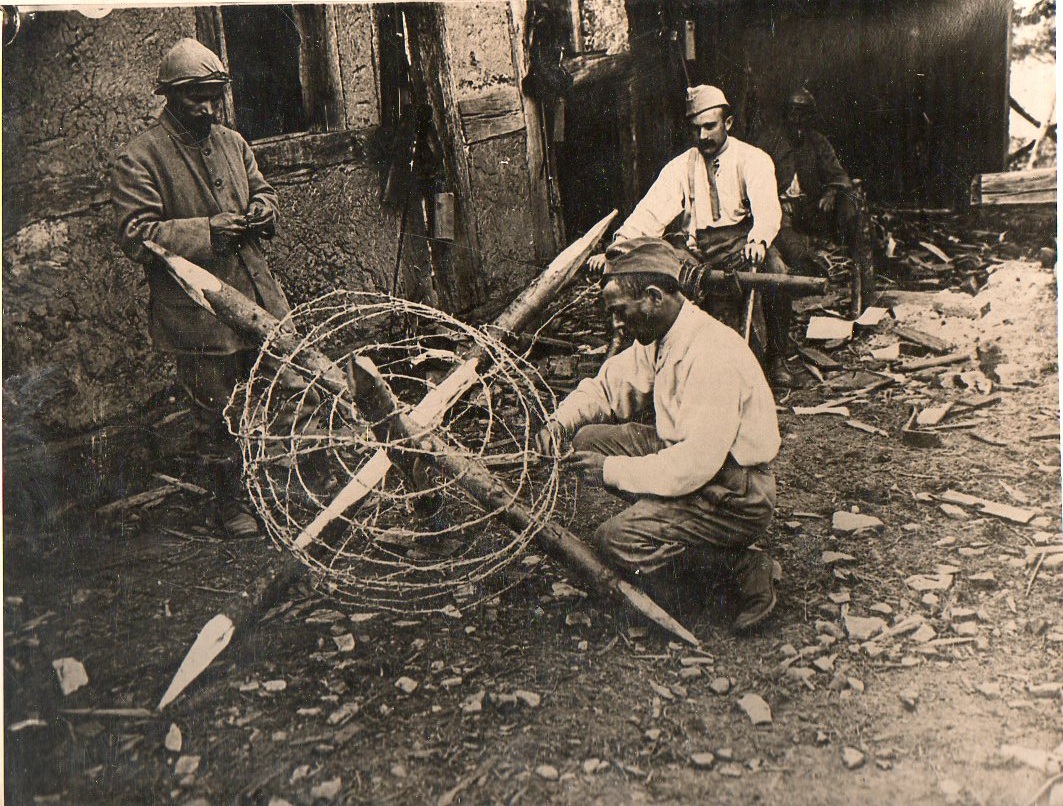
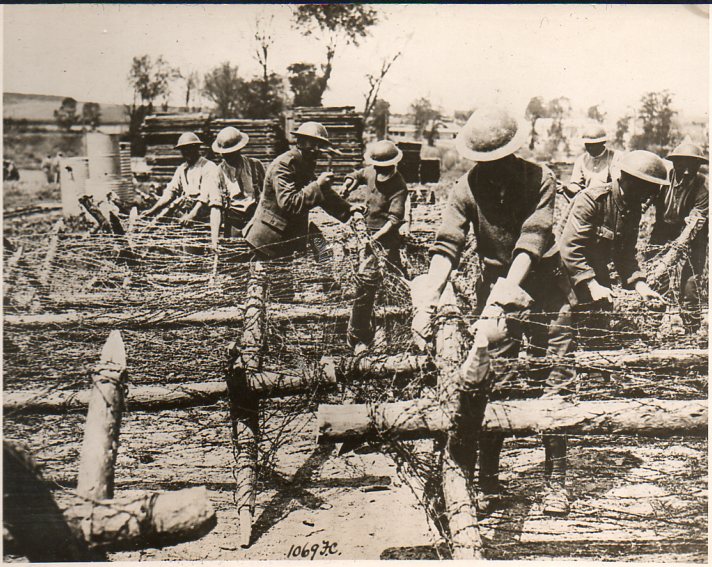
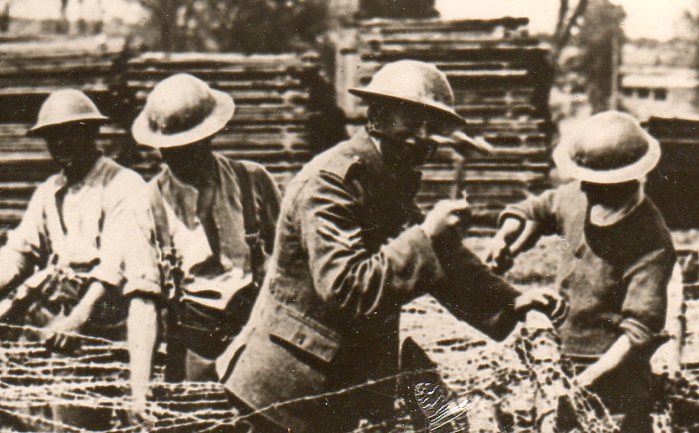
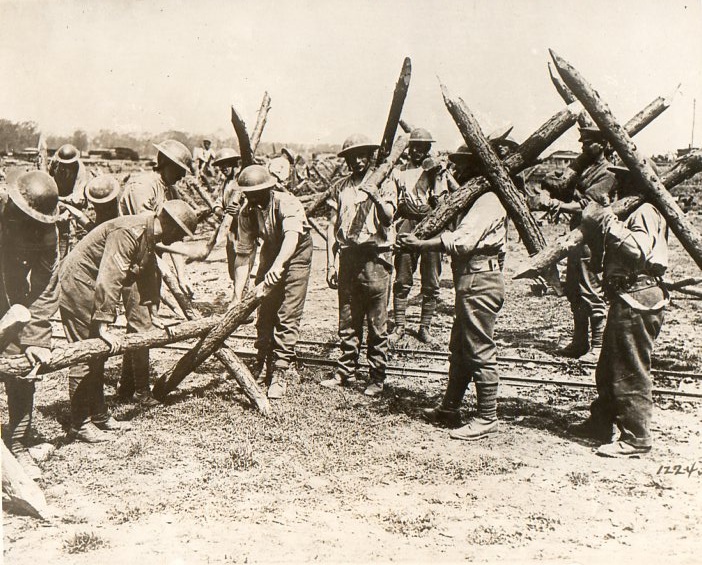
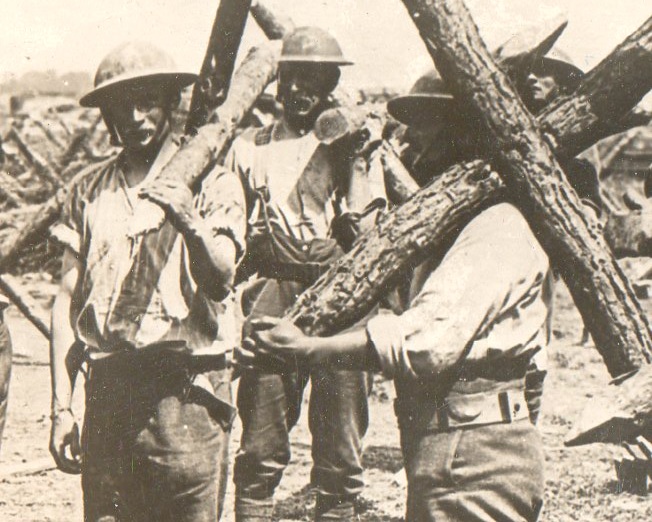
     The following photos were found in my small collection of World War I news photo service images, all of which were made in 1918.  They show the preparation of barbed wire entanglements–these were devilish things, made to grab a soldier and suck them in into a deeper hold when resisted, like a sort of sharp, metallic quicksand.  Since there were something like 12-25,000 miles of trenches dug during WWI, I think that it might be a safe bet to say that there were a million miles of barbed wire fencing laid down–that would be equal to about 75 feet of wiring for every soldier who served, or about 200 feet for every person killed. Given the tactics, the trenches, the barbed wire, the machine guns, the gas, and so on, it is no wonder that there was very little advancement over battlefields that stretched for miles and involved hundreds of thousands of troops, costing (sometimes) hundreds of thousands of casualties.  It would have been just insane-nasty to have to charge through fields of this stuff while being bombed and shot at by people in holes.  (All three original photos are available at our blog bookstore.)

    No gloves, here, not for the soldier weaving the wire or for the spinner in the background:

    Arbed wire301

    I notice that in this photograph the only person wearing gloves is the lead model, front-and-center:

    Arbed wire297
    Arbed wire298

    Here’s the support staff assembling the

    Arbed wire299
    Arbed wire300

    ·Posted by :

    ·in:

    —
  • The First X-Ray of an Atomic Explosion Inside a Person? Superboy/Superman & the Atomic Bomb, 1945-1964

    JF Ptak Science Books  (Continuing  Post 1140)

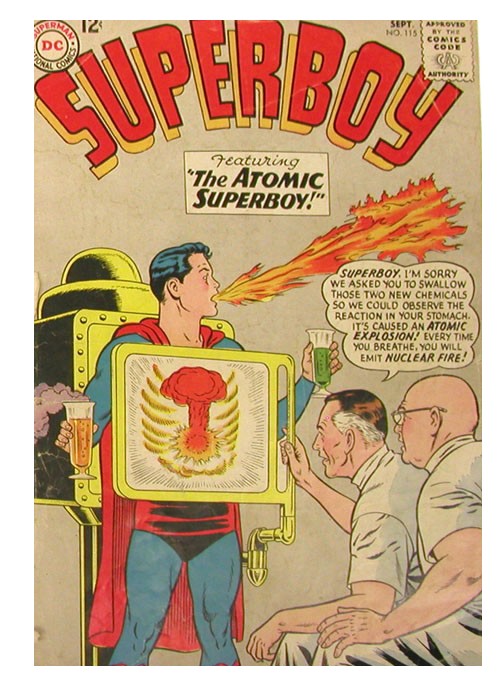
    I don’t know why, but I cannot remember ever having seen an x-ray of an atomic explosion taking place inside of a person, before today.  I guess that Superboy’s body is susceptible to x-rays but is also at the same exact time capable of preventing a nuclear explosion from escaping his body–all except for the “nuclear fire” coming from his mouth.Now that’s some sort of body control! The men in white seem pretty confident, being so close to the Trinity-like action and all.

    Atomic explos superboy
    Superboy evidently needs fewer ribs than humans, and it looks like the detonation point is right on the transpyloric plane, taking out kidney, liver, gall bladder and just about everything else.  And his spine doesn’t show up, either–along with a lot of other innards.

    Atomic explos superb deta 

    The original (published in September 1964) comes from the Oak Ridge Associated Universities, and they point out that this issue comes right after the signing of in-air nuclear weapons testing ban (after a speech by JFK in June 1963, marked by a memorial that was about 10 feet away from where I used to practice the shot put in D.C.)

    This mushroom cloud doesn’t take place inside of Superman, but it does seem to take place, well, oddly–there was no text that I could find that accompanied this image, so we’ll have to leave the story arc to imagination. 

    Supermanrubon-rhinoclean

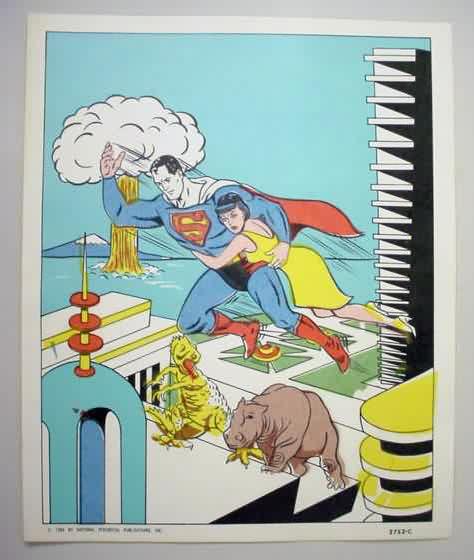
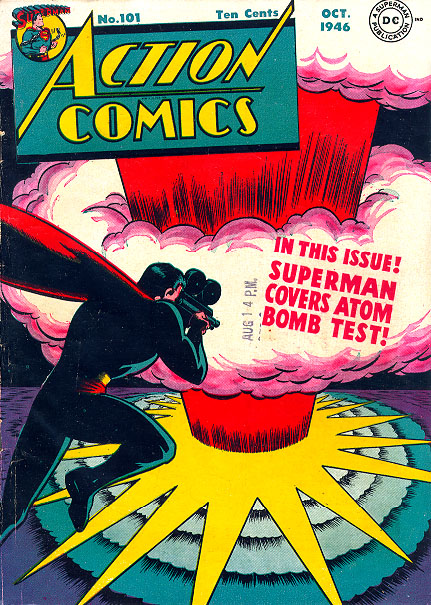
    And, well, if you’re not having an atomic explosion in your stomach and not combating one, I guess as Superman you could cover one (image found here):

    \Atom Action#101Med

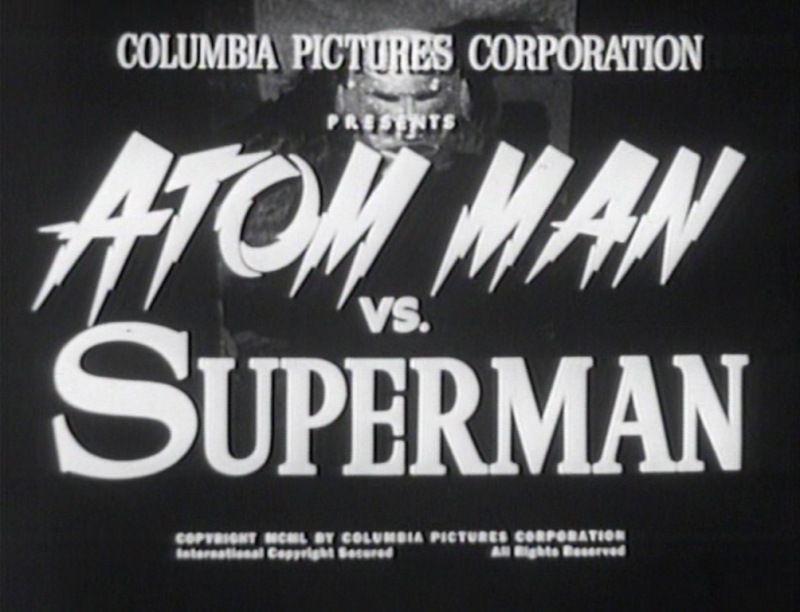
    Atomic Superman50Title


  • Miss Atomic Bomb: the A-Bomb in Popular Culture–Comics, Cakes and the Will of God

    JF Ptak Science Books   Post 1425 
    Follow Me on Pinterest


    I’ve written dozens of posts on this blog about atomic bomb history and where the bomb has shown up in popular culture.  This installment is on the bomb in very popular culture

    Miss Atomic Bomb is an icon of some sort for the relationship of the bomb with society, or, perhaps the bomb and Vegas, which is where this picture was taken. I guess there are reasons to put pretty women in front of computers (in the 1950’s/60’s), cigarettes and automobiles–why not with The Bomb?

    Atomic Bomb Miss
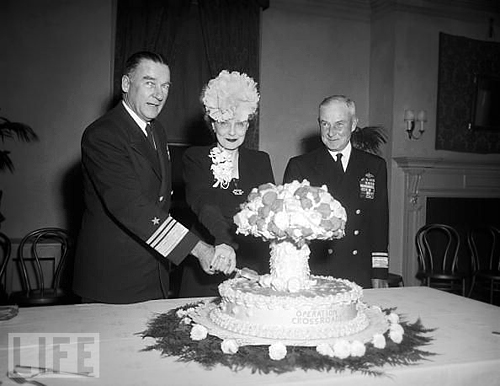
    The atomic cake (with matching headware):

    Atomic cake

    The caption to this story from Life magazine (1946) reads: “U.S. Navy Vice Admiral William H. P. Blandy, his wife, and Rear Admiral Frank J. Lowry cut a cake made in the shape of a mushroom cloud at a reception for Operation Crossroads, November 6, 1946.”  Actually Blandy was an early (August 1945 or thereabouts) forward thinker about how to deal with the U.S. owning the bomb and  international control.  I have little doubt that he probably thought that the cake was a bad idea, but, well, he did what he needed to do.

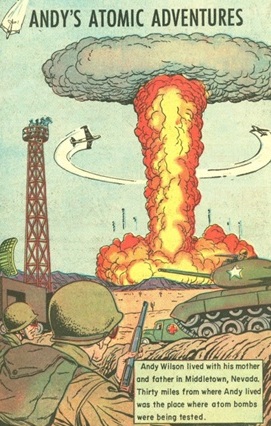
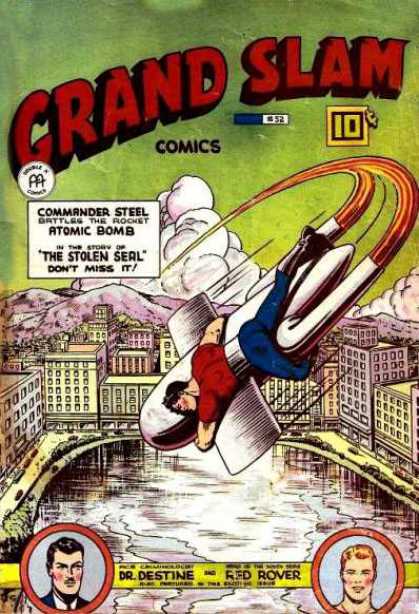
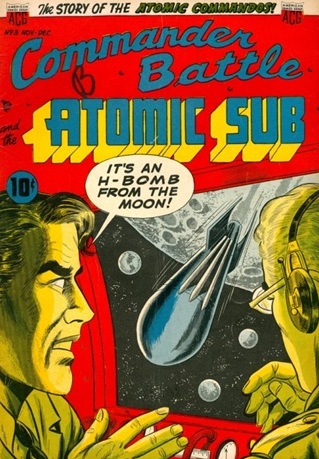
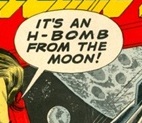
    There were all sorts of comic book adventures dealing withe the atomic bomb, right from the very beginnig (as it seems the earliest of them appears a month after the Hiroshima bombing).  These are just a few examples with the a-bomb on the comic’s cover(s):
    Atomic andy

    Atomic grand slam
     
    Atomic  h bomb from moon

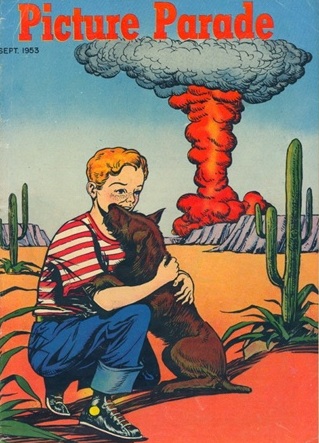
    AtomicbombBizarro–I don’t know the story of this image in Picture Parade, only having the cover graphic–perhaps that’s enough, perhaps we don’t need anything more, perhaps the backstory would spoil a perfectly bizarre image with something perfectly benign.  Or perhaps not. 
    Atomic bomb biazzaro
    Bizarre but for different reasons–a pocket-sized ball bearing patience game. Tokyo is included as a target for this game but in actuality was not considered atomic-bomb-worthy, mainly because it was decimated,  blanketed with a firebombing  that destroyed a host of the city just weeks before the first blast. (On March 9-10, 1945, 339 B-29’s dropped 2000 tons (4 million pounds, about 496,000 bombs) of the incendiary M-69 on Tokyo.  Two initial passes were made on the city, marking a large, burning “X” in the city.  Each plane had the capacity to cover a drop area of 350 feet by 2000 feet, which means a much greater area was affected. The citizens of Tokyo met their ends with buckets of water and brooms in defense. Hours later fifteen square miles of the city were destroyed.  In the months prior to Hiroshima and Nagasaki, 66 cities were bombed with M-69, killing about a million people, and wounding more.)  Fresh cities were needed for the atomic weapons so that there effectiveness could be judged against a palette of a normal. intact city, and not one that had been previously attacked. 

    Atomic Bomb dexterity game
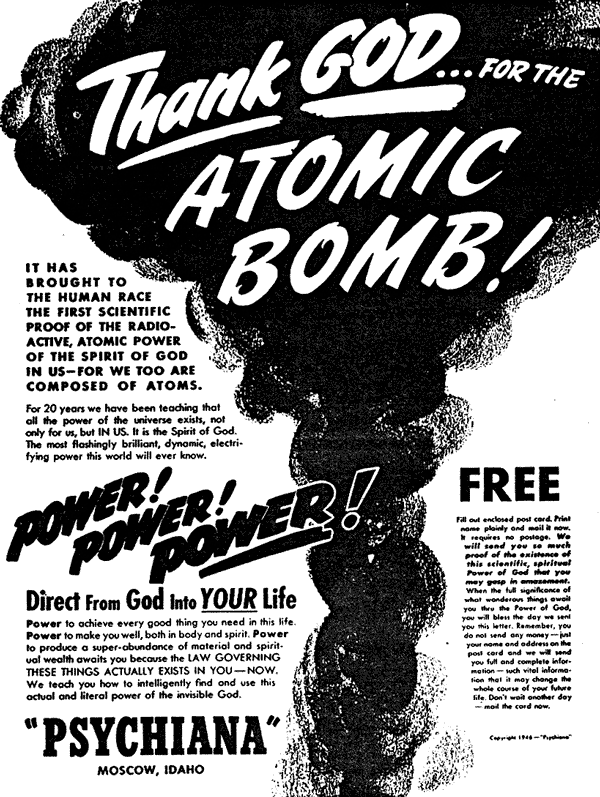
      And still more bizarre, when you combine all of the aspects of the race to the bomb with the race to god and the people who would believe such a thing.  This advertisement belonged to a mail order religico empire builder, Frank B. Robinson, (1886-1948), who claimed himself to be a prophet of god, had conversations with the Creator, and in general used whatever was of interest in the newspapers to drive interest in his ministry by mail.  It looked like his creation–Psychiana–wasn’t much more than a feel-good, self affirming, positive-thinking enterprise driven by a man with a personality big enough to be on speaking terms with the god, who in the ad below somehow was selling “the atomic power of the spirit of god in us”  because we are composed of atoms.

    Atomic bomb thankgod

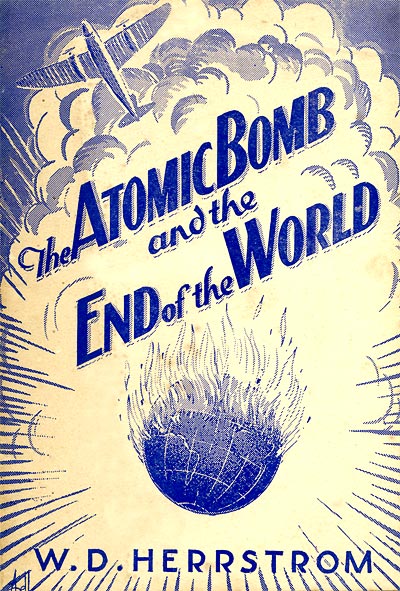
    And of course on the other end of this:

    Atomic_bomb_end_of_world

    This is an example of a host of end-of-the-world, post apocalypse movies (and books, and short stories, and so on) made to scare and entertain.  Judging from the trailer the more-modern television series Jericho owes a lot to Ray Milland. 
    Atomic panic-in-year-zero

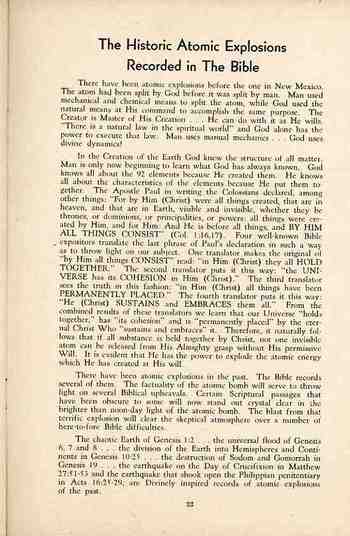
    Mel Morris  published God’s Atomic Bomb  in 1945, which means he must’ve worked a little feverishly to pump up his bible prophesy and history to include the new atomic weapon to replace whatever else he had been using as a prophecy for end of times.  (As it turns out, “God’s Atomic Bomb” was more tempest and disaster in the bible, and not (whew!) the bomb itself.  Though as we’ve learned from scientologists and the sort-of creative mind of Ron Hubbard, a civilization came to the earth thousands of years ago and pummeled it with “atomic bombs” and other nastiness, polluting humans for milennia to come.  But that’s another story–suffice to say that Morris found many dozens of examples of “God’s Atomic Bomb” being used in the deep biblical past, and that the use of the real atomic bomb in 1945 was pre-ordained, and not without its figurative historical counterparts.  I’m not sure why any of this was necessary outside of proving to some small minority that these preachers could at least be contemporary and topical. 

    Blogsept_2_atomic_bomb_god_2txt483

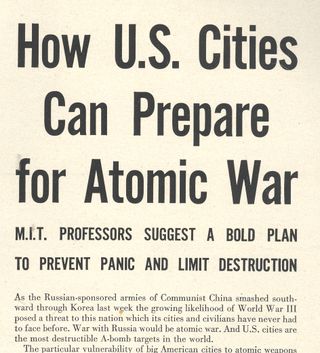
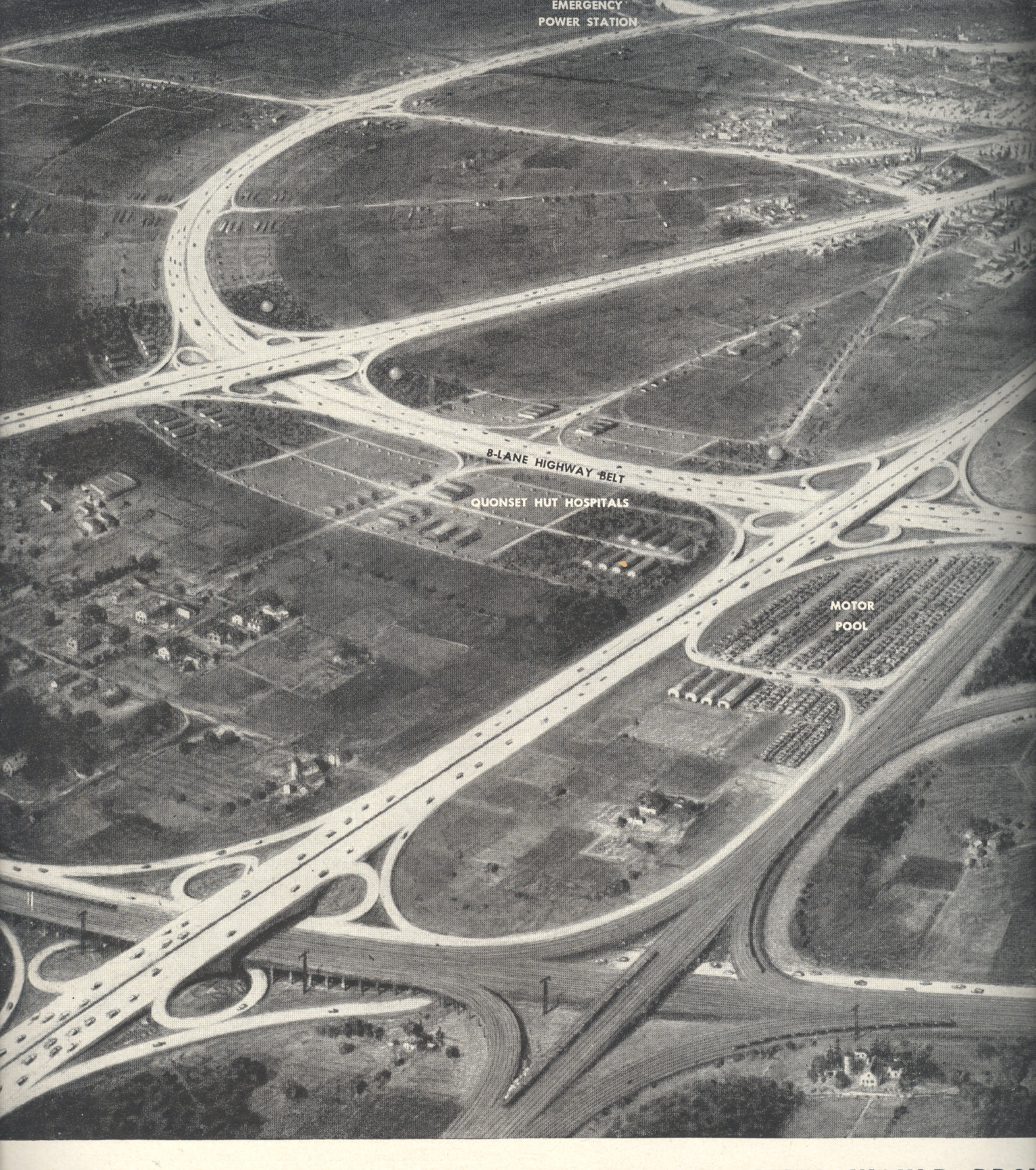
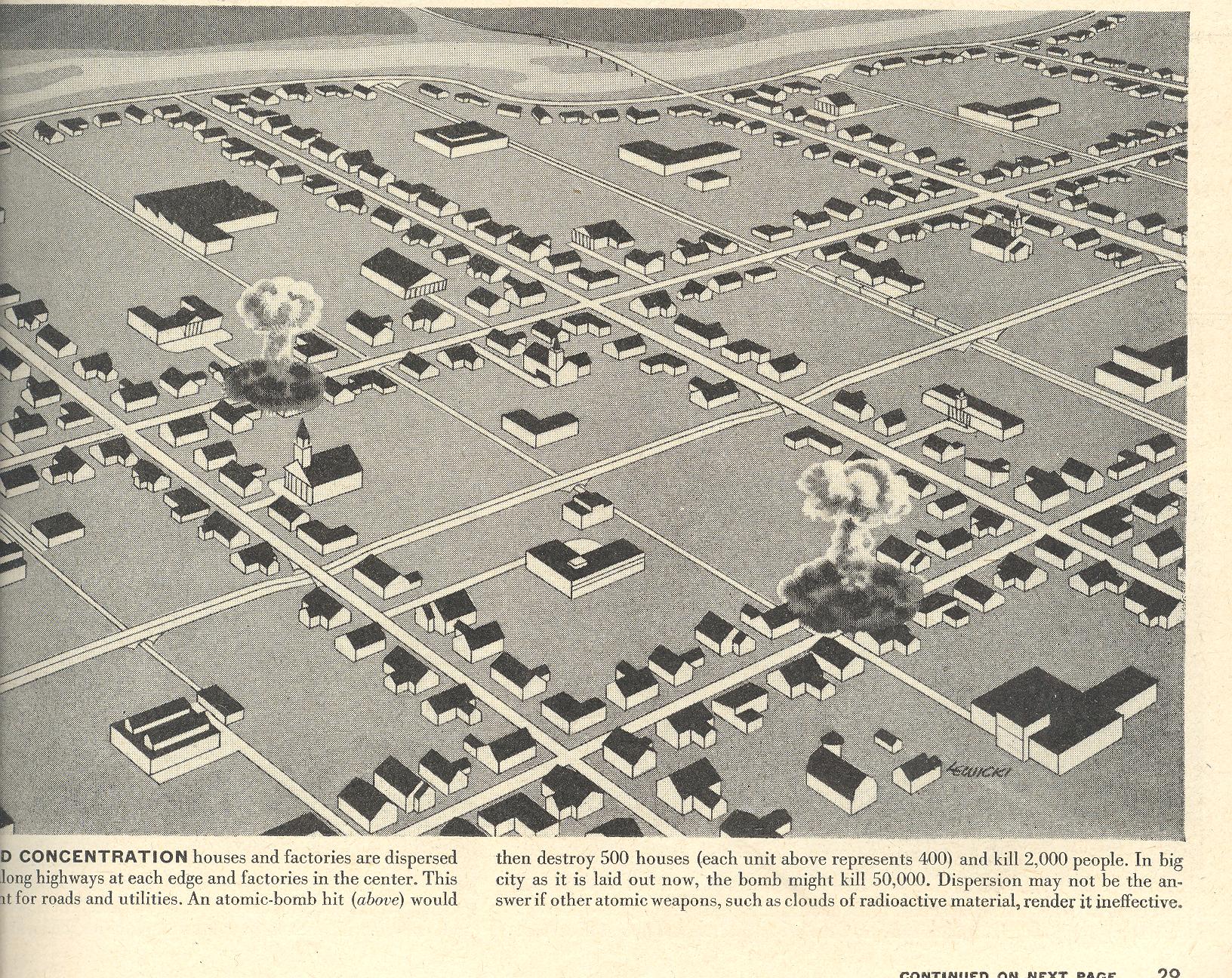
    The following is not the worst idea regarding the survival of nuclear holocaust, though it is an extremely bad one.  (Atomurbia, which makes the entire country a suburb to itself and therefore nothing, and which I write about below, is perhaps the worst idea that I have seen on combating the Soviet menace.)   But this one, which appeared in Life magazine in 1950, does come close, setting up post-attack suburbs (for “refugees”) and which takes some pre-attack city planning into some account.  There is a lot of planning for people in cars to make their way out of the city, which reminds me of the evacuation maps of Washington D.C. (which were still being handed out in the early 1980’s), which sends people on their way east and west depending upon the last digit of their car’s license plate being an odd or even number. 

    Atomic city plan war

    ==Blog July 27=wiener left

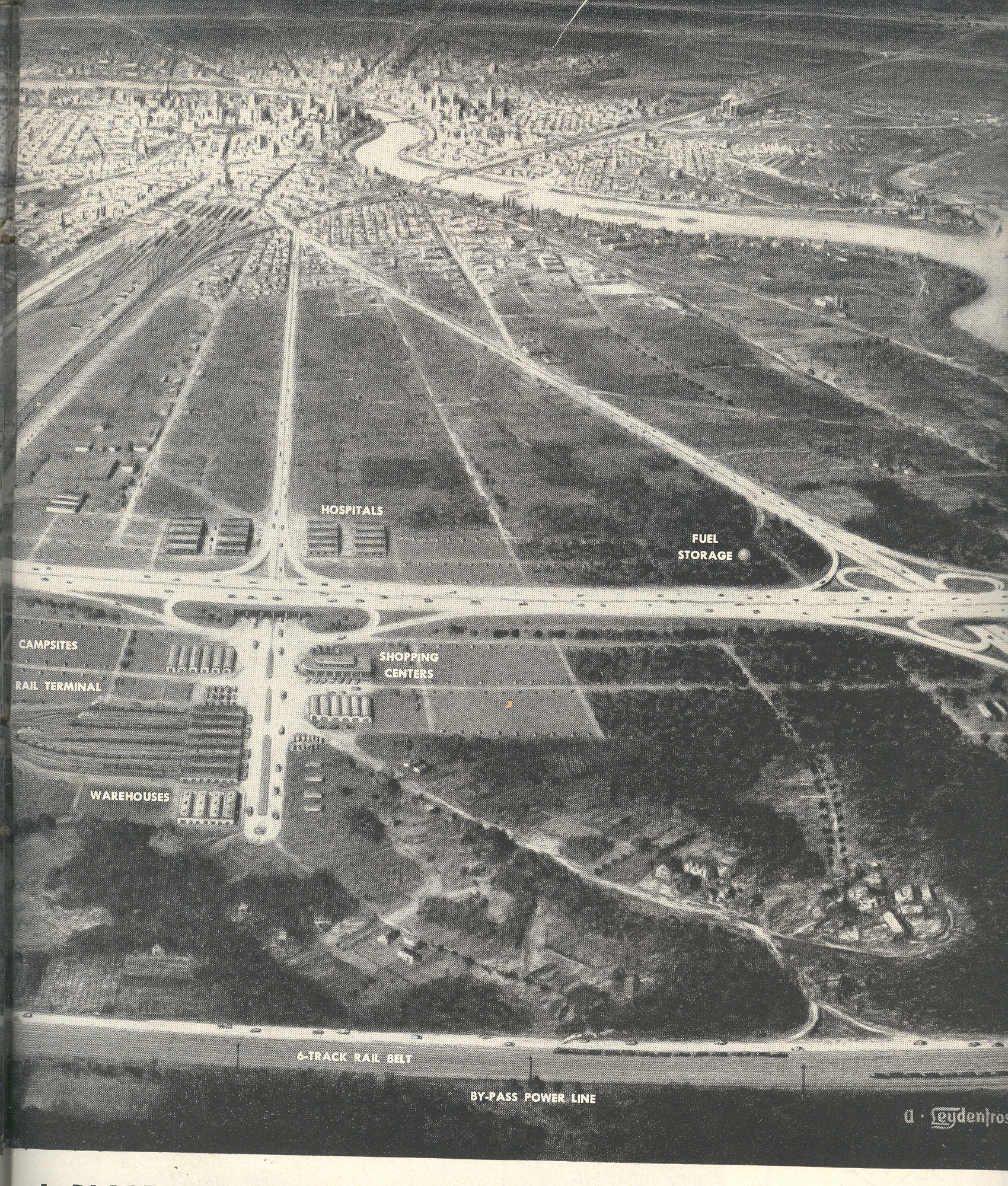
    One reaction to impending Doomsday was to construct concentric outer highways around metropolitan areas, “life belts around cities (which) would provide a place for bombed-out refugees to go”. In the birds eye view provided here, we see the plan in action, the main parts of which are an 8-lane “express” highway belt 10 miles away “from the built up edges of the city” , and a 6-track railway belt five miles further out, these accompanied by various feeder arms stretching straight-away from downtown.  In between the two outer rings would be land that would be kept free of development, so that farms and tent cities could be constructed after the attack. There would also be major collections of hospital and fuel depots in the greenbelt area.  Infrastructure would already be in place (gas and electricity, supplied with power from who-knows-where).   Shopping centers and a giant “motor pool:” would also already be in place, waiting for the Doomsday clock to strike midnight. 

    ==Blog July 27=wiener right

    This idea of city planning was one of many offering the prospect of safety from nuclear attack by spacing out the population of the United States so that the Soviet Union wouldn’t have enough nuclear warheads to take everyone out.  It called for the redistribution and resettlement of virtually everyone in the country, and is one of the most spectacularly bad ideas that I have come across in this field.  (I wrote about it earlier in this blog, here.)

    1-may 3-atomic 4

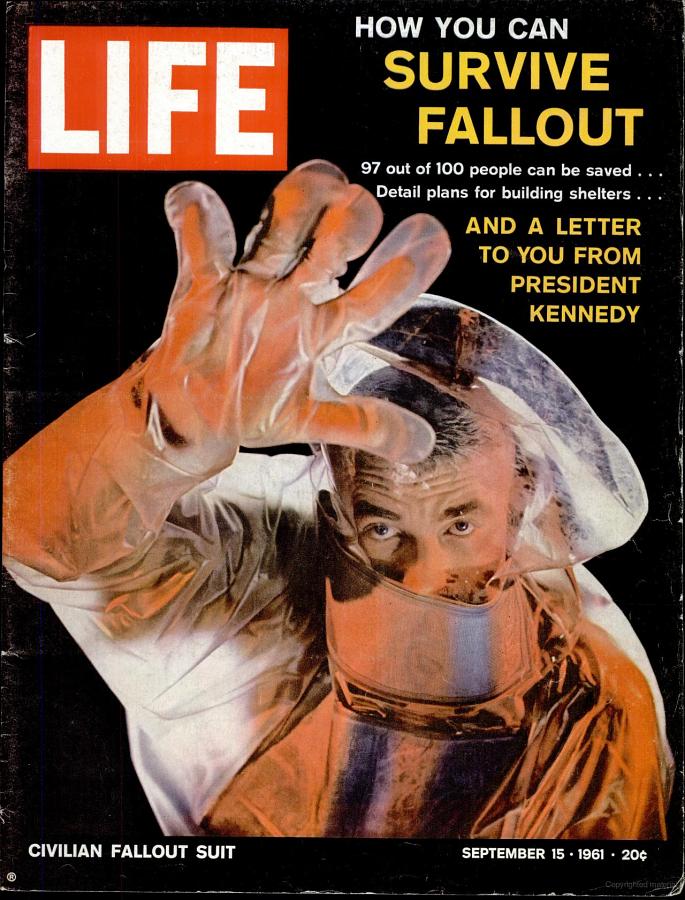
    This issue of Life offered the possibility of hope that 97% of the American population could survive a nuclear attack by the Soviet Union. It was a hard sell of a bad idea of insane optimism.

    Books_004


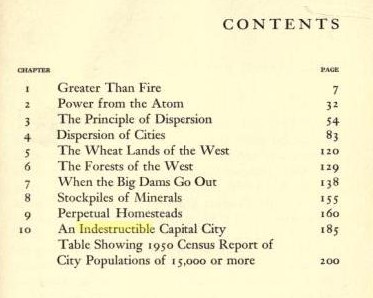
     Sylvian Kindall’s Total Atomic Defense (published by a very severely right-wing publisher in 1952) is one of a series of books made for a deceived American population, offering the general reader both fear and hope, often from the same, exact source. But Kindall has a  somewhat diffident approach, offering his belief that the country and its population can largely  survive an all-out nuclear waBlog--untinkable tpr–intact.  Chapter 10 tells the remarkable story of how to make the captial city of America atom-bomb proof, mostly by digging it into the side of a mountain.

     
    Blog--unthinkable


    Again, this is just the barest touch of the top of a huge pile of such stuff–and I’ve not even mentioned duck-and-cover films.


  • German Military Medical Retreat, Coastal Poland, 1915

    JF Ptak Science Books  Quick Post

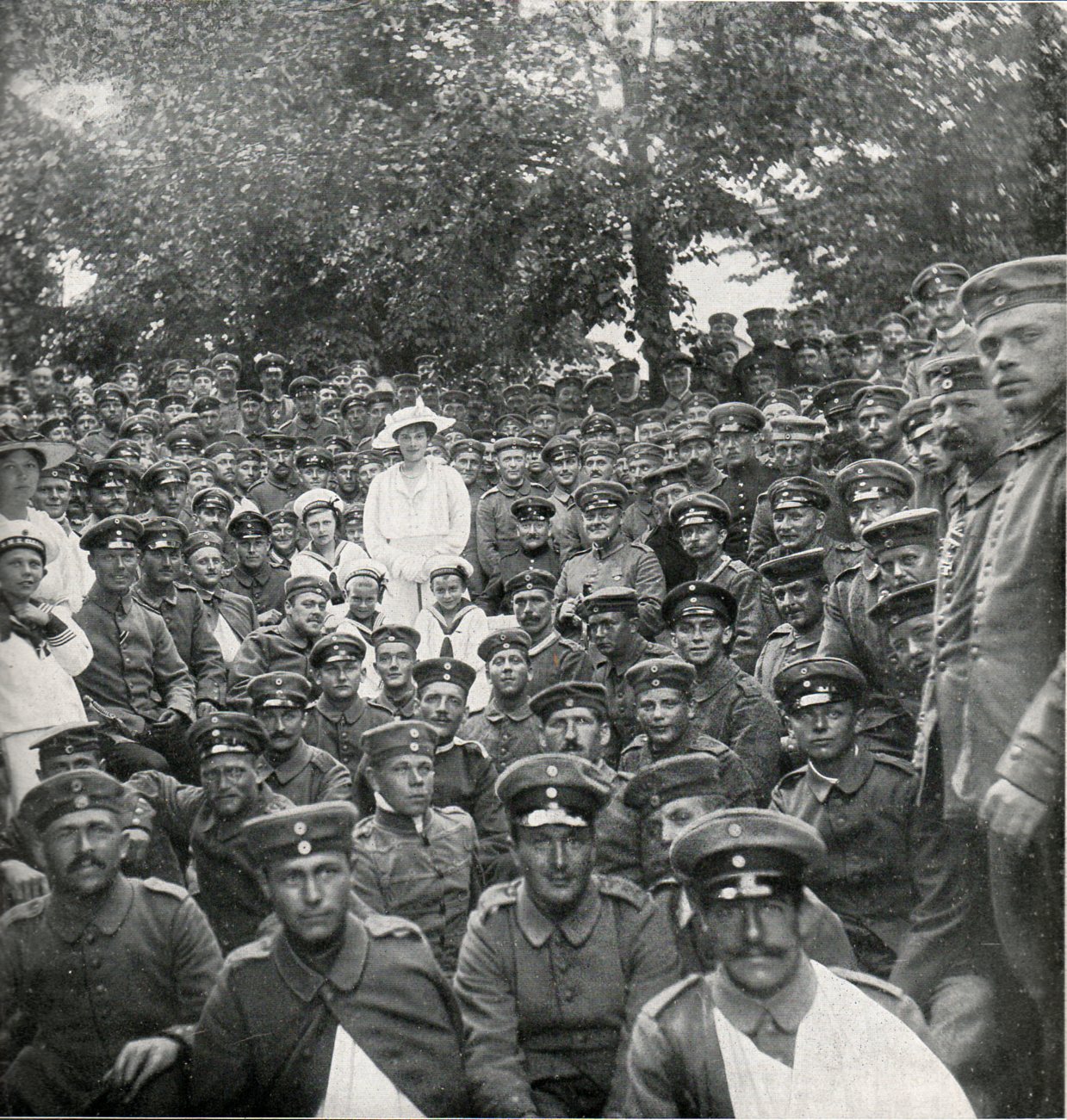
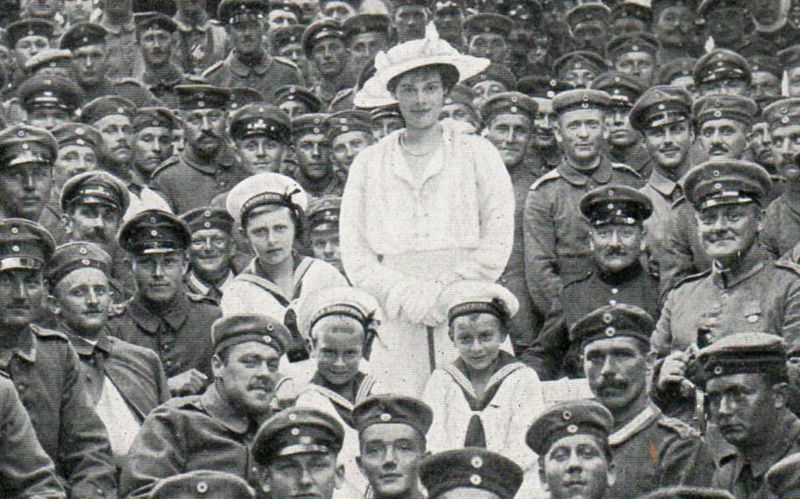
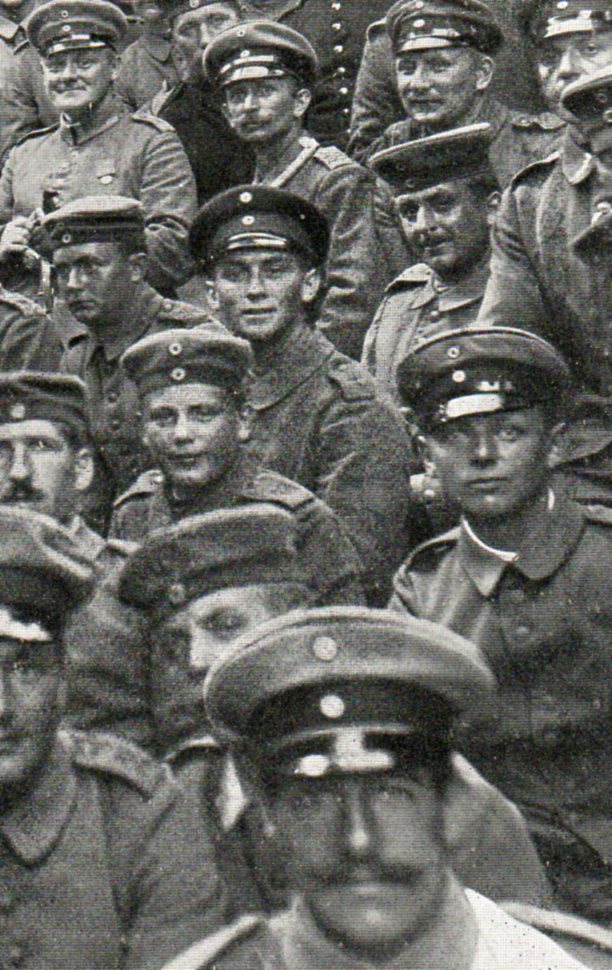
    This image, from the 22 Juli 1915 issue of the Illustrirte Zeitung (Leipzig) shows a collection of German soldiers that were treated at a medical aidstation.  The woman in white is the German crown princess, accompanied by her four navy-uniform-clad sons, are adrift in a sea of wounded and recovering soldiers who I guess were given leave from the war, celebrating their survival at the old spa and vacation spot Ostseebad, in Zoppot (Sopot, Poland).  (The issue may be purchased at our blog bookstore.)

    Wwi german red cross304

    And the detail:

    Wwi german red cross305

    And another:

    Wwi german red cross306

    ·Posted by :

    ·in:

    — —
  • A Note on Teaching Math, Unexpected Art, and Picturing Things Differently

    JF Ptak Science Books   Post  1427

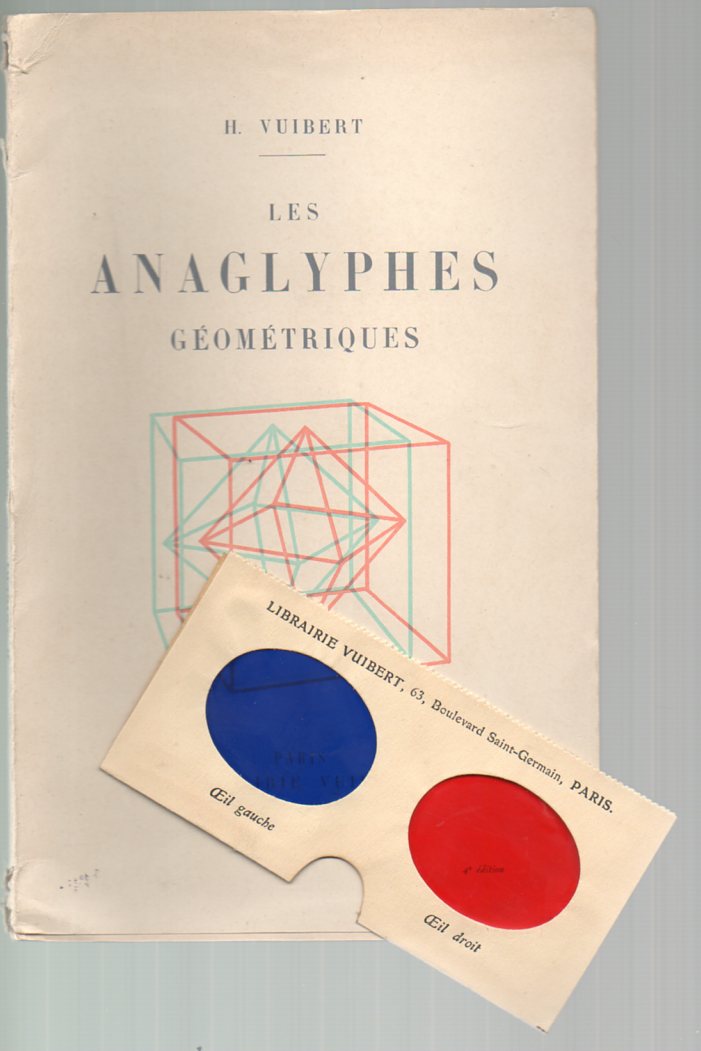
    Vuibert308 Stereo viewing geometrical figures may or may not be useful–I find it a little off-putting, creating a slight dizzying effect, though I’m sure it helps others (particularly children?) see complex geometrical figures a little more easily., especially when it comes to crystalography images. Education was certainly what Henry Vuibert , the author of Les Anaglyphes Geometriques had in mind when he published the work in 1912.  He had a long history in mathematics education, having founded the firm that bears his name back in 1877, a publishing house specializing in school texts in the maths, physics and general sciences.  (We offer the book for purchase at out blog bookstore.)

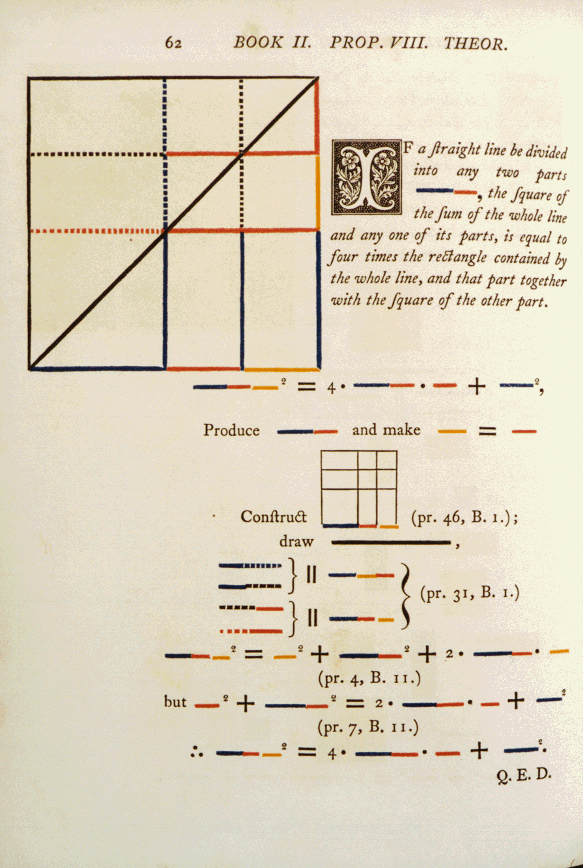
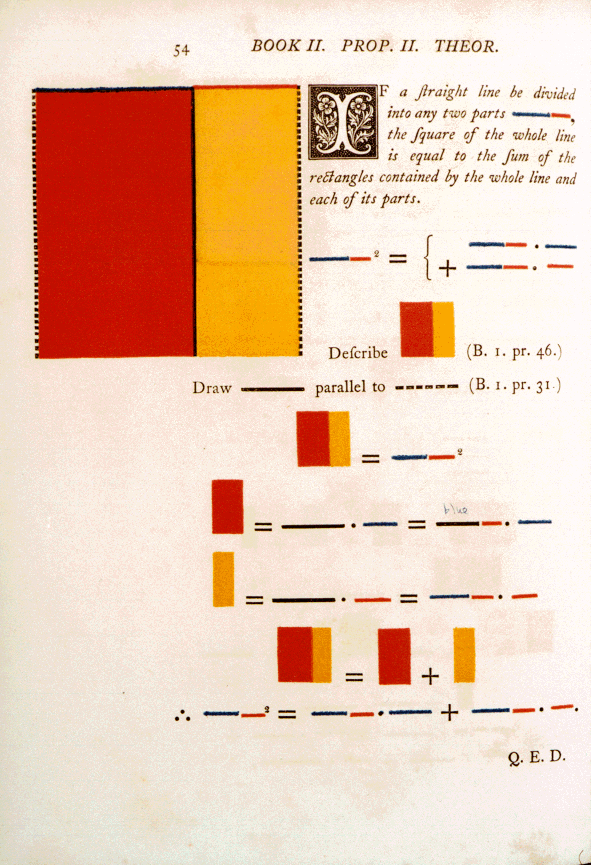
    Vuibert’s book is a very early example of the use of the anaglyphe–examples of the use of the method go back to the 1850’s, when d’Almeida used a version of the idea to punctuate lectures using a magic lantern; the (printing) process of the anaglyphe wasn’t patented until the 1890’s by L.D. DuHaron.  It does confuse me or remind me quite a bit of Oliver Byrne’s beautiful monster The First Six Books of Euclid in which coloured diagrams and symbols are used instead of letters for the greater ease of readers… printed at the Chiswick Press by C. Whittingham for William Pickering in 1847.  The book is, well, unusual and probably not at all usefu11.  Bryne replaced all of the algebraic notation, identifying letters and almost all of the descriptive text with color and color codes, leaving Euclid mysterious, hidden, awkward, impervious, and, yes, beautiful2. As a matter of opinion this work presages the cubists (and especially Piet Mondrian) by 60 years, and all by accident artwork. 

    Byrnes 11.8


    There are certainly much earlier works that tried to get at a fuller representation of geometrical objects, not the least of which was a 16th century Elements of Euclid in which the figures were cut-out paper, pasted into the book and attached to a string so that the reader could pull out the illustration and see it displayed in three dimensions. The elements of geometrie of the most auncient philosopher Euclide of Megara. Faithfully (now first translated into the Englishe toung…3, printed in London in 1570, was no doubt a great and exasperating labor of love, a complex “pop-up” book accomplished with sixteenth century technology.  (The photo below shows the Smithsonian Institution’s copy.)

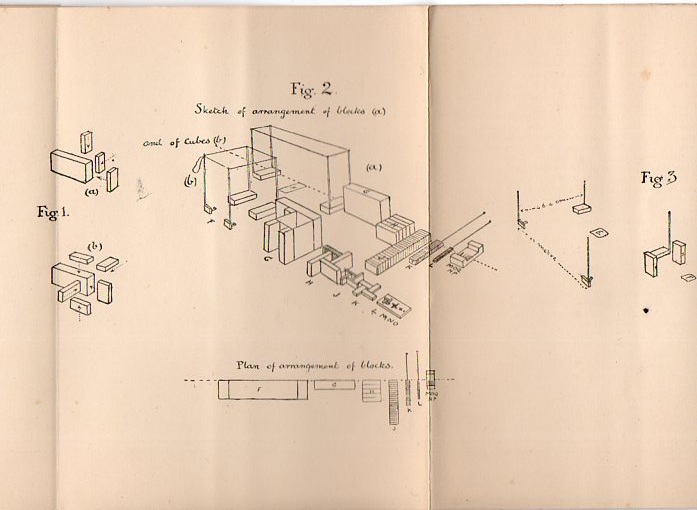
    Of course there’s the very old fashioned way of representing mathematical concepts, and that’s with sticks and stones and blocks and such.  For visceral memory and practical applications, the idea is hard to beat, unless of course, you really beat it , which is difficult to do.  But to me that’s just what Major G. Mackinlay did in his Realistic Arithmetic,  for Teaching Children the Elements of Arithmetic by Means of Special Blocks4, published in London in 1900–his ideas for the use of blocks was very sound and stable; his instructions (and in particular his illustrations) for what to do with the blocks was not.  I am reminded of inscrutable, badly translated and designed instructional manuals for tech stuff that need a manual for the manual. 

    Here’s one of the folding plates describing how to assemble the blocks:

    Math blockis309

    Then there are other sorts of wooden (and etc.) three-dimensional models, such as the (600+) gorgeous geometric designs housed in the Institute Henri Poincare, transferred there from the laboratory of geometry of the Faculty of Sciences of the University of Paris in 19285.  Most of these models were constructed around the time of vast change in mathematics and art (1900-1920), which means that many of them predate the revolutionary ascensions of  Cubism and non-representational art.

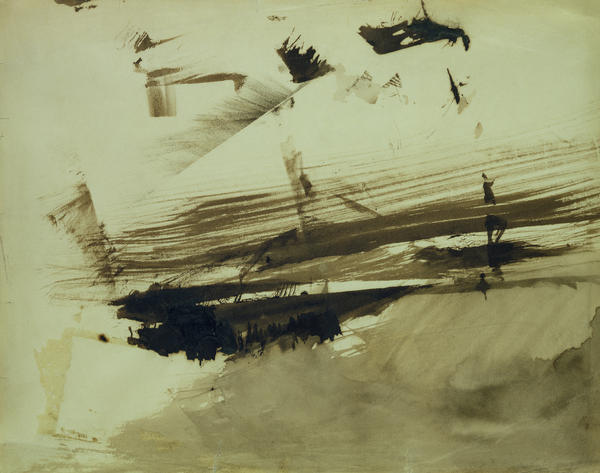
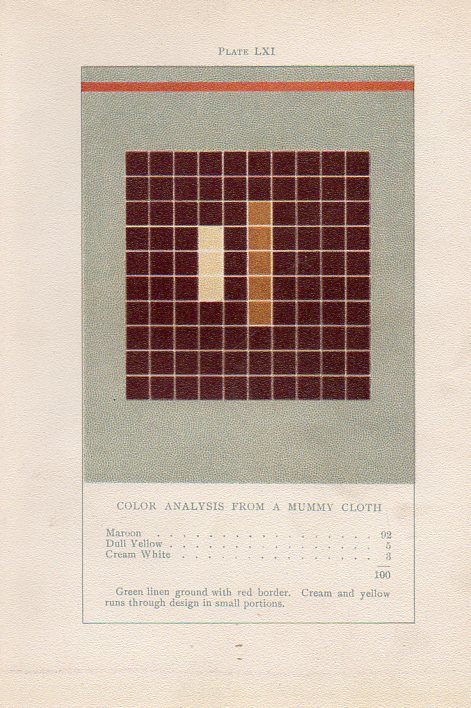
    And as long as were at the point of unintentional and under-recogniozed epochal works, I think that there is a broad book that could be done on exactly this topic, calling into play such examples as Georgina Houghton, Victor Higo, Emily Vanderpoel, and many others. 

    Georgina Houghton, for example, produced this non-representational painting in 1870 (or thereabouts):

    Georgiana

     And Victor Hugo, from the 1860’s

    Evocation of an island Painting  - Evocation of an island Fine Art Print

    And Emily Vanderpoel (1900 or so):

    Art-vanderpoel186
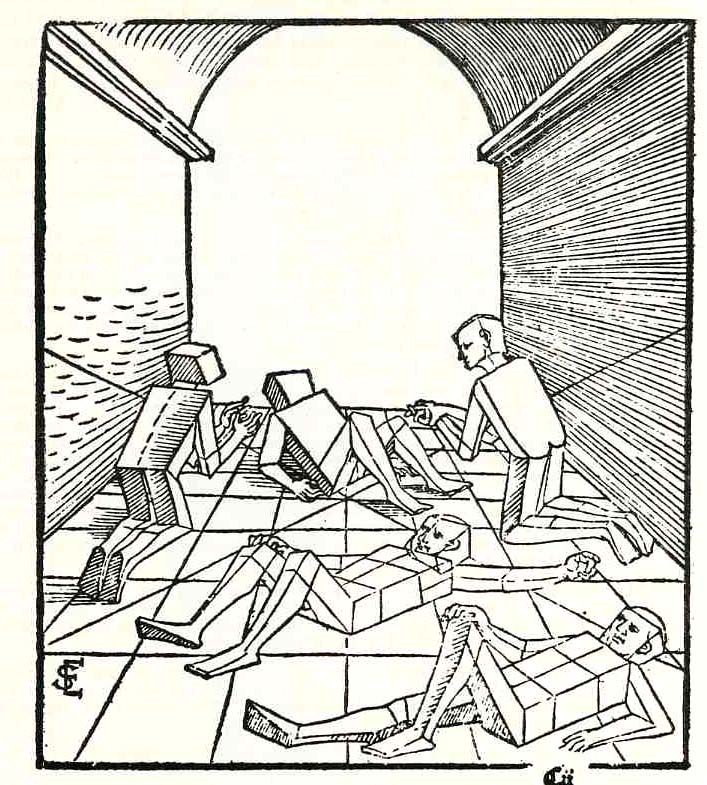
    In another, much earlier case of removing detail and adding abstraction for the sake of simplicity in representing an idea,  Erhard Schoen, in his Unnderweissung der proportzion und stellung der posssen liegent und dtehent, printed in Nurenberg  in 1538, presented these cubed figures (below).  He used simplified geometric form to stand in for the curvy humans, replacing them with proportional stacks of boxes which would more easily explain to the younger reader how to represent the human body in space and in proportion to other things. 

    Schoen

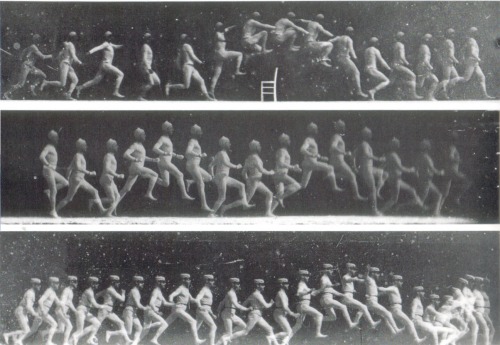
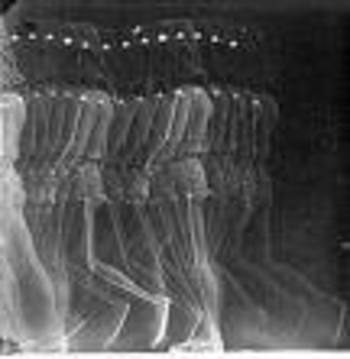
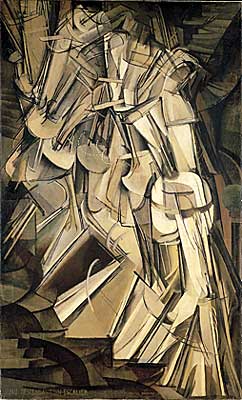
    I think that these were monumentally combative images showing humans in a radical, previously unknown way, much like the moving-through-space-and-time photographs of the somewhat forgotten Etienne Marey, who in the 1870’s created what was essentially the world’s first “slow motion” device. One iteration of Marey’s apparatus was basically a long series of ganged cameras recording a motion for a Marey12 simple task at a given time frame and presented on a continuous strip of photographic paper, sort of like a motion picture with the camera speed set at three frames per second. The resulting images were phenomenal and showed people for the first time the exactness of all manners of simple motions–motions that no longer looked so “simple” once all of its aspects could be studied from captured photographic evidence.  Even the act of hopping over a small stool or bending to pick up a bucket of water were enormously revealing in a way like Robert Hooke’s Micrographia displayed the great detail and complexity of the seemingly simple fly.  Perhaps the most famous of Marey’s series of images was that of a galloping horse, which also for the first time revealed what exactly the horse’s legs were doing and proving that almost every painter in the history of art represented the galloping horse incorrectly.  His series of photographs (as in this sample below) show a fairly close fit to the work of the futurists (like for example Duchamp) who would come into being after another four decades. 

    Marey  And Duchamp’s Nude Descending (1912):

    Duchamp


    I do want to make it clear that this is just a simple note, a thinking-out-loud piece on how attempts to visualize things differently for the sake of explanation or education can come “unintentionally” close to what would become epochal works.  More later.

    Notes

    1. Augustus De Morgan, mathematician and logician, wrote a very highly critical book A Budget of Paradoxes in which he describes hubbub, fakirs, frauds, perpetual motion machines, squaring the circle efforts, millstones and other useless books in the maths, and in here he sniffily dismisses Byrne’s work. At best, to De Morgan, the Byrne book is “curious”. But useless and curious, as I have seen many thousands of times, does not mean that it can’t be attractive and beautiful, and the Byrne book is probably the leading candidate in the Bad & Beautiful category.

    2. In his Victorian Book Design McLean calls the Byrne book “…one of the oddest and most beautiful books of the whole century…a decided complication of Euclid, but a triumph for Charles Whittingham [the printer]”.

    3.  This is also the first appearance of Euclid in English.  The full title: The Elements of geometrie of the most auncient philosopher Euclide of Megara faithfully (now first) translated into the Englishe toung by H. Billingsley, citizen of London; whereunto are annexed certaine scholies, annotations, and inventions, of the best mathematiciens, both of time past and in this our age; with a very fruitfull praeface made by M.I. Dee, specifying the chief mathematicall scieces, what they are, and whereunto commodious; where, also are disclosed certaine new secrets mathematicall and mechanicall, untill these our daies, greatly missed. London, Imprinted by I. Daye, 1570.

    4.  From the Report of the Annual Meeting of the British Association for the Advancement of Science, 1906:


    5.  From the IHP website:  “Most of the models  were created by Martin Schilling in Leipzig between 1900 and 1920 and  a few of them  (in wood)  were made between 1912 and 1915 by J. Caron, Professor of Descriptive Geometry in charge of  the “graphic work” course at the ENS at the beginning of the century (between 1912 and 1915).”

    Also this:   “In the thirties, the surrealists, led by Max Ernst, were interested in these geometric objects. André Breton alludes to them in  “Crise de l’objet” , an article  in the magazine  Cahiers d’Art (May 1936, No. 1-2, p. 21-26.). Man Ray took photographs of the models, which where published in same issue. He would later use them to compose what he called  “Shakespearean Equations”. Many artists, painters, architects and sculptors drew inspiration from them.”

  • Dentists and Mushroom Clouds–the Nuclear Mundane in Planning for the Thermonuclear Post-Apocalypse

    JF Ptak Science Books  Post 1428    Part of a long series on Atomic and Nuclear Weapons History

    How can a person–how can I–write about Nuclear Holocaust as being mundane? When it comes to reading how some people mundanely responded to planning for surviving it.

    It is a very deep Disturbia into which people fall when writing about the millions of details in accounting for the unaccountable, writing about the medical/physical/psychical consequences of surviving a bomb when dozens might well be detonated at the same time, the millions of details overtaken by billions of other details not mentioned and perhaps not imagined. 

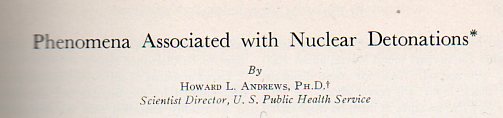
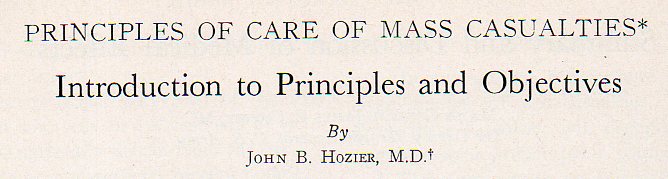
    I’ve collected some wide non sequiturs dealing with the matters of the nuclear apocalypse from a publication called Military Medicine in an article entitled “Mass Casualties, Principles Involved in Management”,  which were papers delivered at the 62nd annual convention of the Association of Military Surgeons, 1956.  Sometimes the chapter heading says it all, giving wide pause; and sometimes you have to wade in a little, but you don’t need to go very far, or very deep.  Overall the issue of the absolutely overwhelming devastation and the impossibility of dealing with the human consequences of nuclear war do absolutely get written about, but it occurs somewhere inside each contribution, which is front-loaded with pop-iconic understatement and then followed up with vast simplification. 

    Then of course there is the official-speak in quietly stating screamingly bad things: “a wide disparity will in all probability exist between patient load and medical resources”.  There’s so much like that in this publication that it is hard to keep up, like differentiating sands on a beach. 

    [I resisted including the section on the use of dentists in the post apocalypse–it was too painful, and I ran out of steam.]

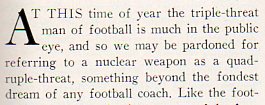
    Nuke--nuke detonation313  Nuke--nuke detonation315

      Nuke--mass cas priciple320
    Nuke--mass cas priciple321

Recent Posts

Archives

Categories