A Daily History of Holes, Dots, Lines, Science, History, Math, Physics, Art, the Unintentional Absurd, Architecture, Maps, Data Visualization, Blank and Missing Things, and so on. |1.6 million words, 7500 images, 4.9 million hits| Press & appearances in The Times, Le Figaro, Mensa, The Economist, The Guardian, Discovery News, Slate, Le Monde, Sci American Blogs, Le Pont, and many other places… 5000+ total posts since 2008.

  • Computer Requirements at America’s Biological Defense HQ (1957)

    JF Ptak Science Books  Quick Post

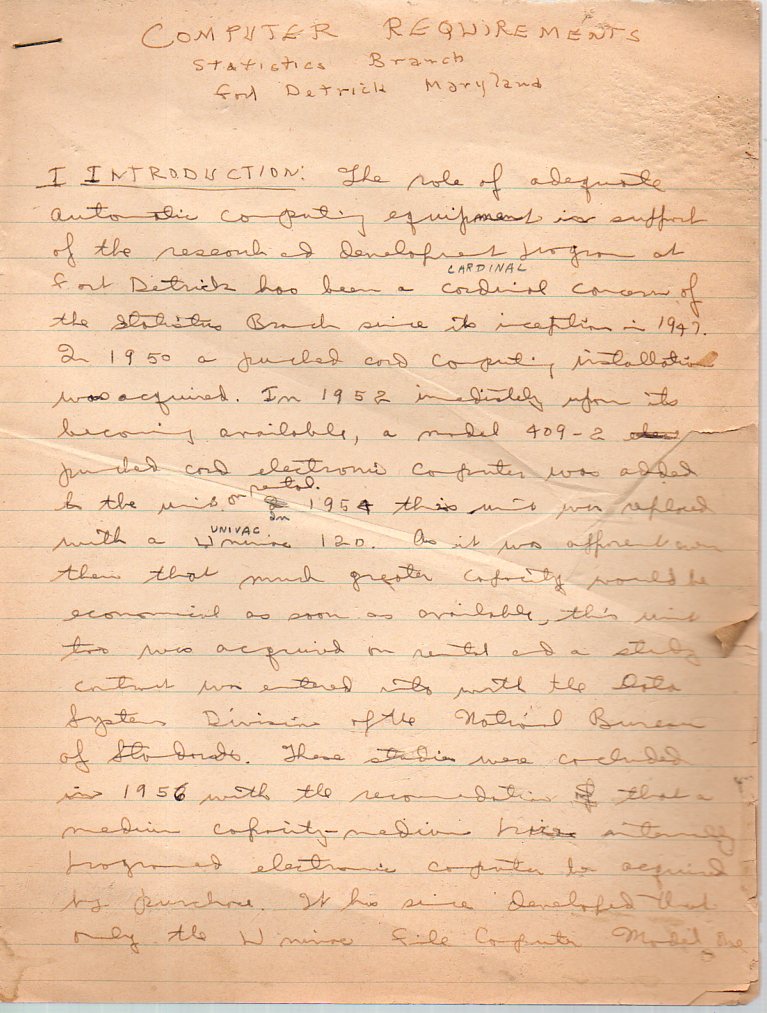
    I’ve found an unusual, informal document; a rough, manuscript outline for a consideration on the computing capacities at Fort Detrick, in Frederick Maryland.  Fort Detrick is a Medical Command, and was the seat of research for the  United States’ biological weapons program (1943–69, which is today a part of the U.S. biological defense system), and  is today a very large facility (on 1,200 acres) devoted to biomedical research. (It houses the “U.S. Army Medical Research and Materiel Command (USAMRMC) and its bio-defense agency, the U.S. Army Medical Research Institute of Infectious Diseases (USAMRIID)”, as well as  medical materiel management and global medical communications.)

     Computers fort detrick855

    The document (“Computer Requirements/Statistics Branch/Fort Detrick Maryland”)  is handwritten by the former chief statistician around 1957, and in five tight pages outlines the basic necessities for the needs of computing facilities at the fort.  The document mentions two machines in particular, the “409-2” (with is the Remington Rand 409-2, an ENIAC style machine, produced in 1952) and the UNIVAC 120 (which is a release of the 409-2, done in 1953).

    ·Posted by :

    ·in:

  • Electricity, Holes, Punch Cards, and the Computer (1878)

    JF Ptak Science Books  Post 2375

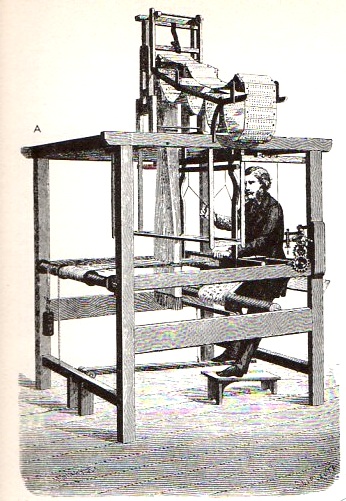
    Jacquard loom142

    Alfred Barlow wrote a splendid history of weaving1 in 1878, and in that book’s later pages–and I suspect much overcome with the recent developments in the electrical field (not the least of which were the newly-invented light bulb and telephone)–Mr. Barlow waxes considerably on the application of electricity to the Jacquard process.

    He writes,”It is scarcely to be wondered at that men acquainted with the application of electricity to telegraphy and other purposes should have believed it equally serviceable in some of the operations of weaving.  As it might be expected, the Jacquard apparatus seemed to offer and excellent opportunity for the needles [reading the holes ion the loom punch cards] to be worked, not by the direct pressure of a card, but by the connecxion of a series of electro-magnets.”

    Amd then this bombshell:   “By this means it was believed that paper may be substituted fir the cards, and the magnets might operate upon the needles through the perforations in the paper, or by passing a current of electricity through the medium of a metallic conducting surface on a sheet of paper or cloth representing the design to be woven, and thereby acting without the use or need of perforations.” (Pages 424-5)  

    It was certainly a capital idea.  Barlow may have been referencing the work of Alexander Bain and his punched-tape telegraph of 1841, though he does not mention him specifically.  Barlow does mention several inventors from the 1850’s who managed to make improvements with electricity in Jacquard-style machines, though none with the great effectiveness which he described here.  The real, great advancement in computation waited for quite some time, even beyond the great innovations of Herman Hollerith (who began his tabulating successes in the 1880’s, coming into international recognition with his work on the 1890 U.S. Census).  But Barlow’s imagination here is quite full,  and just a little beyond his time. 

    Footnotes:

    1. BARLOW, Alfred:  The History and Principles of Weaving by Hand and by Power.  London; Sampson & Low, 1878, xii, 443, iv pp, illustrated throughout with text illustrations.  


    ·Posted by :

    ·in:

  • The Discovery of the Future of Roads (1918)

    JF Ptak Science Books  Quick Post

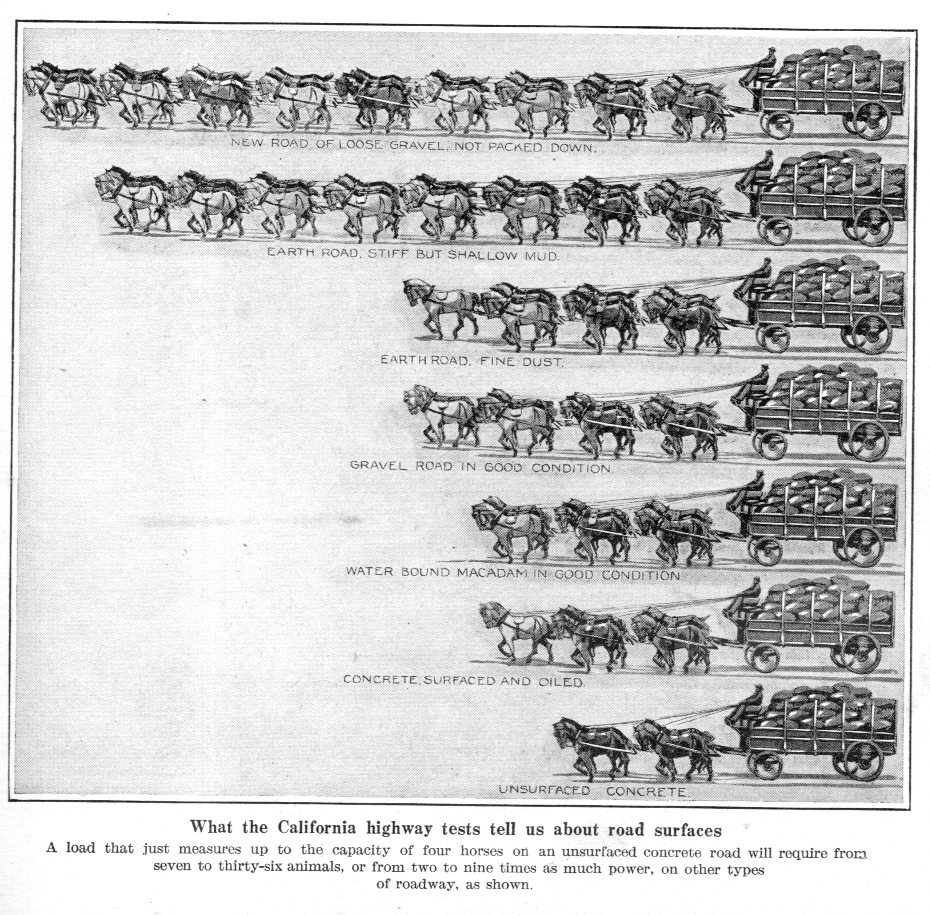
    “Only within very recent years has the paramount influence of roads upon the nation’s life been adequately realized”, so starts this article in the Scientific American for January 5, 1918. No doubt–between 1914 and 1918, the motor vehicle registration doubled and then nearly doubled again (1.7 million to 6.1 million over five years). And since it is far more relatively easy to make cars than  the roads they drove on, it is safe to assume that with this enormous increase in road traffic that it made planners and engineers of various shapes and sizes really think about the issue of roads in the future, as they could well see that car production was exploding and that car prices were making the auto affordable to just about everyone.    

    Roads571These artistic displays of quantitative data really do convey a message to a general audience–that aside from the engineering that went into them.  It is also useful to the historian or reader in history, or anyone interested in how people got from one place to another 100 years ago, and on what sort of surface they were making their way on…and what the surface of that road meant to the traveler.  I do not recall Mr. Holmes making any statements regarding travel time and the conditions of the roads on which the travel was made, but I have no doubt that he would have considered them using data much like this.  

  • An American Hobo in Europe (Well…Scotland) 1907

    JF Ptak Science Books  Quick Post

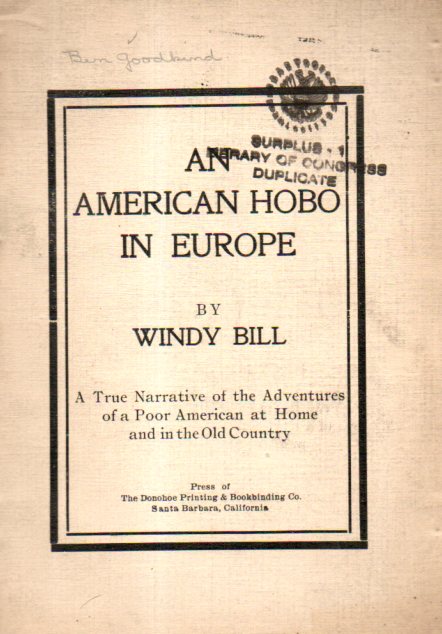
    American hobo575There’s plenty of European stuff and wind in this breezy recounting of a life on the road, but when I opened up this stubby pamphlet my eye feel by chance on his American travels, finding Windy Bill in Winnemucca, Nevada (a 550-mile drive north of Las Vegas).

    Windy does make some pretty interesting observation on Winnemucca, though:”Saloons are plentiful and all drinks are ten cents straight, with no discount for quantity. A pretty good meal can be had for two bits, but short orders and such things as life preservers, sinkers, or a bit of “mystery” with coffee, are all the same price—two bits. I found no place where I could get anything for less.There was a river or creek at the further end of town wherein I wished to bathe, but the water was so intolerably filthy that I deemed it wise to wait until I found a more suitable place along the route.”

    Windy takes more than half of the book to move himself from San Francisco to New York City, where he grabs a $27 ticket to Glasgow.  

    It really is a semi-interesting read, from what I can make of it, a U.S. vagabond vagabonding in Europe, though there are some unnecessary and inexplicably long quotations from Robert Burns that take up 40 pages or so. That said he does record some gems and pearls, like this:  

    “I drifted along Salt Market Street and then came upon a street which, for want of a better name, was called Sauchiehall Street, in the neighborhood of which I saw a restaurant called the “Workingman’s Restaurant,” on the side-wall of which was painted in large letters the following bill of fare:

    Tea, 2 cents.
    Coffee, 2 cents.
    Porridge and milk, 2 cents.
    Sandwiches, 2 and 4 cents.
    Eggs, 2 cents.
    Ham and eggs, 16 cents.
    Broth, 2 cents.
    Pea soup, 2 cents.
    Potato soup, 2 cents.
    Beefsteak pudding, 4 cents.
    Sausage, 2 cents.
    Collops, 4 and 6 cents.
    Dessert puddings, 2 cents.
    Fish suppers, 8 and 12 cents.
    Tripe suppers, 8 and 12 cents.

    Overall though his “European” trip isn’t much of one, unless people in the U.K. describe themselves as being “European”, which they are not wont to do. Windy Bill crosses the Atlantic and gets to Scotland, but doesn’t advance any further east. 

    ·Posted by :

    ·in:

  • A Very Sympathetic Statement on the American Indian, 1880

    JF Ptak Science Books  Quick Post

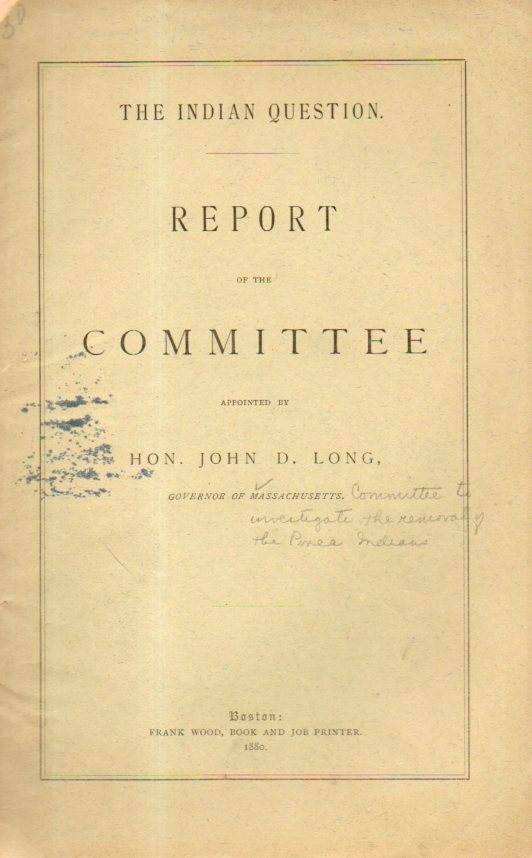
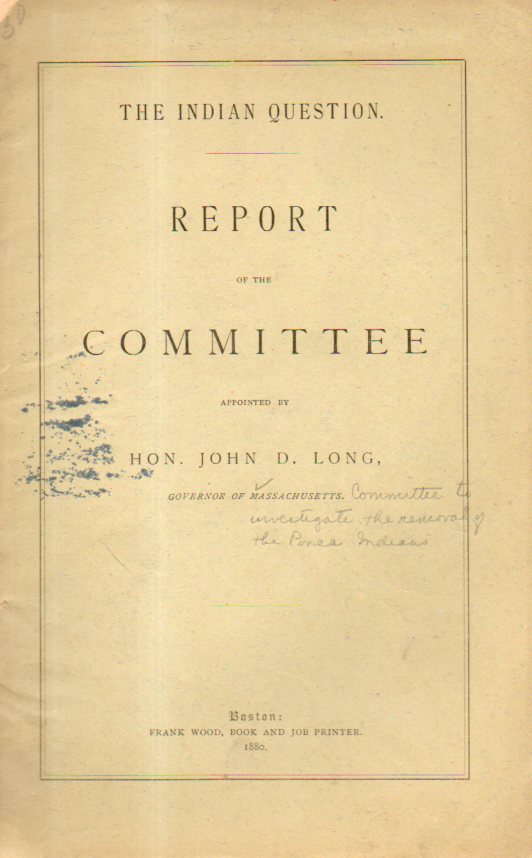
    Indian question576The fighting end of the American Indian Wars was coming to an end when this pamphlet was published in 1880.  When I opened it I fully expected to see the issue of the “questions” of the American Indian being Indian control, or the “problems” of Indians retaining reservation lands now much in demand by settlers, and so on. As it turns out, this report was a very sympathetic investigation of the problems that the Indians were having. The “Indian Question” was a big one–why were the Indians  being so hideously treated?  


    Some of the discussion presented in the pamphlet included section headings like  “unsuitable reservations”, “the way the government robs the Indian”, “evils of the present system”, “Indian children equal to the white in capacity”, “rapid advancement of Indians”, “robbery of property of Indians”, “gross mismanagement and cruel treatment of Indians, “the punishment of murderers of Indians” (which the pamphlet records as “none”), “violation of treaties by the U.S. government”, “inexcusable neglect of Indian Department”, and such.   Pretty impressive.

    Here’s the entire document from the Internet Archive–it is well worth at least a browse. 

     https://archive.org/stream/indianquestionr00indigoog#page/n10/mode/2up

    Notes

    1. LONG, John D. The Indian Question, Report of the Committee appointed by Honorable John D. Long, Governor of Massachusetts. Boston; Frank Wood, 1880.  8vo, 26, 47pp.  Original wrappers, institutional stamp on rear wrapper from the Library of Congress; U.S.  Geological Survey rubber stamp on back of the title page

  • Intel vs. Obelisk: The Renaissance Beauty of the Single-Chip Microprocessor

    JF Ptak Science Books      Revisting Archive Post 1685

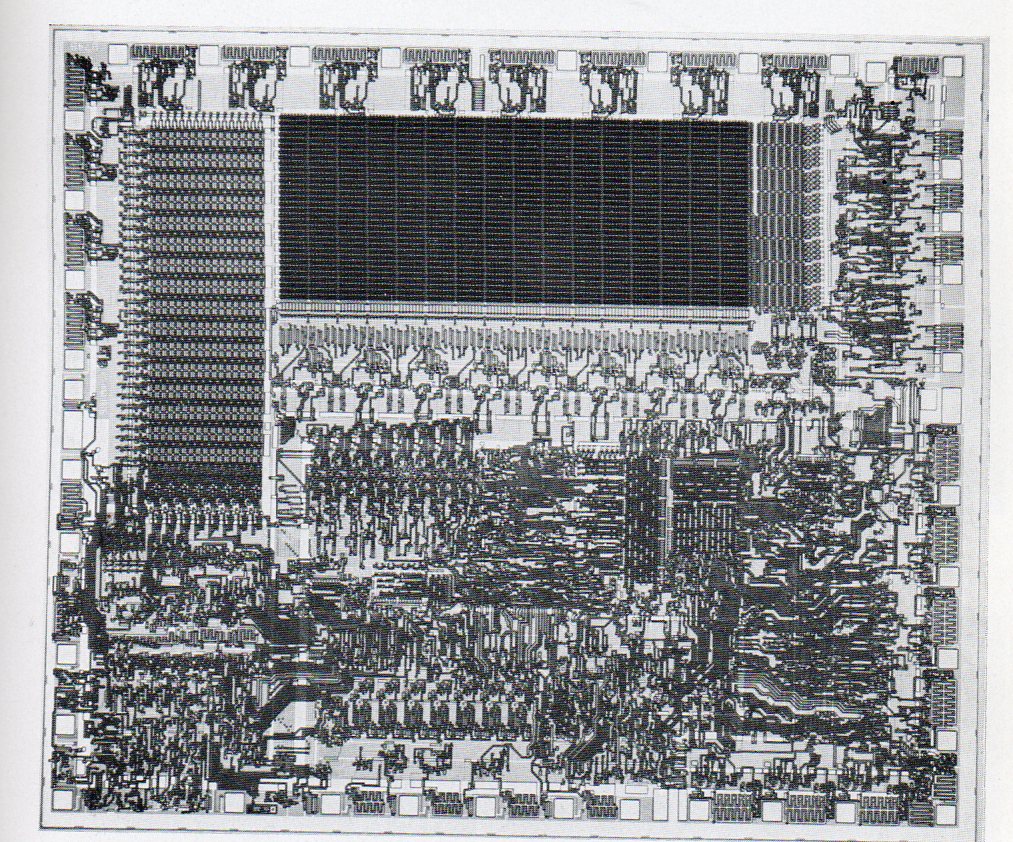
    The moment that I saw this image1 of (what I think is) the 8086 processor I thought of its great visual similarities to one of the greatest engineering works of the 16th century, so much so that with a little imagination, the older work seems a pentimento of the newer. This microprocessor–which in 1979 was a vast leap forward in development–looks like an architectural/engineering plan: large objects being hauled into place by legions of workers with wooden cranes, giant winches and mammoth rope, a fantastical display of concerted effort on a gargantuan scale.  It is, or was, in fact an enormous leap in hardware engineering, a micro-mammoth advancement.

    Fontana microprocessor209

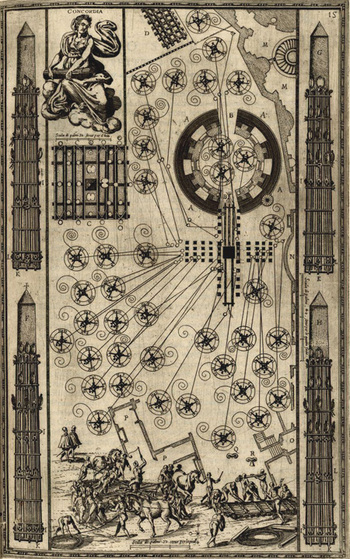
    This older, pentimento image is a plan for moving of the great 500,000-pound Egyptian obelisk (carved during the reign of Nebkaure Amenemhet II, 1992-1985 BCE, and originally standing in the Temple of the Sun at Heliopolis) at the Vatican. 

    Blogfontana_moving

     The engraving appearedin Domenico Fontana’s  masterpiece Della trasporatione dell’obelisco Vaticano…(published in Rome by Bassa in 1590) and illustrated  one of the greatest engineering feats of the Renaissance.  Moving this enormous and relatively delicate object (from the Circus Nero, where it was placed by the emperor Caligula in 37 ACE,  to St. Peter’s Piazza del Popolo, 50 years or so before it would be more enveloped by Bernini’s flying wings) took years of (very) careful planning and months of motion and movement, not to mention an extra month to get everything into place and slowly raise the obelisk into its final position.  Fontana had to be cautious and correct, and he was, performing a not-so-minor miracle of pre-industrial magic to move the priceless 250-ton iconic relic and place it perfectly down in the center of Christianity.  That must have been one hot Roman summer, especially for Fontana.

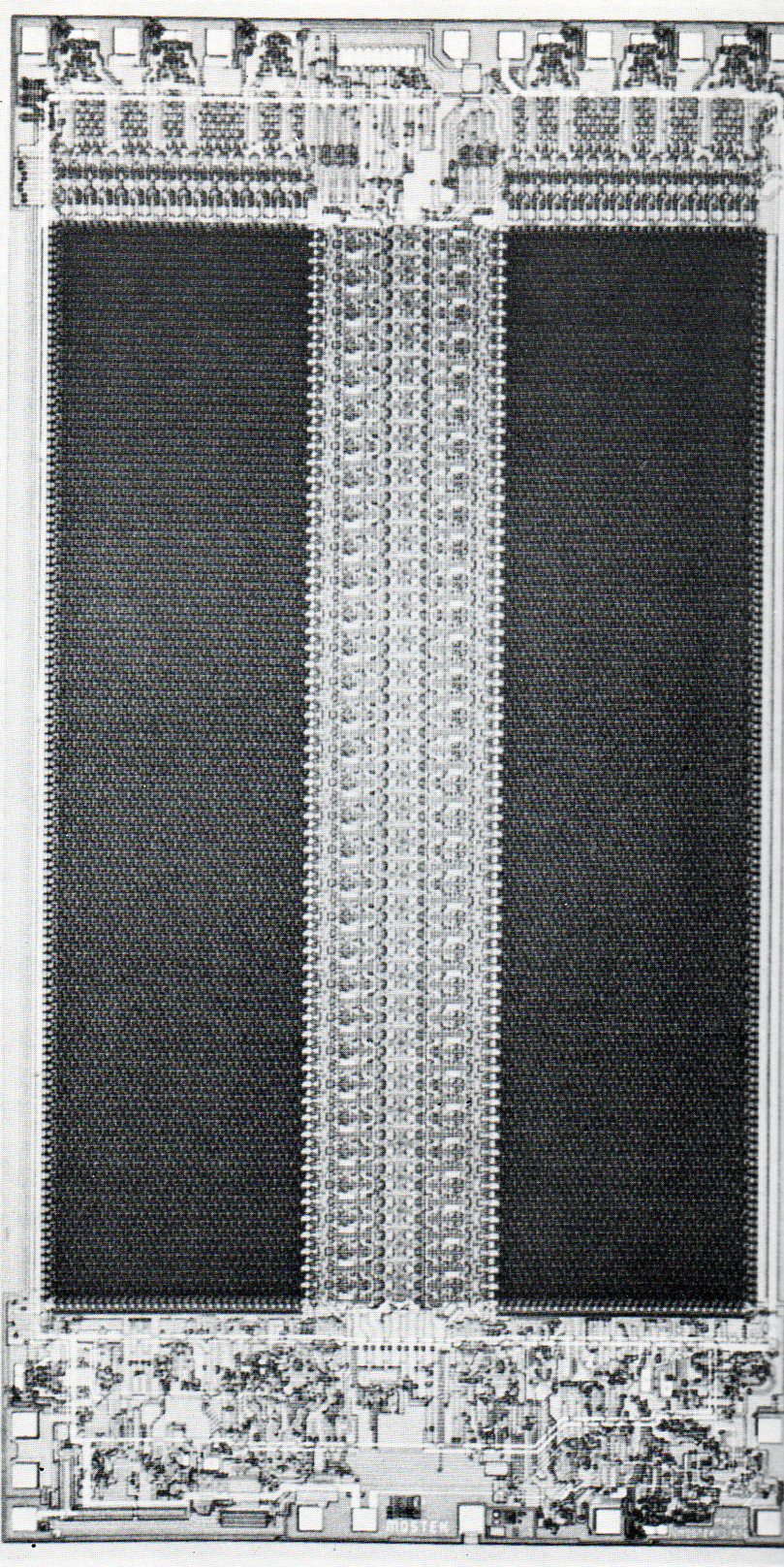
    I can easily see the similarities in Fontana’s work and that of Intel. Here, in a photograph of the 16k bit random access memory chip (via Mostek Corporation) I can see a vast palace at the top of the picture, with a long, columned entrance with manicured gardens on either side.  The image offers an elevation and a plan–that is, the top and bottom images of the buildings are seen in a deeply oblique view, while the central part of the image is a straight-out plan.  At least that’s what I see, its imaginative possibilities more appealing than the physical realities (though that’s where the extraordinary value is/was).

    Fontana microprocessor 2210

    Notes:

    1. J.H. Westcott, “The Application of Microprocessors”.  In Proceedings of the Royal Society of London, A, 367, 451-484.

    ·Posted by :

    ·in:

  • I’ve Never Done This Before, and I’ll Never Do It Again (1918)

    JF Ptak Science Books   Quick Post

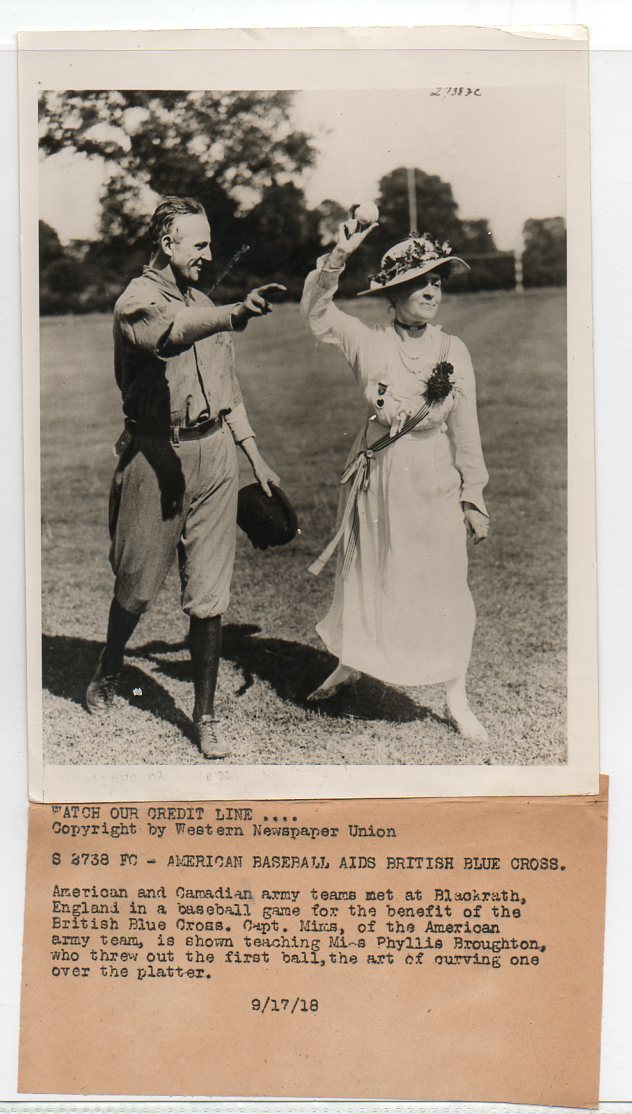
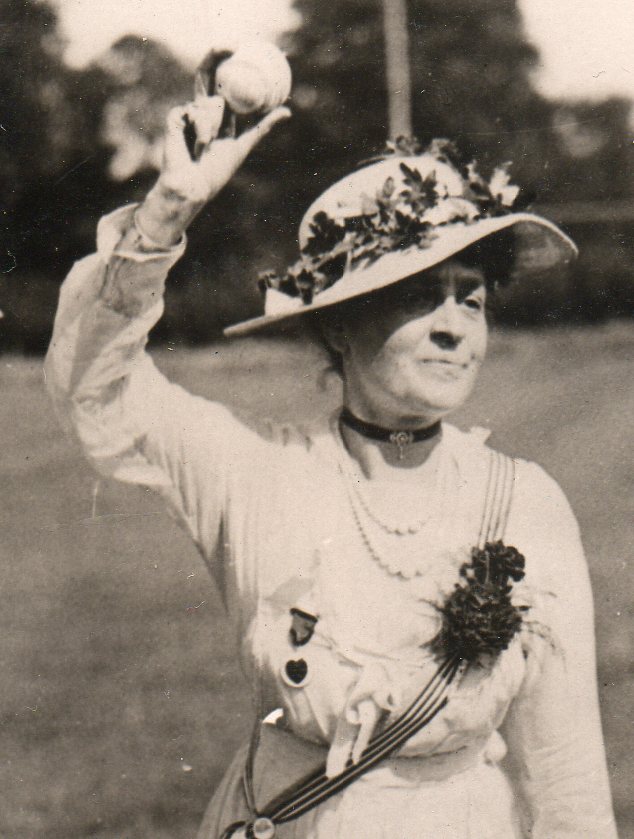
    All in fun and all for the charity of the British Blue Cross, Ms. Phylis Broughton joins the festivities, though whether see is entirely reluctant or determined, we’ll never know.  Perhaps both.  

    WWI--e--women-baseball672


    This lovely photograph is available from our blog bookstore, here.  

    WWI--e--women-baseball det673

    ·Posted by :

    ·in:

    —
  • Rare Block Diagrams for the UNIVAC (1950)

    JF Ptak Science Books  Quick Post 

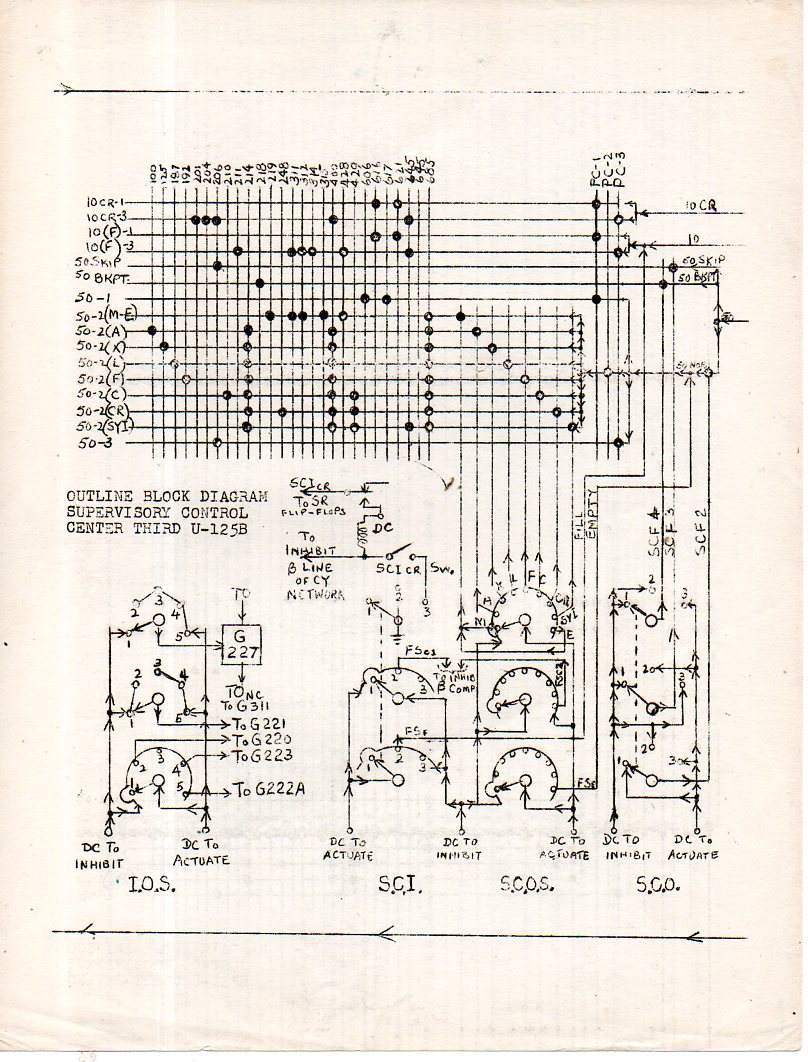
    The UNIVAC (Universal Automatic Computer) was the first commercially-available electronic computer, and the first computer to handle both numeric and alphabetic information, produced by Remington Rand, and  came into working service at the Bureau of the Census in 1951.  It was designed by John Mauchly and Pres Eckert Jr, who also worked together in the design and construction of the first digital computer, the Electronic Numerical Integrator and Computer (the famous ENIAC). The UNIVAC was a Big Boy: 25×50′, with 5,600 tubes, and 18,000 crystal diodes–given its workhorse nature and general success, by 1957 there were 46 UNIVACs in operation. 

    The following are working block diagrams of sections of the UNIVAC, produced by some sort of early offset process in 1950, slightly before the computer came to its working life.  I have a number of sections of the computer represented in this way, but not the entire machine–but what is here may be of interest to historians of computer science.

    MullendoreBlock diagrams497[Supervisory Contro Panel]

    Present in the collection:

    • 1.  The Supervisory Control Panel (2 sheets of 3, including center and left third, both undated but assumed to be 1950 like all of the others. [Shown above]
    • 2.  Input-Output controls.  3 sheets of 3. (left, middle and right thirds), dated 8/10/50 and 8/7/50.
  • On the Relation of Birds to Airship Flight (1890)

    JF Ptak Science Books  Quick Post

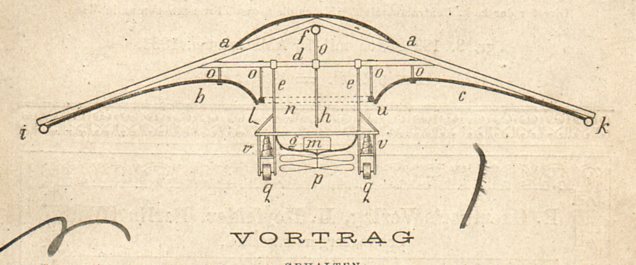
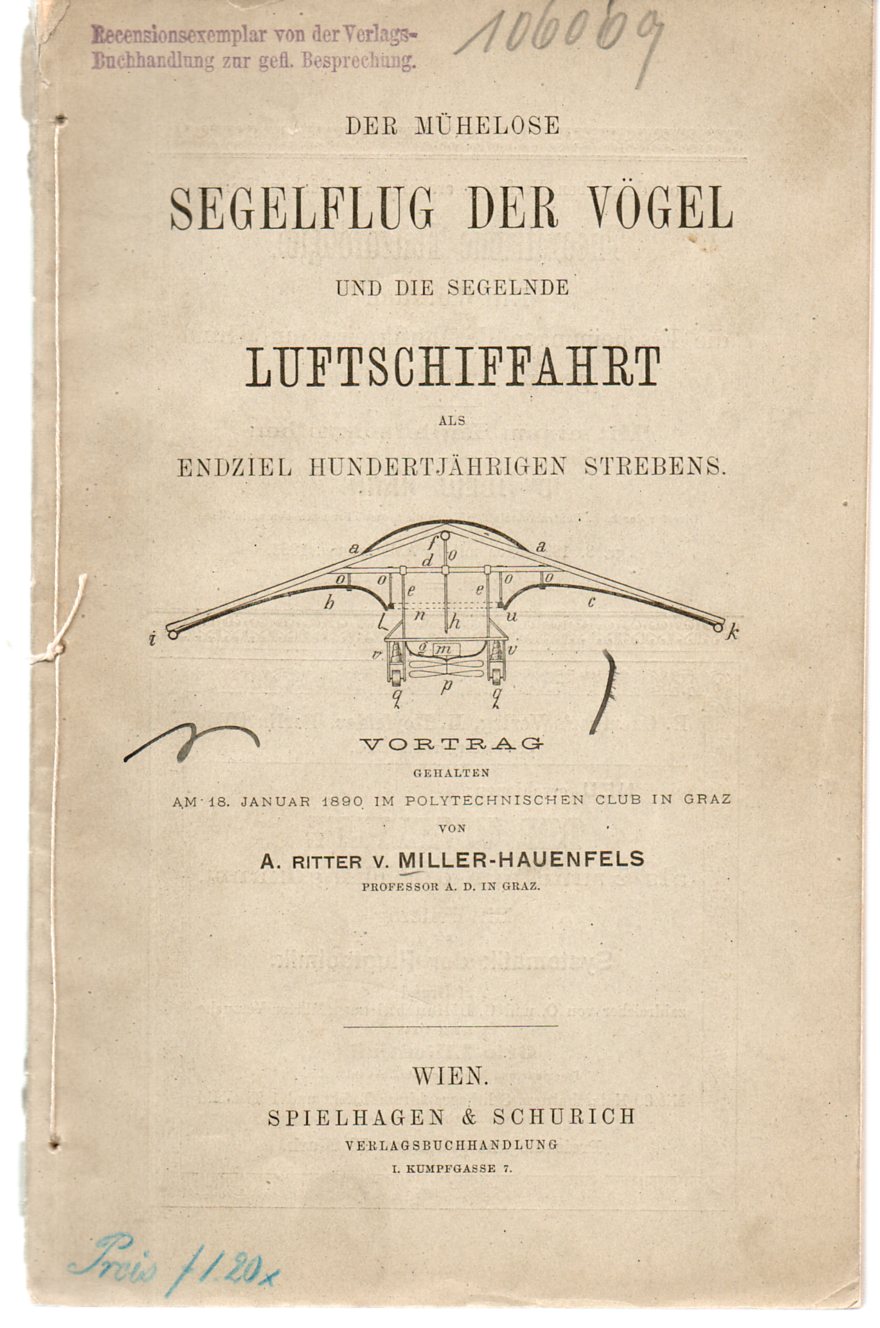
    Here’s an interesting and lovely little classic:  A. Ritter v. Miller-Hauenfels Der mühelose Segelflug der Vögel und die segelnde Luftschiffahrt als Endziel hundertjährigen Strebens. (Roughly “The effortless gliding of birds and the sailing airships as the ultimate goal for the end of the century”).The matieral was delivered  (January 18th) 1890 at the Polytechnischen Club in Graz and publisahed later that yer in Vienna by Spielhagen & Schurich.  My copy of this work also happens to have been in the collection of Vicktor Silberer, 1846-1924, a pioneer aviator from Vienna and a prolific author, jorunalist, and politician.

    Aviati0n ritter382


    Aviati0n ritter381

    In his lectures at Graz Miller-Hauenfels looks at the possibility of human (non-powered, gliding) flight via forward-progression bird flight, basing his work on that of Marey, Lilienthal and Parseval.

  • Small Comforts of the Wounded, 1917: Electrophones

    JF Ptak Science Books  Post 2377

    WWI Electrophone267

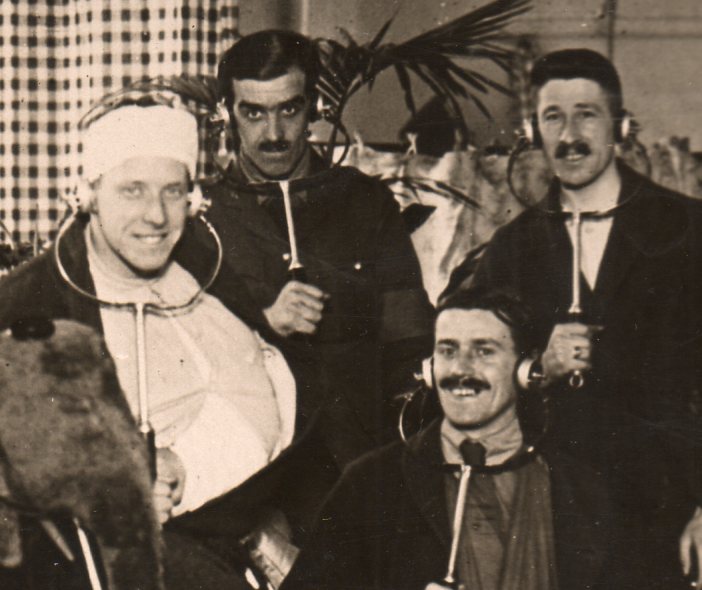
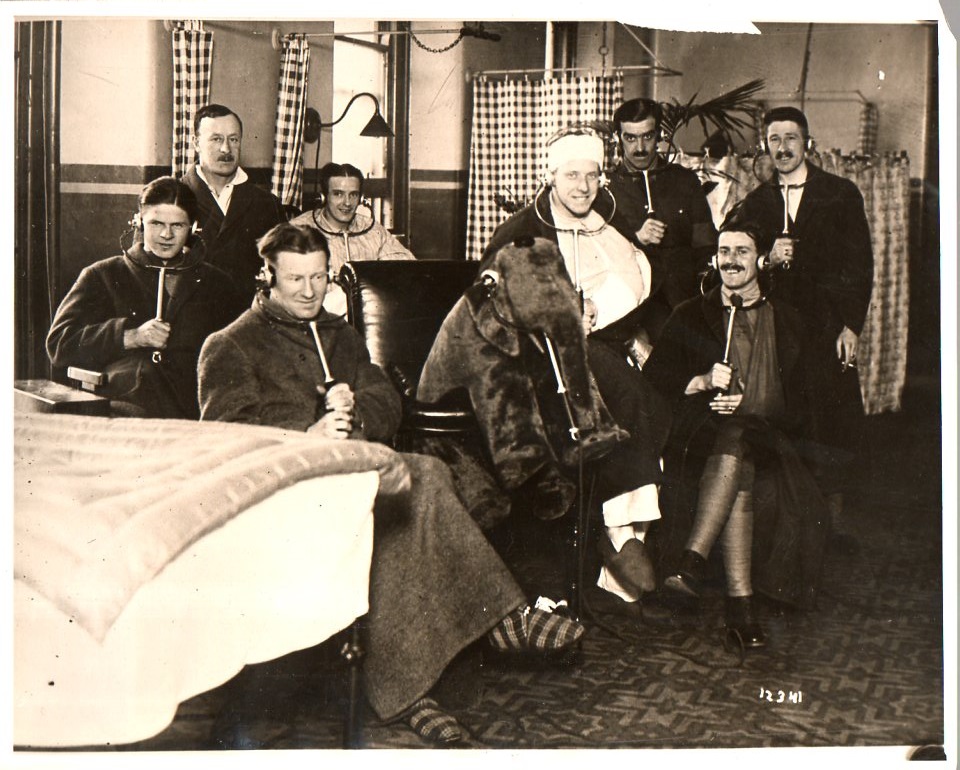
    Overall, these soldiers look to be in pretty good spirits, even if they were perhaps told to be so, they still looked fairly genuine. And who wouldn’t be, at least to some degree, being survivors?  They were a few of the millions of soldiers who were wounded in WWI, which means at least that they were among the millions of the dead.

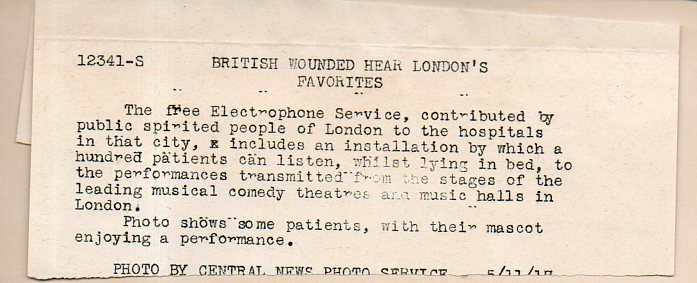
    The caption that accompanies these News Photo Service image (made by the Central News Photo Service and dated May 11, 1917, says that they were enjoying the donated headsets–Electrophones–and represented a few of the hundreds that received them.  This device was basically a telephone receiver, and years after Bell and Edison dreamed of social integration and advancement and wide-ranging culture, of delivery literature and music to people flung near and far, these soldiers were enjoying the benefit of limited concerts and other entertainments via telephone lines.  

    [This lovely photograph is available at the blog’s bookstore, here.]

    WWI Electrophone266

    Here’s a very good quote ont he electrophone from the highly interesting The Cat’s Meat Shop, written by Lee Jackson, author of Dirty Old London, the Victorian Campaign Against Filth. (It is an interesting topic–filth and its control–because you really can’t have an Industrial Revolution without lots of workers living close to their jobs, which means that lots of people live close together, and you can’t have that unless you somehow control for good sanitary conditions, which means you’ve got to take care of filth.)  

    WWI Electrophone265

    ·Posted by :

    ·in:

    —
  • Massiveopolis: Filling in the North Sea (1930)

    JF Ptak Science Books   Post 2378

    This is part of a series of Mega-Massive Invisible Engineering, the Filling-it-In Section. Other examples from this series not necessarily filling-stuff-up include:

    The title of this post is a bit of a tweeker–the project is not to fill in the entire the North Sea, just the southern North Sea.  This actually makes a pretty big difference bathymetrically, because the sea floor gets mighty deep up along the coast of Norway. Still, though, as impossibly ambitious projects go, this is still a massively unstable consideration, the entire North Sea or not.  
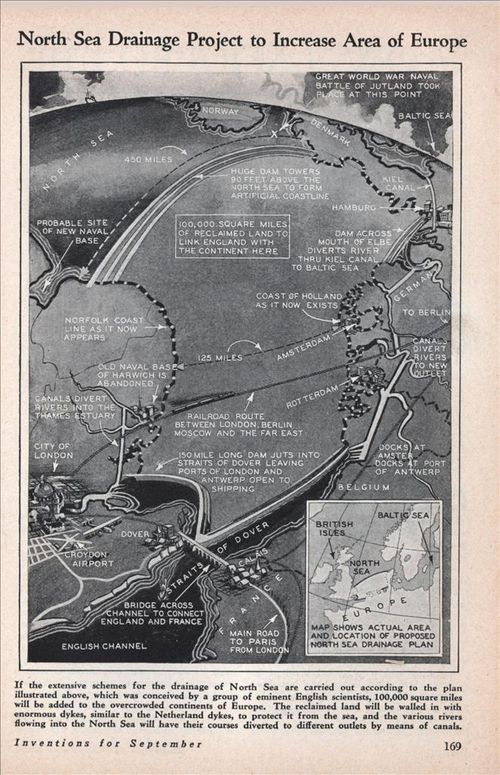
    North sea[I owe the fun I had thinking about this project to two great sites: Modern Mechanix and Imaginary Cities–Modern Mechanix for posting it to begin with and Imaginary Cities for tweeting it.  These are two great sites well worth subscribing to.]

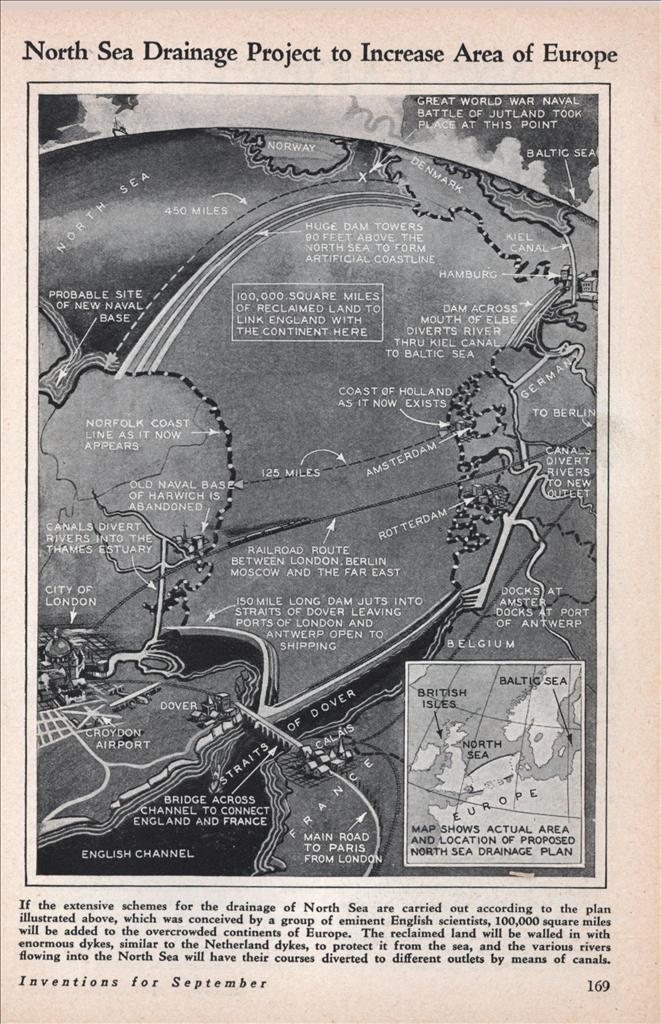
    A sort-of Atlantis was drowned some 8500 years ago, a large piece of land that connected what is today Great Britain and Europe. Rising water did away with this territory leaving behind the great island nation and much else. The plan referred to above in the title is the extraordinary thinking for “raising” that lost Atlantis-esque land, and was floated in the September 1930 of Modern Mechanics. 

    The author maintains some sort of possibility for recovering some 100,000 square miles of submerged land that would connect south-eastern England with France, Belgium, the Netherlands, and Denmark. It would be accomplished by erecting some 700+ miles of dykes and dams and then, somehow, emptying all of that surrounded and captured water into the sea that it once belonged to.  

    100,000 square surface miles is an area twice the size of England, three times the size of Lake Superior, nearly the size of the Caspian, and equal to the size of Colorado. 

    The English Channel and the straits of Dover would become a divided thoroughfare; the Thames would be part of a canal system that would extend along the old Norfolk coast to The Wash; a bay from the Straits would extend inland to Belgium, where it would be met by a canal system that would extend to the Baltic.  All of this would be held in place by a 150-mile long dam of unusual  shape. And just for good measure, bisecting these two would be a monster bridge from Dover to Calais. 

    This is of course extraordinary, but when we look north we see a breathtaking proposal for a  450-mile long, 90′-high dyke extending from the English coast to Denmark. The artwork claims that this is 90′ above the water for the rest of the North Sea, which means that the structure would have to be at least 110′-150′ high, plus the foundation. Luckily for the designer the southern North Sea is a relatively shallow water sea, 20-40′ deep, though there is a stretch of 100′ miles where the depth is considerably deeper.  I haven’t considered yet how wide this dyke would be, except that it would be, well, big.

    There is also a drawing for a London-Berlin and points east train. The  Elbe is dammed, and it looks as though the Netherlands is no longer the Lowlands, everything there being “filled in”, with the sea being moved some 200 miles to the west. 

    This is just a short spec piece that appeared in a popular science magazine 84 years ago, but there is no mention of what these changes might mean to the currents of the south North Sea, or Jutland coastal waters, or the Continental Coastal waters; or the changes it might dictate to salinity, or nutrients to the rest of the North Sea, to say nothing of the sea floor inhabitants and fish, and so on.  There would no doubt be some natural consequences to this (literal!) undertaking.  

    I suppose someone at some point would have to think about how all that new land would be divided, but I guess that would all take care of itself.  

    • Another related article from Modern Mechanix posting a Modern Mechanics May 1931 addresses the issue of water removal albeit at as much lesser scale, here.
Recent Posts

Archives

Categories