JF Ptak Science Books Quick Post
Here are a few things on the top of the stack in the telecom box–I think that I left them like that as a treat to myself for the next time I opened the box:
A Daily History of Holes, Dots, Lines, Science, History, Math, Physics, Art, the Unintentional Absurd, Architecture, Maps, Data Visualization, Blank and Missing Things, and so on. |1.6 million words, 7500 images, 4.9 million hits| Press & appearances in The Times, Le Figaro, Mensa, The Economist, The Guardian, Discovery News, Slate, Le Monde, Sci American Blogs, Le Pont, and many other places… 5000+ total posts since 2008.
Contact johnfptak at gmail dot com
JF Ptak Science Books Quick Post
Here are a few things on the top of the stack in the telecom box–I think that I left them like that as a treat to myself for the next time I opened the box:
JF Ptak Science Books Quick Post
Oh to be young and free and red! This pamphlet told of the joys and works of the Young Communist League of Britain, a youth version of the Communist Party of Britain. It was launched in 1922 and somehow survived until 1988. This pamphlet was published in 1937, which is probably the low point for the Stalinst Soviet Union for the decade of the ‘thirties, which was very low, and enforced-famine-stricken, and murderous, as just about any in the history of worst decades. There’s a lot in the pamphlet about fighting the Fascists in Spain, and not much more.
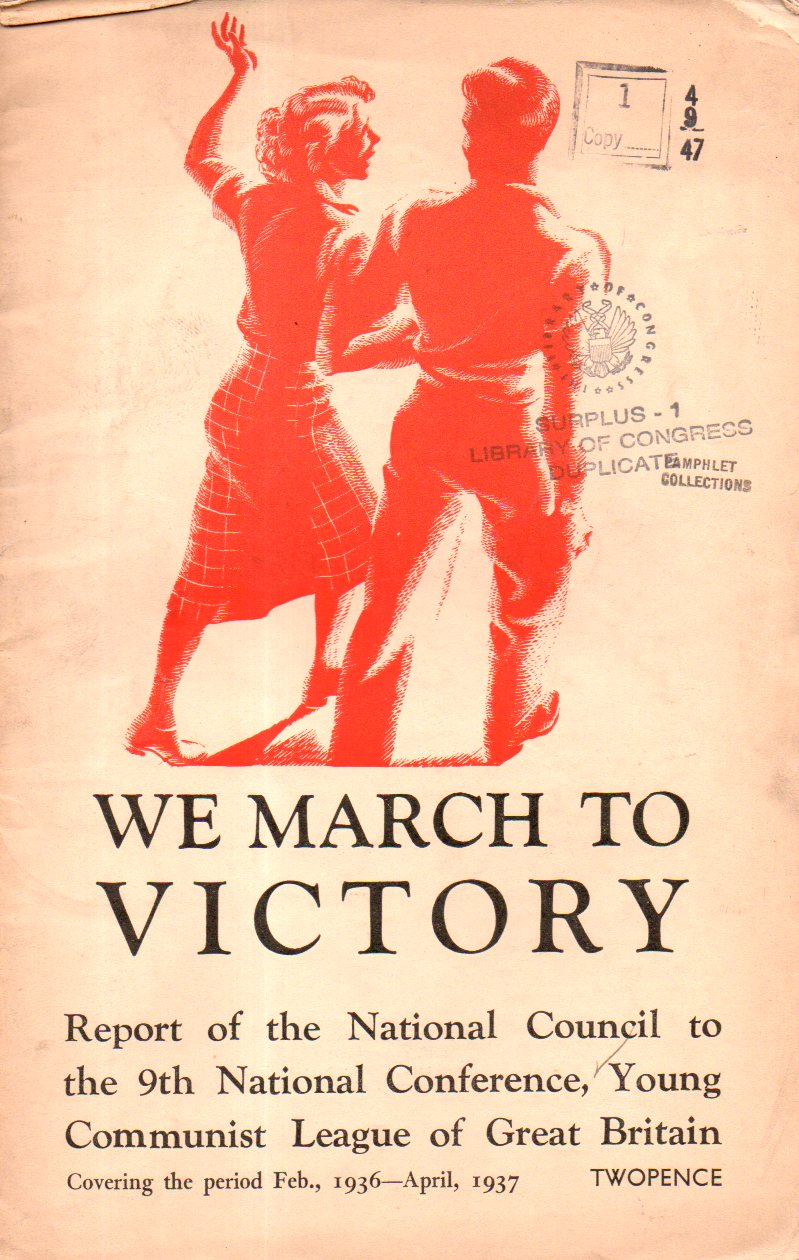
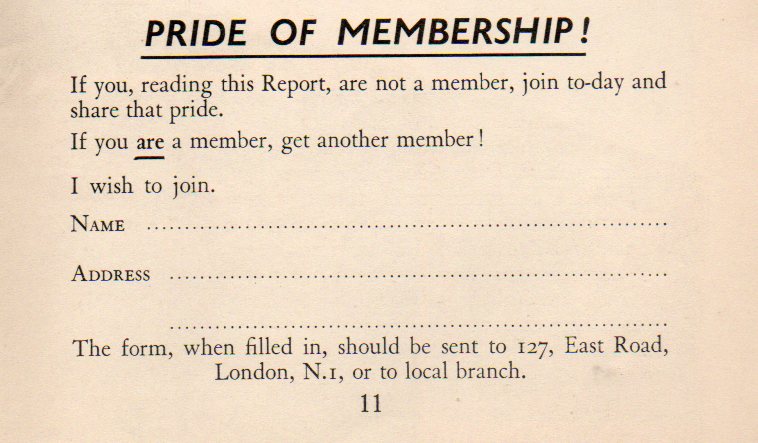
Become a member today! Be aware to fill in the form before mailing it out! (It looks like today that address is a two-storey apartment building.)
JF Ptak Science Books
.003%
That’s what I reckon this column of soldiers would represent of the total casualties of WWI.
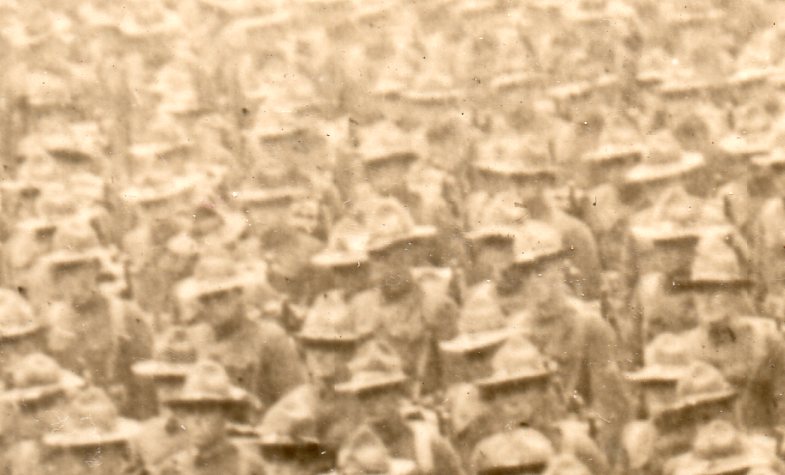
Generally images like this are a virtual image-host for me, a bucket of ice cold water thrown onto a sizzling summer sidewalk, all sorts of ideas steaming from it. But for photographs of Doughboys1 marching, especially assembling for parade, this one struck me a little more oddly than most, giving instant pause, making me concentrate on the haze, or dust, that allowed the columns of soldiers to blend into one another and fade, losing their boundaries with their mass receding into a dull blur.
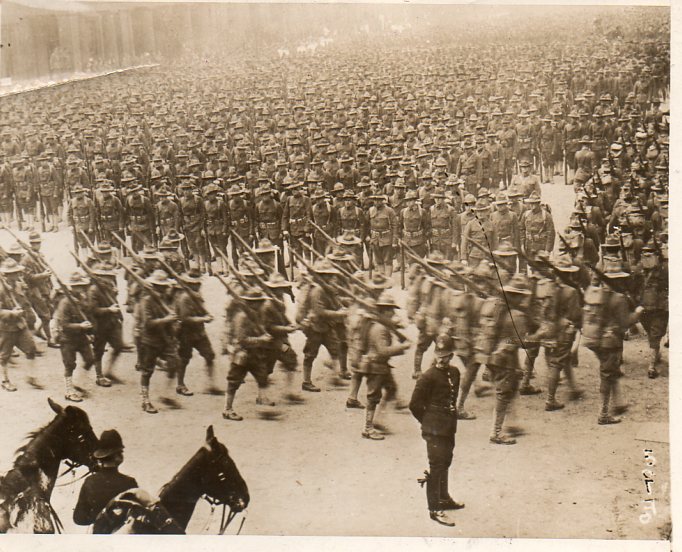
The Western Newspaper Union was selling this image for insertion in newspaper or journal stories about the war, for a small use fee. There were a few American organizations like Western Newspaper that were created to photographically cover the war, using pools of photographers who would distribute their work anonymously and which was available for common, general use for a small charge. The photographs allowed out were certainly restricted and censored, though in my stash of these of objects (numbering about a thousand) I’d say that 10% of them look pretty edgy to my eyes. Most of the action of war was not covered, but then again this aspect was still fairly technically difficult in 1918. Images of pain were almost never allowed, and certainly not pain of Allied troops. Aid stations were almost never covered as well, as were dead bodies, or at least those again of Americans or Brits or French or Canadian. The imaging of the war was certainly under a fair amount of supervision and control. (The original is available for purchase through our blog bookstore. here.)
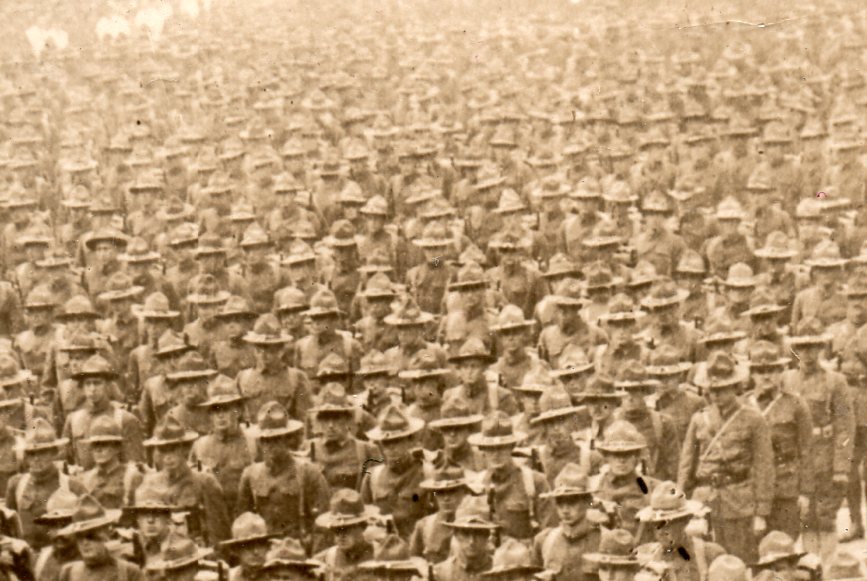
The image shows American troops assembling for a parade through the streets of London before being deployed. The mistiness of the composition looks like a statistic to me, these men standing for those who had come before and fallen.
The U.S. lost .13% of its population to casualties (125,000 killed and 205,000 wounded) during the war–a war which by the time America got here had already been visciously fought for three years, costing dozens of millions of lives. The figures for everyone else weren’t nearly so “fortunate” as the U.S.: New Zealand’s 18,000/41,312 killed/wounded amounted to 1.6% of its population. The U.K. lost 2.19% (964,000/1,663,000), Italy was 3.48% (650,000/953,000 plus 650,000 civilian casualties), while France suffered a 4.29% (1.4 million/4.27 mil) blow of its total population to war. Things were worse on the other side: Germany 3.82% (2 mil/2.4 mil plus 426,000 civilian deaths, and the Ottoman Empire 12% (400,000/771,000 plus 2.1 million civilian deaths. Worst of all was the Ally Serbia, suffering a catastrophic 16% loss of its population to war, including 275,000/725,000 plus 426,000 civilian casualties. As gruesome as the numbers were, the Americans felt only a small percentage of the total sting of war–by 11 November, more than 21 million soldiers would have been wounded, with 9.7 million soldiers and 6.8 million civilians killed. It was an enormous price.
And that’s what I see in the mist of what may be something like 10,000 soldiers on display in this photograph. .003% That’s two of these columns every day, twice a day, for the entire 1550 or so days of the war.
Notes:
1. The origin of the term “Doughboy” is unclear, or varied, or rich, but it is at least pretty oldm beginning around the time of the Mexican American War in 1846-1848–evidently when the soldiers marched through dry, tough terrain they wound up being covered by earth with the color of dough. Doughboy.
JF Ptak Science Books Post 2605
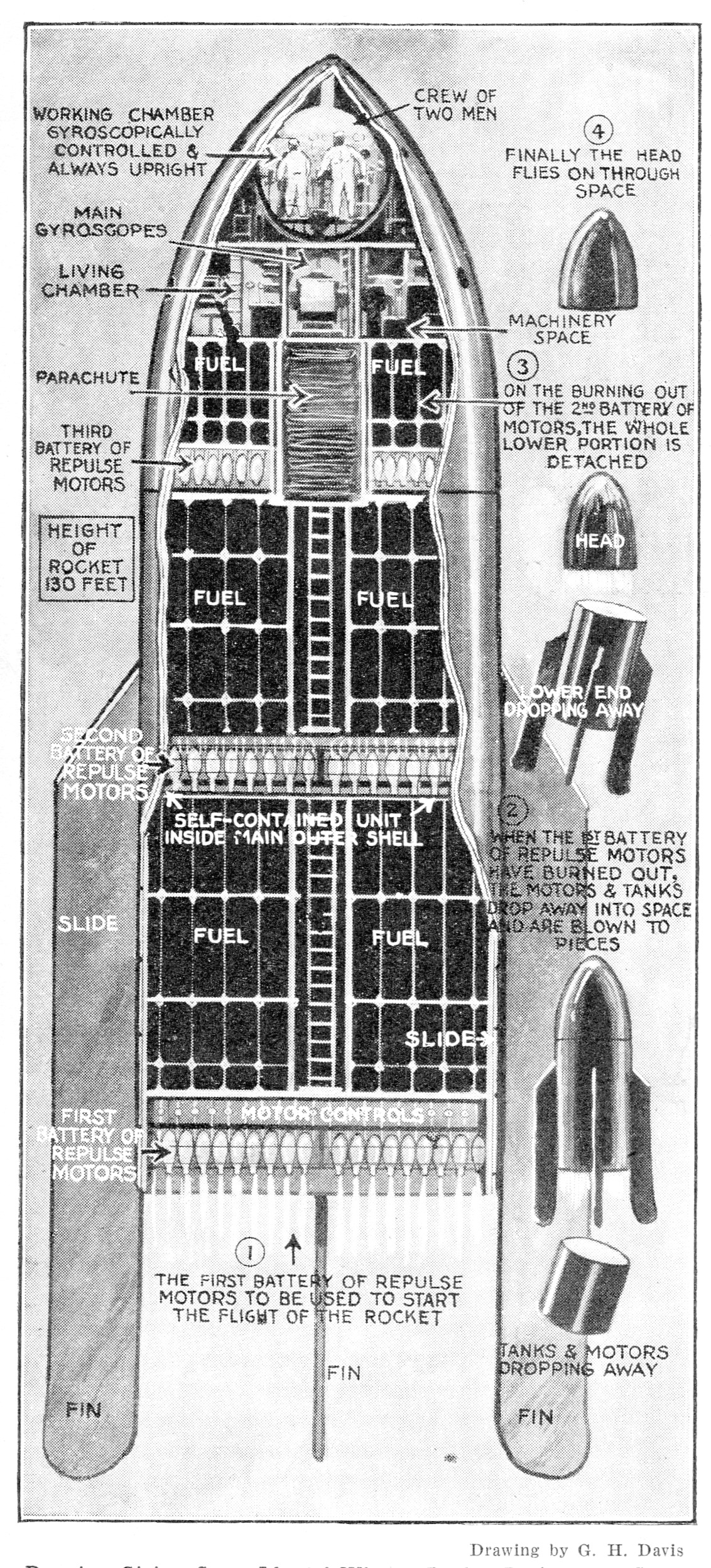
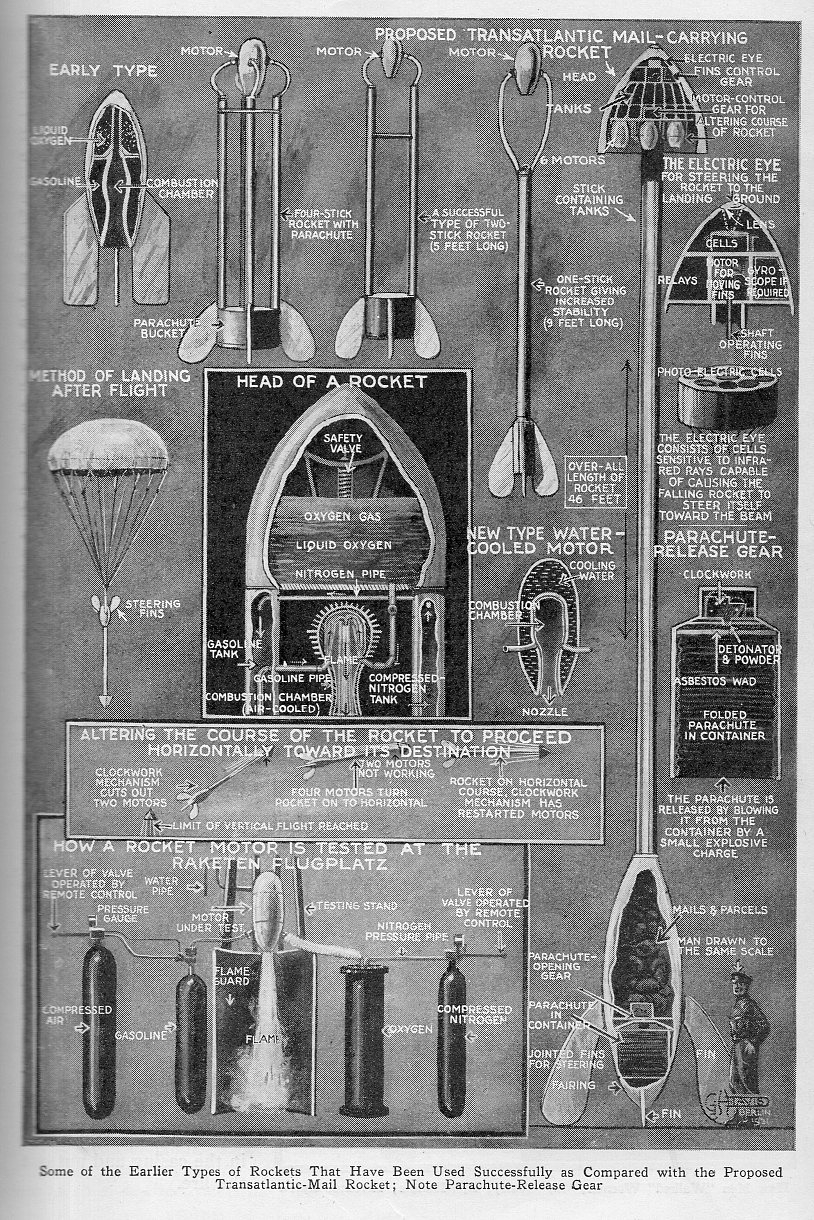
This interesting schematic was drawn by one of my favorite technical artists, G.H. Davis, who generally worked for the Illustrated London News, though he appears in this article in the March 1932 issue of Popular Mechanics. Davis was exceptional and prolific and produced (I guess) hundreds of drawings like this one, below. “From Europe to New York by Rocket?” is mostly about delivering trans-Atlantic mail in twenty-five minutes rather than people, though that is mentioned somewhat, along with a scant reference to the possibility of interplanetary travel. Mostly the article is based on Davis’ trip to the Raketen Flugplatz–the Rocket Airfield–a 300 acre former munitions/weapons site pockmarked with highly-useful bunkers in the Reinickendorf suburb in northeast Berlin, which is today very nearby the Berlin airport. This was the world’s first such aerodrome, and it was staffed by the amateur rocket club of Germany which composed of such names as Nebel (who named the Raketen Flugplatz), Ritter, von Braun, Riedel, Heinish, and Oberth, among many others. The place was opened in 1931 and saw the development of the liquid fueled rocket in Germany. The place was short-lived though its influence was long-felt, the facility closed down over an unpaid water bill in 1933–it was at that time, anyway, where the Wehrmacht assumed control of rocket development in Germany and amateur exploits/testing was forbidden. Six years later the Nazis went to war, and shortly after that appeared the V-weapons that so terrorized Europe and Great Britain, killing tens of thousands and leaving hundreds of thousands homeless, not to mention the thousands of slave workers who were killed in the process of production.
But for 1932, when this article appeared and when Davis happily toured this facility, liquid-fueled rockets (introduced by Robert Goddard in 1929) seemed to hold the key to the future of rocket/space travel.
Here’s Davis’ cutaway of a proposed rocket–it is not named nor is its purpose described, though it is not a rocket built for mail delivery, which was the discussion on this page of the article–this is clearly far too massive (seemingly 100+ feet tall) for that, and also has sleeping quarters for the (standing) crew in the nose.
There are a few photographs of the team at the team at the Raketen Flugplatz, though no one is actually named–there is this photo which I’ve seen before and recognize, and I’d like to point out that aside from depicting Kurt Heinish (1910-1991) and Klaus Riedel (1909-1944) it also shows Heinish handling what I think is liquid nitrogen with basically no protective gear at all, save for some gloves.
JF Ptak Science Books Post 2605
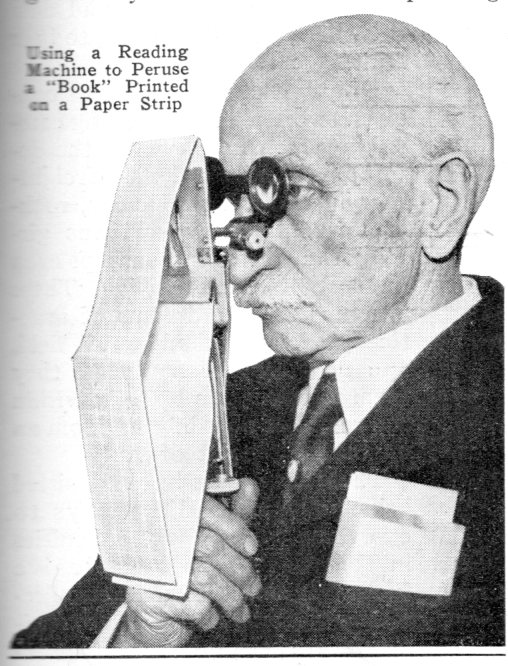 Before the internet the idea to the idea of the internet existed to some extent in the head of a great unsung hero of the U.S. WWII figure, Vannevar Bush, a person who may well have invented the notion of hypertext. Vannevar (pronounced “van ee var”) was a flinty no-nonsense New Englander who was an organizational and mechanical genius who as a professor at MIT developed a remarkable analog computer that greatly advance computation capacities for solving differential equations. This was in the 1930’s, and even after creating an improved electromechanical version of the machine still chose the wrong way to go in the soon-to-materialize digital computer revolution. During WWII Bush was one of the most important Americans in the war effort, overseeing the entire scientific effort of the U.S.—an enormous effort dispatched beautifully (and successfully). His importance in this regard is difficult to overstate. He also published a short paper on the hypertext idea in an article in The Atlantic in 1945.
The article, “As We May Think”, outlined his idea for a device he called the MEMEX (“memory” and “index”), which compressed and organized all that its user could remember and whatever information would be obtained in the future via electromechanical apparatuses, and available with associative tracking between the microtext frames. So all manner of book and papers and reports and newspapers and images would be microphotographed and stored in a beautifully-indexed mechanical retrieval system where it would live with the information of others. There was also the possibility of real-time textual additions to whatever it was that was retrieved, the genetic precursor of hypertext. Bush’s thinking has been deeply recognized (and also by the creators of the internet) as the intellectual grandparent of the modern internet.
And so I had a mostly-comical response to the image that I found (left) in the pages of the March 1932 issue of Popular Mechanics–it was actually on the back of the page that I was looking for (on passenger rocket travel across the Atlantic). With Bush in mind, this image of a man reading a miniaturized book using the system of Rear Admiral Bradley A. Fiske (1854-1942), and the photo shows the reader with the equivalent of a 100,000-word novel. The article only mentions this one book, and doesn’t venture out into imagining anyone carrying a library with them, nor does it mention searches of organizing systems, but it does bring to bear the possible power of having access to a vast amount of info held on a strip of paper about the size of a newspaper column. And for 1932, that was a strong idea.
JF Ptak Science Books Quick Post
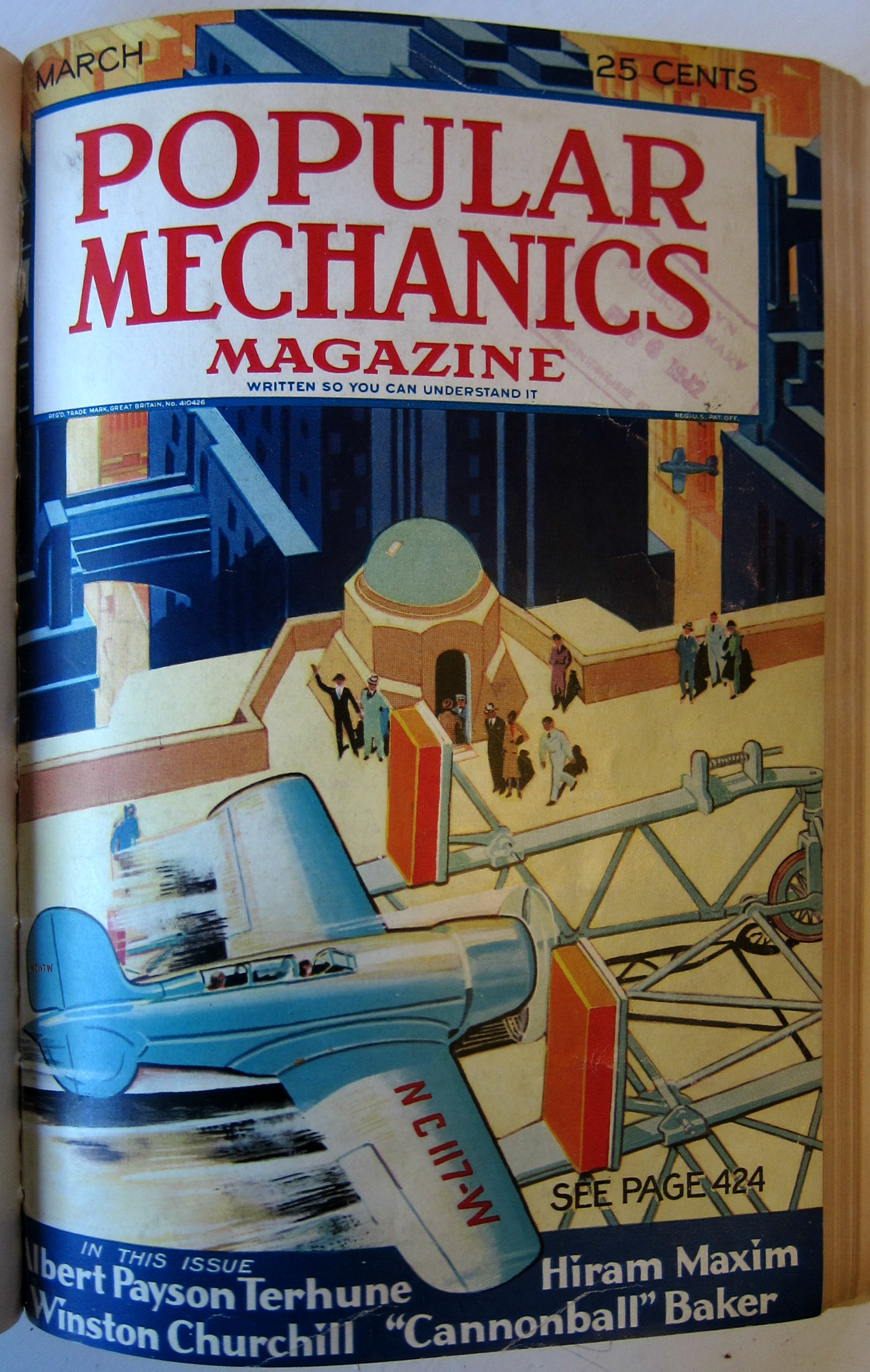
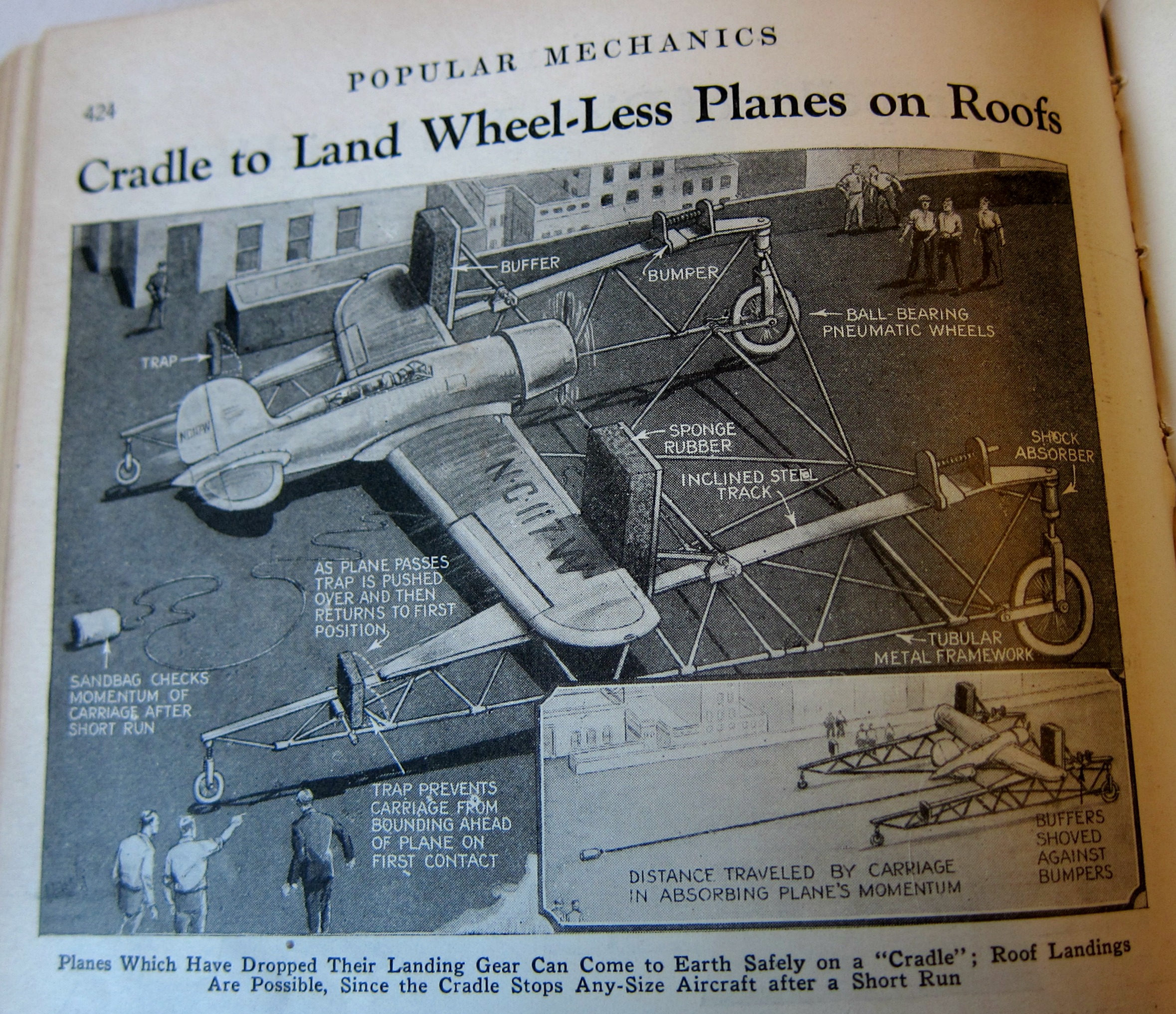
There’s a certain attraction to relieving an aircraft of the weight and drag of landing gear–except for the actual “landing” part of the aircraft, which becomes more, well, difficult, without wheels. Except of course when you have an apparatus like that below, something to basically catch the aircraft. For the sake of fuel economy the idea of getting rid of wheels and other landing gear made the cover of this Popular Mechanics issue for March 1932. The apparatus was supposed to be able to (safely) stop an airplane in the space of 40′, which no doubt would have interested the U.S. Navy if such a thing worked with damaging the airplane or the pilot. I really don’t see how the thing could have possibly worked, even with the helpful image in the text of the thing being a “reverse catapult”. Still, publishing such stuff may have given someone an idea for something else–some bit or insight in this apparatus may have come in handy for someone else working on something entirely different, as is sometimes the case with Outsider ideas.
JF Ptak Science Books Quick Post
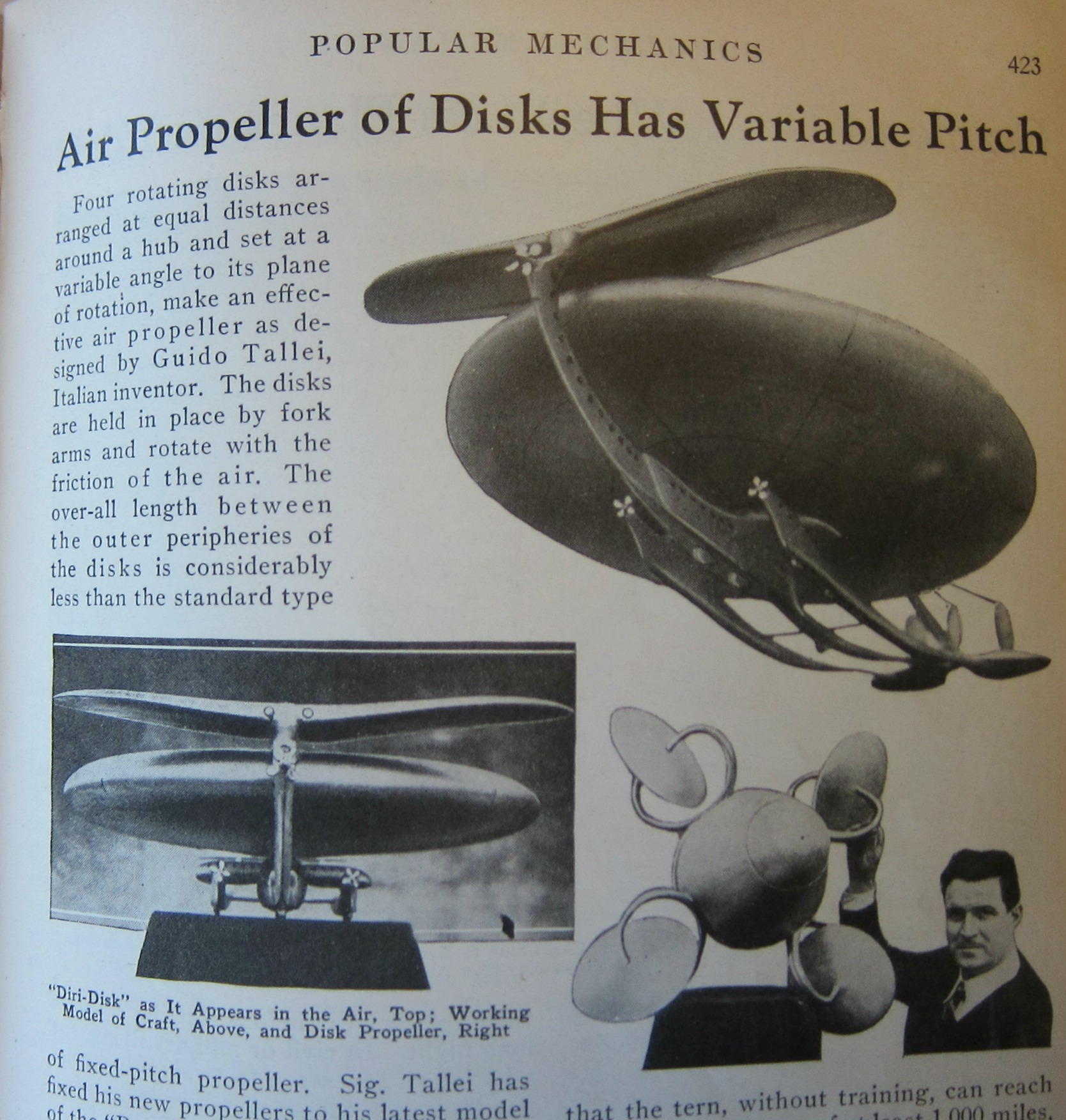
An indulgence: I’ve posted a few things on this site of old and/or found tech that reminds me of the USS Enterprise (NCC-1701-D). Here is one that popped up in the pages of Popular Mechanics for May 1932–an airship designed by Guido Tallei that was effectively a flying saucer, a dirigible-disk. There was another design from him from 1931 that was similar to this except that it looked a LOT like a sleek underwater-swimming penguin.
 April, 1932, Popular Mechanics
JF Ptak Science Books
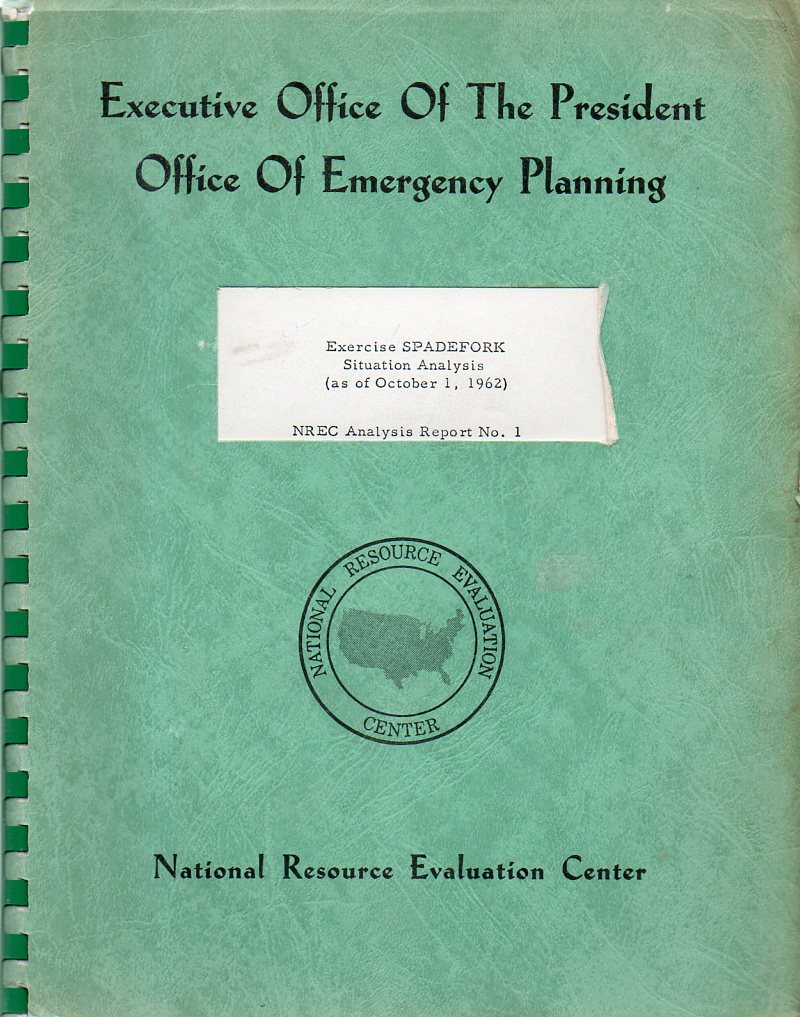
This report on Exercise Spadefork was issued at the very beginning of the Cuban Missile Crisis on October 1,1962. Undertaken by the National Resource Evaluation Center (NREC) and other agencies it was supposed to give a good indication of what happens after a very large nuclear attack on the United States, “Measuring the Capability of Survival”, evaluating what remains of the country and its sovereignty.
 The theoretical attack began at 3pm, Friday 21 September 1962. 221 nuclear missiles were exploded in/over the U.S. In the first hour, with a total of 355 in the first 48 hours. [I’m not sure that the Soviet Union had 221 intercontinental ballistic missiles at this time, nowhere near that, unless of course they were able to get their 700-missile medium-range ballistic missiles closer to the U.S.]
A total of 1, 779 megatons were exploded almost equally between ground and air bursts.
20 were 1 megaton; 15 were 10 megaton, and 320 were 5 megaton.
Most of the attack was delivered against military sites, “population and industrial centers appeared to be secondary targets, with only about 50 major centers receiving signifcant amount of blast damage”. Somehow “no major sections of the country were isolated due to fallout contamination”.
How we make out:
Military & “Sovereignty”: not so bad. Air Force and Navy take major hits (something approaching 50% casualties) but the Army does better, not being targeted so heavily, with 20% losses.
“While our sovereignty is preserved, there are some troublesome areas” (page 10), the very first notice being that “over ½ of the federal civilian personnel are available to work but with only ¼ of the actual floor space in about half of the offices normally functioning”.
And by the way “our normal Federal headquarters at Washington, D.C. Is severely damaged and completely out of operation”. The “headquarters” being, basically, downtown D.C.
Federal workers out in the country away from D.C. fared better.
Communications: in this report 80% of pre-attack telephones and 95% of pre-attack central stations…[would] be in service and have access to toll routes”.(pg 15) though “no route [would be] intact for transcontinental or through north-south traffic”.
Radio does better at night: “it is evident that heavy damage to radio stations will leave some areas with little or no daytime coverage, but night time coverage should still be good”.
Finance: “sufficient banking capacity has survived to support the surviving productive capability…the Federal Reserve System, though badly damaged, is in a position to support surviving banking institutions”.
One third of the $18 billion held by the Fed has been destroyed…though there will be enough currency in circulation “for a reduced level of economic activity, although there may be some local shortages…”
One-half to two-thirds of the commercial banking system survives.
The board of the Federal Reserve also survives.
Population: 21 million die either immediately or shortly after the attack from blast effects, with 13 million dying from fallout, making the total 34 million. 17 million are injured and expected to recover. 135 million do not have a significant injury. 51 million total. Most of these are in big cities, though we see that the states of MA, WA, VT, TN, Wva, OR suffer 42%-49% casualties, CT, MO, IL, MI, DE, NY, CA, OK, TX, LA, KS, NM, OH all suffer 30%-38% casualties. D.C. Leads away with 88% casualties.
Medical: a big topic dispensed with in two sentences (and to be read while whistling a happy tune), and which seems to make little sense at all when discussing injury rates in the 2 million range and their treatment. In shorter than the shortened story, all inventories of medical supplies “could priovide for needs for the first 25 days. Deficiencies would occur on many items…”
No mention of medical personnel or facilities survivability is made.
Somehow though 70%-95% pf drug and pharmaceutical companies survive and operate, though the manpower is down 25%. How this occurs when so many of these places are located near large cities that have been decimated, I do not know.
Food: the report assumes that food stocked “in the home, the retail store, and the small wholesaler would be sufficient to meet local needs for 30 days…” I think everyone has seen what happens to food and toilet paper when a snow storm threatens. Also grain mill products, sugar factories, production of fats and oils, meat/dairy/bakery services would be 40% available after 30 days.
About 50% of “lands in farms and 46% of crops harvested” would be available immediately. By D+30 88% would be available.
Leading the way for operations under “non-emergency conditions” is tobacco, 91.6% of farms being available after 30 days. Fruit and nut and vegetable production is last at 75% after 30 days.
Housing: it is calculated that on a nationwide basis that “housing will not constitute a major problem from the standpoint of requirements for materials and manpower”. Most of this evidently is accomplished by doubling-up occupancy “from pre-attack levels of .65 persons per room to 1.26”.
“Early decisions as to investment in physical plant will great effect subsequent GNP”.
21% of steel and 34% of all industry (?) is available immediately after attack, the numbers jumping to 55% and 52% with emergency effort after 90 days, with the balance “denied w/o major repair or decontamination”.
Part of the report concentrated on how dependable the data are, and how reliable the interpretation was . In summary it seems to my reading that the exercise showed fairly accurate information, and given the massive attack that the sovereignty (measured in terms of governance and military capacity) and the capability to survive (meaning financial structure, production, industry, population) remains basically intact even given large amounts of destruction. The bottom line is that the country survives and gets on with life. The report has nothing to do with the U.S. response, or the outcome of the war.
The Nuts & Bolts:
Exercise SPADEFORK Situation Analysis, printed by the Executive Office of the President, Office of Emergency Planning. 1962. 11×8″. This report on Exercise Spadefork was issued at the very beginning of the Cuban Missile Crisis on October 1,1962. Undertaken by the National Resource Evaluation Center (NREC) and other agencies it was supposed to give a good indication of what happens after a very large nuclear attack on the United States, “Measuring the Capability of Survival”, evaluating what remains of the country and its sovereignty. It is odd that even though this document received a small circulation there is only one copy (at the U.S. Army Heritage Center library) located in the massive database, WorldCat/OCLC. You can own this report for $750
JF Ptak Science Books Quick Post
The title of this little pamphlet is provocative–the content is even more so, and the description of the pogrom is more so yet. The author, Col. John P. Irish (1843-1923), was a Iowan transplanted to California, and a fire-breather, an orator and agitator for immigration, rights for the Japanese, votes for women, and other causes. The “Senator Phelan here is James D. Phelan (1864-1930), who was mayor of San Francisco 1897-1902 and the Senator 1915-1921, a racist used “Keep California White” as a campaign slogan for his lost reelection bid in 1920.
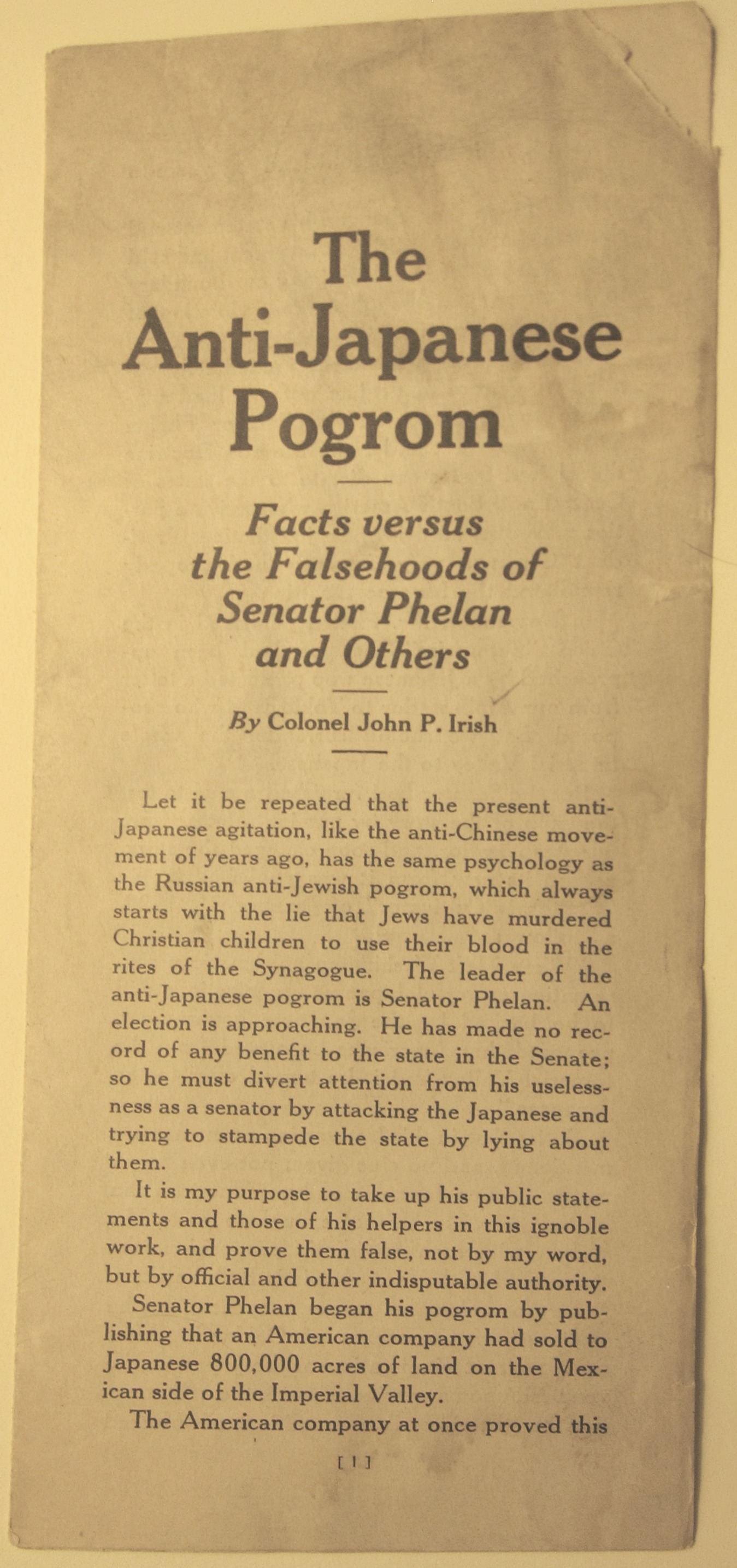
Full text here: https://archive.org/details/antijapanesepogr00iris
This was evidently republished (at least in part) on August 30, 1920, in the L.A. Times under the unlikely title of “Col Irish on the Japs”.
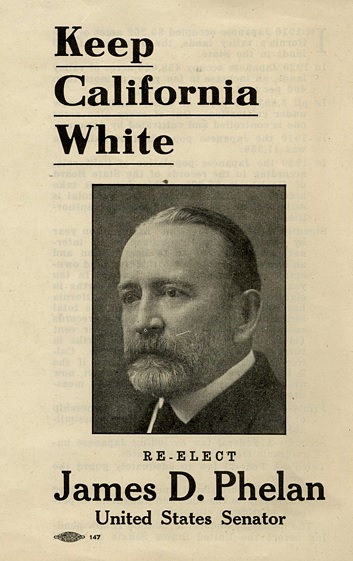
[Source: University of California, Irvine: http://www.lib.uci.edu/sites/all/exhibits/immigrant/index.php?page=section_1]
Irish writes some very strong stuff, saying that the present anti-Japanese movement “has the same psychology as the Russian anti-Jewish pogrom” and that its leader was Senator Phelan. Irish states that Phelan “has no record of any benefit to the state in the Senate” and that he must “divert attention from his uselessness as a senator by backing the Japanese and trying to stampede the state by lying about them”. Irish then spends the rest of his short pamphlet refuting the anti-Japanese program of Phelan.
Good on Col. John P.Irish.
JF Ptak Science Books Quick Post
I’m pretty sure that we don’t need to establish here the intellectual history of Albert Einstein’s miracle year of 1905. What I don’t normally see are the first mentions of the papers in English, and among the earliest reports there appear in Science Abstracts, Section A–it wasn’t until 1920 that the papers were first fully translated into English by M. N. Saha and S. N. Bose as The principle of relativity : original papers by A. Einstein and H. Minkowski, and published by the University of Calcutta.
And so here they are–I only have the first three of the four papers from the Abstracts, as I don’t have the second 1905 volume in which the last paper appears.This series was published in London by E. & F.N. Spon (Ltd.) and is the physics volume for the abstracts of scientific papers published in dozens of the world’s leading journals, and was/is a standard reference tool. ‘
The photoelectric effect paper: A. Einstein, Annalen der Physik, volume 17, 132 (1905) [17 pp.] “Über einen die Erzeugung und Verwandlung des Lichtes betreffenden heuristischen Gesichtspunkt”, (“Generation and Transformation of Light”), abstract #1562, page 500:
JF Ptak Science Books Quick Post
There is probably a more elegant way of asking this question and still be catchy/popular, like “Speed of Stuff” or “On the Speed of Stuff” or some such–fact is though I should have begun a series by this (sort of) name years ago. It is a nice catch-all for mostly unrelated stuff, except for the “speed” part, which would be a nice thread. In any event, I came upon this article today while looking for the beautifully-named Fleeming Jenkin article on a very unusual telegraph. It appeared in the May 5, 1870 issue of Nature, which is actually the first series in volume II of the then brand-new journal, and this was just issue #27. But right up front in this issue was a great-looking paper by a “M. Foster” called “The Velocity of Thought”. (This was not by a wonderful Mr. Foster from high school who warned us kinds in 1970 that we will one day be fighting in Afghanistan, “you mark my words,boys”–a bold position given that we still had a few years to go in Vietnam at that point.) I think that this “M. Foster” is Professor Michael Foster, who in time would add (if he hadn’t already) an M.D. and then a F.R.S. to his surname. In any event I append the entire article below, which I found online at the University of Wisconsin.
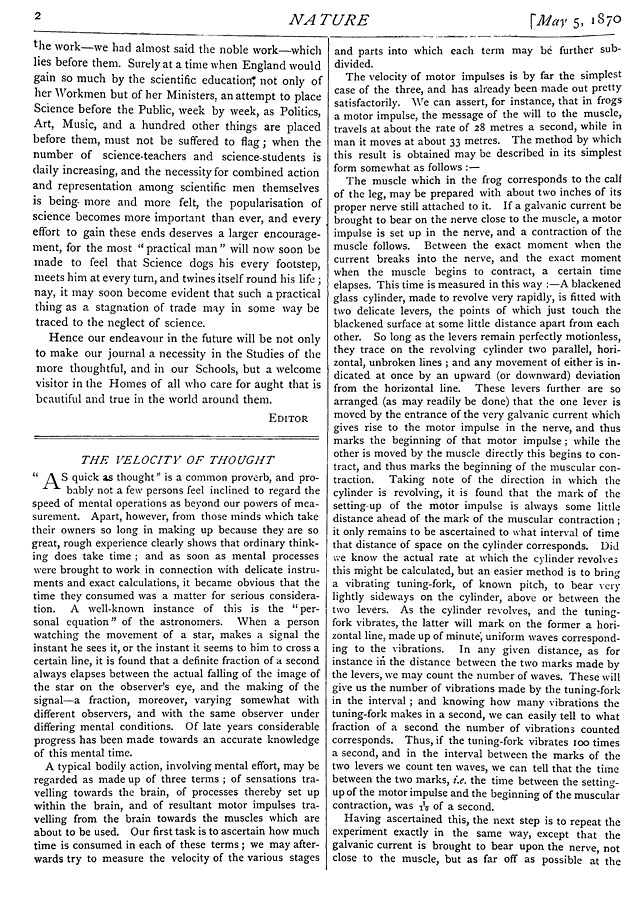
(I should add that there is a nice book review by the great W. Stanley Jevons in this issue as well–anyone interested in purchasing the original issue cane write me at the addy found in the “About” section of this blog.)
[Article image source: http://digicoll.library.wisc.edu/cgi-bin/HistSciTech/HistSciTech-idx?type=turn&entity=HistSciTech.Nature18700505.p0004&id=HistSciTech.Nature18700505&isize=M]