JF Ptak Science Books Post 2466
There is almost nothing so spirited and heartbreaking and proud than people who find themselves in very difficult situations and who try to provide for themselves some comfort of a peaceful time, something far away from what they are experiencing, something that calls to some sort of peace and normalcy. An this is what we have here, for me, in this picture of a French soldier and his unit’s jury-rigged automatic shower. From the looks of the engineering, I’m assuming that the ting worked just fine, and I am certain that it provided no end of relief for those able to use the machine. You’ll notice that teh soldier is also standing on a very small piece of wood elevated above the ground, so that the bather’s feet don’t become muddy.
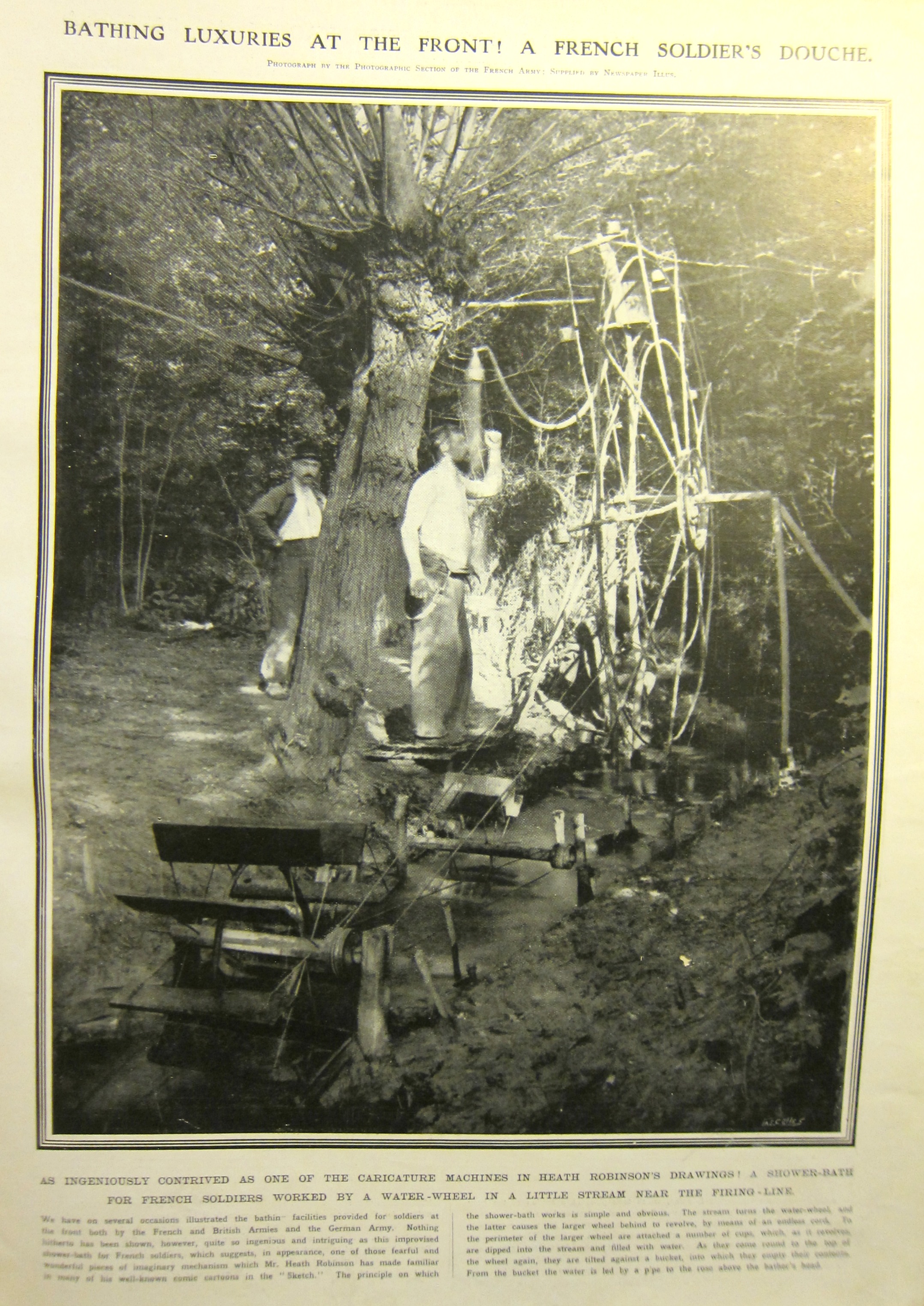
[Source: Illustrated London News, November 13, 1915–there would be nearly three more years of war to go. This image is very expandable.]
The caption makes note of the drawings of Mr. Heath Robinson (1872-1944) who was a lovely, quirky, charming, skewed, dark, stiff-bouncing and creative illustrator capable of considerable whimsy (light and complex) and deep skepticism. It really does a small disservice to the battlefield engineers who built the shower–the thing is really pretty elegant, and seems to be quite light in spite of its size. Those guys did a good job.
The two following images are from one of his three WWI books, Hunlikely, published in 1916 (Some “Frightful” War Pictures (1915), and Flypapers (1919), were the other two) and depict scenes from the intra-trench tunnel wars, which were battles fought in the midst (or, actually, beneath) other battles. This was a savage, grueling, post-adjectival affair—exceedingly dangerous, difficult, awful. And it happened a lot during the war, given the experience of stalemates between vast armies sunk into mole city trenches, with no one going anywhere for long periods because there was nothing in between the two impervious lines but a death vacuum.
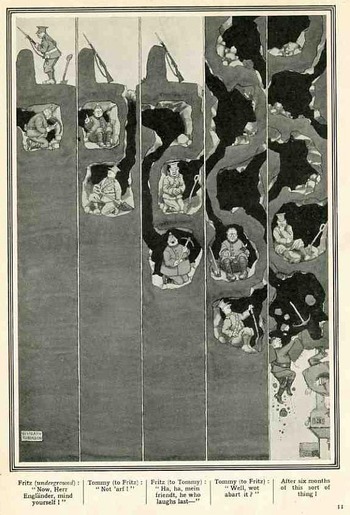
So one of the solutions was to try and tunnel underneath the opposing army’s defenses, fill the far end with high explosives, and blow them up. The other side was doing it too, and in the middle of it all was the incorporation of newer/better listening devices to detect forces rummaging around underneath your position dozens of feet into the ground. It was a bad business. (One of the other means of breaching the trench lines was aerial combat, but bombers carrying tons of HE were still yet to be invented; poison gas was another. Most of the time the armies would just meet in the middle in wide plains of nothingness in a sea of hot, expanding metal, where to this day in many of those places nothing can live).
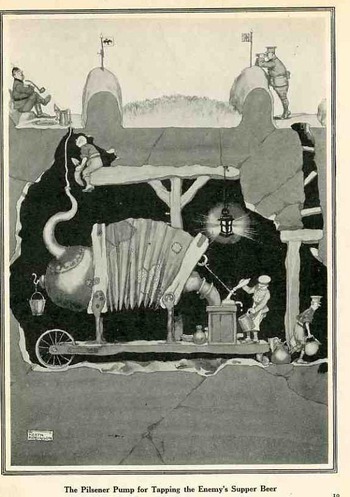
Robinson’s illustrations are odd, and oddly funny, the dark humor coming at the expense of both sides of the conflict, piercing each. This one is more in line with the French battlefield shower, and shows Robinson’s over-the-top (so to speak) apparatus for stealing German beer: