JF Ptak Science Books Post 2711
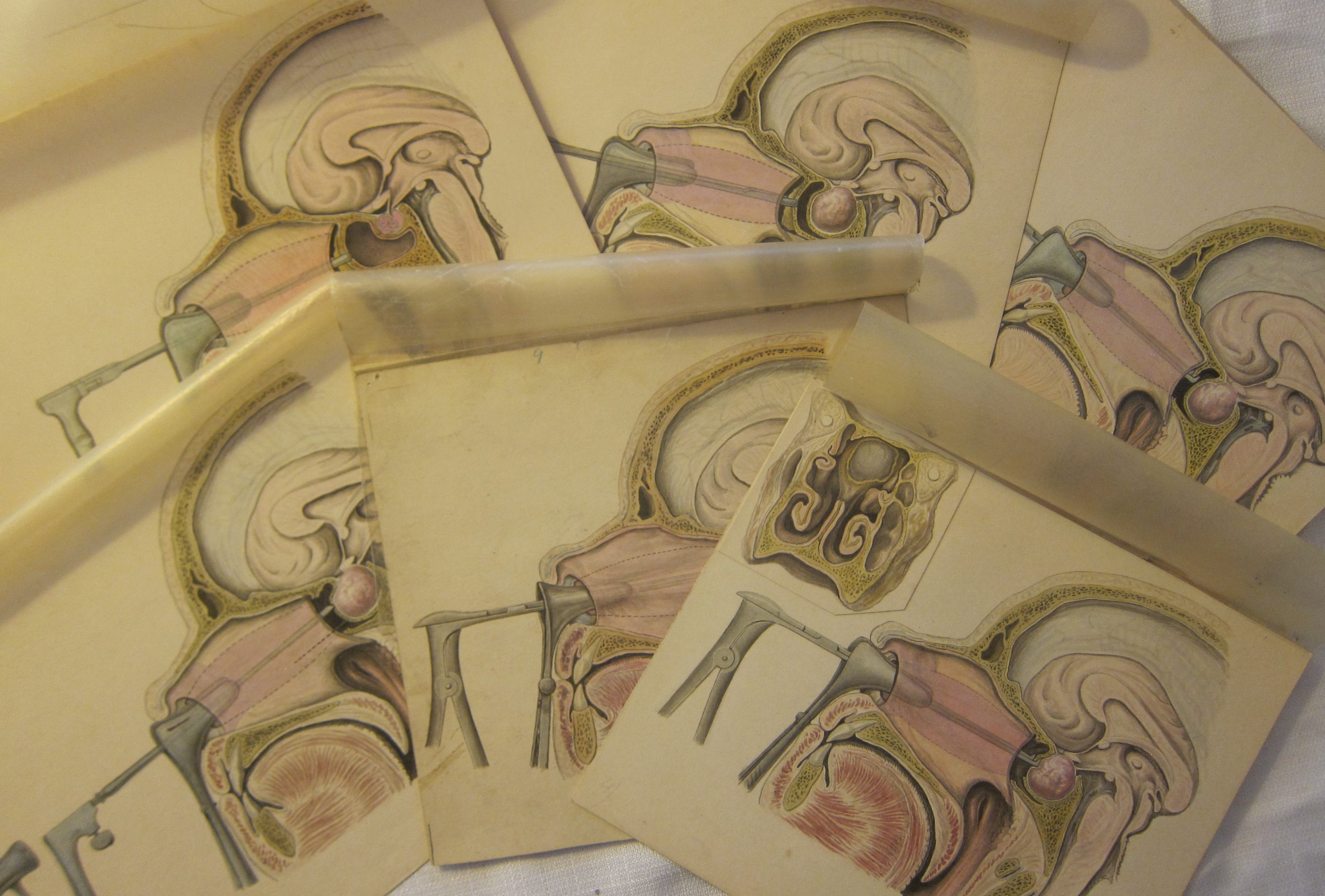
I don’t intend to say anything at all, really, about the following drawings–I was attracted to them and purchased them a while ago, figuring them to be pituitary tumor removal of some sort and knew that for being done in 1930 that they were sort of early. The twelve fine pen and ink images were made by the prolific anatomical/medical illustrator Bruno Keilitz (b. 1898) and do indeed show some of the stages of the removal of a pituitary tumor. The illustrations seem to have been for an article written by Dr. Prof. Oscar Hirsch (1877-1965), who was an early and influential Viennese rhinologist who made major contributions to pituitary surgery, performing this transspheroidal procedure for Harvey Cushing in 1911, and who would go on to perform the procedure more than 500 times in his long career.1 Cushing of course is the Big Name, though in this area of neurology I found out that Hirsch is looms pretty large as well. I don’t know how these stand in the history of this operation, but they certainly seem interesting enough to share online, and so I do:
Details:
- Of the 12 drawings, 9 are very closely related and show the progress and route of a transsphenoidal surgery for the removal of a pituitary tumor. I feel pretty confident that these drawings were done in 1930 (see below). These images are labeled I-VIII (including a “Ia”). These images measure about 6×8.5 inches each, drawn on a heavy stock, and done in colors. Each of these images is drawn from the same perspective and show different aspects of the surgery in progression. These drawings I-VIII are all rubbers tamped on the back with Bruno Kelitz’s name and address; two of this series are signed by Kelitz in the drawing, both of which are dated 1930. There are also some other notations in ink on the reverse that I can’t quite place, as well as some later dates, as the images seem to have been used on more than one occasion.
One drawing in this series has an old American Medical Association label (seemingly stamped Feb 11, 1952), identifying the publication of origin (“Arch. Otol” Archives of Otolyrngology), the author (“Hirsch”), and the type of reproduction to be used when illustrating the article.