JF Ptak Science Books Quick Post
There have been a number of posts to this blog on “Measuring Stuff With Unexpected Things” (a collection that never became its own category and which is basically folded into the “Display of Information” series) where there are graphic displays of objects being unexpectedly measured with known but unusual units of measure. The Eiffel Tower seems to be a favorite (seeing a stacked column of them showing how deep the Atlantic Ocean is, for example); there is also occasional use of the Great Pyramid, the Woolworth Building, the Titanic (up to a certain point), the Hoover Dam, rows of the Great Pyramid filled with Dirt (!), and so on. It is actually a useful tool, even though I’m having a bit of fun with the idea right now–people might not be able to comprehend how much xxx-tons of dirt is that was excavated from the Panama Canal, but if you put it in terms of filling the Great Pyramid and having a row of them going from one end of Manhattan to the other, then there is some sense made of a big number.
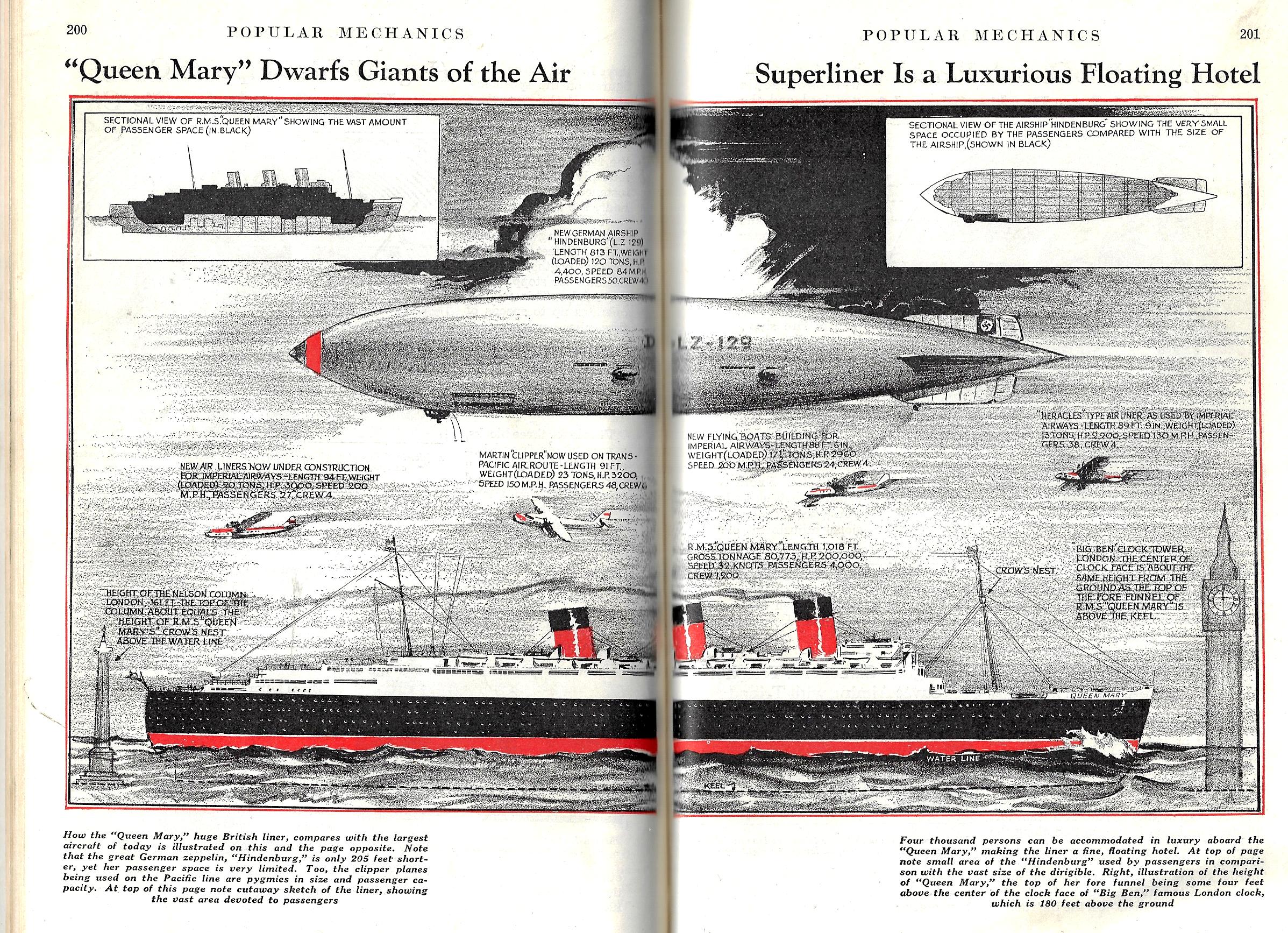
Tonight’s example is much simpler than most of the other entries, as we’re simply measuring the new ship Queen Mary against the Hindenburg had newly burst onto the fame stage, and became an instant well-known entity, a manufactured mountain in the sky, an impressive sight to everyone–and so when it is compared to the Queen Mary and found to be smaller, everyone knew instantly how big the ship must be–making this mode of comparison a useful tool.
The Hindenburg had been first launched just months before it appeared in this piece in the August 1936 issue of Popular Mechanics; it would famously crash just seven months later.
The other reason I decided to share this image is that it is simply a wonderful design, something that would look fantastic enlarged to 4’x8′.