JF Ptak Science Books Quick Post
Sometimes things are very obvious–so obvious that they hide in themselves, in plain sight. That was sort of what happened here, with these cutaways of subway tunnel construction in France in 1895. When I’m reading something to figure out what it is in order to place it in the Books for Sale section of this blog, trying to determine what it was beyond the thing that looked so obvious, it only takes one short sentence or fragment to wrap the whole thing up, and to validate the achingly obvious thing to be exactly what it seemed to be. Such is the case here, with the construction of the extension of the Paris-Sceaux railway (as reported in the Scientific American Supplement for May 11, 1895). Now it seems that in the four-section cutaway showing the progress of work that the workers first dig a deep trench and then construct a masonry “archbutment”, taking most of the sidewalk but not the street during the construction process. Once this is finished, part of the street is closed and the construction of the tunnel ceiling is built for the arch. That done, the work gets flipped to the other side of the street and repeated, though from this end the arch of the tunnel is joined, and the whole of it covered by earth and roadway, again.
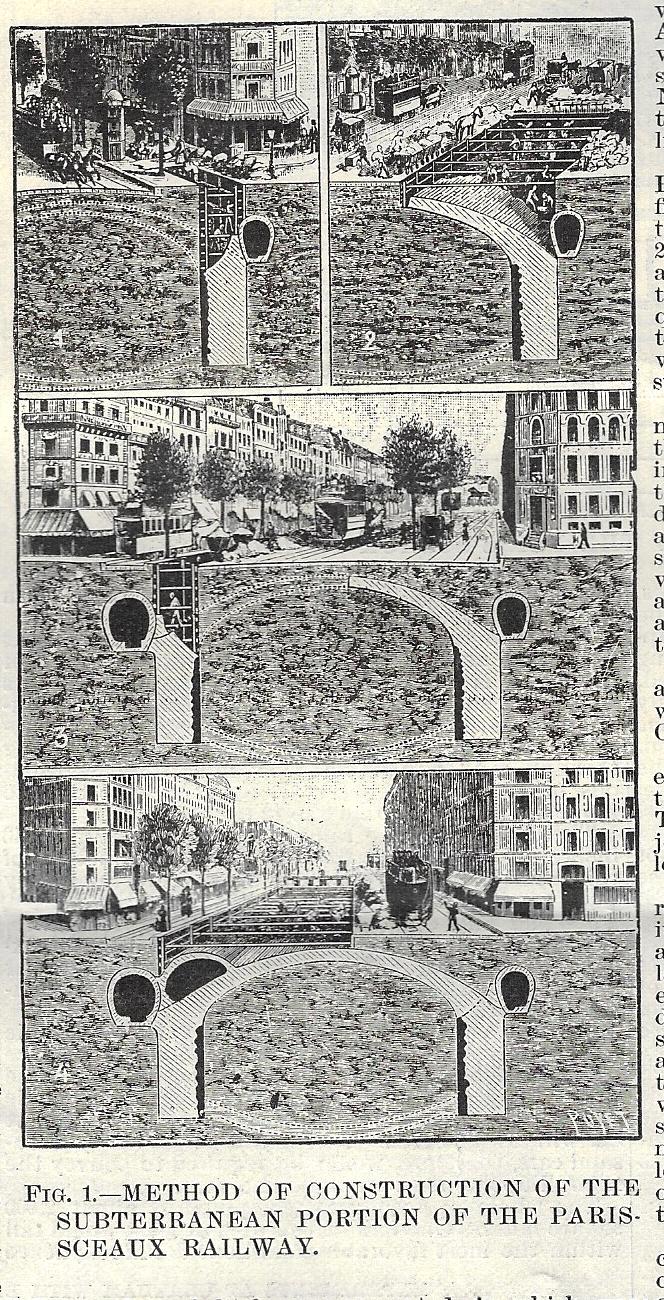
[This small 2×4″ image is a detail from the front page of Scientific American Supplement, May 11, 1895.]
Then the magic sentence appears:
- “(F)inally a tunnel filled with earth was obtained”.
How lovely! And of course, how obvious it is, in spite of looking at the procedure and thinking it somehow ‘backwards”. Then:
- “It was only necessary to clear this and establish a floor, and then the thing was finished.”
There was still track and stations and electricity and ventilation and all of the rest to be installed, but once there was a place to put those things that was not simply dirt, it would be much easier.
As they say here in the South, “It is what it is”.