JF Ptak Science Books Quick Post
Leafing through an unusual piece of 1930’s Soviet news I came upon a rusty paper clip secured at the bottom of a single page. I’m a fan of found book art, so I read a bit of what it was that it was possibly marking for attention. There was a word that jumped right out at me just above the metal dog ear–“liquidation”. The document, Rosja Sowiecka (Soviet Russia), was part of a Polish translation program of Soviet new that was done at the request of the U.S. Embassy in Warsaw, with each slim (ca. 100pp) volume it seems to me reviewing events in the U.S.S.R. primarily from the few months before its publication date. This one was volume and published February 28, 1934, which would place it in the thick of a particularly brutal period of Soviet history: there was the Soviet famine of 1932-33 (just ten years after the last great famine there), the Holomodor of 1932-3 (in which 10 million Ukrainians were murdered via famine), a completely oppressive police state of massive suspicion that would lead to the deportation and death of millions, the Great Purge, and much more that would nearly cause a collapse of the Soviet Union come 1941.
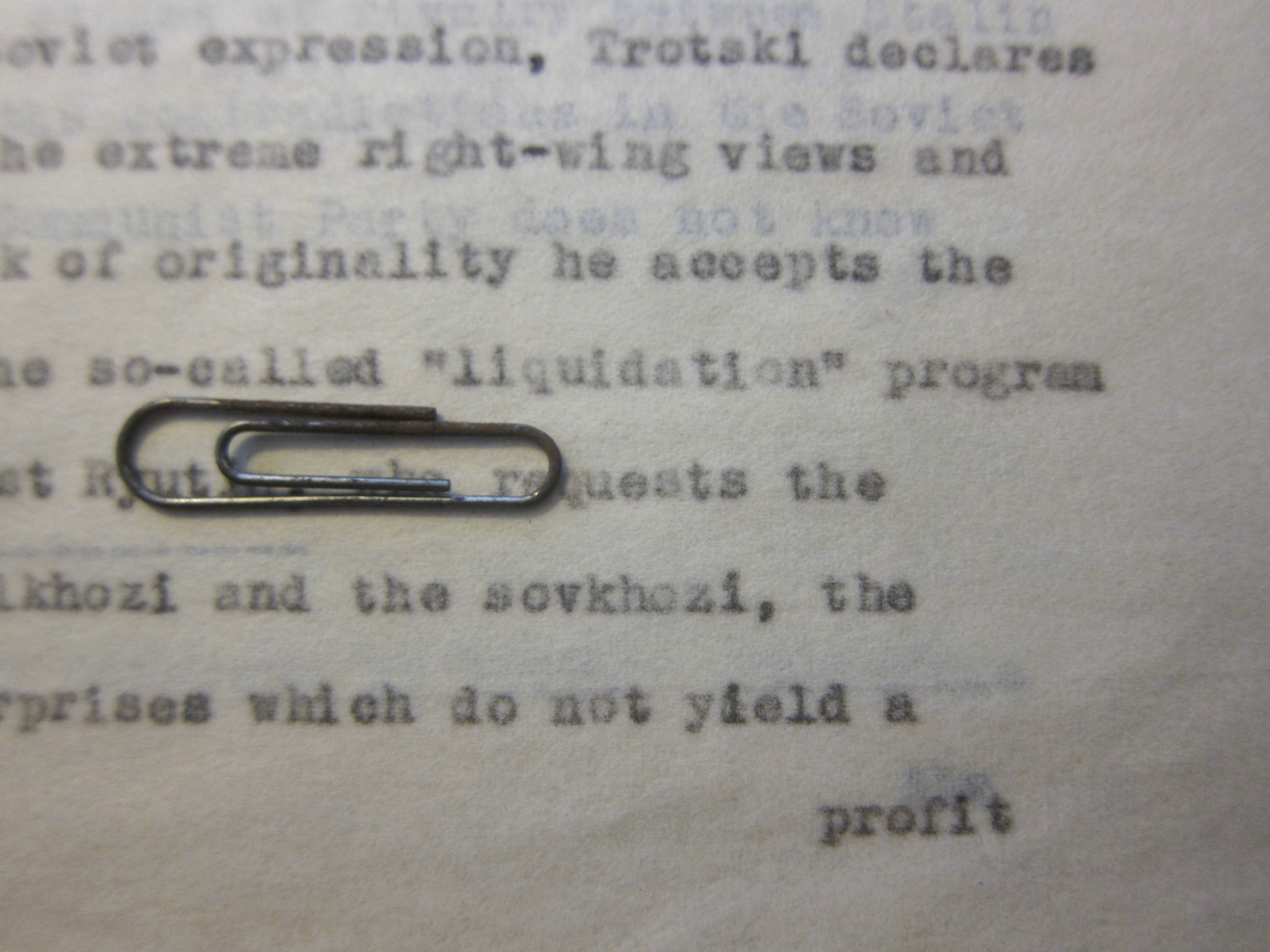
The “liquidation” here though was being used in reference to dismantling the farm collectivization scheme that lead to the destruction of so many millions of people, and was coming at the suggestion of ‘rightist” (meaning more liberal) leadership in the Soviet government. In this particular case, the suggestion was that of Martemyan Nikitich Ryutin, a high-level political functionary who was pro-peasant and definitely anti-Stalin, a stance that would lead in 1937 to his arrest and execution (all in a 24-hour period, like so many of them). Even though I really only know the highlights of Soviet history in the 1930’s, reading this section of the document definitely left me with a sad admiration for this man and his allies, because nobody was allowed to survive under Stalin who was not a believer in his removed self.
This was the path of following a simple paper clip.