JF Ptak Science Books Quick Post
The Future of Nuclear Science, Princeton University Bicentennial Series, Series I Conference I (1946), with a forward by the director of the conference, E.P Wigner, is mostly just a short (36-page) introduction to the conference, with a few highlights of superstar comments, most notably from Dirac and Feynman (see below). There is a remarkable and seldom scene photo of the conference’s participants–it is a mega-powerhouse of physics people. Perhaps what I enjoy most of the photo part of the publication is the out-of-context artwork in the skeleton/ghost photo that accompanies the image so that you can identify those pictured. It really does take on a life of its own–though I admit I’m partial to these bits.
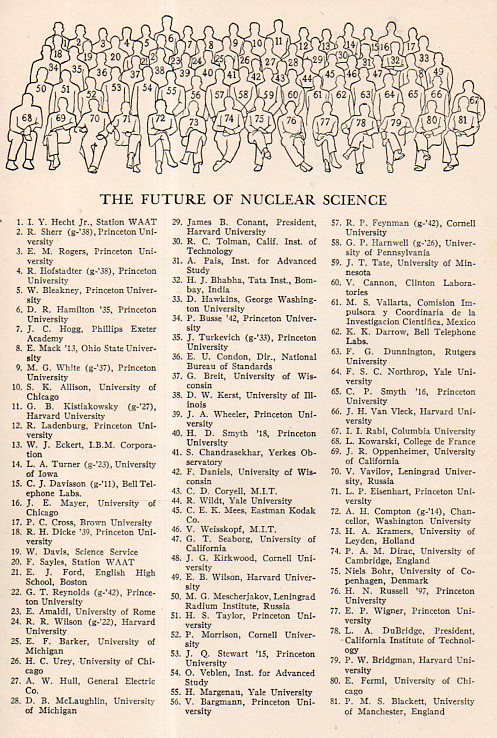
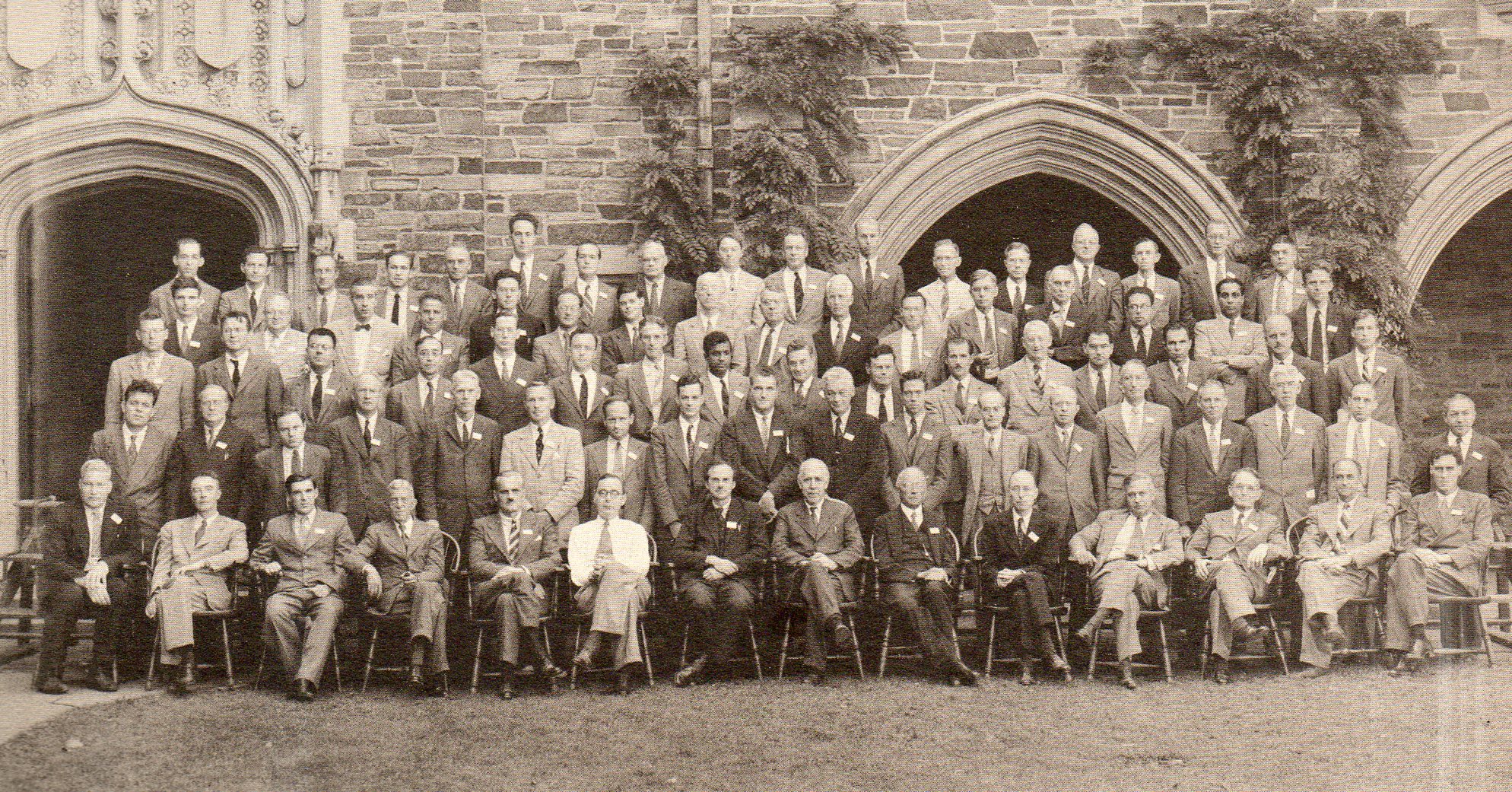
It is a considerably heavyweight group of physicists–among them are Hofstadter, S.K. Alison, Kistiakowsky, Ladenburg, W.J. Eckert, L.A. Turner, R.H. Dicke, E. Amaldi, Urey, Conant, Tolman, Pais, Turkevich, Condon, Wheeler, Smyth, Chandrasekhar, Weisskopf, Seaborg, Wilson, Morrison, Veblen, Bargmann, Van Vleck, Eisenhart, Compton, Kramers, Dirac, DuBridge, Bridgman, Fermi, Blackett, and so on. Interesting that Feynman stands right behind the seated Dirac, and that Rabi is on the far right, almost out of the picture, leaning away ever so slightly from the group.
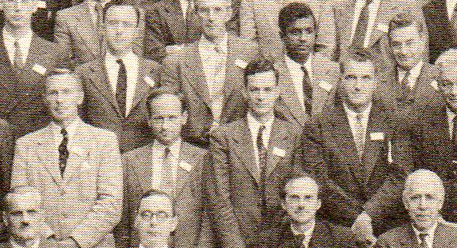
Here’s a relatively-random detail featuring (bottom left -to-right) Compton, Kramers, Dirac, Bohr, plus (middle left-to-right) Margenau, Bargmann, Feynman, Harnwell, Tate, and (third row) Wheeler, Smyth, and Chandrasekhar. This was an extraordinary group.
Full text via Hathi Trust via Cornell University.
Here’s an interesting quote from Feynman:
“Typical were the comments and queries made by R. P. Feynman of Cornell University and Gregory Breit of the
University of Wisconsin: “What will the fundamental particles turn out to be- more particles or less particles?
Or perhaps all of our so- called ‘different’ particles are not ‘different’ particles but different states of the same
particle.” The final theory of physics must be complicated, but cannot a logically consistent approximation to it be
expected—like classical mechanics, which is a logically consistent (but experimentally wrong) approximation
to quantum mechanics?”
“Maybe the problem involves a fundamental frequency related to the classical electron radius. . . . Or again,
perhaps the meson (note: an elementary particle, found in the cosmic rays, and linked by theory to the
nuclear force fields) and the electromagnetic field may be two manifestations of the same thing, with the
link provided by the fact that they both obey Bose-Einstein statistics.”
But perhaps all this may best have been summed by the comment of Dr. Feynman, “We need an intuitive
leap at the mathematical formalism, such as we had in the Dirac electron theory (note: the theory which predicted
the positron discovered in 1932); we need a stroke of genius.”