JF Ptak Science Books Post 2740
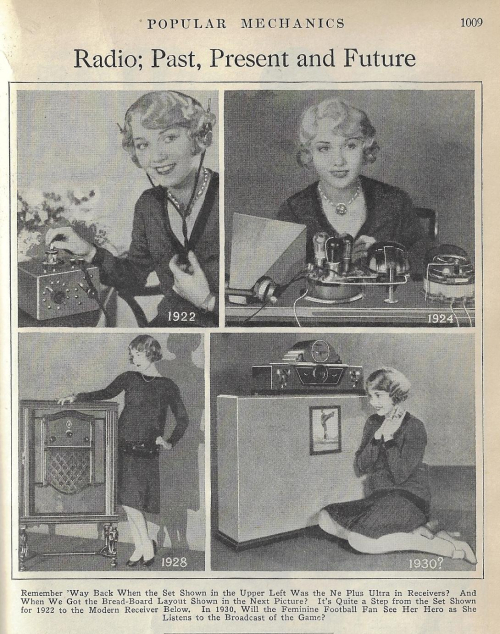
The odd thing about this odd speculation for an odd look advancing a single odd year into the future is that it is so, well, odd. Here on page 1009 of the January-June volume of Popular Mechanics the editors speculated on what the approaching year might bring in the evolution/revolution of the radio. Radio as a popular medium was relatively new-ish in 1922 and the in six quick years very much developed for wide use, and so it must have appeared not too long a leap to jump into a radio for 1930 that offered images to accompany the broadcast. The idea of “seeing by wireless” was already upon folks back then, or at least the technology was.
Since the vision of the future of 1930 was that of the radio, I’m assuming that the image that “the feminine football fan” was seeing in 1930 was a static image of someone punting–the capacity for that already existed, so I suppose that what Popular Mechanics was expressing was the general distribution of this new wireless set. Perhaps “television” wasn’t mentioned because this was a speculation on radio.
As a matter of fact, television as an invention was already established by 1929–deeply so. There was already a television station (established in 1928, WRGB), which already was several years after John L. Baird’s1 first public demo of his mechanical tv at Selfrdige’s department Store in London on March 25, 1925. And by 1926 Baird had made a successful demonstration of a moving image, which was well documented in a 62-page book months later by Alfred Dinsdale, Seeing by Wireless, in which “television” is elegantly described as an invention where “we see what is happening at a distance while it is happening”. (There is a famous and relatively creepy image that is described as the first photo of a moving image transmitted via television, a death-mask-like portrait of Baird’s business part, Oliver Hutchinson, and which first appeared in The Times on January 28, 1926.)
In the same period a D.C. man, Charles Francis Jenkins, was having success with his electronic television, where by 1925 he had already publicly demonstrated a transmission of silhouetted images (and this following a dozen years after his first publication on the subject, “Motion Pictures by Wireless” in 1913). Two years later (April 7, 1927) yet another very successful demo was made by Herbert E. Ives and Frank Gray (both of Bell Labs). A year later, on September 3, 1928, the beautifully-named Philo Farnsworth was far enough along with his invention that its public demonstration on that date is recognized as the first electronic television demonstration.
In any event, I wanted to note some of the events in the development of television that occurred around the time of the publication of this issue of Popular Mechanics to show how much work and how far along the new medium had come to give a little background into the question of why this photo essay would stand by a static-image radio while a moving image electronic television was being shown to be so successful. I’m a little stumped.
Notes:
1. I don’t know where else to hang this tidbit, so here it goes: it is just interesting to note that two Scots–Alexander Graham Bell and John Logie Baird–gave ears and eyes to human communication, one with the telephone and the other with the television. There are many others who made very significant contributions to both developments, but I thought that this was worth a mention.
Also, Frankenstein’s “monster” may not have been flesh and blood, but a moving picture of it. Here’s the work of one Frankenstein with a patent relating to the development of the media monster, television: “VON JAWORSKI, W. und FRANKENSTEIN, A., “Verfahren und Vorrichtung zur Fernsichtbarmachung von Bildung und GegenstÄnden mittels Selenzellen, Dreifarbenfilter und Zerlegung des Bilden in Punktgruppen durch Spiegel”, Brevet allemand, 172 376, 20 August 1904.”