JF Ptak Science Books, LLC Post 256
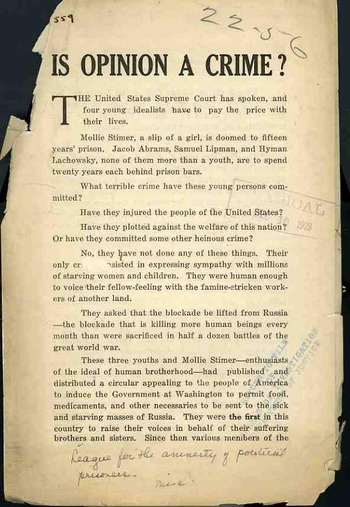
The answer to the question of this pamphlet, Is Opinion a
Crime (published by the League for the
Amnesty of Political Prisoners, 1919), is “yes”, and yes by a 7-2 decision by
the U.S. Supreme Court (in Abrams v United States 250 U.S. 616 (1919). The case involved political speech which was
deemed to be criminal act –rather than an expression of free speech guaranteed
under the First Amendment—by violating the 18th amendment to the
Espionage Act of 1917. Earlier in 1919 the court found again against the defendant in
a similar case, Schenck v.
United States
, 249 U.S. 47 , the majority opinion famously stated by Justice Oliver Wendell
Holmes Jr.:
“The question in every
case is whether the words used are used in such circumstances and are of such a
nature as to create a clear and present
danger that they will bring about the substantive evils that the United States Congress has a right to
prevent. It is a question of proximity and degree. When a nation is at war many things that
might be said in time of peace are such a hindrance to its effort that their utterance
will not be endured so long as men fight, and that no Court could regard them
as protected by any constitutional right….”
It was in the Abrams case though that Holmes sided with Justice
Louis Brandeis in ten minority opinion, siding with the defendants in this case
who were distributing printed material which urged people not to support the
American military—with the sole aim, really, of trying to get food to starving
Russians. The case was brought against Mollie Stimer “a slip of a girl”, Jacob
Abrams, Samuel Lipman, and Hyman Lachowsky, who dumped their leaflets from tall
buildings, urging that people not support the governments’
decision to send troops to Europe to defend Czarist Russia against the
Bolsheviks, and to allow the Russian revolution to proceed unhindered by
American interests and allow “the people of Russia to pursue their own
destinies.
 The Court found that
the pamphlets were in violation of the Espionage Act and sentenced the four to
between 15 and 20 years in jail. Holmes,
in another landmark piece of judicial thinking, held that the defendants
threatened no one and no thing, and should not have been found guilty. His contribution is reproduced in full in the
continue reading section, with the content given its landscape by the good folks
at Wordle. (Click on the image to for a larger and clearer picture.)
Ohio (395 U.S. 444, 1969), in which the Court found that government cannot
punish inflammatory speech unless it is directed to inciting and likely to incite
imminent lawless action.—in this
instance defending the 1st and 14th Amendment rights of a
KKK spokesperson.