JF Ptak Science Books Post 2754
“Just as psychoanalysis reconstructs the original traumatic situation in order to release the repressed material, so we are now being plunged back into the archaeopsychic past, uncovering the ancient taboos and drives that have been dormant for epochs… Each one of us is as old as the entire biological kingdom, and our bloodstreams are tributaries of the great sea of its total memory.”–The Drowned World, J.G. Ballard,1999, p. 41.
Is there really a need for a plural of apocalypse? There is, of course, even if it is a word that is supposed to spell out the end of times–there can be more than one apocalypse, and they can happen at the same time, although given my very limited knowledge of the scifi genre I don’t know of any books addressing dual/multi-combative apocalypses. (And here I’m not talking about one apocalypse generating all manner of associated badness, but a second, completely unrelated, apocalypse.)
So in trying to understand the nature of apocalypse storytelling I decided to make a very abbreviated overview of a vast literature of the end of times/apocalypse/technocaust/end of the world themes. This is just a short working list, really, and includes only short stories or novels, and to keep it relatively crisp I’ve chosen the artificial delimiter of an alphabet of apocalypse types. In many cases there is just one example (where there could be hundreds, so please don’t fault the list for completeness because that would take years of assembly and understanding). The same goes for the categories of apocalypse–I’m certain I not included the majority of them, though I think that this is a good start (There are no movies or television shows listed independent of a text, so Soylent Green will show up but under Harrison’s Make Room! Make Room! I think that tv shows/movies etc must be enormously outnumbered and the scale of orders of magnitude by the print media.)
Also–the list is a little heavy with Wells, Christopher, Aldiss, Heinlein, and Ballard; this simply because I’m a little familiar with these writers. Further caveat: this list is highly individualized. I only have a very mild and occasional grip on a very limited number of books in this genre, so if I’ve missed some great classics for any category, or buckets-full of possible apoca-categories, don’t be surprised as you’re now armed with this warning–this is only a pushing-off point. So, the list:
Alien Invasion: the great initiator, H. G. Wells, The War of the Worlds 1898; Edgar Rice Burroughs The Moon Men 1926; Robert A. Heinlein, The Puppet Masters, 1951. There were other earlier incarnations of extra-terrestrial visits, especially if you considered religious/mythological aspects, though in literature it was far less common–like Swift’s mathematicians of Laputa (in Gulliver’s Travels… 1726) and Voltaire’s titans in his Micromegas (1752). For the modern era though it is Wells who seems to create this idea.
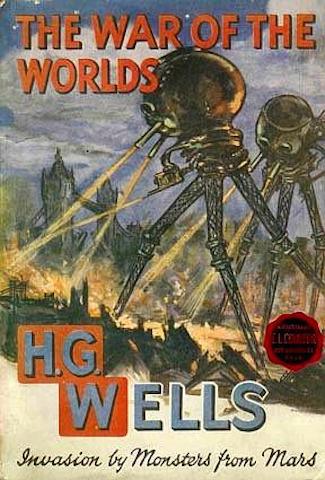
[Flavorwire has a selection of 15 different covers for The War of the Worlds, here.]
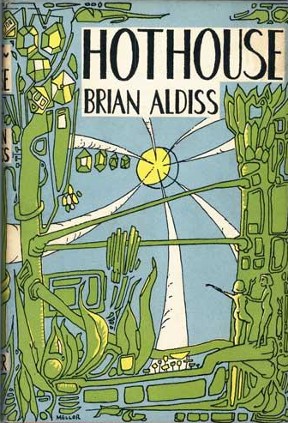
Botanical endgame virus destroying all plant life: John Christopher, The Death of Grass. On the opposite end is the 1962 novel Hothouse by Brian Aldiss, where the plants take over everything.
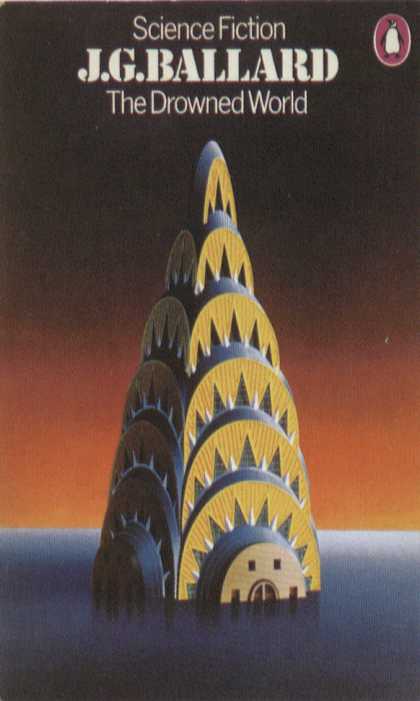
Climate Change: apart from the state of global warming as we know and deny it now, The Drowned World by J.G. Ballard from 1962 is perhaps the best and most well-known adventure in this field. In this book in 2145 solar radiation has shrunk and mostly melted the polar ice caps, which is a lot of water, and has turned most cities into architectural swamplands of vertical mangrove. Conversely Ballard wrote the novel The Drought in 1964 about all of the water on earth drying up. (As a kid the Ballard cover was a great favorite.)